Inspiration
Learning platforms are very good at providing content, but they often treat every learner the same.
A student can complete a course, take a quiz, and receive a score without really understanding why they are struggling. A learner may be trying to study advanced topics while still having gaps in prerequisite concepts.
We wanted to build something different.
The idea behind LearnBridge is simple:
What if an AI learning platform could understand not only what a student wants to learn, but also what they actually understand?
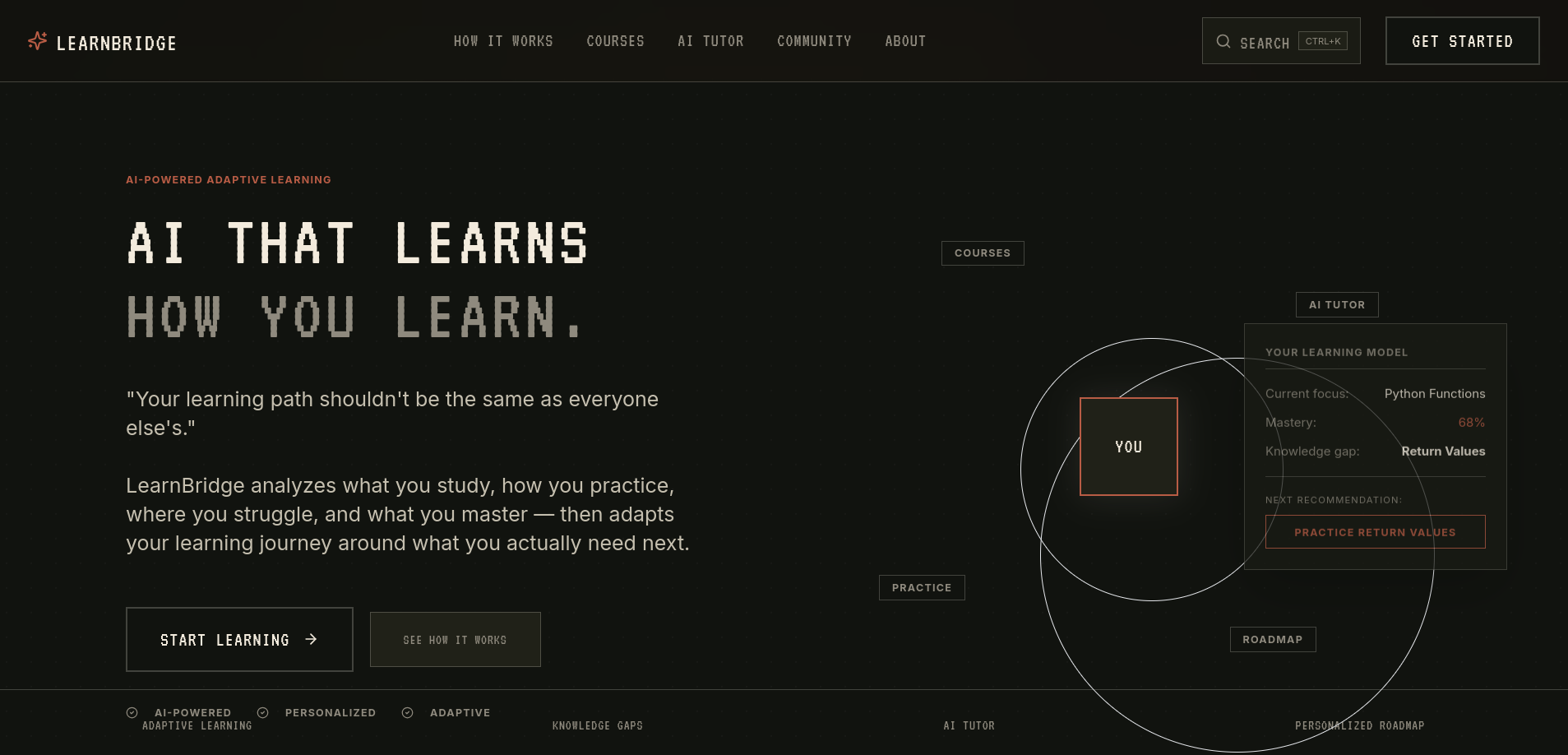
That question led us to build LearnBridge — an AI-powered adaptive learning platform that continuously learns from a student's interactions and changes their learning path accordingly.
What it does
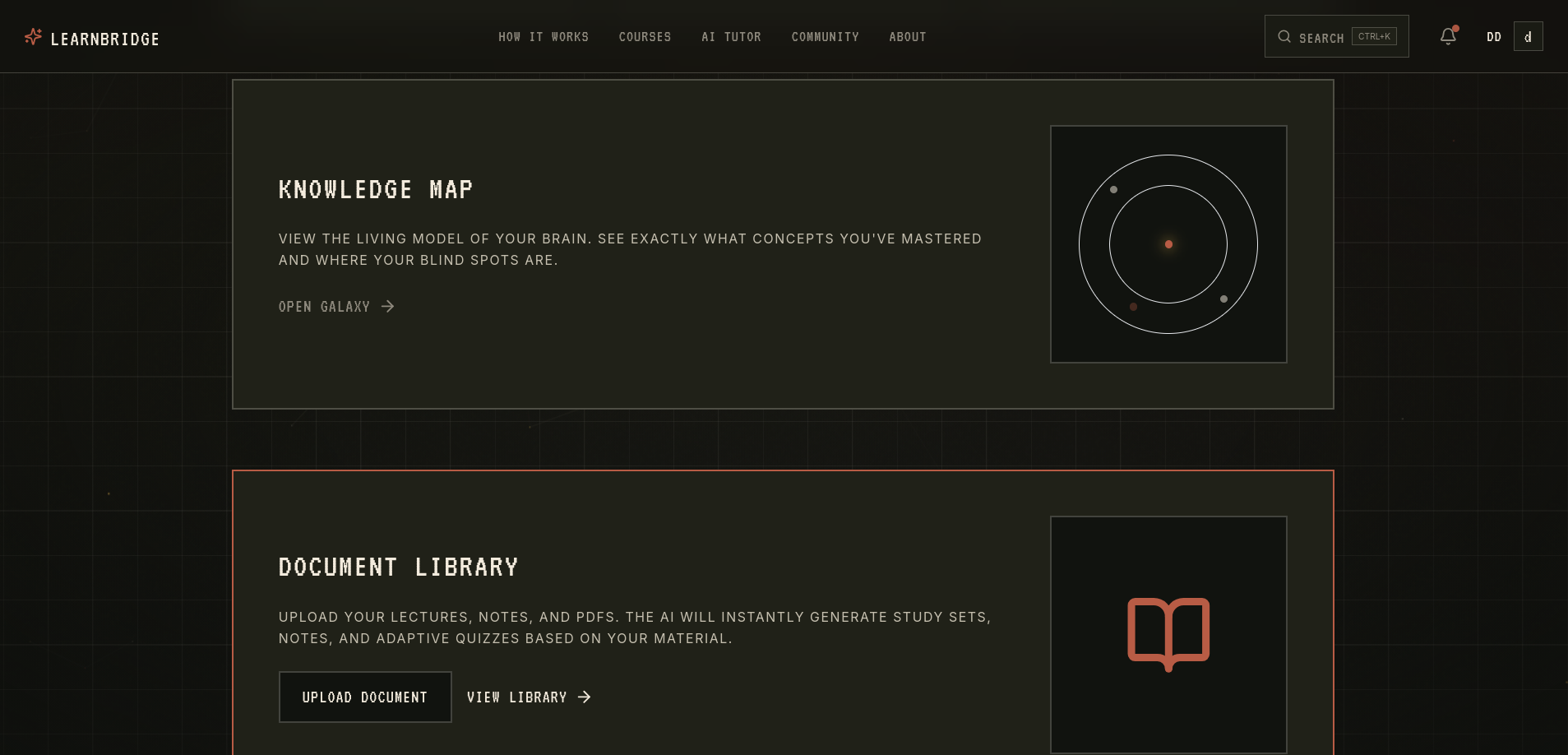
LearnBridge combines AI-powered study tools with an adaptive learner model.
A student can:
- Sign in securely
- Set their learning goals and preferences
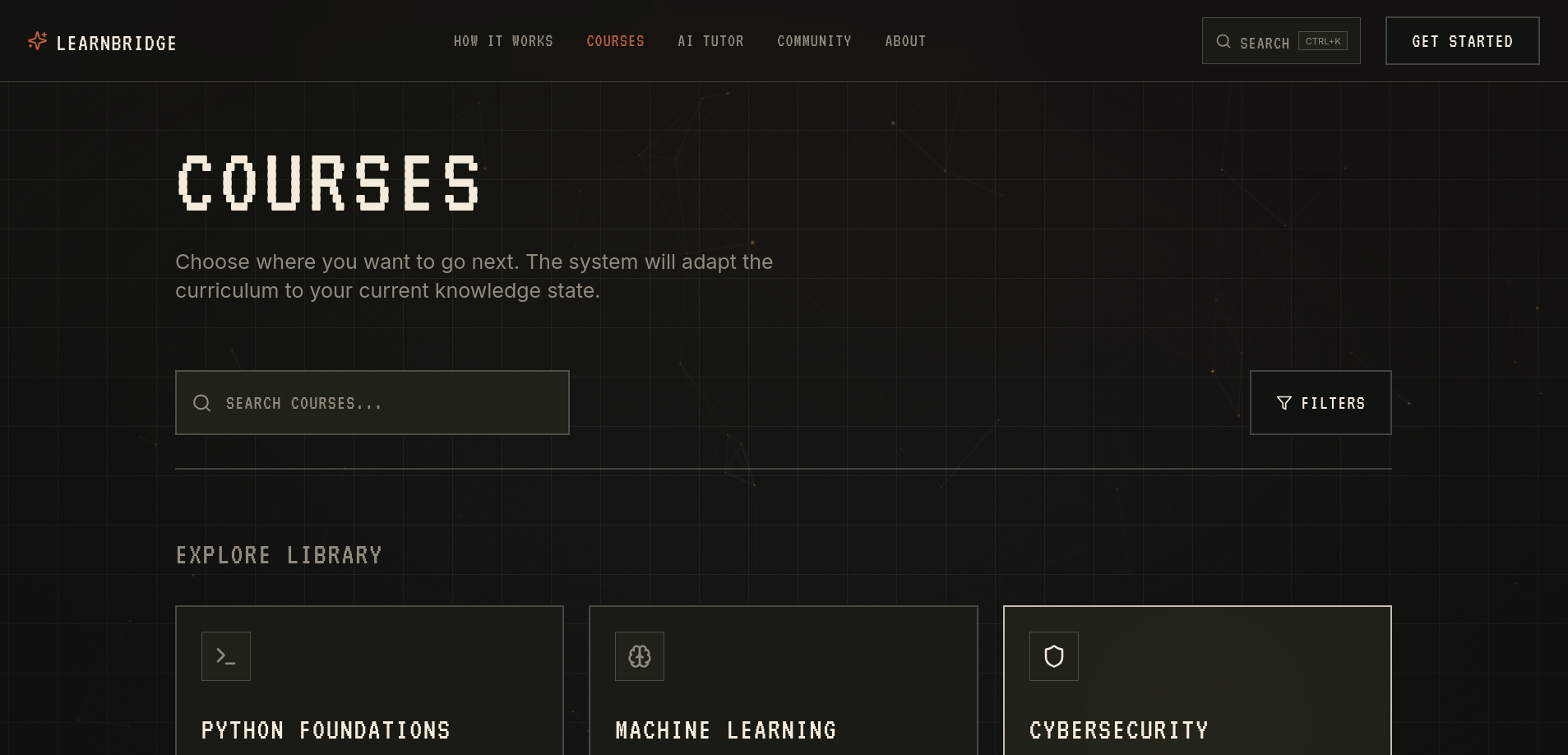
- Explore structured courses
- Upload learning material
- Generate AI-powered notes
- Generate flashcards
- Generate quizzes
- Practice concepts
- Ask an AI tutor questions
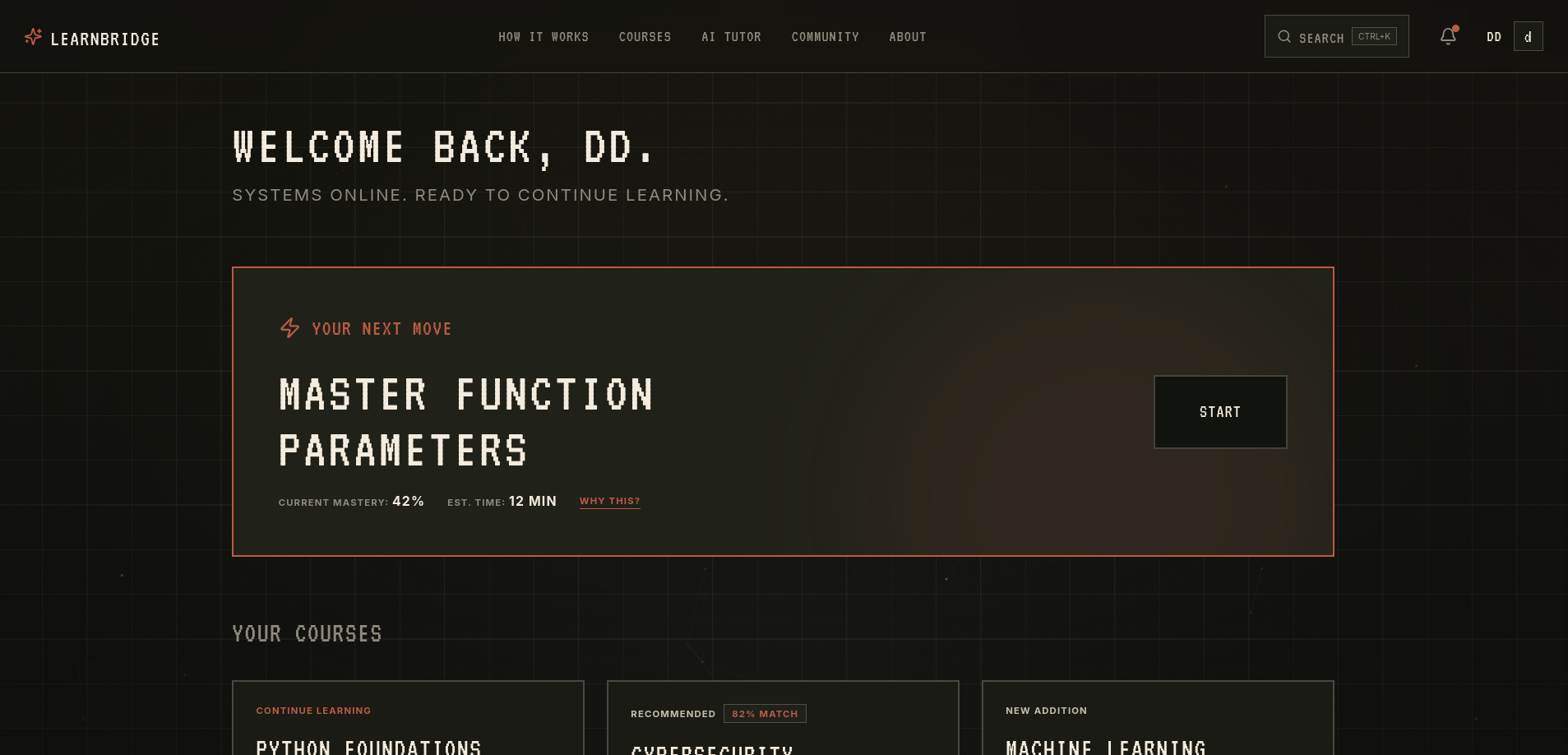
- Receive personalized recommendations
- Track mastery
- Discover knowledge gaps
- Follow an adaptive learning roadmap
- Measure learning improvement
The core LearnBridge learning loop is:
ASSESS → DIAGNOSE → ADAPT → LEARN → PRACTICE → MEASURE
The goal is not simply to generate more educational content.
The goal is to determine what the learner needs next.
The Problem
Consider a student learning Python.
They are trying to understand Object-Oriented Programming, but they repeatedly struggle with classes and objects.
A traditional platform may simply recommend more OOP content.
However, the real problem could be a missing prerequisite:
Variables
    ↓
Conditions
    ↓
Loops
    ↓
Functions
    ↓
Parameters
    ↓
Return Values
    ↓
Object-Oriented Programming
## How we built it
## How we built it

LearnBridge was built as a full-stack AI learning platform with a focus on connecting AI capabilities to a persistent learner model.

The application is structured around five major layers:

**1. Learning Interface**

We designed a focused web experience where students can explore courses, upload learning materials, practice concepts, interact with AI tutors, view their roadmap, and track their progress.

**2. Backend & Data Layer**

The backend manages users, courses, modules, enrollments, assessments, documents, flashcards, quiz attempts, notifications, learning activity, knowledge gaps, and personalized roadmaps.

A database stores the learner's progress so that each interaction can contribute to their long-term learning profile.

**3. AI Learning Engine**

The AI layer powers features such as:

- document analysis
- AI-generated notes
- flashcards
- quizzes
- practice questions
- study plans
- AI tutoring
- personalized explanations

The important part is that these AI features are connected to the learner's context instead of operating as isolated tools.

**4. Knowledge Gap & Adaptive Learning Engine**

This is the core of LearnBridge.

Quiz results, mistakes, topic performance, and previous learning activity are analyzed to estimate topic mastery.

When a weakness is detected, LearnBridge can identify a related prerequisite and recommend a different learning sequence.

The learning loop becomes:

**Interaction → Evidence → Knowledge Model → Recommendation → Practice → New Evidence**

**5. Security & Administration**

We separated student and administrator authentication.

Students use Google authentication, while administrators use a dedicated secure authentication system with role-based access control.

The administrator environment includes security controls such as password hashing, optional two-factor authentication, rate limiting, secure sessions, audit logging, and document integrity verification.

Throughout development, we focused on making the system modular so that additional AI models, learning algorithms, courses, and educational tools can be added without redesigning the entire platform.
## Challenges we ran into
One of our biggest challenges was going beyond the idea of an AI chatbot.

Generating a summary, flashcard, or quiz is relatively straightforward. The much harder problem was deciding what should happen to that information afterward.

We wanted LearnBridge to understand that a wrong answer is not just a wrong answer. It can be evidence of a deeper knowledge gap.

For example, if a learner repeatedly struggles with an advanced topic, the system needs to consider whether a prerequisite concept is missing.

This led us to think about learning as a continuous feedback loop:

**Practice → Mistake → Diagnosis → Intervention → Practice Again**

Another challenge was keeping the experience simple while the underlying system became more complex.

LearnBridge contains courses, assessments, AI tools, documents, knowledge gaps, roadmaps, notifications, progress tracking, and personalization. We had to make these components feel like one product rather than a collection of unrelated features.

Document processing was another challenge. Uploaded material needs to be converted into useful structured information before AI features can generate reliable notes, flashcards, and quizzes.

Authentication and security also required careful consideration. We wanted students to have a simple Google sign-in experience while keeping administrator access separate and significantly more protected.

Finally, we had to balance ambitious AI functionality with the reliability required for a real application. A feature that looks impressive but fails during a live demonstration is not useful, so we prioritized working end-to-end flows over simply adding more features.
Accomplishments that we're proud of
## Accomplishments that we're proud of

We are most proud of turning the idea of an adaptive learning system into a complete product experience.

Instead of building only an AI tutor, we connected multiple learning activities into one continuous system:

**Learning Material → AI Study Tools → Practice → Knowledge Gaps → Adaptive Roadmap → Improvement**

We are particularly proud of the knowledge-gap concept.

LearnBridge attempts to answer a question that traditional learning interfaces often leave unanswered:

> "Why am I struggling with this topic?"

Rather than simply showing a low quiz score, the platform can connect performance across related topics and use that information to recommend what the learner should study next.

We are also proud of the personalized AI experience. The system can use information such as the learner's current topic, previous mistakes, learning preferences, and uploaded material to make AI interactions more relevant.

Another accomplishment was creating an end-to-end study workflow from uploaded material. Instead of treating a PDF as a static file, LearnBridge can turn learning material into an interactive study set containing notes, flashcards, quizzes, practice, and AI tutoring.

We also built a dedicated administrative architecture with role-based access and stronger security controls, demonstrating that LearnBridge was designed as more than a prototype interface.

Most importantly, we are proud that the project is centered around a real educational problem rather than using AI simply because it is available.
## Accomplishments that we're proud of
Building LearnBridge taught us that building an AI product is much more than connecting an application to a language model.

The most important lesson was that **context matters**.

An AI tutor that knows what a student is currently studying can be more useful than a generic chatbot. An AI tutor that also knows the student's previous mistakes, weak topics, learning preferences, and study material can become even more useful.

We learned how important it is to maintain a persistent learning model instead of treating every interaction independently.

We also learned about the challenges of turning unstructured educational material into useful structured learning resources.

On the technical side, we gained experience with:

- full-stack application architecture
- AI integration
- document processing
- database-backed personalization
- adaptive learning logic
- authentication
- role-based authorization
- secure administrator systems
- API design
- user experience design
- error handling and reliable application flows

One of our biggest conceptual lessons was that personalization should not mean simply recommending different content to different users.

True personalization should respond to evidence about what a learner understands.

That shaped the core philosophy of LearnBridge:

**Don't just ask what the learner wants to learn. Understand what they need to learn next.**
## What we learned
LearnBridge is designed as a foundation for a much larger adaptive learning ecosystem.

The next stage is to make the learner model more sophisticated.

We want LearnBridge to develop a deeper knowledge graph that represents relationships between concepts and prerequisites. This would allow the system to reason more accurately about why a learner is struggling and which concept should be addressed first.

Future versions could include:

- multimodal learning across text, images, audio, and video
- lecture and audio processing
- image-based problem solving
- stronger prerequisite detection
- advanced spaced repetition
- improved adaptive assessment
- personalized exam preparation
- educator dashboards
- classroom analytics
- collaborative learning
- accessibility-focused learning modes
- richer learning analytics
- stronger long-term learning memory

We also want to improve the way LearnBridge measures learning impact.

Instead of only asking:

**"Did the student finish the course?"**

we want to answer:

**"What did the student understand before, what do they understand now, and what should they learn next?"**

Our long-term vision is for LearnBridge to become a continuously evolving learning companion that understands each learner's strengths, weaknesses, goals, preferences, and progress.

The ultimate goal is simple:

> **A learning platform that doesn't force every student to follow the same path, but builds the right path for each learner.**

**LearnBridge doesn't just teach students.**

**It learns how they learn.**
Built With
- ai
- api
- artificial
- fastapi
- generative
- intelligence
- learning
- machine
- oauth
- postgresql
- python
- react
- rest
- tailwind
- typescript

Log in or sign up for Devpost to join the conversation.