-
-
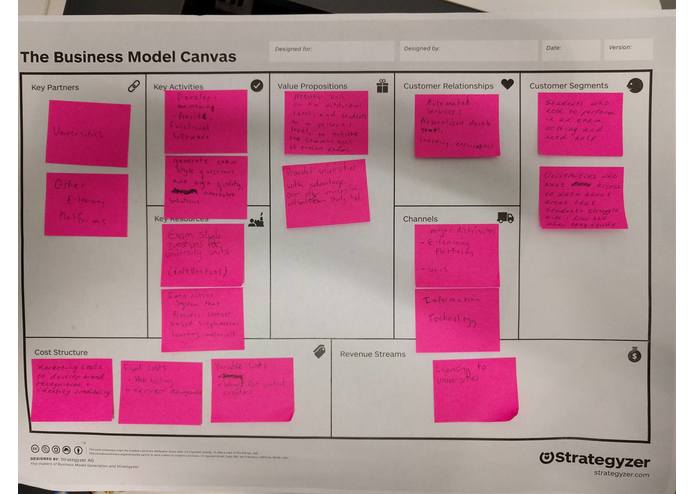
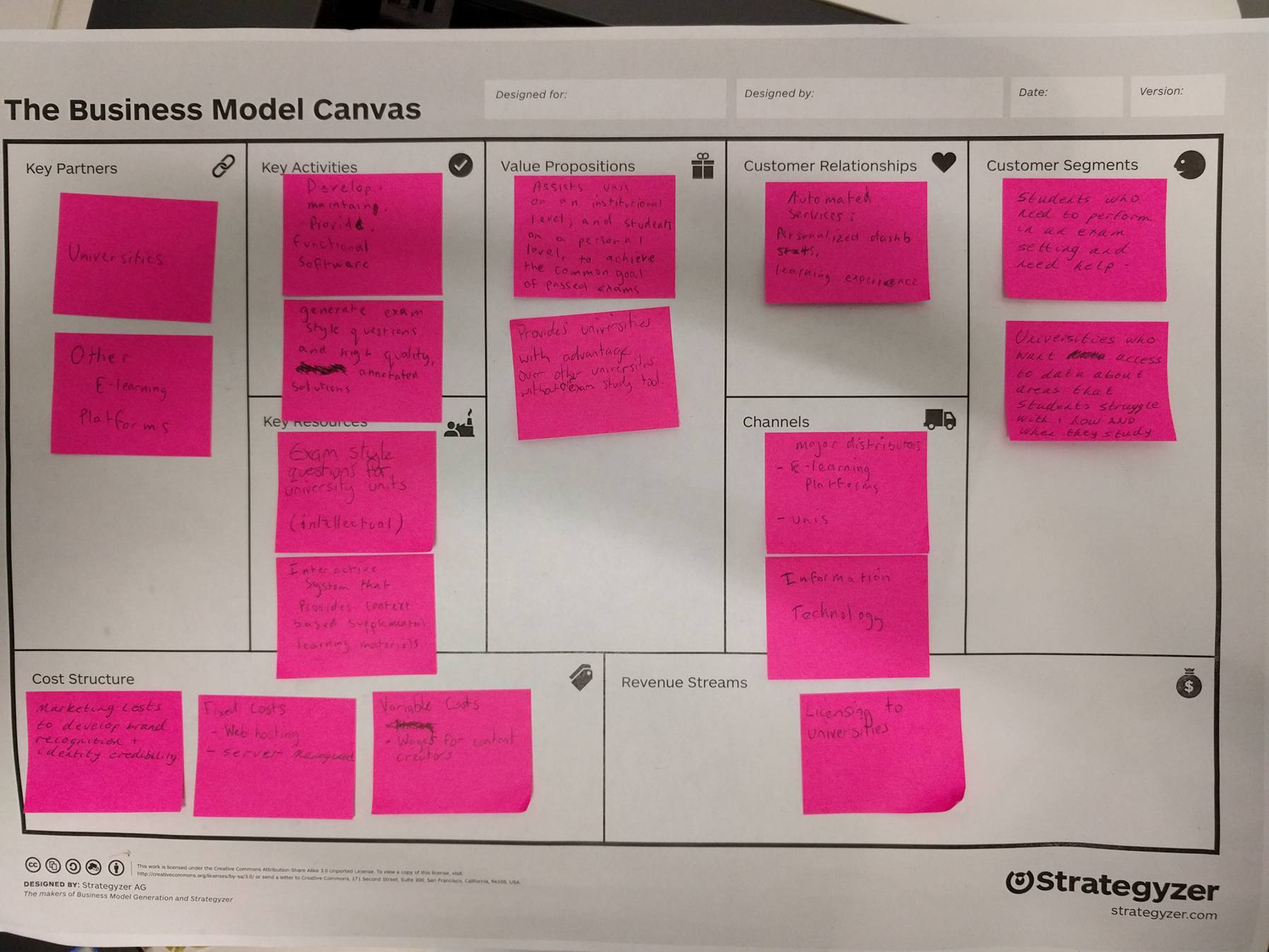
Business Canvas
Team: Learnblock
Our Inspiration
As university students we have all faced the trials and tribulations associated with the examination period at university. We are constantly faced with a system that recognises talent based on the metric of exam performance, but we have not always been equipped with the knowledge or the skills necessary to address the parameters and constraints of the exam setting. There has been an unintentional rift between the learning outcomes that occur throughout the semester and the skills that are required to excel at the end of the semester in the exam setting. We wanted to develop a tool that makes the process of preparing for exams easier, less daunting and engaging, so that the exam is no longer perceived as a haphazard determinant wrought with strife and ambiguity and instead transform the experience, so that the exam is merely another juncture, that is manifested in excellence - something that we believe, as students, we deserve.
Our System
We have developed an adaptive, intuitive and interactive web-based examination learning platform that provides students with both the data and the tools that will improve their examination results with profound efficacy,which reduces the stress of students and improves the student satisfaction ratings for universities.
The Problem
We want to solve the disillusionment faced by students who struggle to find the help that they need to perform well in their exams, by providing them with real-time explanations and support that guides them through an understanding of relevant exam material. Students are manifested in dichotomous ways:
- Some students choose to engage, but do not have a structured approach to exam preparation. They have the knowledge, but not the skills to represent that knowledge for an exam setting.
- Some students legitimately struggle with core concepts but are unwilling to receive the support out of fear of judgement by the lecturer or vilification by peers.
- Some students seek relevant channels, but then fall short with individualised focus, because the support networks simply do not have the time to cater to the breadth of their needs, during the busiest time of semester.
- Furthermore, lecturers are under phenomenal stress as the university increasingly exacerbates their role and responsibilities. Sometimes they want to help - but repeating the answer to the same question multiple times is daunting, amidst the onset of irrevocable workloads.
We want to solve these problems, by utilising the power of information within the scope of a contextualised, relevant resource delivery channel.
Our Solution
Our tool is designed to focus on the two most important aspects of a student's exam based preparation experience:
1) We want to tell students WHAT they should study and WHEN to study it 2) We want to TEACH students THROUGH SOLUTIONS to EXAM-BASED questions using INTERACTIVE learning.
How are you using data to fix the problem
Our two-fold solution, involves using DATA in a two-fold way.
1) How will we tell students what to study and when to study it? We will be using data-centric artificial intelligence algorithms based on a hybrid machine learning system that we have developed that factors in expert knowledge WITH a predictive neural network algorithm in order to feed students with the relevant exam questions AND solutions to maximise their exam based performance within the time-frame they they have before the exam. We will strategically select questions for students based on the following factors:
- When is their exam?
- How difficult have student found this exam, historically?
- What knowledge gaps have we identified through the user's interaction with the questions in our system?
- What subjects have the students performed better in from within their past and how are these subjects related to the new subjects they have coming up?
2) How will we enable students to learn THROUGH exam solutions and interaction? We have developed a personalised, interactive solution tutor. The solutions are labelled with metadata that connects critical points of the solution within the question, to the repository of data that already exists across the internet. We will provide students with modularised digital explanations that explore a component of the solution from two different lenses: the context of the question (at a granular level) and the theory related to the question (at a holistic level), so that students are correlating knowledge acquired from their courses WITH the actual exam questions.
How I built
To develop this solution, we used a combination of algorithmic and mathematical techniques, guised under the profundity of a seamless and engaging user experience.
From an algorithmic perspective, we have utilised universal web-based technologies that enables us to scale a prototype with speed and efficacy (Codeigniter, PHP, MySQL, jQuery and AJAX). From a user experience point of view, we have used principles in participatory design and human computer interaction to develop a user experience that is INCLUSIVE of the demographic we are catering for.
The reality is that current e-learning platforms are being developed by EDUCATORS, who are removed from the pertinent challenges that face students. Therefore, we used white board scaffolds and wireframes that brought students in as active participants to weigh in on the design and provide their suggestions.
Challenges I ran into
The onset of any project is incredibly idealistic that is broad in nature. Therefore, one major challenge we faced was honing down a product. Even though our system was capable of so many more things (learning, data analytics for educators), we paired back our focus to our two fundamental areas and this was a time-consuming endeavour.
The process of developing advanced functionality that is intuitive and user friendly is always a challenge. Being under time intensive pressure, having to make difficult decisions in a speed driven environment at times hindered our creativity: as we had to sometimes favour function over form, even though form was an integral ingredient to our product. Part of this also meant further simplifying functionality.
The process of user targeting and business modelling was difficult. Our team was lucky enough to have background in e-learning systems. One member is currently developing an e-learning platform for Medicine students, while other members have also been active tutors. We recognised the fact that we could target multiple demographics (high school students and university students), each who have different needs and requirements, each of who operate under a different business model, and each which presents opportunities and challenges. Honing our market and having conviction with our choice was a difficult task amidst a context of development, whose decisions were also dependent on this analysis.
Accomplishments that we're proud of
We were incredibly proud of the phenomenally positive feedback we received by every member regarding our concept. Past students repeatedly told us how they remembered the challenges of preparing for exams and how they would have loved such a system in their time and the practical implications it could have had on their learning. Present students compelled us by how proactive they were willing to be a part of our system beyond this competition, to realise its goals, given the universal appeal this has to so many stakeholders. This also included university lecturers who believed that such a system will help their students, while also saving them much time towards the end of the semester, where the system could play a supportive role in student learning.
Additionally, we were proud at the sheer persistence, perseverance and determination of our team, as we ventured through the late hours of the night to push the parameters of the human condition to realise our goal and aspiration. To us, this is not just an idea, it is a revolutionary concept that could transform student education forever. Its a system that we need and we want to actualise, utilising the strength of collaborative partnerships within our group dynamic.
What we learned
We learned conflict resolution strategies and the importance of receiving opinions from people of all walks of life. No opinion is invalid, no matter how critical it may appear to sound. People here, exist to help one another actualise their dreams and aspirations. We developed ways to meet in the middle over concepts, while recognising and appreciating everyone's value to the concept.
What's next for Learnblock
Our plan is to develop a proprietary prototype and develop a proof of concept through market involvement within a constrained environment to validate our concept and ultimately our beliefs. We will do this, by utilising our resource potential within ourselves, to offer this tool to ICT education students, using our knowledge of curricula to render and populate relevant exam questions and interactive solutions. We will offer product as a Beta test to the University of Tasmania's School of ICT and Engineering, with the hope to expand our product offering over the course of one year, to incorporate a second school, on commencement of concept proof.
We intend to conduct an evaluation of the product at the one year mark, and begin an expansion strategy, so that we cater to the broader Tasmanian University populace.
The system, ultimately is universal and can be expanded both nationally and internationally. Our five year projection is to meet a key performance indicator, whereby we support at least 20 Australian universities, before beginning a global strategy, which is beyond our foreseeable future at this stage.


Log in or sign up for Devpost to join the conversation.