-
-
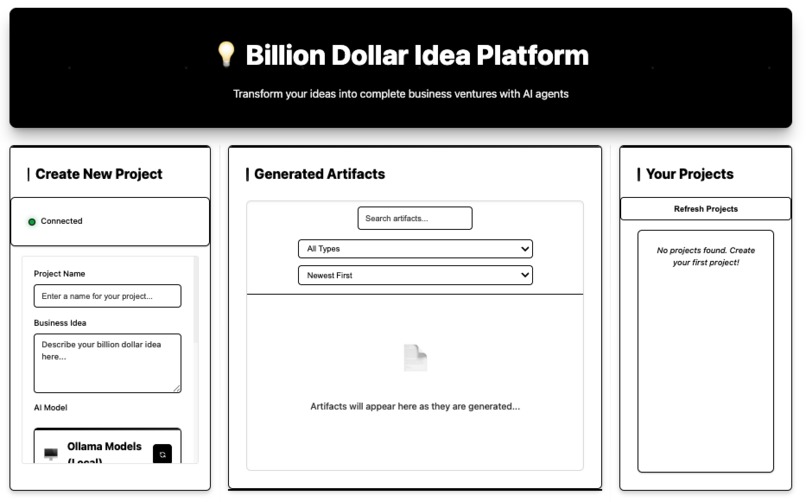
Billion Dollar Idea Platform
-
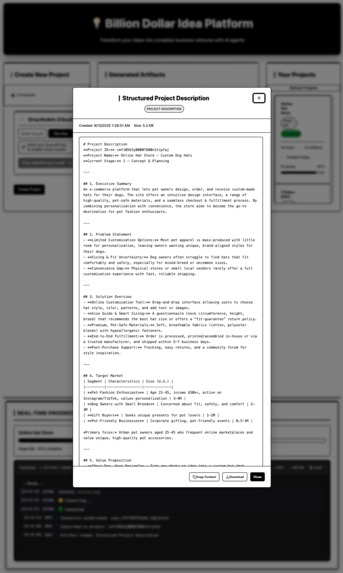
View Output
-
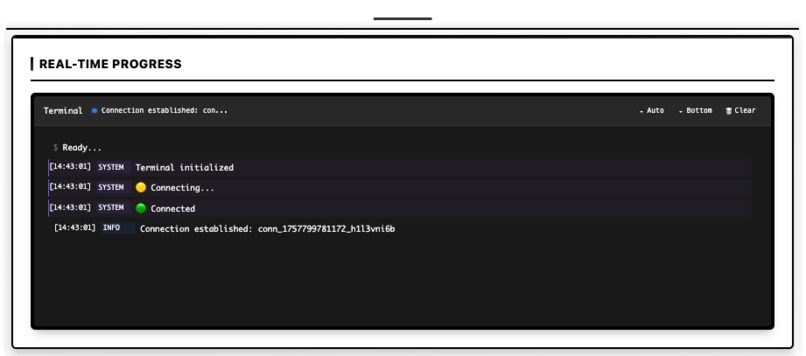
Debug window
-

Kiro Rules
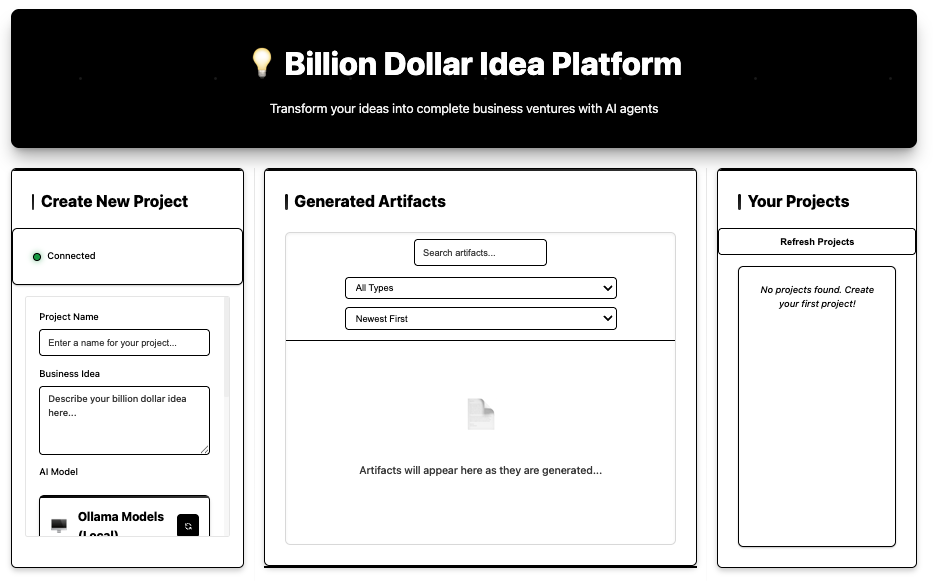

Billion Dollar Idea
Inspiration
The concept of autonomous AI agents is powerful, but what if we pushed it to its logical extreme? What if you could orchestrate an entire workforce of specialized AI agents to take a business idea from a simple thought to a fully operational, self-improving entity? This was the moonshot idea: from idea to IPO without hiring a single employee.
Building a system this complex—with a multi-stage pipeline, over a dozen interacting agents, background processing, and real-time feedback—would be impossible in a traditional IDE within a hackathon timeframe. This project was inspired by the promise of Kiro itself: to act as a true development partner, allowing me to focus on high-level architecture and strategy while it handled the heavy lifting of implementation. I wanted to see if Kiro could help me build the most ambitious AI agent orchestrator possible.
What it does
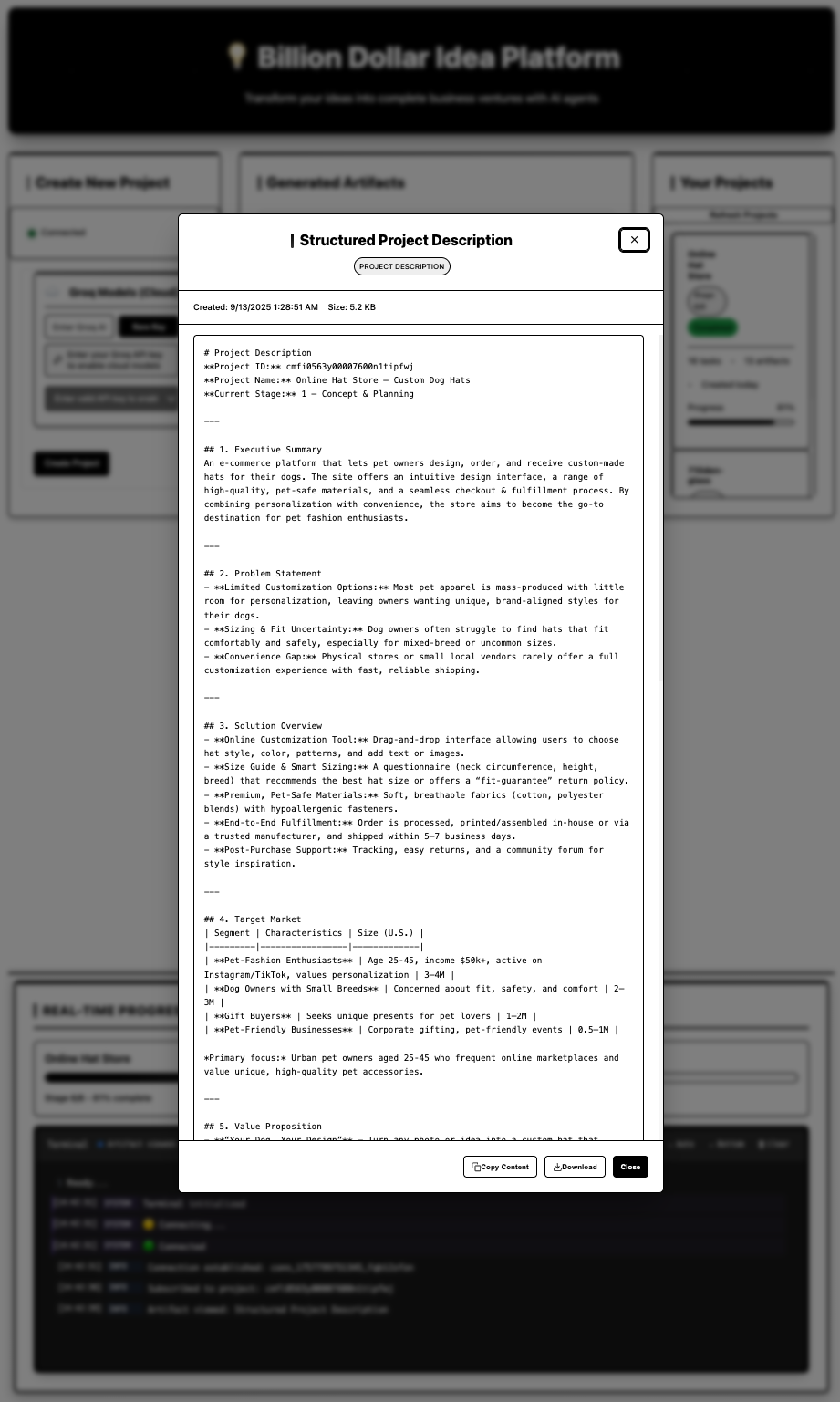
"Billion Dollar Idea" is an AI-powered business automation platform that simulates and executes the entire lifecycle of a startup. A user inputs a business idea, and a 6-stage pipeline powered by 13+ specialized AI agents gets to work.
The platform autonomously moves the project through stages:
- Validation & Strategy: A Market Research agent and Technical Architect validate the idea.
- Development: UI/UX, Full-Stack, QA, and DevOps agents design and build the product.
- Go-to-Market: Business Setup, Content Marketing, and Sales agents prepare for launch.
- Operations & Self-Improvement: Customer Support, Analytics, and System Optimizer agents run and improve the business.
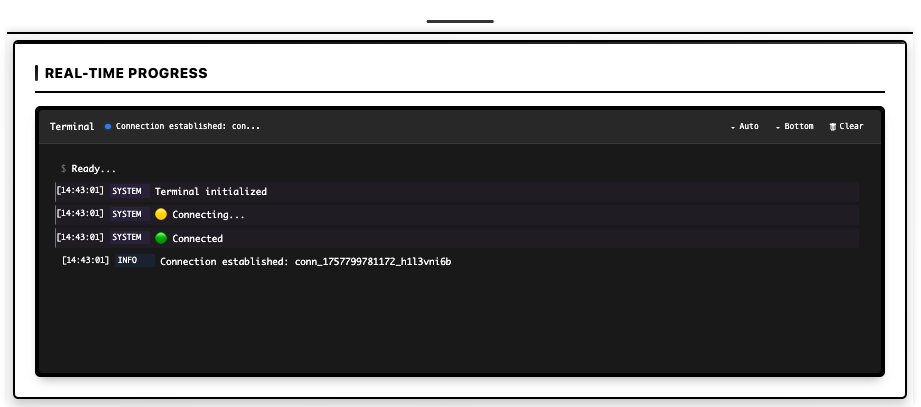
All of this is managed through a real-time dashboard with a retro Mac OS interface, with the AI agents running on a local, private gpt-oss:20b model to ensure zero API costs and complete data privacy.
How I built it with Kiro
This project is a testament to Kiro's spec-driven development philosophy. The entire application was built from a detailed spec that I co-wrote with Kiro in natural language.
Spec-to-Code Architecture
I started by creating a comprehensive .kiro spec file. I defined the 6-stage pipeline, the roles of all 13 AI agents, and the required database models (Users, Projects, Agents, Tasks, etc.). Kiro took this high-level spec and scaffolded the entire Flask application, including the SQLAlchemy database models in database.py, the API endpoints, and the basic HTML templates. This saved days of boilerplate coding.
Agent Logic with Multi-Modal Chat
For each of the 13 agents, I used Kiro's chat to brainstorm and implement its core logic. For example, to create the seed_initial_agents function in app.py, I described each agent's name, purpose, and capabilities in plain English. Kiro translated this into the structured Python dictionary and the database seeding logic required.
Implementing Complex Features
Integrating a Celery task queue for background processing and Socket.IO for real-time notifications was a major challenge. I used Kiro to work through the integration, asking it to refactor synchronous functions into asynchronous Celery tasks (execute_agent_async) and to set up the WebSocket event handlers for real-time UI updates.
Automating with Agent Hooks
To keep my project documentation clean, I configured a Kiro agent hook. Every time I defined a new API endpoint in my spec (e.g., POST /api/projects/<id>/advance), the hook would automatically run, find the corresponding function in app.py, and generate a markdown description of its functionality, adding it to my README.md. This ensured my documentation was always perfectly in sync with my code.
The presence of the /.kiro directory in the final repository is proof of this deep, spec-driven workflow that was essential to the project's creation.
Challenges I ran into
Orchestration Complexity
Managing the dependencies and data flow between 13+ agents is incredibly complex. The initial spec I wrote in Kiro was crucial for visualizing the entire system and ensuring that each agent's output could serve as a valid input for the next.
Integrating Asynchronous Systems
Getting Flask, Celery, and Socket.IO to work together seamlessly is notoriously difficult. Kiro was invaluable in generating the correct initialization patterns and ensuring the application context was available to background workers.
Local AI Reliability
Local models like gpt-oss:20b can be slow and require robust error handling. I used Kiro to help me write the AI provider module (ai_providers.py), including logic for extended timeouts and error management to handle the unique behavior of local inference.
Accomplishments that I'm proud of
Realizing a Moonshot Idea
Building a system of this scale and complexity in a hackathon timeframe is my biggest accomplishment, and it was only possible by using Kiro as a development partner.
True Spec-Driven Development
This project isn't just using Kiro; it's built on its core philosophy. The final application is a direct, functional implementation of the high-level architecture defined in the .kiro spec.
A Fully Local, Private AI Workforce
By integrating Ollama with gpt-oss:20b, the platform runs with zero external API costs and guarantees user privacy—a major achievement for a system this powerful.
Polished User Experience
The retro Mac OS theme and real-time, non-blocking UI make the application not just functional but genuinely fun to use.
What I learned
The biggest takeaway is that spec-driven development isn't just a feature; it's a fundamental shift in how complex software is created. Defining the "what" and "why" in a structured spec and letting the AI partner handle the "how" is exponentially more efficient than traditional coding. It allowed me to stay focused on the architectural vision without getting bogged down in implementation details.
What's next for Billion Dollar Idea
The platform is built on a scalable foundation. The next steps, clearly laid out in the README.md, include:
- Docker Containerization: For easy one-command deployment.
- GitHub Integration: Allowing agents to commit generated code directly to repositories.
- Support for More Local Models: Including local image generation models for design tasks.
- Advanced Analytics: Building a more sophisticated dashboard to track the business metrics of the simulated companies.
Built With
- celery
- css3
- flask
- gpt-oss
- html5
- javascript
- kiro
- ollama
- python
- redis
- socket.io
- sqlalchemy
- sqlite

Log in or sign up for Devpost to join the conversation.