Inspiration
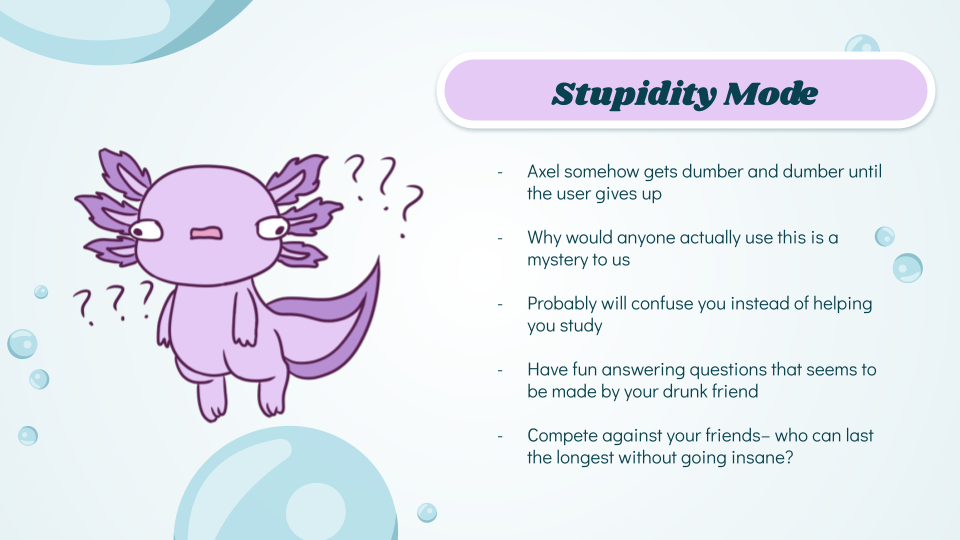
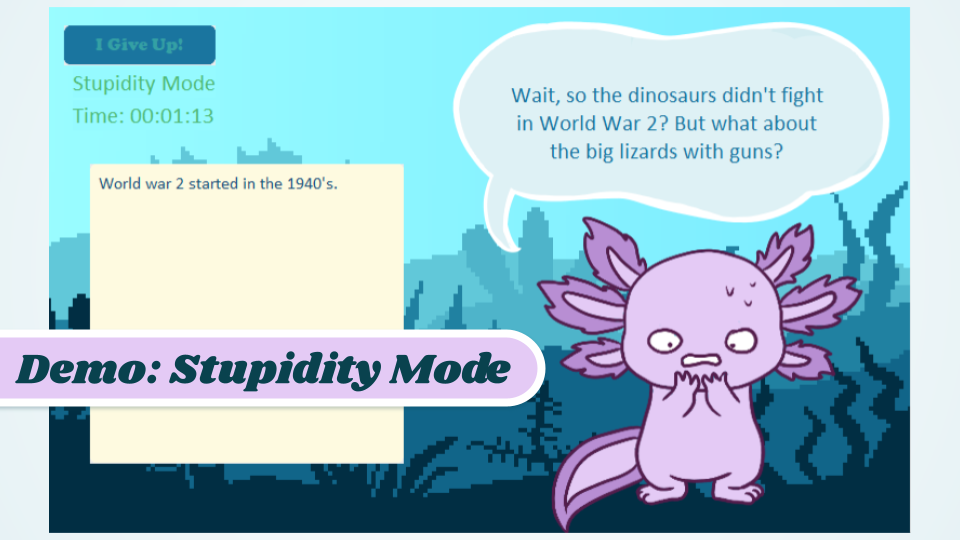
The lack of a fun way to learn in today's student society was the central issue we focused on. Being entertained while learning would help keep retention in students and help motivate them to study more, so we wanted to solve that issue. Along the way, however, the idea of creating the anti-studying chatbot, now called the Stupidity Mode, was proposed, and we decided to create an app that has features to both help and hinder studying progress.
What it does
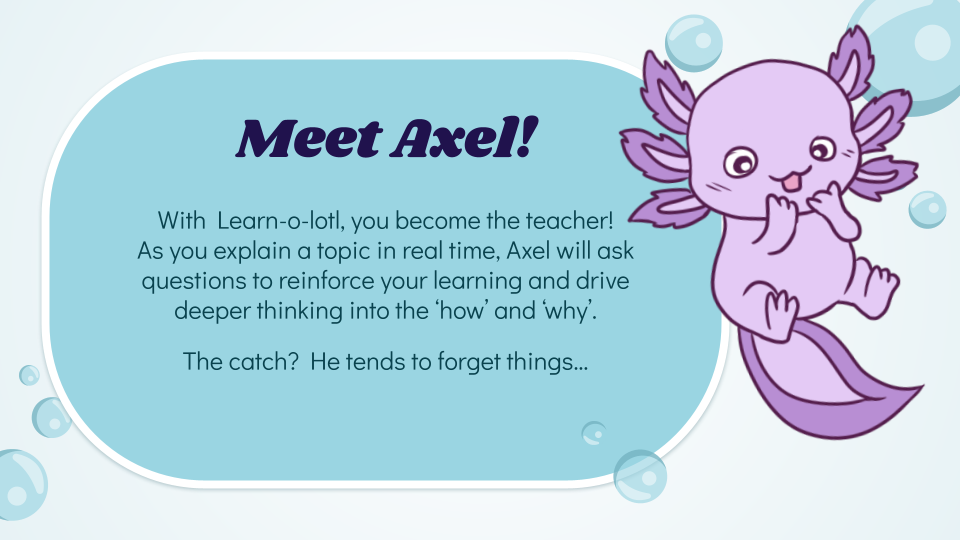
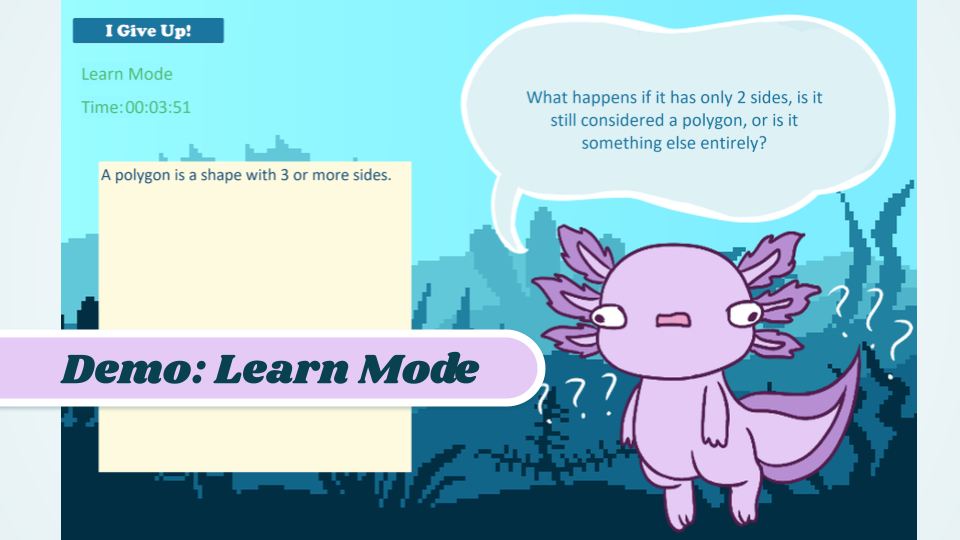
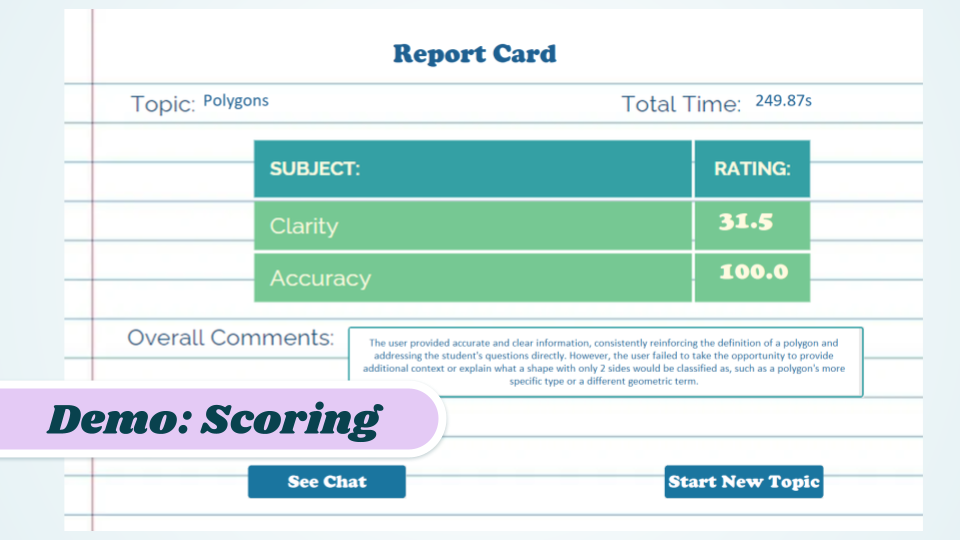
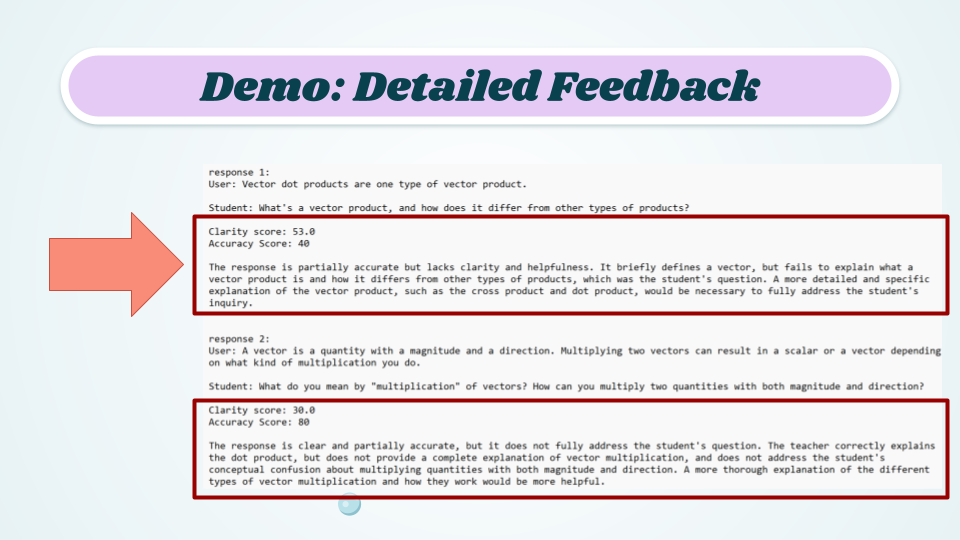
The Learn-o-Lotl incorporates the Cerbras Llama 3.1-70b model to generate (sometimes) relevant questions and to grade the user's response. Users can choose a mode and a subject, and begin answering Axel's questions about the topic that stems from previous responses/explanations the user gave. Each question's difficulty, relevancy, and thoughtfulness will be based on the mode the user chooses. Finally, after the user "gives up", the final page will show the overall rating for the explanations the user gave to Axel, based on clarity and accuracy. Users can also find individual ratings of the explanations by downloading the .txt file with the chat history and the AI's ratings for each explanation.
How we built it
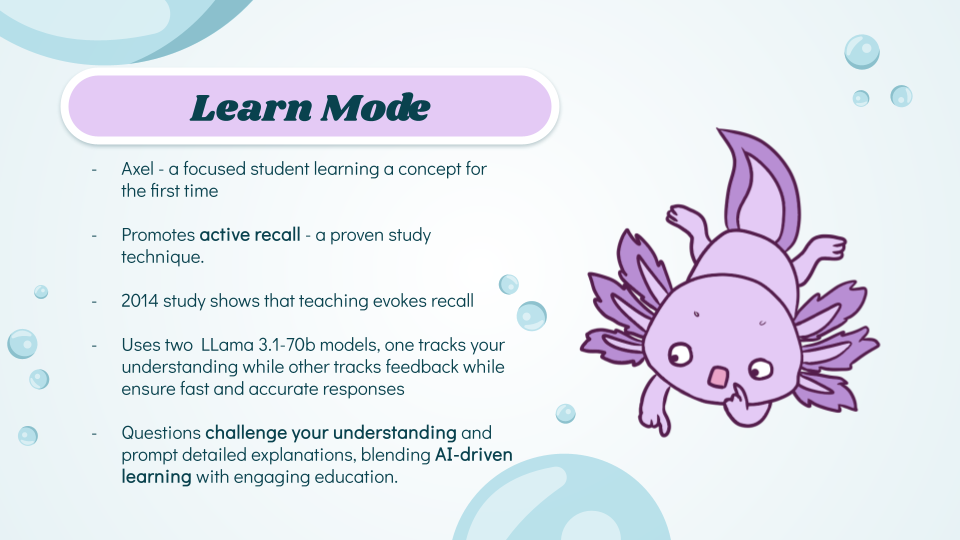
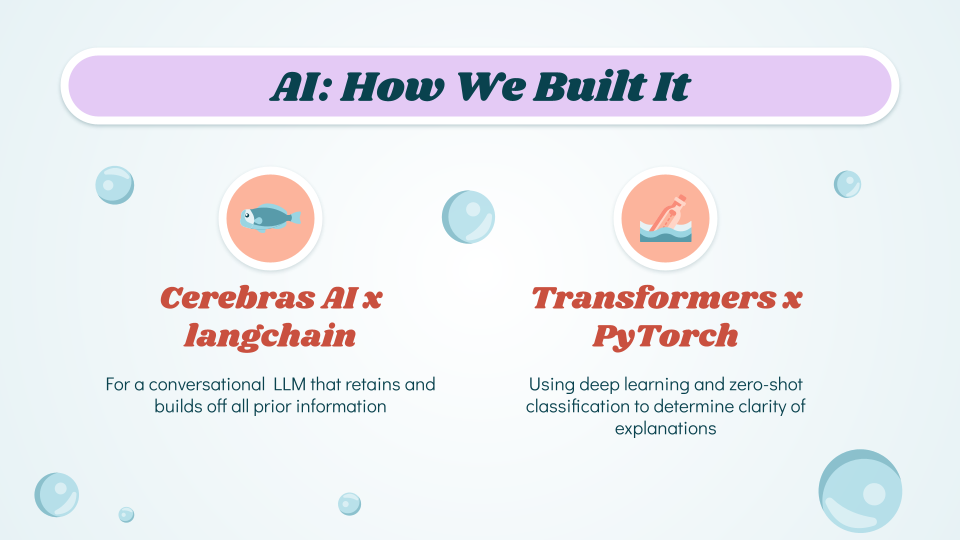
The GUI for our app was created using the Tkinter package in Python. It consisted of many detail-oriented changes and making the GUI user-friendly. Under the hood, Learn-a-Lotl uses two LLaMA 3.1-70b models - one to track your understanding while the other provides feedback. We’ve utilized Cerebras’ advanced AI technology, ensuring the user’s interaction with Axel is fast, engaging, and accurate. Furthermore, we utilized a transformers library for deep learning based on PyTorch to perform zero-shot classification to determine the clarity of each explanation. These advanced AI features allow Axel to adapt based on how well you’ve responded and explained the concept, and allow Learn-O-Lotl to grade you based on your accuracy and clarity.
Challenges we ran into
There were several challenges that our team ran into. Beginning with the backend development of the app, utilizing and training (changing the parameters) the Cerebras API took a significant amount of time. For the front-end developers, the central issue lay in learning a new package and its documentation, and constantly needing to change small design-related details which seemed to never end. Rescaling the GUI for different window sizes was one issue that frequently arose. Time management and collaboration between our members were also rough at the start but became much smoother as time passed. In the end, however, all these challenges taught us lessons that would make this hackathon memorable.
Accomplishments that we're proud of
First of all, finishing the actual app and being able to show the demo of the final product was an accomplishment we're proud of, especially considering that this was the first hackathon for the majority of our team. Other accomplishments include being able to successfully incorporate a high-end language API smoothly into a project, which added to the fun and depth of our result, and developing a useless idea into a full app.
What we learned
New technology, ideas, and experiences were the core behind our hackathon experience for our team. The front-end developers learned a new Python package and ways to incorporate the Cerebras API into our development. The backend developers tested out many different ideas with this API and learned to train it to return a specific response. Time management, coordination between front and backend developers, and overall workflow of a computer science-driven work environment were valuable skills that were reinforced during the creation of our app.
What's next for Learn-o-Lotl
There are numerous aspects to improve upon, including smaller, quality-of-life design development, but there are three primary functionalities that we wish to implement in the future. To make the app more interactive, we see incentives playing a large part in user retention and continuous usage of the app. Therefore, adding progress badges or achievements of some sort is a challenge to tackle in the future. Adding voice recognition and image upload features may be coupled with AI analysis to develop ways to analyze and grade users' written works or oral explanations.
Built With
- cerebras
- customtkinter
- python
- tkinter
- transformers


Log in or sign up for Devpost to join the conversation.