Learn-KuchBhi
Inspiration
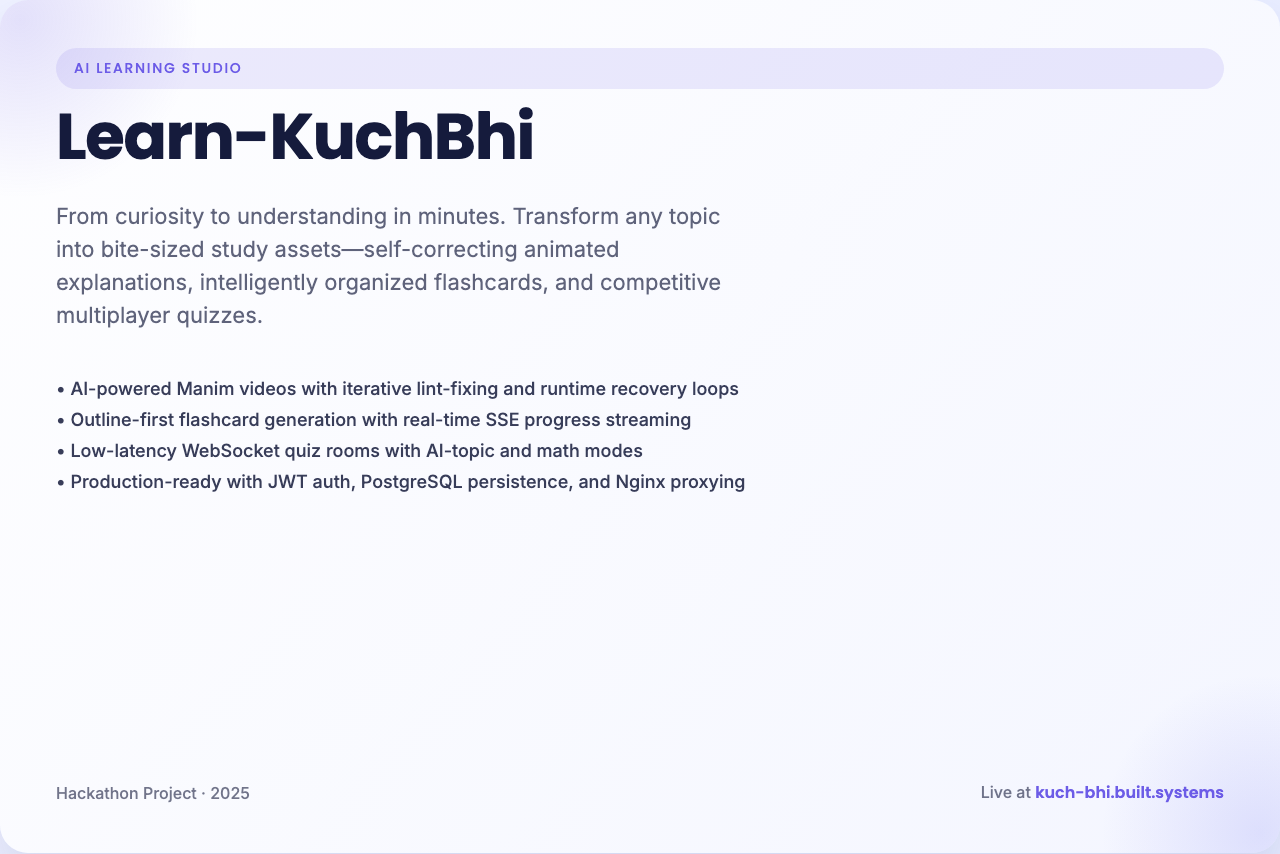
We learn best when concepts are explained visually and reinforced through practice. We wanted a way to turn any topic into bite-sized study assets like animated explanations, organized flashcards, and a quick multiplayer quiz, so that students can go from curiosity to understanding in minutes.
Access Credentials
Go to https://kuch-bhi.built.systems/login and use the below credentials to login to the platform.
- Email:
[email protected] - Password:
[email protected]
To see the already generated outputs, navigate to the My Topics and My Videos sections.
What it does
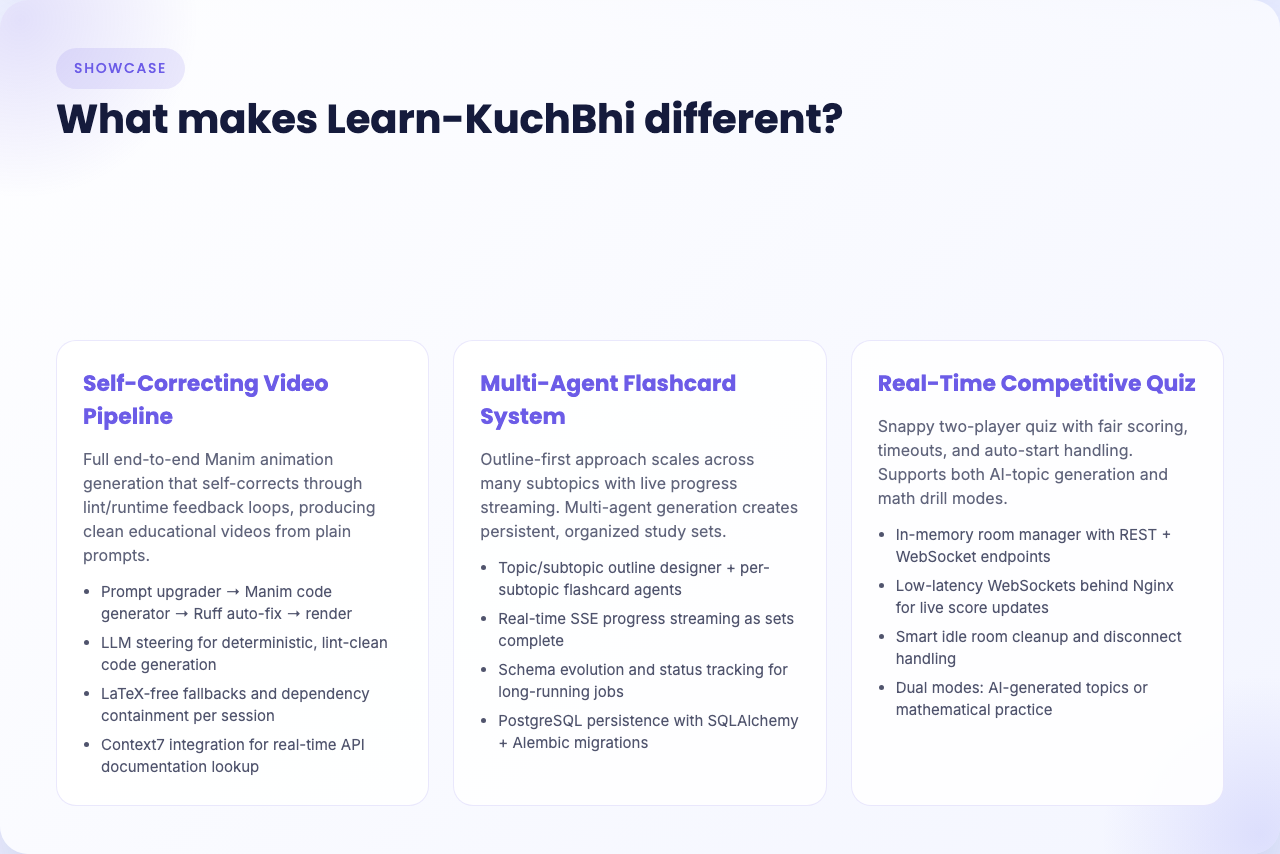
- AI-powered Manim videos: Type a prompt, get a clean, educational animation. The system upgrades prompts, generates Manim code, lint-fixes it, and renders an MP4 you can stream instantly.
- Smart flashcards with outlines: It first designs a topic/subtopic outline, then generates high-quality flashcard sets for each subtopic. Progress streams live via Server-Sent Events (SSE).
- Real-time quiz (two-player or solo): Play a fast multiple-choice quiz on an AI-generated topic set or math mode. WebSockets power low-latency gameplay and score updates.
- Accounts and persistence: Authenticated users can trigger generations; all runs, videos, and flashcards are stored and queryable.
- Hosted demo: Live at https://kuch-bhi.built.systems
How we built it
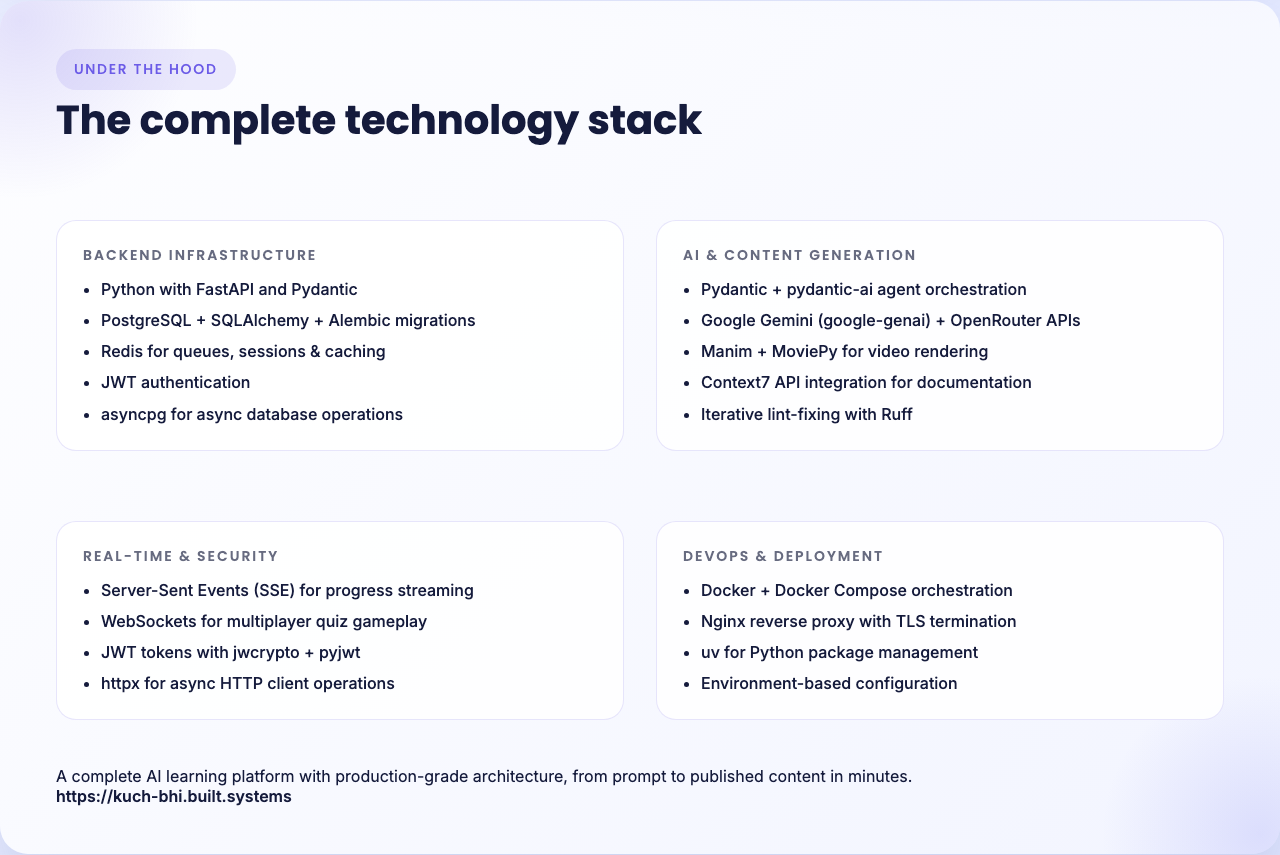
- Backend: FastAPI app with modular services for video generation, flashcards, and quiz. Uvicorn runs the ASGI server.
- Video pipeline: Prompt upgrader (Gemini) → Manim code generator (Gemini 2.5 Pro via pydantic-ai) → Ruff lint/auto-fix → preflight → render with Manim/MoviePy → store and serve under
/videos. - Flashcards: Outline agent + per-subtopic flashcard agents (pydantic-ai). Stores runs and sets in PostgreSQL, streams run status and new sets via SSE.
- Quiz: In-memory manager with REST + WebSocket endpoints; supports topic-AI or math modes, two players max, auto-start when all players are ready.
- Data & auth: SQLAlchemy models + Alembic migrations on PostgreSQL; FastAPI-Users for auth with JWT (jwcrypto/pyjwt). Redis for sessions/caching.
- Ops:
uvfor Python envs, Docker Compose for local Postgres/Redis, Nginx for TLS, SSE and WS proxying. Context7 integration to fetch docs for the codegen agent.
Challenges we ran into
- Making LLM-generated Manim code reliably lint-clean and runnable; added iterative lint/runtime fix loops and fallbacks.
- Containing dependencies per-session for rendering while keeping runs fast and deterministic.
- Designing an outline-first flashcard flow that scales across many subtopics with live progress via SSE.
- Building a simple but robust WebSocket quiz loop with fair scoring, timeouts, and auto-start while handling disconnects.
- Schema evolution and status tracking for long-running jobs across DB tables.
Accomplishments that we're proud of
- A full end-to-end video pipeline that self-corrects (lint/runtime) and produces clean animations from plain prompts.
- Multi-agent flashcard generation with persistent runs, per-subtopic sets, and real-time progress streaming.
- A snappy two-player quiz with both AI-topic and math modes over WebSockets.
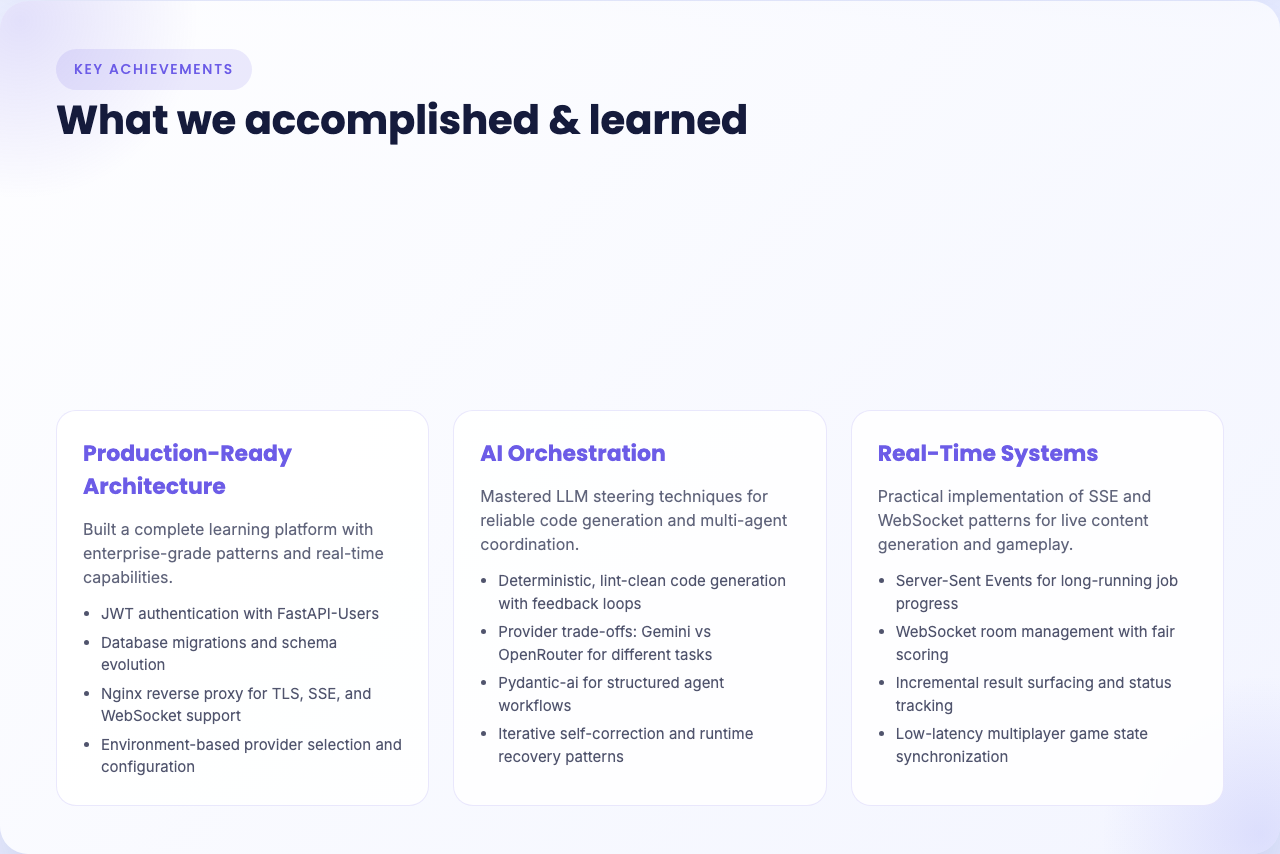
- Production-ready touches: JWT auth, DB migrations, static video serving, Nginx WS/SSE proxying, and environment-based provider selection.
What we learned
- How to steer LLMs for deterministic, lint-clean code generation with feedback loops.
- Practical patterns for SSE and WebSockets on FastAPI behind Nginx.
- Schema design for content generation pipelines and incremental result surfacing.
What's next for Learn-KuchBhi
- Rich frontend for creation, review, and study flows; shareable links and classrooms.
- Editable timelines for videos and flashcard curation; export to Anki/CSV.
- More quiz modes (buzz-in, timed rounds), leaderboards, and persistence.
- Caching, deduplication, and reuse of assets; cost/latency optimizations.
- More providers and guardrails; better observability and retry logic.
Built With
- Python with Pydantic and FastAPI, Uvicorn
- PostgreSQL, Redis, SQLAlchemy, Alembic, asyncpg
- Manim, MoviePy
- pydantic-ai and Google Gemini (google-genai)
- Server-Sent Events (SSE), WebSockets
- Nginx (TLS, reverse proxy for SSE/WS)
- Docker, Docker Compose
uv(Python package manager)- Context7 API integration for latest docs
Built With
- docker
- fastapi
- gemini
- langchain
- nextjs
- postgresql
- pydantic
- python
- redis



Log in or sign up for Devpost to join the conversation.