-
-
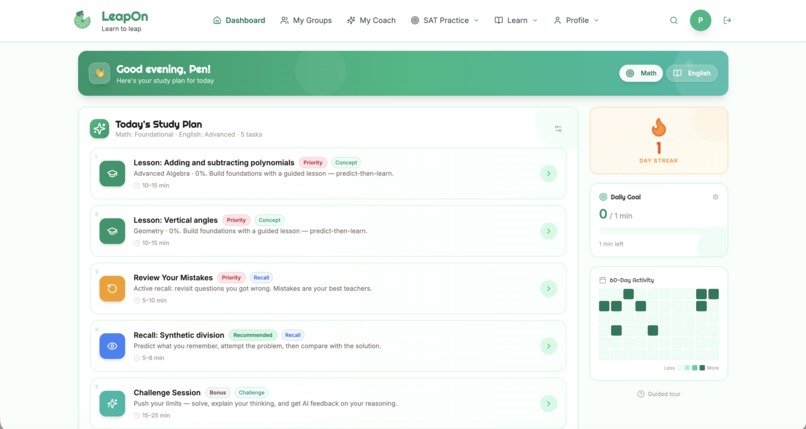
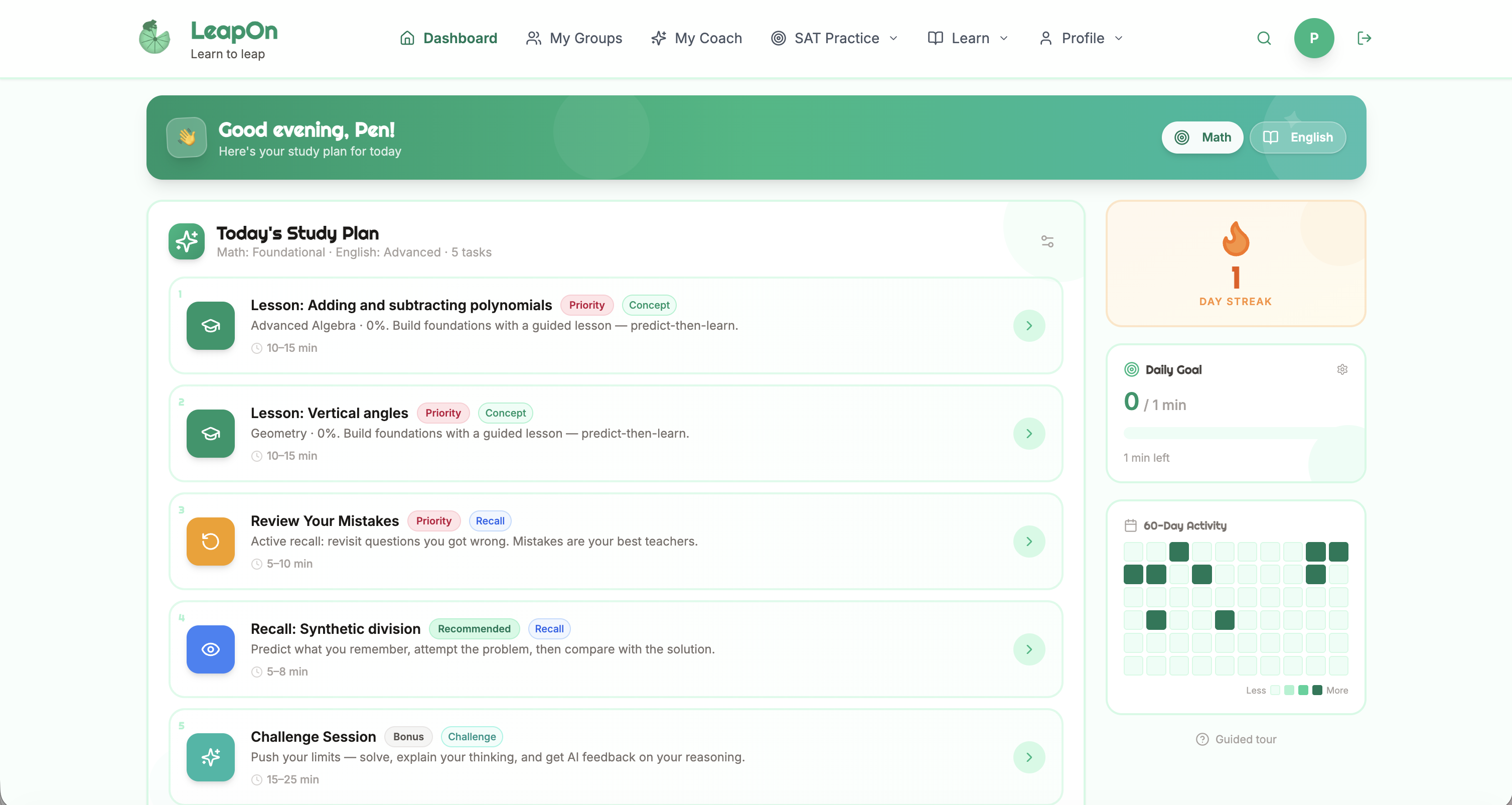
Student Side Dashboard - The agent curates a study plan based on your knowledge graph and diagnostic.
-
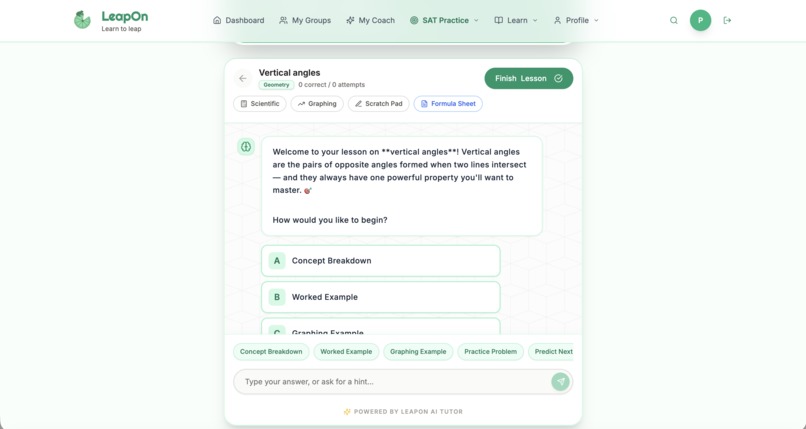
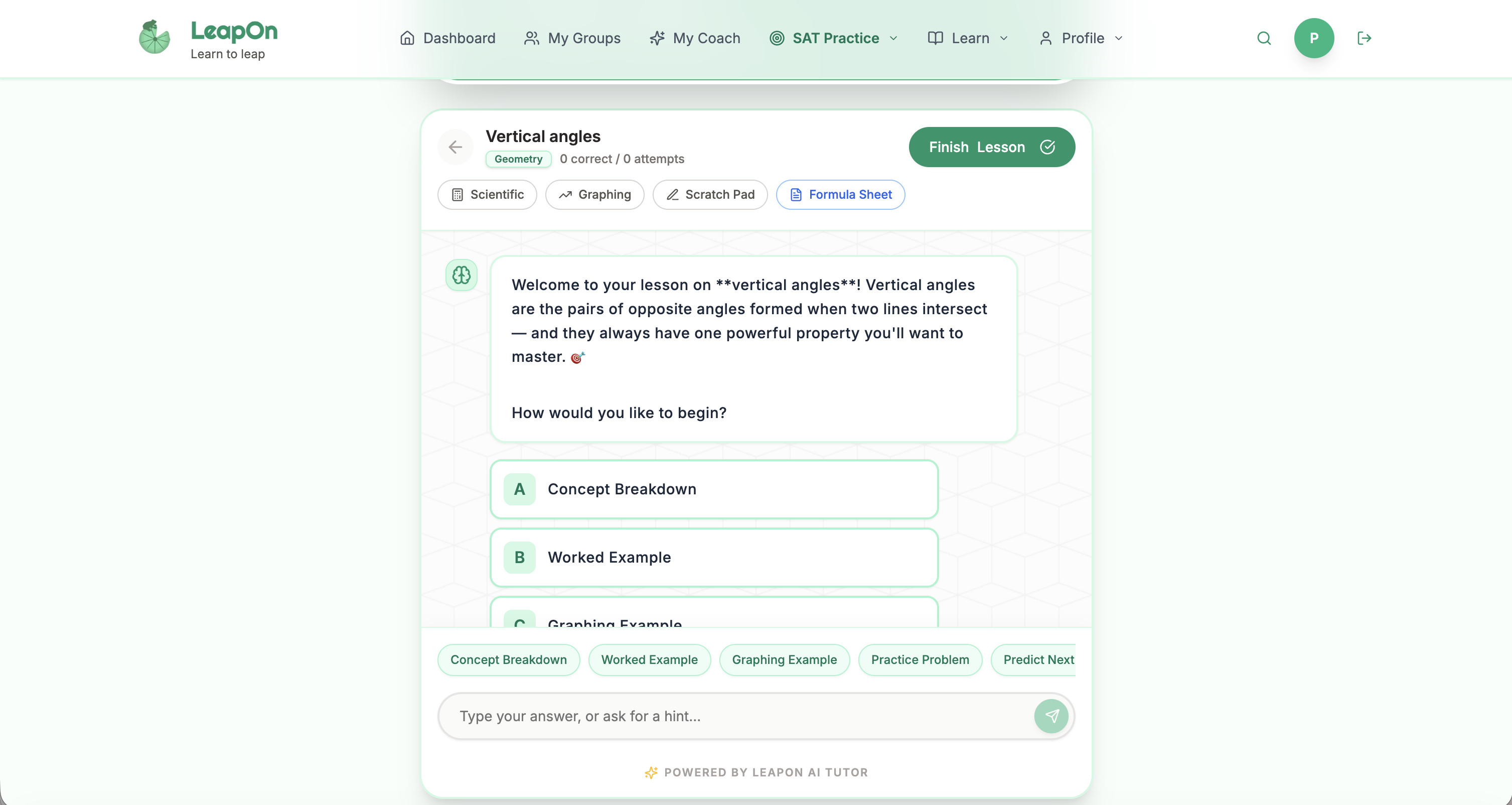
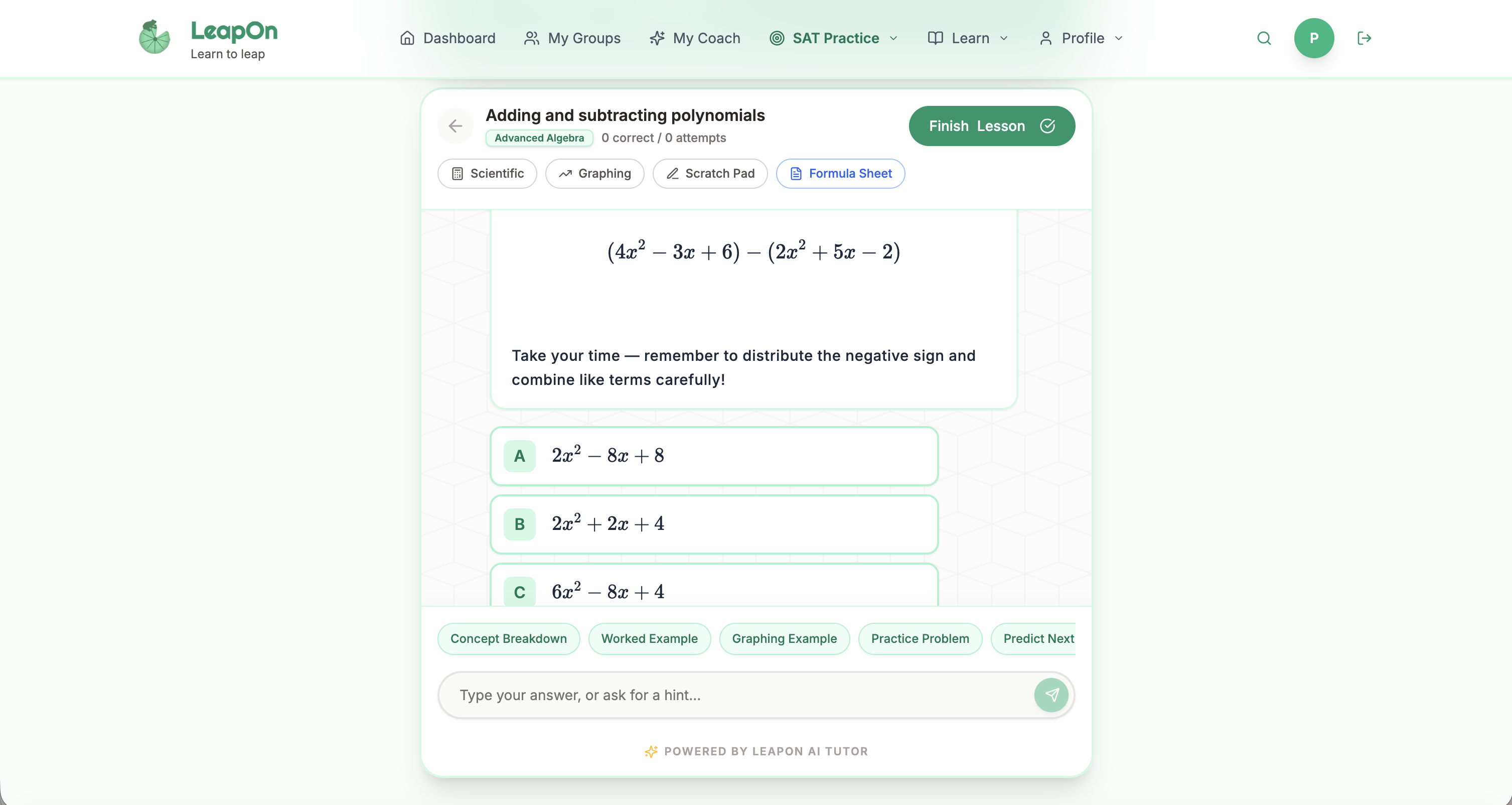
Student Side - AI Tutor Interactive Lesson Using Real Learning Techniques and Strategies
-
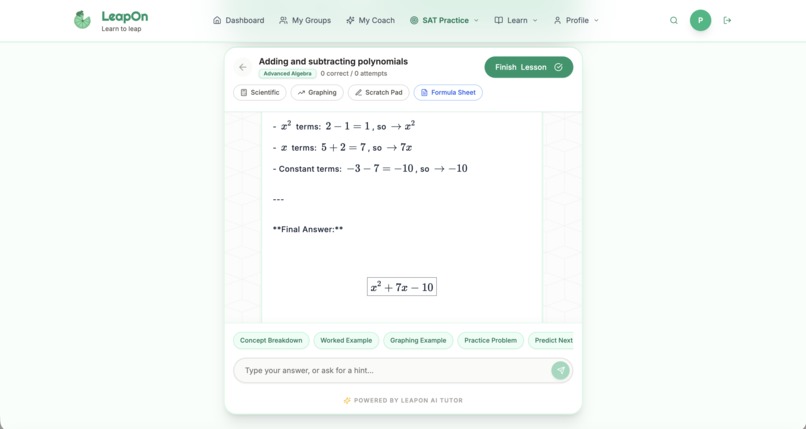
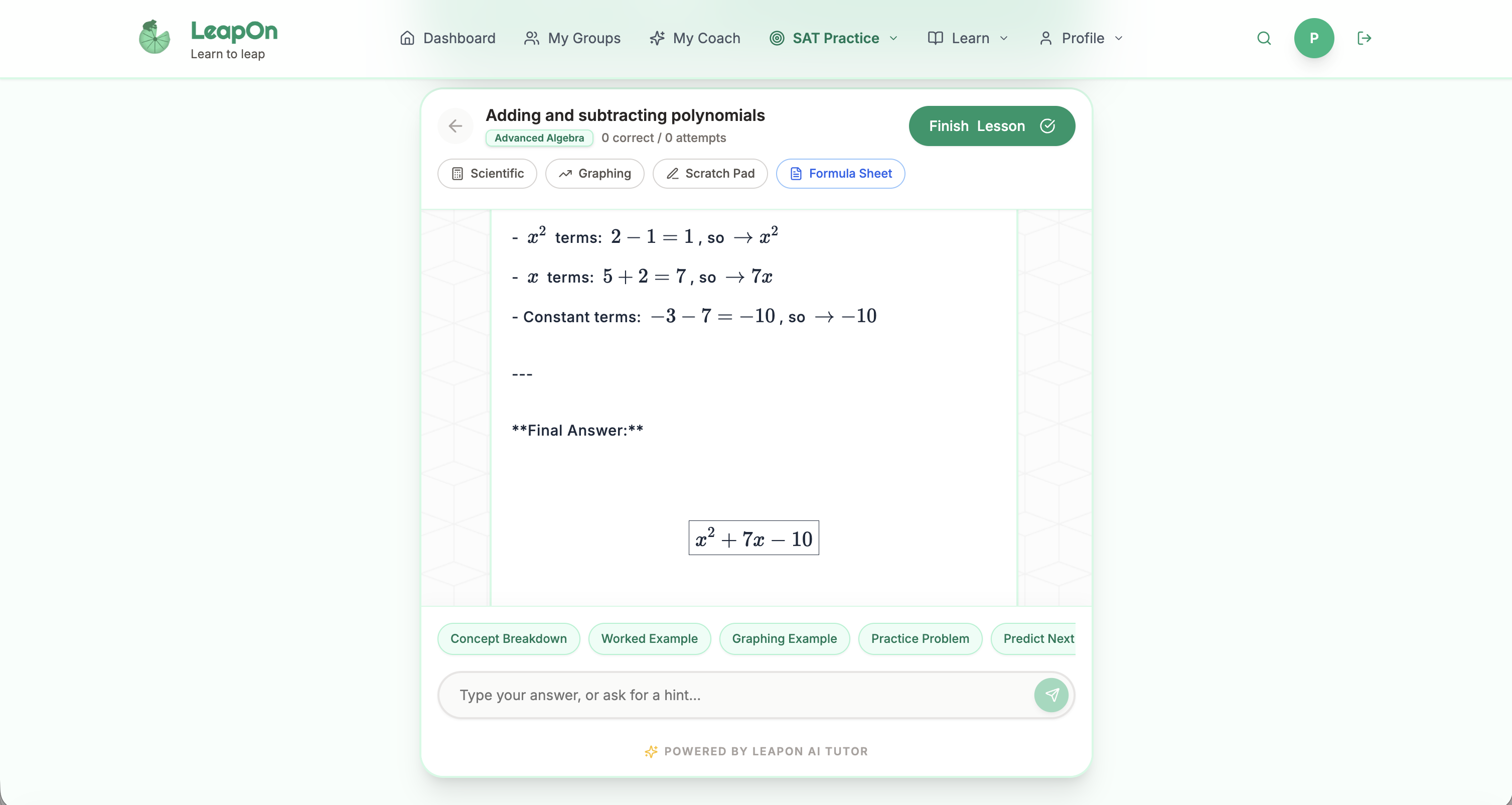
Student Side - AI Tutor Provides a Worked Example
-
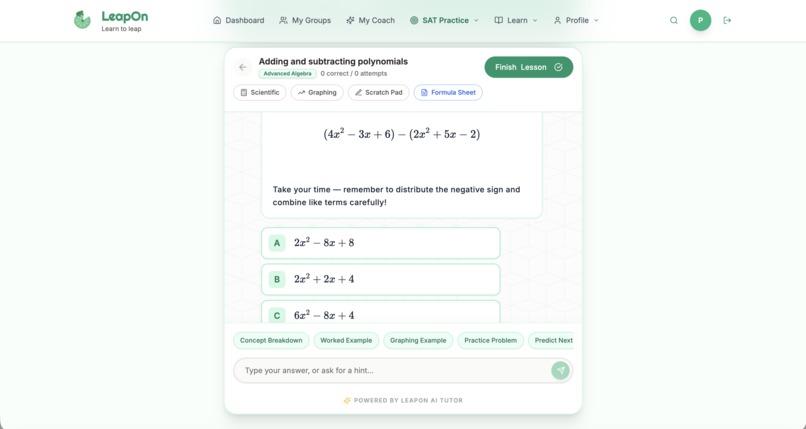
Student Side - AI Tutor Provides a Practice Problem
-
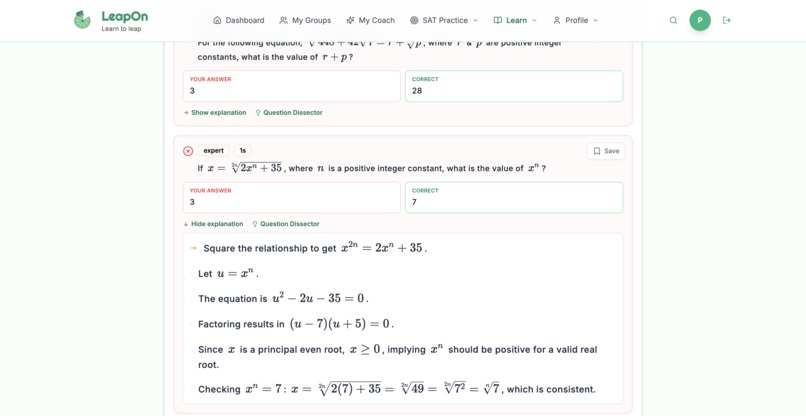
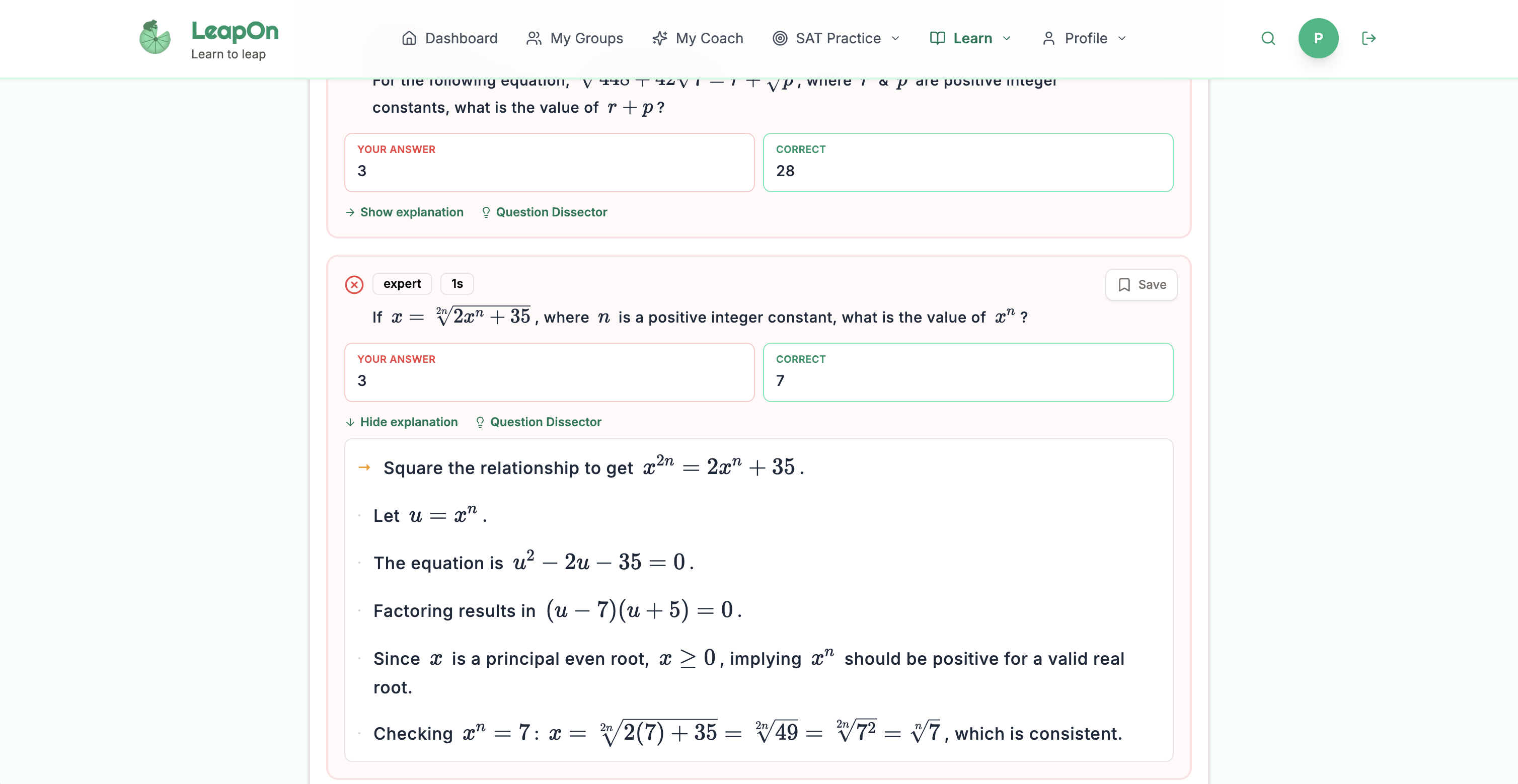
Student Side - AI Tutor Breaks Down Mistakes
-
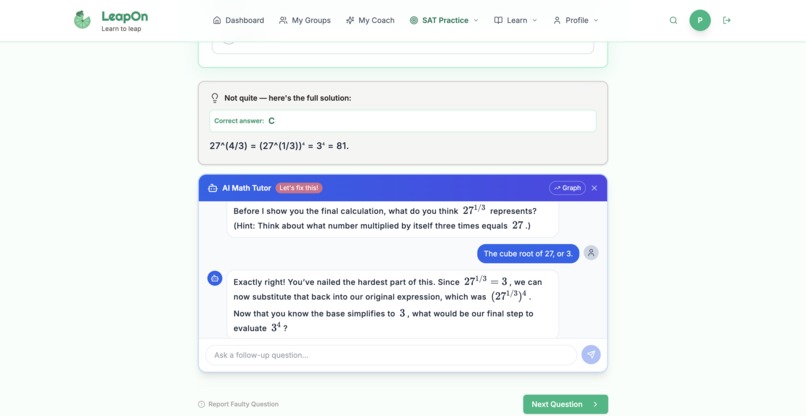
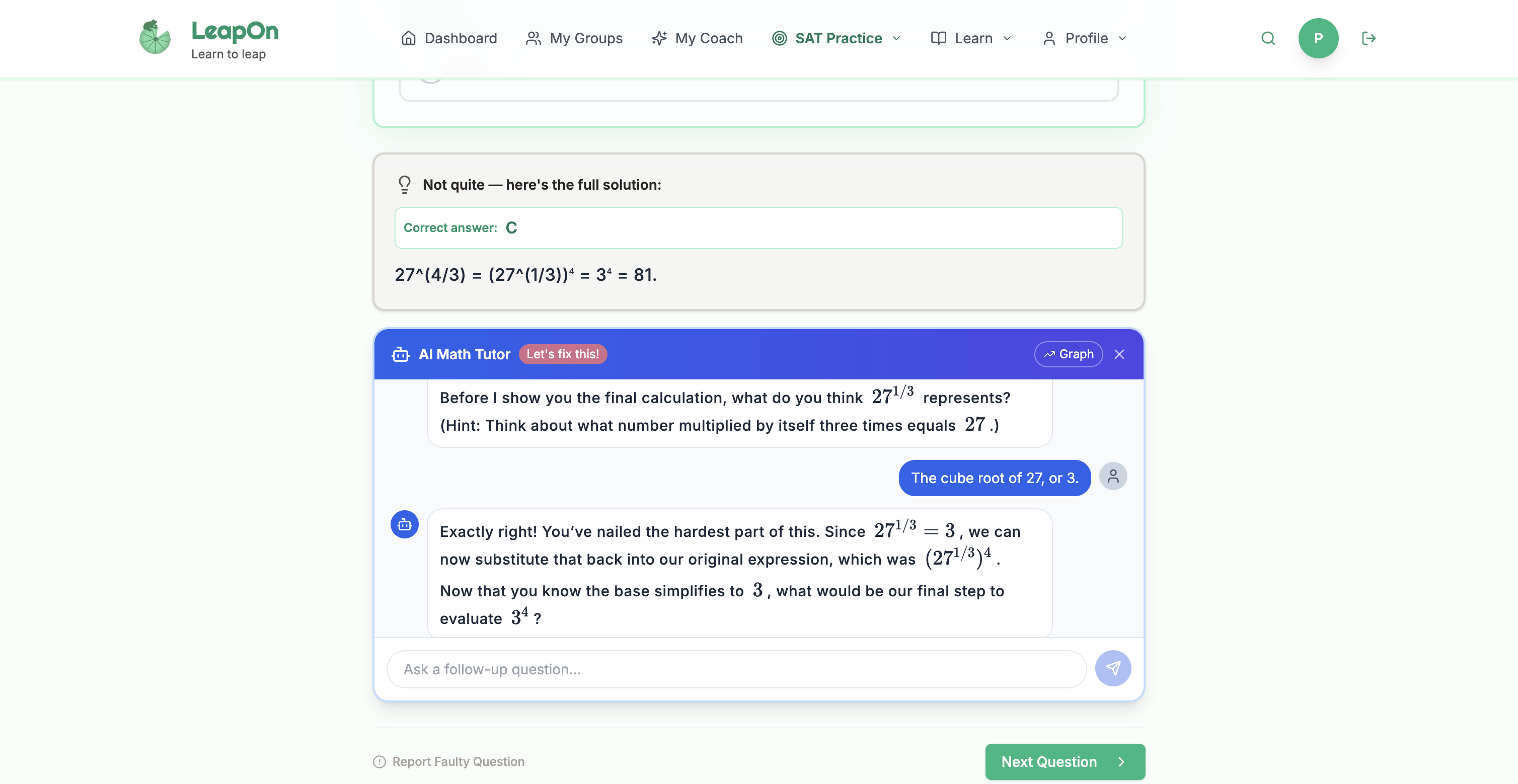
Student Side - AI Tutor Works THROUGH a Problem with a Student Rather Than Simply Solving
-
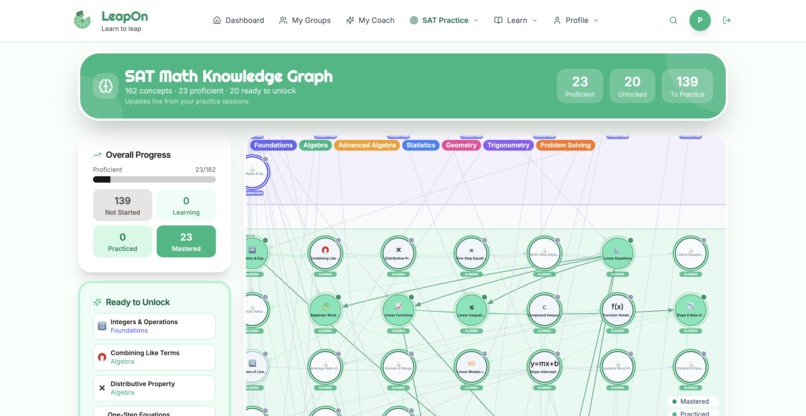
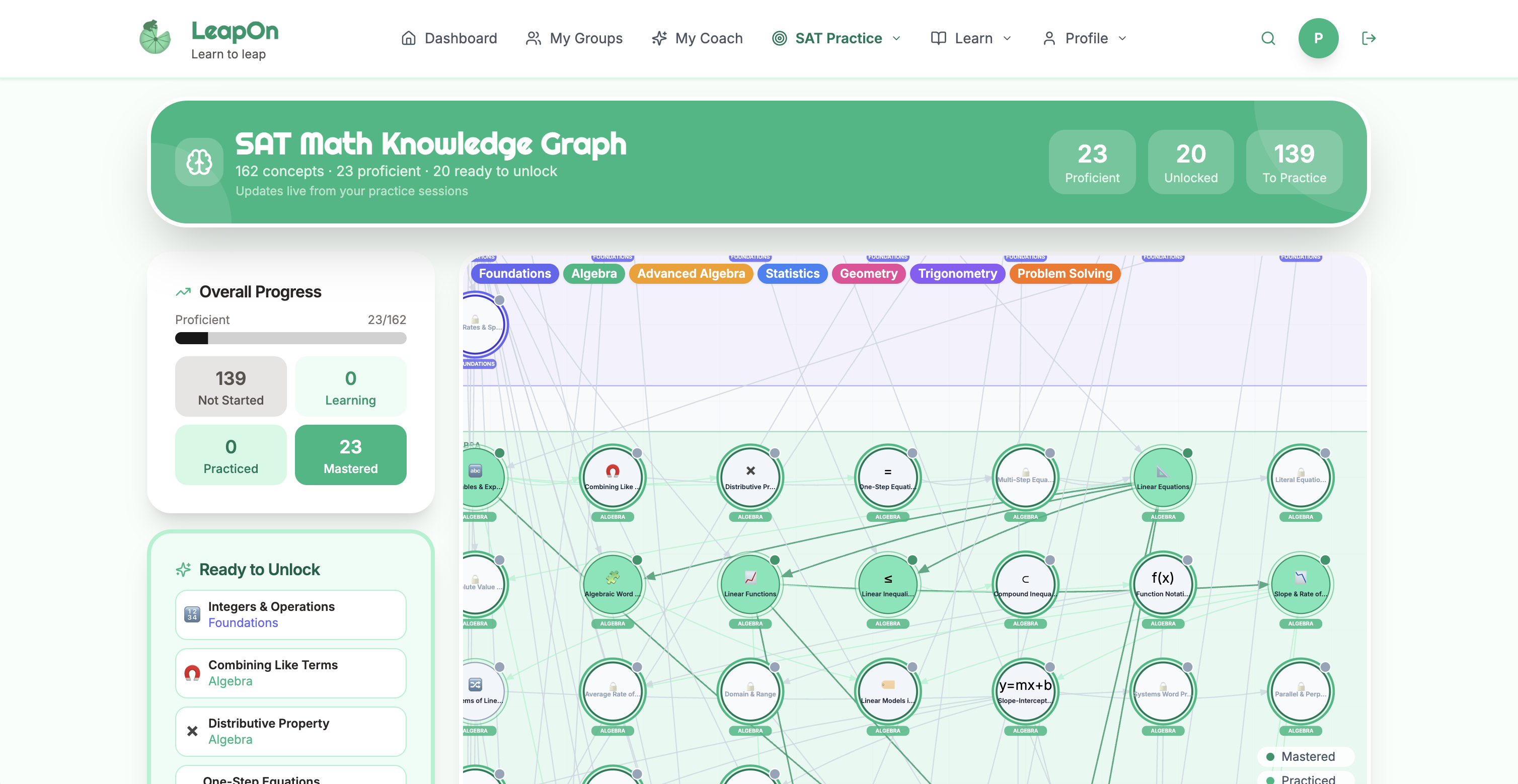
Student Side - The Math Knowledge Graph Used by the AI Agent to Determine Subsequent Lessons + Actions Needed
-
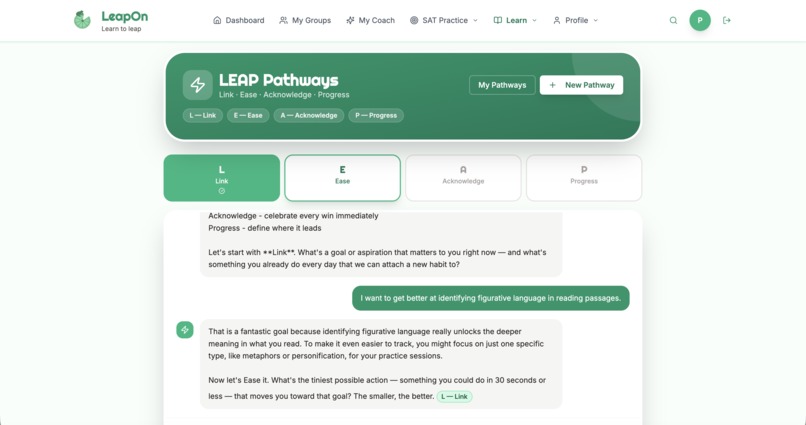
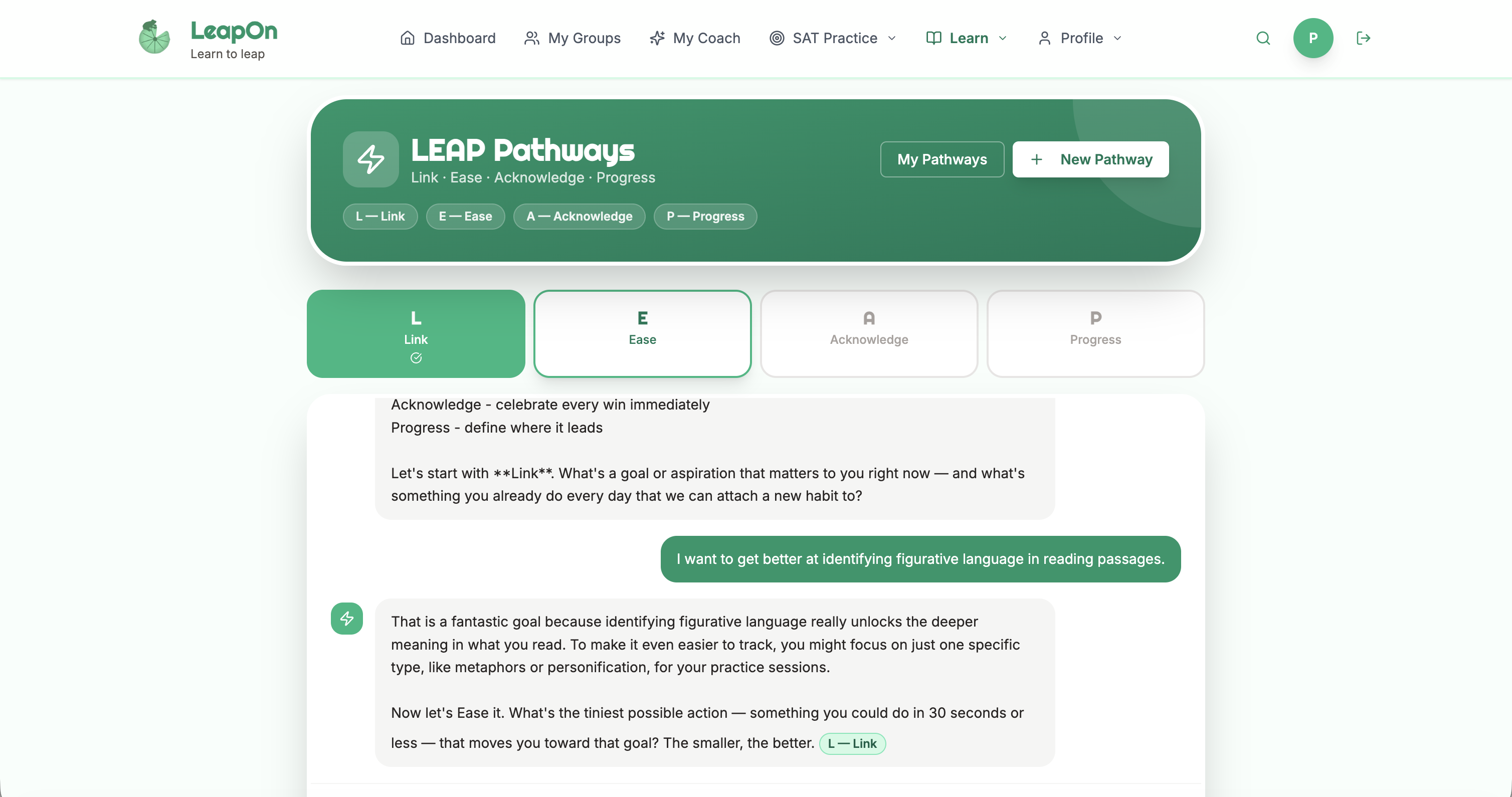
Student Side - The LEAP Pathways Agent Works with Knowledge of the Student's Learner's Profile to Create Study Habits That Stick
-
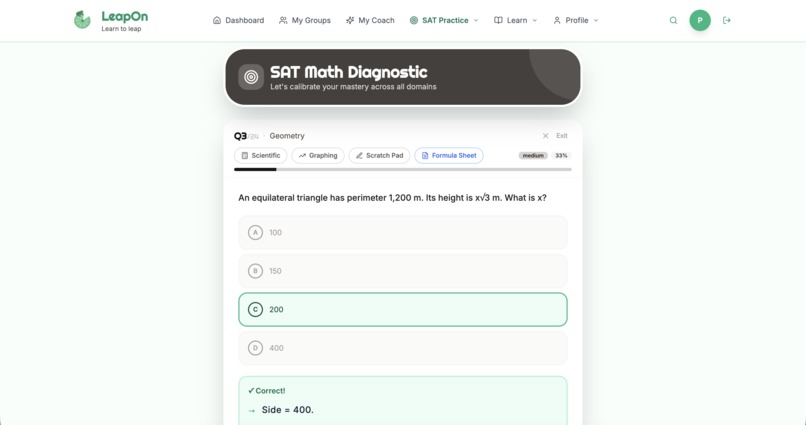
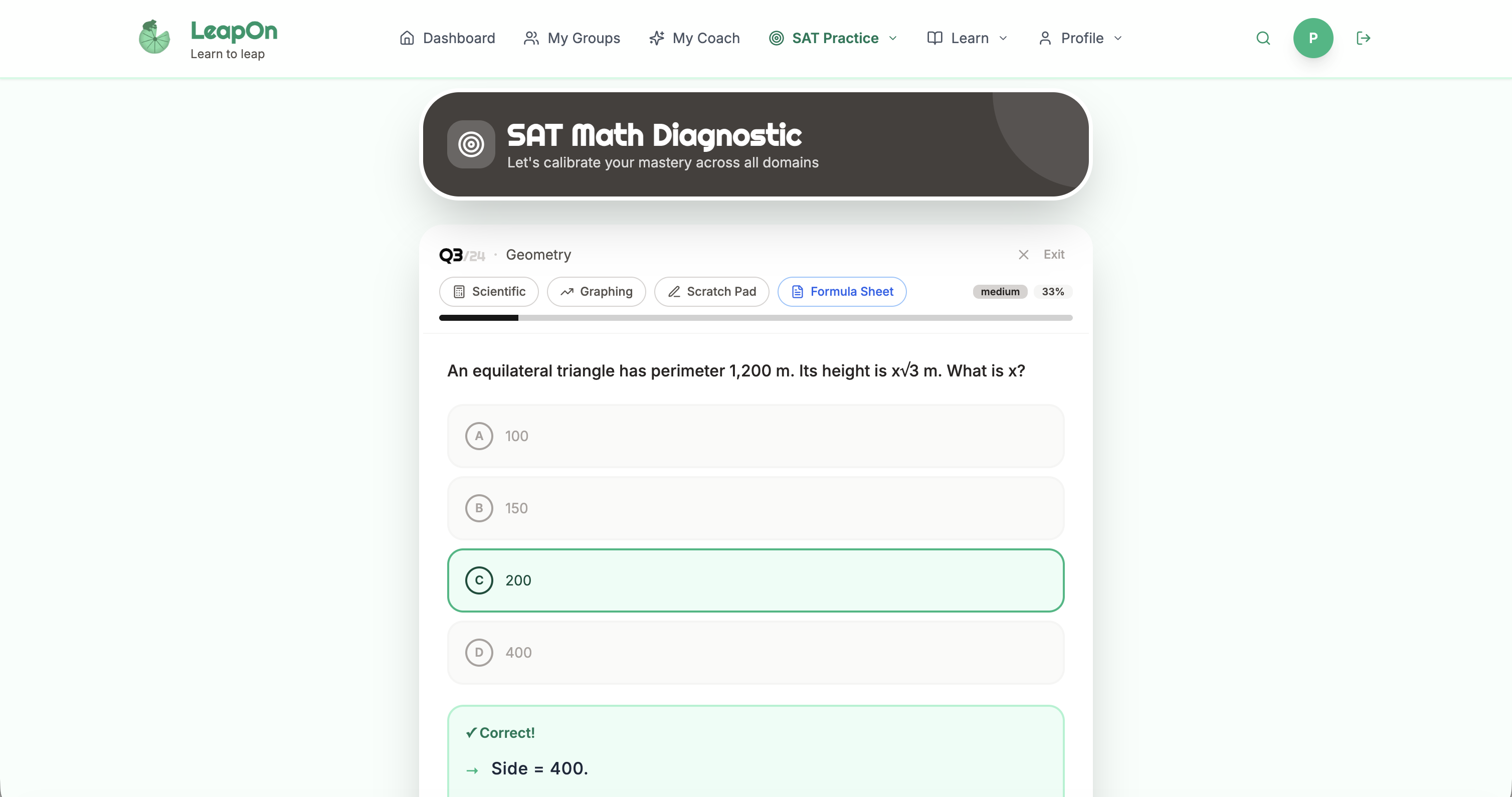
Student Side - Adaptive Math Diagnostic Calibrates Math Skill Mastery Levels
-
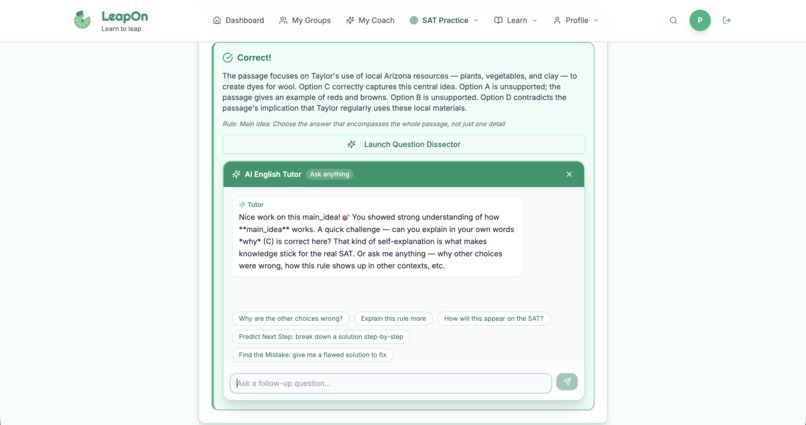
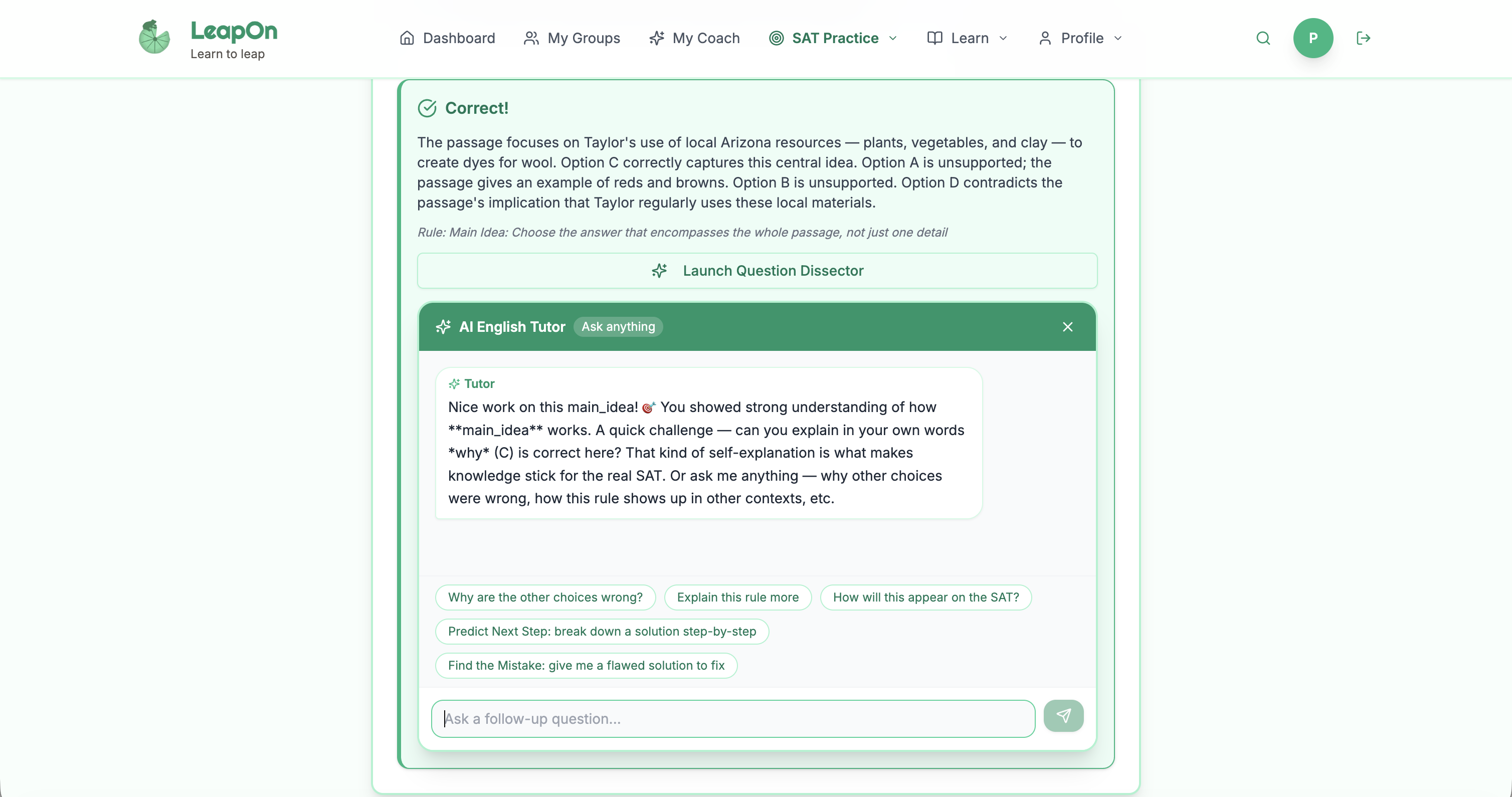
Student Side - AI English Tutor Begins a Discussion
-
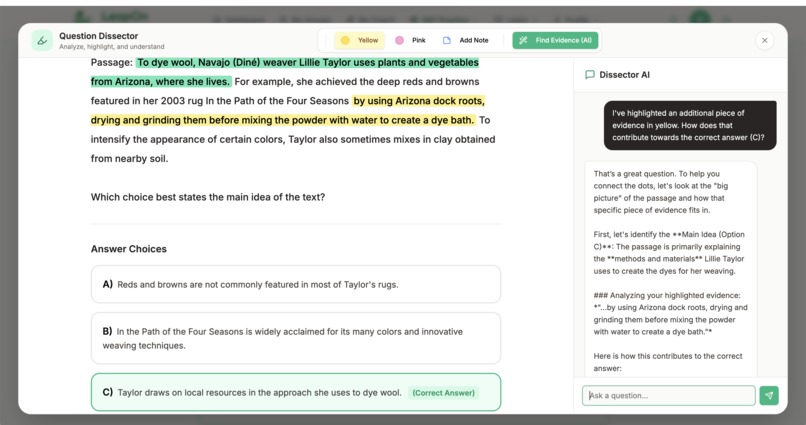
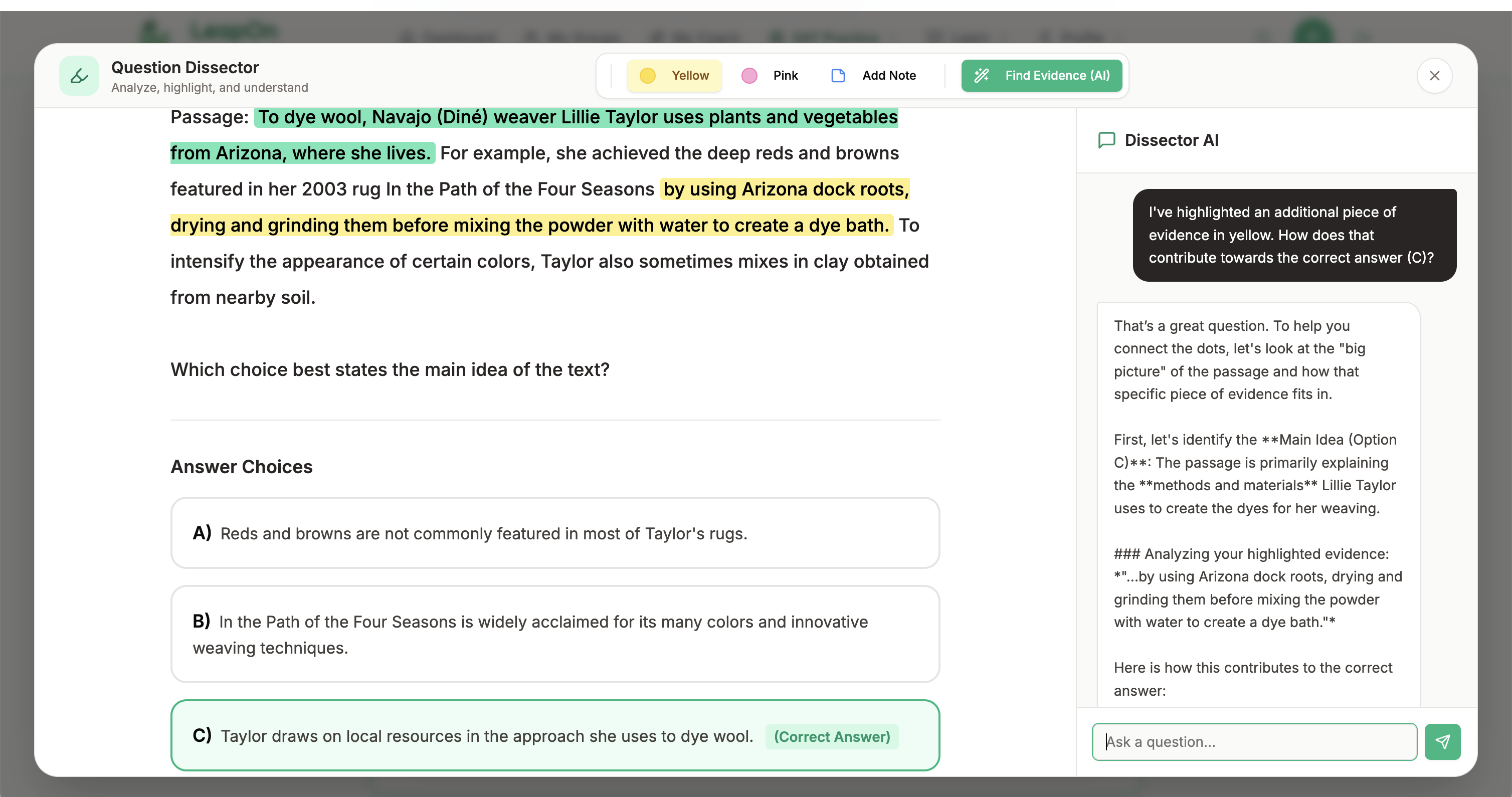
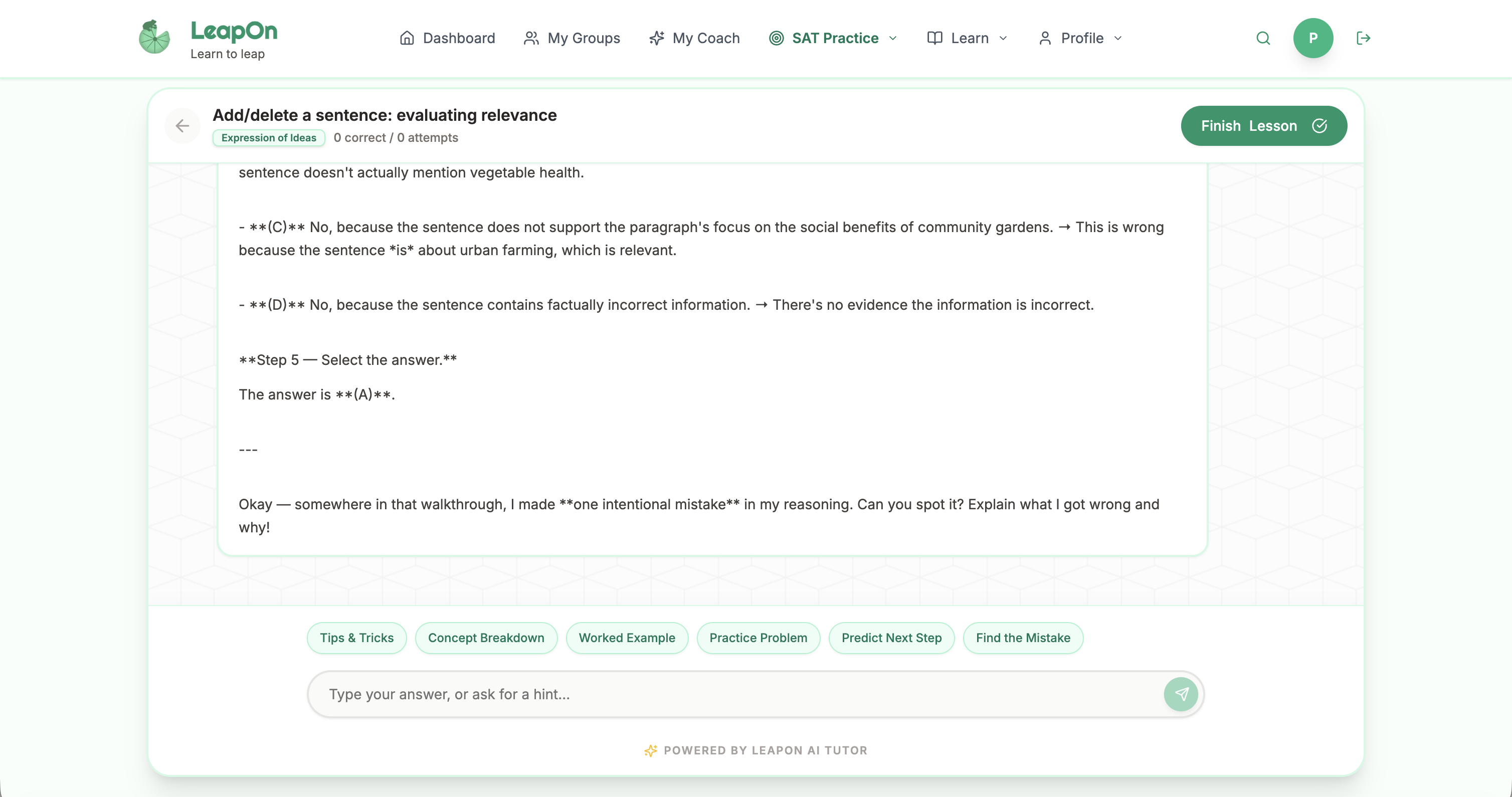
Student Side - Question Dissector Allows Students to Pick Apart Evidence and Analyze with AI
-
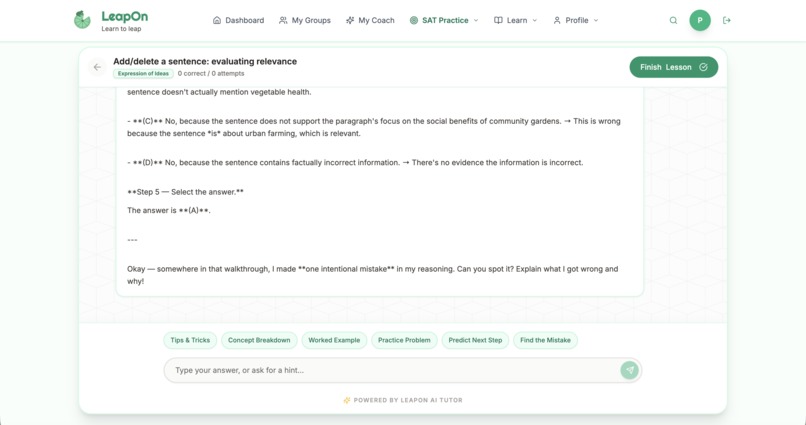
Student Side - AI English Tutor Allows the Student to Pick How They Learn
-
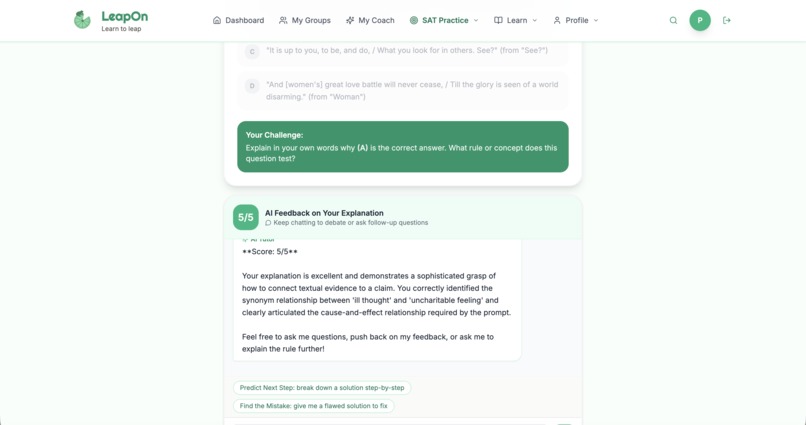
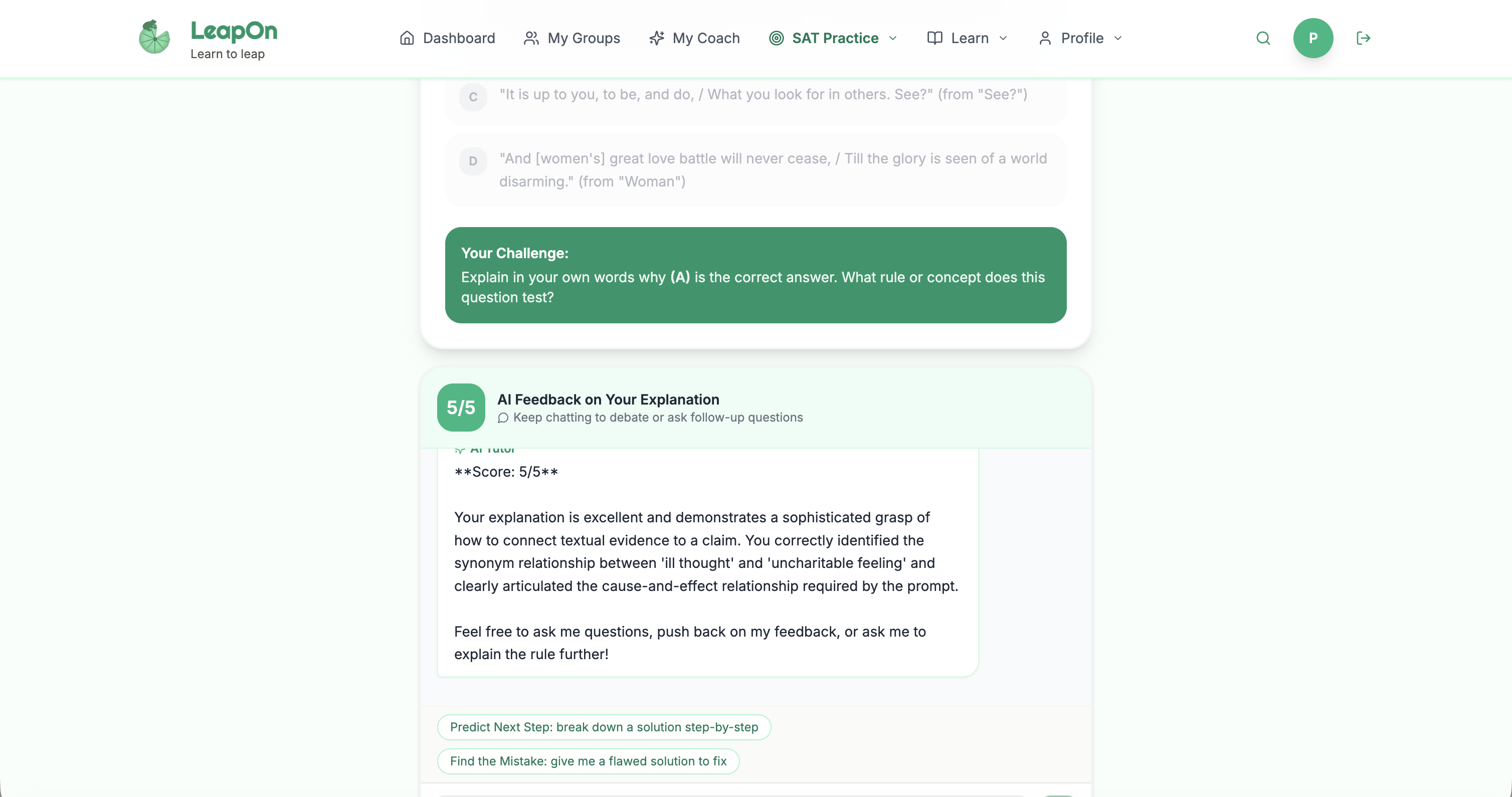
Student Side - AI Tutor Analyzes Explanation
LeapOnSAT
The AI-powered adaptive SAT practice platform for mastery.
Problem Video: https://youtu.be/Zd20QkzVP0o
Currently deployed and ready for use at leaponsat.com
Inspiration/Problem:
As a senior in high school myself, I was inspired to create LeapOn by the utter lack of progress I witnessed when attending tutoring programs, academies, and other online platforms for the SAT myself, causing me to compare experiences with my classmates, peers, and friends before sitting down to think about the specific issues I encountered within the common system. The stagnation, disengagement, and ultimate disinterest in improving scores, studying specific SAT techniques, and recognizing patterns rather than memorizing shallow tactics stemmed, in my observations, from the following core issues:
- Most tutoring places and centers don't have the technology to meet you where you're at cognitively - Although steps have been made in recent years to have students take diagnostic tests upon registering with academies or preparation centers, most models fail to account for all that is belied by the outward performance on a simple test, including the cognitive load, knowledge gaps, executive functioning (or life skill) deficiencies, learning styles, mindset differences, and communication styles, resulting in unproductive lessons and meeting with tutors where students feel as though their parents are simply paying for them to solve problems with another person on the call.
- Although tutors, teachers, and instructors often have the best intentions, they don't have the resources and training to properly communicate with students and adapt to each specific pupil's needs - In order to completely and wholly immerse a student in a precision learning system, one that adapts to their every move and node on the knowledge graph, extensive performance tracking is needed, not just using accuracy scores derived from percentages, but using feedback forms and textual explanations to better understand how the student felt while solving a given problem, how they were able to solve it, and whether or not they are truly ready to move on to the next concept. The traditional spreadsheet, gradebook, or designated binder isn't equipped to handle the data, let alone its analyses, leaving teachers without methods to cater to their students' full potential.
- The learning stops when the call ends or the doors shut - Barring minimal homework assignments, which are, in my experience, often left uncompleted as other responsibilities, both academically and within one's personal life, pile up, learning and improvement largely stops once the tutoring session has ended.
These issues don't disappear for independent learners and autodidacts, especially when high school schedules of the modern ages are already subject to contortion at the hands of extracurricular activities, part-time jobs, and, in many lower-income and underprivileged communities, familial duties that may include childcare and housework. In speaking with several people who elected to study by their selves, utilizing online resources as well as books recommended to them through channels such as Reddit and Instagram, I was able to identify the following issues that seemed to beleaguer even the highest performers:
- Even when you take a Bluebook practice test or other lengthy exam, you don't know where to start - Although the internet has been incontrovertibly beneficial in terms of enhancing accessibility to resources otherwise left exclusive to certain groups, many students complete a practice test, look at their vague score bands, and then wonder what's to come. Logging on to platforms like Khan Academy, which present the same courses, quizzes, videos, and articles for every user, students are met with blank slates that presume Unit 1 is the starting stone for everyone, often forcing some students to repeat material while neglecting to present remedial materials to those who may need them.
Solution and Features:
LeapOn provides a three-part solution that caters to the needs, profiles, and mindsets of students, teachers, and parents, facilitating progress, communication, and performance tracking through a system that uses AI as a tool to enhance connection rather than hinder it. As for the independent learner, the AI agent integrations within the LeapOn platform adapt specially to the specific cues picked up on in the Learner's Profile diagnostic, which identifies where student's brains are still developing and how this may affect their practice consistencies, time management skills, and goal-setting abilities, allowing users to make plans, ask questions, and receive lessons in constructive ways.
Dynamic knowledge graphs, first set upon completion of Math and English diagnostics and subsequently updated with all practice sessions, lessons, and assignments completed, ensure that students aren't stultified by the paces of traditional SAT Prep curriculums when they're seeking specific concepts, refreshers from previous courses, or practice lessons from different domains.
LeapOn SAT goes beyond a simple API Call, providing the agents with real data and information directly from the user's own profile that makes a difference in all future responses. In addition, all prompts were designed in collaboration with a real educator, ensuring that messages from AI Tutors and Coaches utilize Mentor Mindset frameworks from Dr. David Yeager's 10 to 25: The Science of Motivating Young People while simultaneously cultivating problem solving skills.
Comprehensive List of Features:
All features can be seen in the image gallery, demonstration video, and live platform (accessible at PHOTOS.md on the Github page, YouTube, and leaponsat.com respectively)
- Adaptive Diagnostics - Adaptive diagnostics are the first things taken when a user registers with LeapOn SAT, beginning the continuous process of calibration for an accurate knowledge graph and profile.
- Knowledge Graphs - The nodes of the knowledge graph represent the interconnected concepts of SAT Math and SAT English, so students don't have to take lessons for the nodes they've already demonstrated mastery in. The way in which a student's knowledge graph is filled, which in and of itself shifts as they practice and answer questions, influences the items recommended to the student by the AI Study Plan.
- Study Plans - When a student enters the platform, whether it's for a focused study session or a quick 5-minute review of less concrete concepts, the struggle of navigation is eliminated by the AI-powered, knowledge graph informed AI Study Plan system that automatically recommends activities of specific complexity levels to users depending on previous performance and necessary remedial actions.
- Deeper Practice - Challenge Mode problem sets, classical literature passages, and explanation-based discussions encourage students to understand where the patterns lie, how they can be identified, and how to organize their creative thoughts in systematic ways for easier articulation. Features such as the "Reverse Mode," which sees a student writing a defense, with their own evidence and reasoning, for an answer already marked as correct, were designed with the Feynman technique in mind to create practical, critical cognitive skills that last long after the SAT.
- AI Tutors - Instructive conversation is never far away on the LeapOn SAT app, for the AI Tutor can be accessed from lessons, practice sessions, mistake reviews, and more as a portable educator who seeks understanding from the student rather than a perfectly correct answer.
- Interactive Lessons - Our AI-powered interactive lessons begin with concept explanations and proceed as the students continue to understand the facets of the concepts themselves, giving users choices between guided examples, next-step prediction, mistake identification, further discussion, practice problems, and more for an engaging experience.
- Deep Mistake Review
- Question Dissector - For evidence-based analysis and discussion of reading passages, question texts, and other English excerpts.
- Extras - From vocabulary drill games to question generators that use excerpts of students' own pieces of writing, LeapOn SAT is always finding new ways to help students recognize patterns and strategies, creating an environment where everyone can practice, learn, and grow in a way appealing to them.
- 3 Portal System - For tutors, the Classes feature is integral for student organization, as it allows a tutor to connect their account to a student's for the purpose of being able to see progress, monitor skill mastery, and assign specific problem sets, lessons, and activities. The student is, in turn, able to communicate directly through the platform with the teacher, eliminating the struggle of scheduling messages buried in email inboxes by providing a dedicated space used for little else. Tutors can also manage classes with multiple pupils through the class messages and the announcements features, both of which are optimized for coordination and dissemination of class slideshows and notes. Parents, on the other hand, are able to set up Families, or groups that connect the student accounts to the parent accounts, allowing them to set goals for their children, monitor performance, and understand where their children lie cognitively.
Where We Differ:
- Average Chatbots vs. LeapOn SAT: Memory and context issues found within most major, mainstream LLMs (including but not limited to ChatGPT, Claude, Gemini, and more) prevent true performance tracking from being executed to its fullest potential, meaning students relying solely upon chatbots found in the regular websites to study and learn may find themselves repeating materials or being served quizzes with difficulties incommensurate with their knowledge levels. In addition, unless prompted in specific, often abstruse ways, LLMs do not tend to utilize teaching and tutoring techniques found effective, such as active prediction, active recall, and mistake explanation, substituting in-depth discussion with surface-level explanations without checking to see whether users truly understand concepts.
- Self-Study Online Platforms (eg. Khan Academy) vs. LeapOn SAT: Where online platforms such as Khan Academy simply deposit information for the course at your feet, expecting you to know where to begin or how to start, LeapOn calibrates itself especially not just for your caliber, but for the making of your mind itself, allowing you to grow from your current skill level consistently. In addition, the integration of AI within LeapOn runs deep, spanning everywhere from constructive, impromptu sessions following mistakes on questions to lessons and recommended study plans, meaning that the environment is wholly adaptable to the student.
- Preparation Academies and Franchises vs. LeapOn SAT: The LeapOn AI Tutor is always available for help whenever a student is struggling on a difficult Math or English problem, so routines don't have to be adjusted to fit specific opening hours, tutor availability slots, or commute struggles. The storage of data for each agent to readily access when needed also means that the AI Tutor is completely focused on the student at hand, surpassing the limits of human memory via performance tracking, readily displayed insights, and internal metrics that aren't traditionally kept or maintained at in-person, brick and mortar preparation institutions. Students who struggle with finances, or who simply may not be willing to spend money on programs with dubious benefits, aren't often welcome at business-oriented prep centers beyond trial lessons, but at LeapOn SAT, they're provided with the whole suite of materials, resources, and features, ready and waiting to be used and shaped. The same goes for students with executive functioning needs, be they attention or time-management related, as those who find themselves restless, unable to focus, or disengaged during sit-down, one hour sessions at preparation centers are able to learn in concentrated, focused spurts using LeapOn's bite-sized lessons and intuitive pacing.
- Private Tutoring vs. LeapOn SAT: The traditional model of private tutoring, while beneficial to the human connection, is limited in that it exists independently of organized performance tracking and online systems, meaning tutors must keep track of all things pertaining to their students by themselves. The burnout created often occludes tutors from fully customizing their programs to individual students' needs, forcing them instead to provide generic resources and practice sets to every student so no student is given services of better quality. Private tutors care and want their students to succeed, but they're not given the mentorship techniques, platforms, or resources to work at the efficiency level required to accelerate student learning and mastery.
- Private Tutoring WITH LeapOn SAT: The Teacher-Parent-Student portal system embedded into LeapOn SAT's core structures is designed to enhance the productivity and efficacy of private tutoring, which is often beneficial for the human connection it fosters and the mentor-relationships built between tutors and their students. We firmly believe that AI Agents cannot and should not supplant these integral connections, with their places instead being in the realm of bolstering human communication and human abilities, allowing us to grow as individuals inside and outside of academics. We are already in frequent, regular collaboration with a math tutor, who, in addition to providing us with several specialized problem sets and workbooks for the SAT Math digital test, helped us mold the platform with what educators needed in mind, and we seek to reach out to more private, independent tutors.
Creation/Development Process:
We used an emerging agentic coding and software development platform known as Base44 to manage the bulk-creation of our files, the integration of APIs and SDKs where necessary, and the handling of data, ensuring that security rules were adequately met while allowing us the flexibility to experiment with new features and pages when needed. That being said, a fair amount of code was handled independently of the agent, as there were certain features, such as the SAT Wordle component, that were initially created as separate tools, made either for fun or for personal use.
Step 1: Basic Feature Outlines
From the beginning of this journey, we knew that we wanted LeapOn SAT to function not simply as another independent preparation platform, but as something that can be used no matter where you are in relation to the SAT Preparation industry that currently involves parents, tutors, schoolteachers, and students with no centralized way to streamline communication or easily share progress. It was this concept that propelled us through the first outline, which was essentially an in-depth report detailing how each branch was to interact with the other branches, which pages were to go where, and which options were to be set as defaults.
Step 2: Base Resource Ingestion
After deciding where we wanted our pages to be placed, what the brand's identity was supposed to be, and how the three portals would interact with each other to mirror and build upon the systems and intricacies of real-life interactions, we proceeded to find books upon books of resources for Math and English problems, some of which were provided to us exclusively by partners. It was here that we used the LLM PDF ingestion process that will be expounded upon in the Challenges and Lessons Learned section to insert large amounts of questions into the database without compromising time, efficiency, quality of tags, organization, or categorization in the process.
Step 3: MVP Deployment
We deployed and tested our MVP, featuring the more inchoate versions of each of the three portals, to the families managed and taught by one specific math tutor, giving us a real, albeit isolated, testing ground to see where exactly the system came apart.
Step 4: Continuous Iterations
The deployment of the MVP allowed us to send the project to a different stratosphere, one of actual practicality, influenced by the needs and desires of real people who didn't have time to dedicate to mastering use of a platform still in beta. This is where more of the manual coding was done, as individual, smaller features and hyper-specific style specializations were first done by hand before being automated into skills to prevent further, more unnecessary labor from being needed.
Challenges and Lessons Learned:
While creating the platform and endowing it with the educational resources needed to provide adaptive questions and tests to students preparing for the mathematical section of the SAT, we found ourselves in need of a quick, relatively accurate way to ingest large amounts of questions into a database without compromising on the explanations, answer choices, or question text. The strategy, at first, seemed relatively obvious: utilize a capable LLM or agent to analyze and scan PDFs, write explanations, and properly format expressions, but the reality quickly proved far more labyrinthine that we had initially assumed.
When trying to ship our MVP, we found ourselves overloading the platform with choices, believing that we were offering the users everything they could have possibly needed to succeed, but when users not connected to the project began to use the site, we began receiving fusillades of questions pertaining to navigation and operation. Although the user interface seemed intuitive to our own eyes, given that we had clearly labelled all of the buttons and pages, students and parents found themselves overwhelmed by the sheer number of options and buttons displayed on one page, creating a cognitive overload that shut the learning experience down before it could begin. After fielding walk-through calls, webinar demonstrations, and creating several short screen-recordings that had to be redone each time a new feature was added, we overhauled the user interface, transforming the initially eclectic practice pages into sleek Math and English hubs with four large buttons each while simultaneously implementing the AI-powered study paths in the dashboard to direct users to the wisest courses of practice and action.
Future Aspirations:
What We've Done for Underserved Communities and Our Plans:
As LeapOn is currently completely free, with the entire platform, its resources, its AI integrations, and its lessons being available to users without free trials or subscriptions of any kind, we have already taken preliminary steps to prevent underserved communities from facing difficulties when attempting to access our platform. In addition, as LeapOn contains resources not only for SAT Math and English, but for life skills, executive functioning skills, and independent study ventures as well, we have already started to pave an avenue full of enrichment for those who would not have had the resources to seek it otherwise.
Broader Plans:
As LeapOn SAT is currently up and running for users of all ages and grade levels, we first seek to continue slowly adapting the platform based on student feedback and performance of current students on the upcoming SAT tests. As we refine agentic workflows, add gamification features, populate our databases with more questions, and generally enhance the quality of existing content, we will begin to expand into PSAT and pre-SAT skill-building courses and features aimed towards younger high schoolers and middle schoolers. While this will benefit all users, including those in communities where private tutors, SAT Prep academies, and other such pricy programs are readily paid for, we believe that underserved and marginalized communities will benefit especially from the closing of the knowledge gaps at earlier ages.
LeapOn SAT's three-portal system, comprising portals for students, parents, and teachers that can all be linked to streamline communication and share progress in respectful, constructive ways, is something we will continue to emphasize and build upon as we onboard families and student groups, with the eventual goal being to roll use of the LeapOn SAT platform out to schools in communities across the state and, eventually, the nation.
Built With
- agentic-coding
- api
- base44
- css
- javascript
- react
- sdk
- tailwind


Log in or sign up for Devpost to join the conversation.