Inspiration
7.58% of children have a developmental language disorder (DLD). That is about two children in every Kita group of 26. At the same time, 22% of Kita children in Germany mainly speak another language at home, and in Bavaria about 24,000 children were sent to German classes in 2025 by a test that measures German, not language disorders.
Kita teachers can't tell "needs more German" from "needs a doctor". So children with another home language are referred too often or too late, and families get letters they can't read. We wanted a screening that is fair to every child, whatever language they grow up with.
What it does
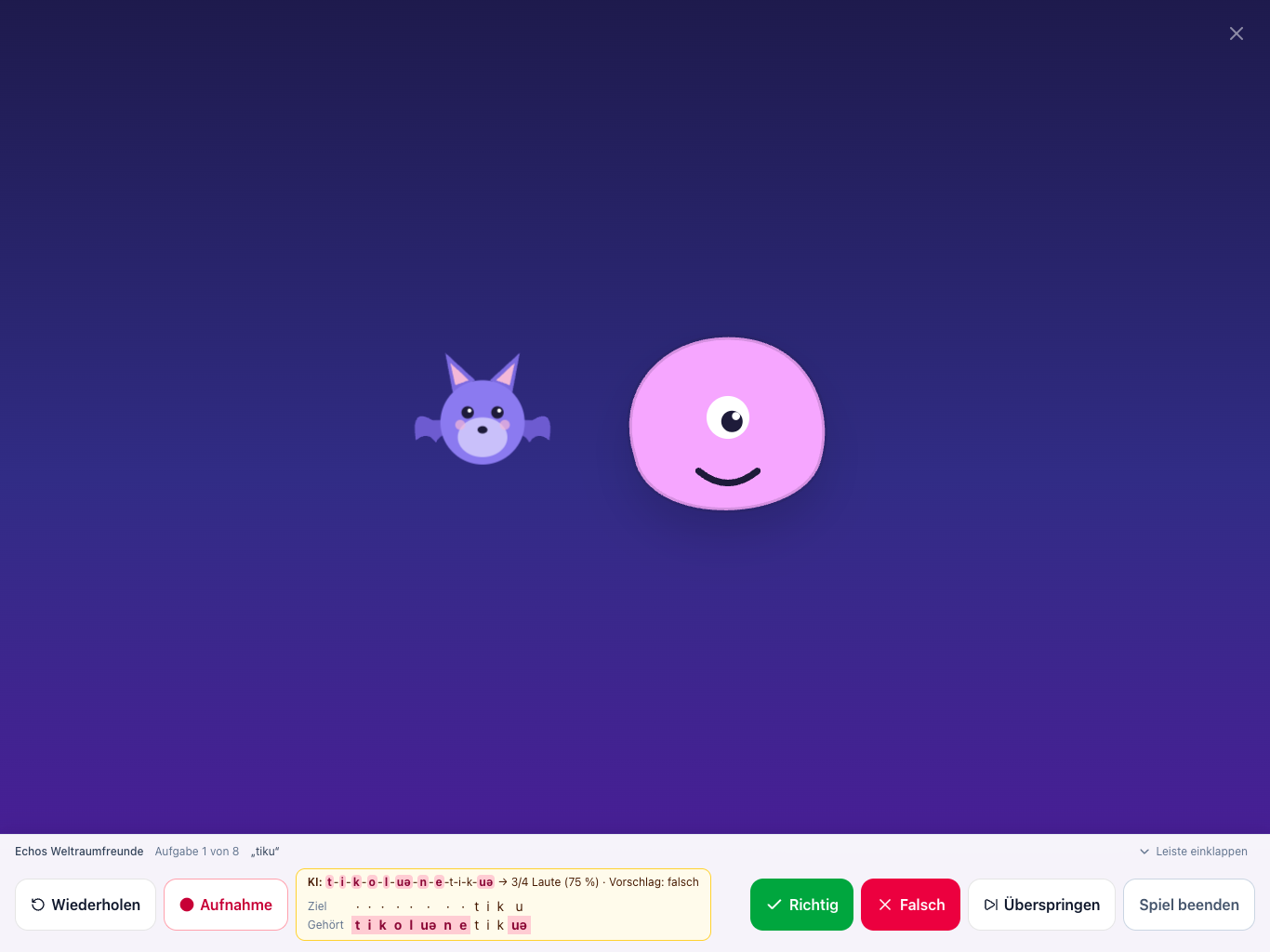
Echo is a tablet web app for Kita teachers. In about ten minutes it screens every child aged 3;6 to 5;11.
- Screening: the child plays three short games with Echo the bat: nonword repetition (made-up words, so it works whatever language the child speaks), sentence repetition and picture comprehension. The teacher scores every item with one tap. On-device speech models only suggest.
- Parent check: a parent answers ten questions on their own phone, opened from a QR code, read aloud and with picture answers, in German, English, Turkish, Arabic (right to left) or Ukrainian. No app, no account.
- A route, with reasons: a transparent, versioned rule engine combines both. It refers only when two independent signals agree. Weak German after less than three years of German routes to "needs more German", not to a doctor. A "why" panel lists every signal with its measured value and threshold.
- Hand-off: a family letter in the family's language with audio, a one-page summary for the pediatrician, a follow-up tracker and weekly ideas for the wait.
In the demo, Emir (4;8, Turkish and German) starts as "re-check, provisional". When his mother's Turkish answers arrive, his route flips live to "refer", because his Turkish developed late too. Ayla has the same German score but typical Turkish, and Echo says she needs more German, not a therapy slot.
How we built it
- Web app: Next.js 15 (App Router, TypeScript strict), Tailwind, shadcn/ui and next-intl for five languages. Prisma with SQLite, and zod validation at every boundary.
- Decision engine: a pure function with no I/O. Every threshold lives in a versioned indicator file; nothing is hard-coded. Teachers can load a new indicator set, see which routes would change, and restore the old one.
- Scoring service: FastAPI running Allosaurus and wav2vec2 phoneme recognition with alignment for nonwords, and faster-whisper for German sentences. We picked wav2vec2 as the default after a two-speaker benchmark, with Allosaurus as the automatic fallback.
- Privacy pipeline: audio goes to a temp file and is deleted right after scoring. Translations and text-to-speech run only at build time, on generic strings.
- Tests: vitest for every engine case in our spec, pytest for the scoring service, and a Playwright run of the full demo script against the production build.
- Deployment: the web app runs on Render with a Vercel front door. The speech models run on our demo laptop behind a Cloudflare tunnel. If scoring is ever slow or down, the app falls back to cached suggestions within 8 seconds and the teacher keeps going.
Challenges we ran into
- Fairness across languages. A German test alone mislabels multilingual children, so we built around nonword repetition and the parent's view of the home language, and required two independent signals before any referral.
- Audio in real browsers. Microphones need a secure context, so tablets and phones go through HTTPS. Safari doesn't record webm. And browsers block audio until the first tap, so every flow starts with a big Start button that unlocks sound.
- Speech AI that can't block a ten-minute screening. Scoring has a hard timeout and a cached fallback, and the teacher's tap always wins.
- Five languages, one of them right to left. Every string goes through translation files, and the parent pages mirror fully for Arabic.
- Careful wording. Teacher and parent screens never say "disorder", and a test fails the build if they do. Parents never see a route or a score.
Accomplishments that we're proud of
- The live moment works: a parent's answers on a phone change a child's route on the teacher's dashboard within seconds, with the reasons shown.
- Echo also tells teachers who does not need a therapy slot. That matters as much as finding the children who do.
- Privacy by design: no audio is stored, no child data reaches a third-party AI, and parents only ever see a thank-you screen and practical tips.
What we learned
- Fair screening is mostly about the right question for each child: for multilingual children, the home language tells you more than German does.
- Explainability builds trust. A teacher who sees "nonword repetition 3, threshold 5, plus late Turkish development" can talk to a family in a way a bare score never allows.
- An AI that only suggests is easier to trust, and easier to make reliable.
What's next for Echo
- A pilot in Munich Kitas.
- A validation study with speech therapists, to replace our placeholder thresholds with validated ones.
- A data protection impact assessment and a proper consent process.
- EU hosting and an MDR classification check.
Echo is a screening prototype, not a diagnosis. Thresholds are placeholders and not clinically validated.
Built With
- allosaurus
- cloudflare
- docker
- fastapi
- faster-whisper
- next-intl
- next.js
- playwright
- prisma
- pytest
- python
- pytorch
- react
- render
- shadcn-ui
- sqlite
- tailwindcss
- typescript
- vercel
- vitest
- wav2vec2
- zod

