-
-
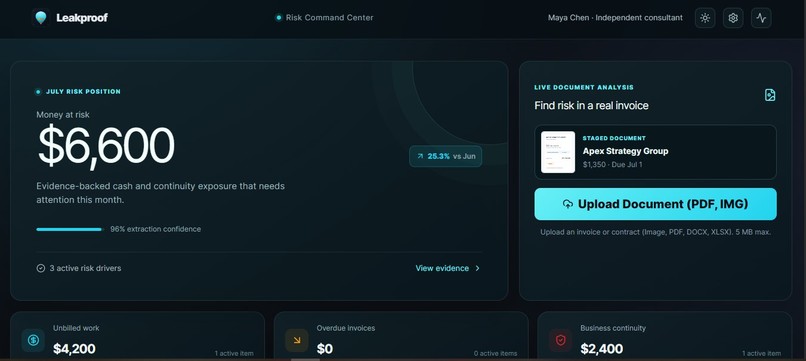
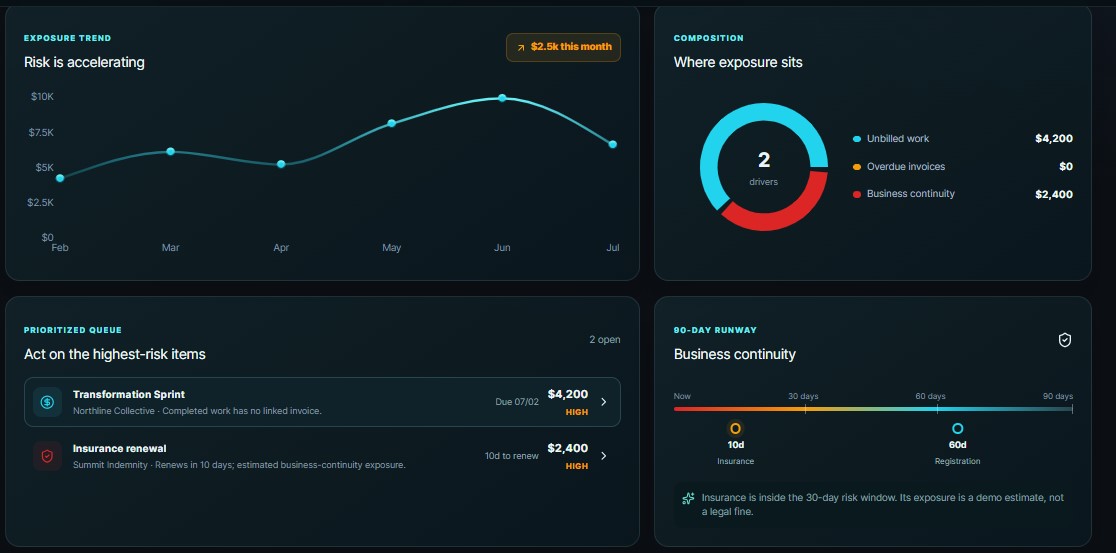
Shot 1 - main figures, docx uploads
-
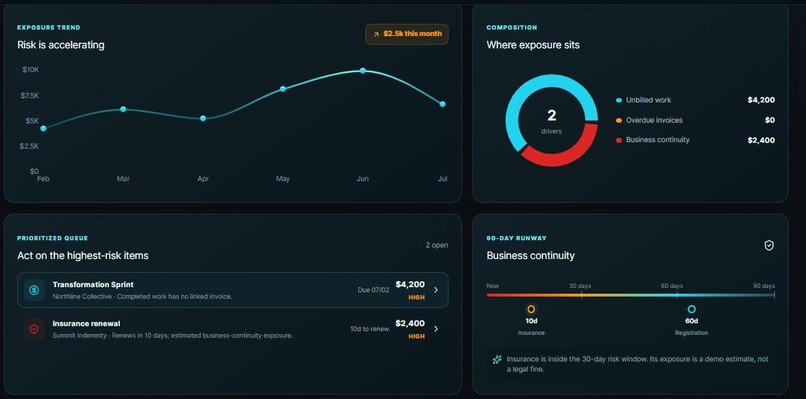
Shot 2 - Data Classifications, Risk exposures
-
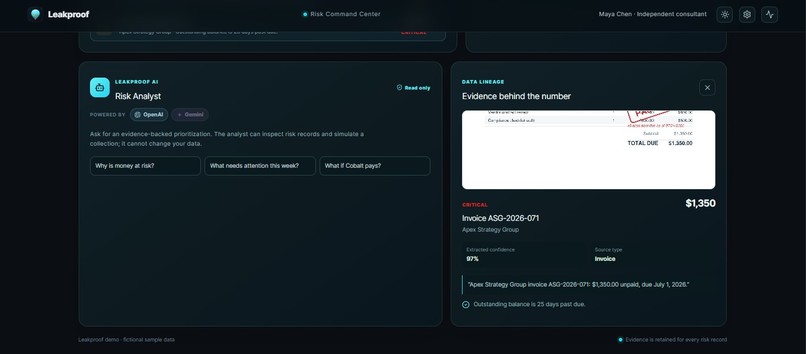
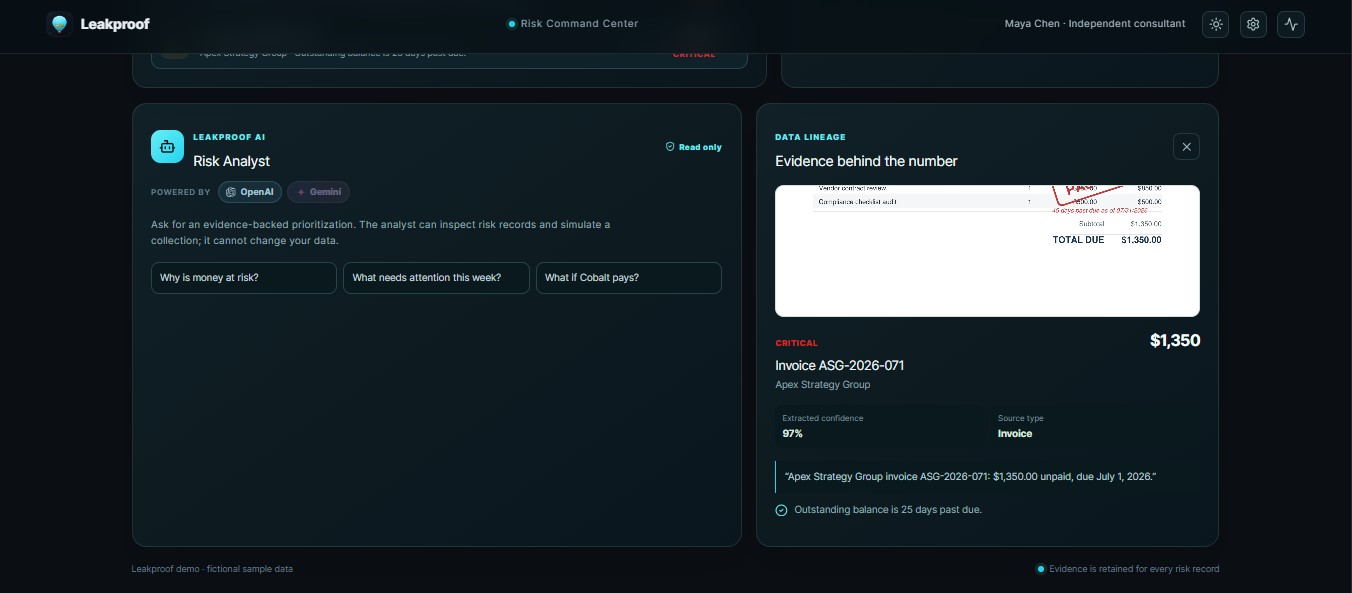
Shot 3 - Risk Analyst
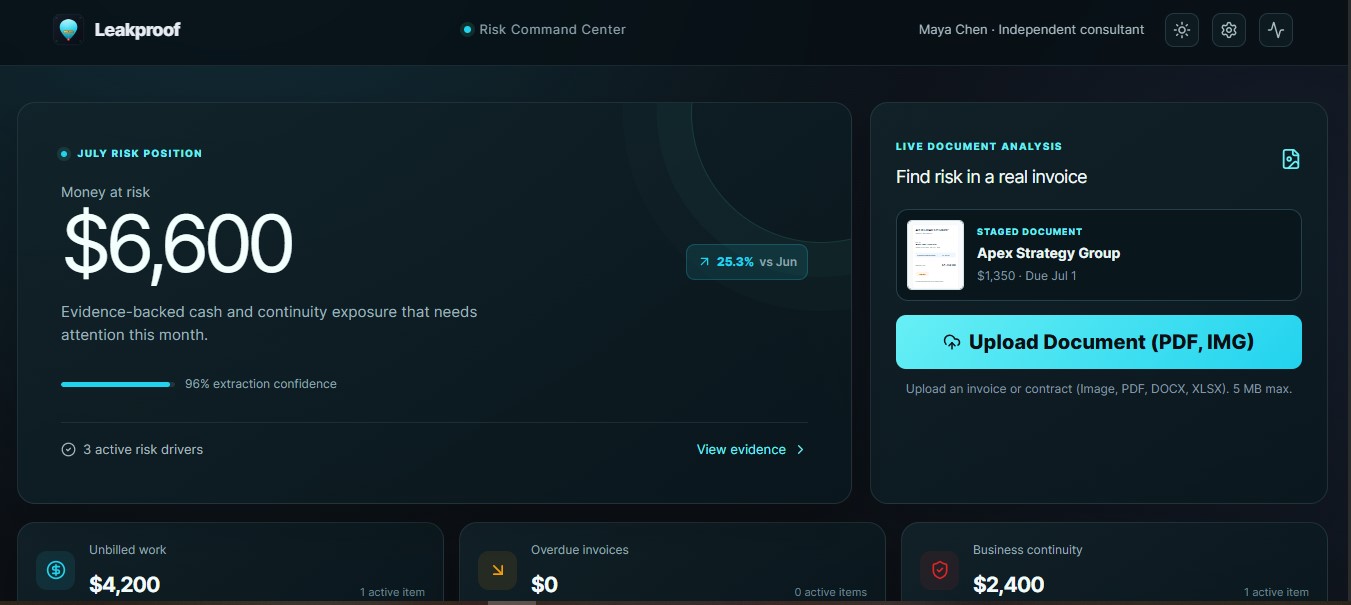
Inspiration
Solo operators, freelancers, and small agencies often wear every hat in their business. Without a dedicated finance team or risk analyst, cash flow and compliance issues easily fall through the cracks. Unbilled revenue, overdue invoices, and expired professional-liability insurance represent "leaks" that can sink a small operation. We wanted to build an accessible, automated safety net that acts as a 24/7 financial bodyguard for solo operators.
What it does
Leakproof is a Risk Command Center tailored for solo operators. It serves as an autonomous AI risk analyst that monitors your business exposure. Users simply drag and drop raw business documents (invoices, contracts, compliance certificates) in PDF, DOCX, XLSX, or Image formats.
Leakproof's AI engine instantly parses the file, classifies the document type, extracts critical financial and temporal data, and injects it into a live database. The built-in "Risk Analyst" agent then reads your real-time risk snapshot and provides dynamic, daily briefings—summarizing your total financial exposure and prioritizing immediate actions (e.g., "Collecting the Cobalt Labs invoice would reduce recorded risk by $5,800").
How we built it
We built Leakproof with a modern, serverless stack designed for speed and reliability:
- Frontend: React, Vite, and TypeScript. We designed a custom, glassmorphic UI using vanilla CSS to ensure a premium, modern aesthetic without the bloat of heavy component libraries.
- Backend & Database: Supabase (PostgreSQL) powers our live database, utilizing strictly typed schemas and Row Level Security for data integrity.
- AI Integration: We deployed Supabase Edge Functions (Deno) to securely proxy our AI requests. We leverage Google Gemini 1.5 Flash (with fallback to OpenAI) using strict JSON Schema extraction to force the LLMs to return highly predictable, structured financial data instead of conversational text.
Challenges we ran into
- Strict Data Extraction: Forcing generative AI models to output perfectly mapped, predictable JSON arrays for database ingestion was difficult. We had to dive deep into the new
responseSchemaandresponse_formatcapabilities of the Gemini and OpenAI APIs, tuning our prompts to prevent the AI from hallucinating unstated fines or missing fields. - API Troubleshooting: We ran into complex deployment issues with Edge Functions, including troubleshooting mysterious 404s from the Gemini REST API and 429 Rate Limits from OpenAI, which required us to build out robust, detailed error handling to ensure the UI fails gracefully.
- UX Design: Designing a dashboard that clearly conveys urgent financial risk without feeling overwhelmingly stressful to the user required careful attention to color theory, typography, and micro-animations.
Accomplishments that we're proud of
- Zero-Friction Ingestion: The seamless drag-and-drop pipeline that takes a raw, messy PDF and turns it into structured, actionable database rows in seconds.
- Dynamic AI Agent: Building an AI agent that doesn't just act as a generic chatbot, but actually reads the user's real-time Postgres state and changes its briefing recommendations dynamically based on newly uploaded documents.
- Aesthetic Polish: Delivering an extremely premium, dynamic user interface with custom animations that feels like a high-end enterprise tool.
What we learned
- How to write, deploy, and debug secure Deno Edge Functions via the Supabase CLI.
- How to strictly enforce JSON schemas on modern LLMs to bridge the gap between generative text and relational databases.
- The importance of robust backend error logging when dealing with third-party AI APIs.
What's next for Leakproof
- Inbox Integration: Direct integrations with Gmail/Outlook to automatically scan incoming attachments and flag risky contracts or unpaid invoices without requiring manual uploads.
- Automated Workflows: Allowing the AI to automatically draft and send polite payment follow-up emails to clients for overdue invoices.
- Expanded Compliance Vectors: Adding native tracking for industry-specific compliance requirements (like HIPAA BAA agreements or SOC2 renewals).
Built With
- css
- gemini
- html
- javascript
- lucide
- openai
- react
- sql
- supabase
- typescript

Log in or sign up for Devpost to join the conversation.