-
-
LeakLens-Devpost
Inspiration
Small businesses often spend money driving traffic to their websites before fixing the last part of the funnel.
We kept seeing technically small but commercially expensive problems: phone-only booking, unclear next steps, mismatched currency labels, weak trust proof, and generic positioning.
We wanted to build something that could find those problems quickly without requiring a business to send its website copy to a hosted LLM.
What it does
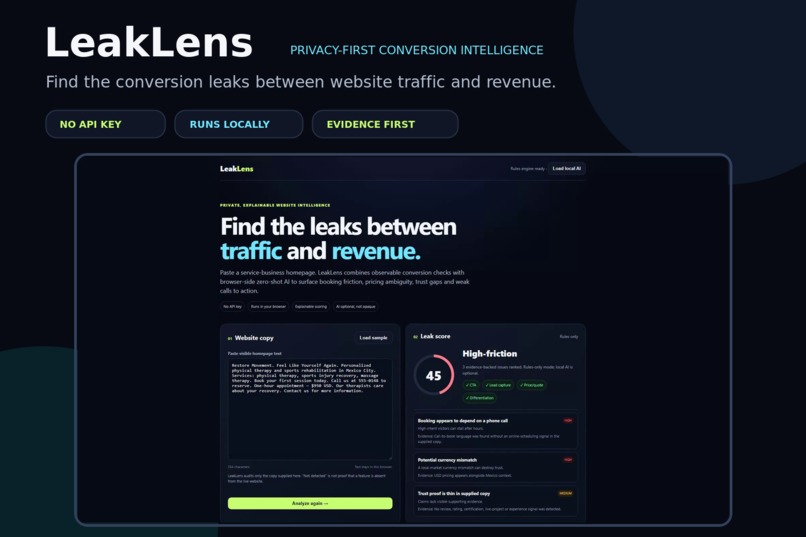
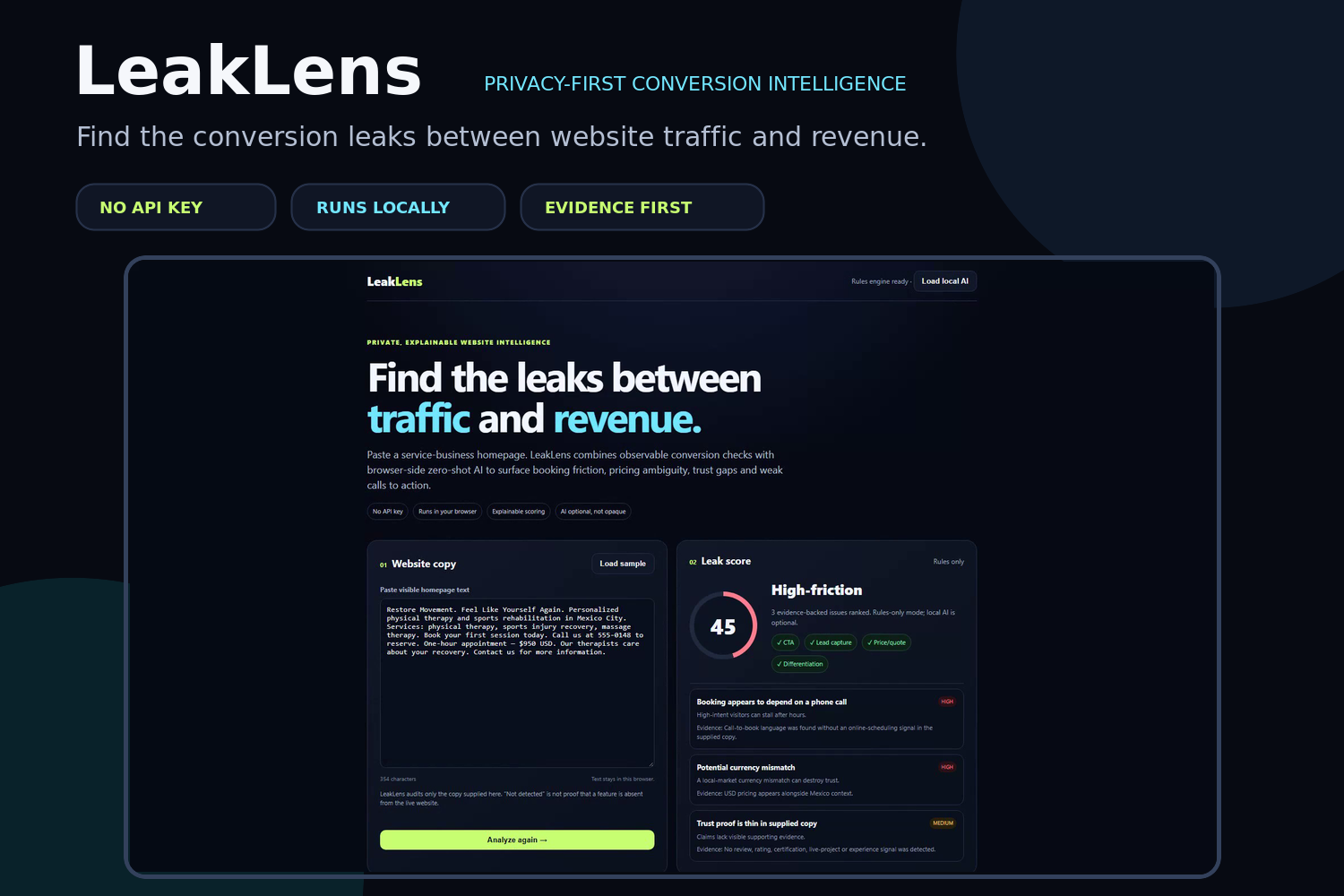
LeakLens is a privacy-first conversion auditor for service-business websites.
A user pastes the visible copy from a homepage and LeakLens produces:
- a 0–100 conversion-health score
- ranked findings with severity
- evidence explaining why each issue was detected
- recognized positive conversion signals
- a prioritized P1/P2/P3 action plan
The deterministic engine looks for observable conversion evidence such as calls to action, booking friction, lead capture, pricing signals, trust proof, differentiation, and potential currency mismatches.
An optional browser-local zero-shot AI layer evaluates semantic risks that simple keyword rules may miss.
How we built it
LeakLens uses two complementary layers.
The first is a deterministic evidence engine written in JavaScript. We use rules for things that should be observable and explainable rather than asking an AI model to guess.
The second is MobileBERT MNLI running through Transformers.js. After the browser obtains the model assets, semantic inference happens in the browser.
A fusion layer only adds AI findings when confidence crosses an explicit threshold.
This is intentionally not a prompt wrapper. Deterministic rules handle observable facts; AI handles semantic ambiguity.
The product is deployed as a static application on GitHub Pages and does not require an API key or application backend.
Challenges we ran into
One of the hardest problems was false positives.
An early version incorrectly treated legitimate phrases such as “Get a quote,” “Send us a message,” and “built around your real workflow” as missing conversion signals.
We built a real-world regression case around Eureka Tech and changed the product so absence findings are explicitly scoped to the copy supplied by the user rather than claiming a feature is missing from the live website.
Browser-local AI also creates a different challenge: the first model download depends on network conditions. LeakLens therefore remains fully useful in rules-only mode and now recovers gracefully if the optional model cannot load quickly.
Accomplishments we're proud of
Our reference sample consistently scores 45/100 and identifies three concrete problems:
- phone-dependent booking
- a potential Mexico/USD currency mismatch
- thin trust proof
Those findings become two P1 actions and one P2 action.
We also built a regression case using complete Eureka Tech homepage copy. LeakLens correctly recognizes its CTA, lead capture, pricing/quote, trust proof, and differentiation signals instead of manufacturing problems.
Before submission we ran both rules-only and local-AI acceptance tests against the live deployment.
What we learned
The biggest lesson was that explainability matters more than simply adding more AI.
A deterministic rule is better when the evidence is objective. AI becomes valuable when language is ambiguous and semantic interpretation adds information.
We also learned that an AI product needs a useful degradation path. LeakLens still produces its complete deterministic audit when the optional model is unavailable.
Responsible AI and privacy
Pasted business copy is not sent to a hosted LLM provider.
LeakLens has no application backend submission endpoint and does not persist the pasted website copy.
AI confidence is presented as a risk signal rather than as a factual diagnosis, and the product clearly distinguishes deterministic findings from optional semantic AI findings.
What's next
Next we want to expand the evidence engine beyond homepage copy into full conversion journeys: forms, booking flows, mobile interaction, pricing consistency, and measurable funnel events.
The long-term goal is a privacy-first conversion intelligence layer that helps small businesses find revenue leaks before spending more money acquiring traffic.
Built With
- css3
- github
- html5
- huggingface
- javascript
- mobilebert
- onnx
- transformers.js


Log in or sign up for Devpost to join the conversation.