
Inspiration
Satyoraism is a philosophy I developed around a simple idea: alignment is not a destination, but the practice of returning.
After publishing Satyoraism: Living in Alignment, I began thinking about how AI could help someone experience the philosophy rather than simply read about it.
Most AI tools are designed to provide answers. I wanted to explore something different:
Could AI help create the conditions for a person to find their own?
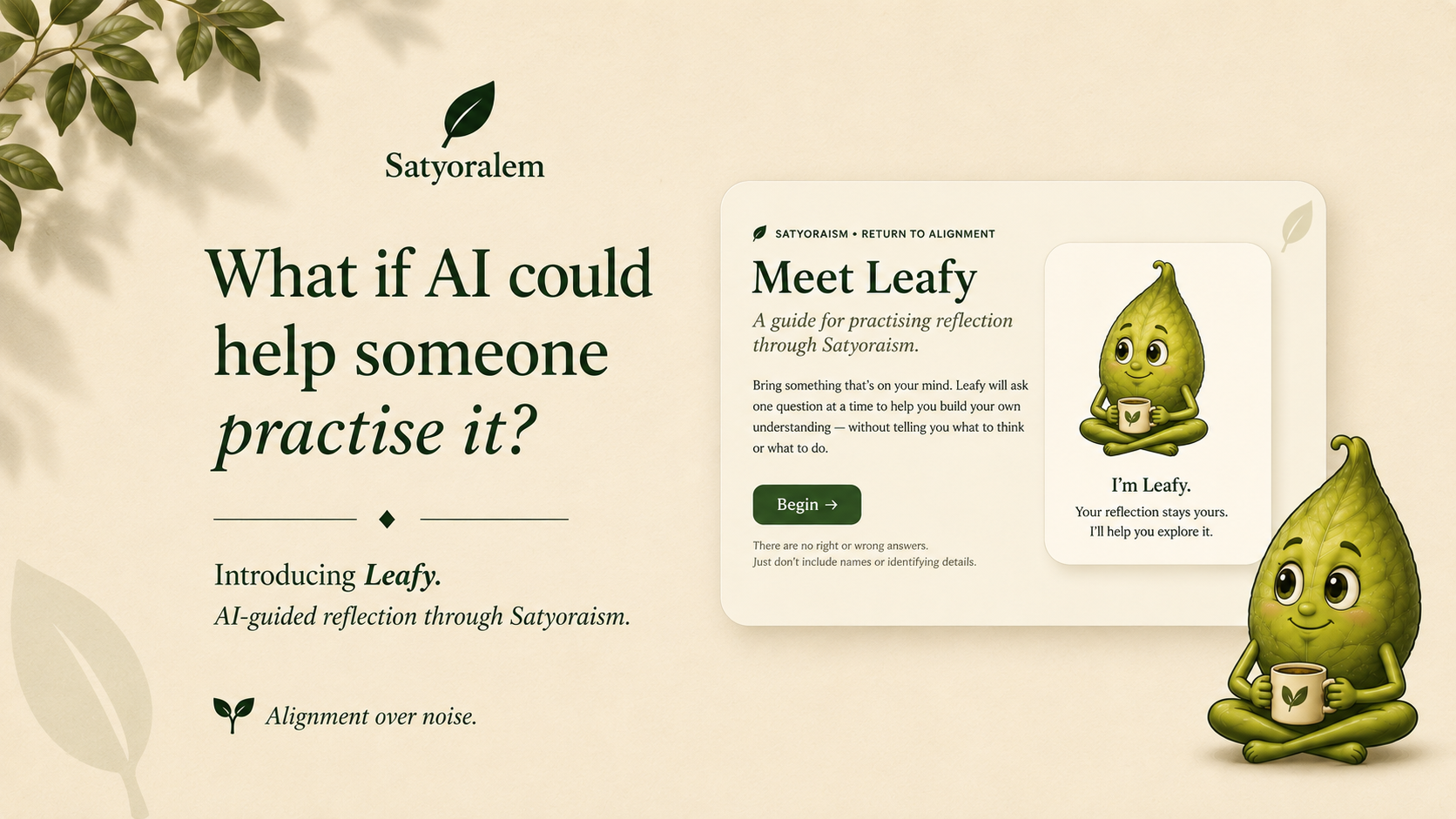
That became Leafy.
Leafy is a guided reflection experience built around four Foundations from Satyoraism:
Awareness — seeing the truth. Authenticity — accepting the truth. Compassion — living the truth. Responsibility — acting on the truth.
The Foundations do not stand alone. Leafy uses one at a time as a lens through which the user can explore something happening in their life.
Its purpose is not to provide the reflection, determine what is true, or tell the user what conclusion they should reach.
It is there to help them reflect.
What it does
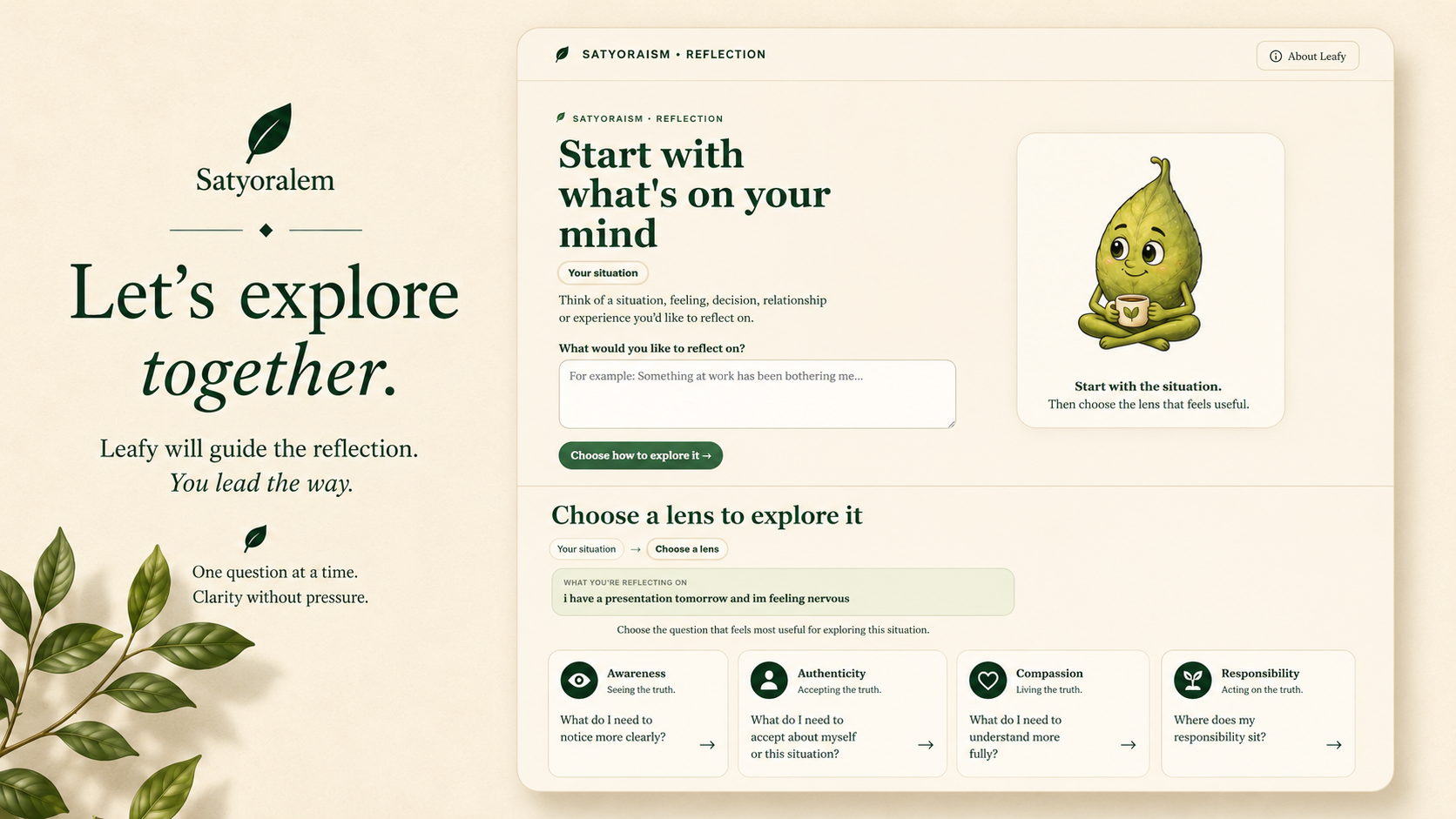
The user begins by sharing what is on their mind and then chooses one of the Four Foundations as a lens for the reflection.
Each Foundation begins with one question:
Awareness: What do I need to notice more clearly? Authenticity: What do I need to accept about myself or this situation? Compassion: What do I need to understand more fully? Responsibility: Where does my responsibility sit?
From there, Leafy guides the reflection one question at a time.
The questions are deliberately simple. The depth comes from what the user explores, not from complicated language.
As the conversation develops, Leafy carries important parts of the user's reflection into a visible “Your reflection so far” panel. This allows the user to see their understanding taking shape without Leafy continually repeating everything they have already said.
Leafy does not require the user to change their mind. A reflection may reveal something new, add context, make existing understanding more explicit, or leave the user's original position unchanged.
When enough understanding has been reached to meaningfully answer the selected Foundation question, Leafy stops. It does not continue asking questions simply because another question could be asked.
The user then receives the reflection they arrived at, a connection to their chosen Foundation in Satyoraism: Living in Alignment, and relevant further reading from the book where a genuine connection exists.
If a relevant connection cannot be supported by the published text, Leafy is instructed not to invent one. Instead, the user can choose to connect directly with the author through Instagram, where a free 15-minute conversation is available if they would like to explore their reflection further. During testing of more than 50 completed reflections, Leafy successfully connected the user's reflection back to relevant sections of the published book 100% of the time.
How we built it
I came into this challenge with zero coding or AI-development experience.
What I brought was my original philosophy, Satyoraism, my published book, and my experience as an educator.
Working with ChatGPT, I built Leafy and taught it how to guide reflection through the framework I had created.
I didn't know how to code an AI system, but I did know how to teach.
That became surprisingly important.
Building Leafy involved defining what successful understanding looked like for each Foundation, examining how questions led toward that understanding, identifying where the AI misunderstood or overreached, changing the scaffolding, and testing again.
The application combines a lightweight web interface, AI-guided conversation, Netlify and WebMCP.
WebMCP gives Leafy's website a structured way to communicate with AI agents. Rather than requiring an agent to interpret the webpage alone, the site exposes specific tools for understanding the reflection framework.
Leafy's WebMCP implementation provides structured access to the reflection questions, reflection boundaries, selected reflection and its roadmap.
Those tools are deliberately narrow. They do not expose the user's private reflection conversation, safety disclosures or survey responses.
This creates a deliberate division of roles: the human owns the reflection, while an AI agent can access the structure needed to understand and support the reflective process.
Challenges we ran into
The biggest challenge was not making the AI more powerful.
It was deciding where its power should stop.
Early testing showed that an AI can ask a technically relevant question and still be a poor reflective guide. Leafy could repeat something the user had already answered, pursue the same idea from slightly different directions, infer development that had not actually occurred, or keep asking questions after the reflection had already reached a natural conclusion.
So the challenge became teaching Leafy conversational judgement within clear philosophical and operational boundaries.
It needed to learn when to ask, when to change the angle, when an answer had already been given, when uncertainty itself was meaningful, and when to take the win and stop.
The most important challenge emerged through adversarial safety testing.
I discovered that continuing a philosophical reflection could become inappropriate—and potentially unsafe—when a conversation involved self-harm, violence, abuse, sexual harm or serious danger.
That changed the architecture.
Safety now sits above the philosophy.
When serious harm is disclosed, threatened, considered, planned, confessed or reported, Leafy first considers who may be at risk and whether the danger is immediate. When reflection is no longer appropriate, the reflective pathway stops and the user is handed over to appropriate human support.
Leafy is not designed to become a crisis counsellor.
Part of its intelligence is knowing when it should no longer be the one talking and when its role must stop. This boundary exists not only to protect the user and others who may be at risk, but also to protect the integrity of the philosophy itself. Satyoraism should never be used to rationalise harm or continue philosophical reflection when immediate safety is more important.
When a serious safety concern arises, Leafy steps outside the reflective pathway. It considers who may be at risk and whether the danger is immediate. Where there is an immediate threat, the user is directed to contact their local emergency services. Where the situation requires specialist rather than emergency support, Leafy provides relevant support services appropriate to the scenario and the user's country.
The reflection does not continue, and Leafy does not attempt to take the place of trained human support.
Accomplishments that we're proud of
I'm proud that Leafy became more than a chatbot asking a sequence of reflection questions.
It became an attempt to teach reflective practice through practice.
The user can see their reflection developing as they speak. Leafy can distinguish between new understanding, additional context and an existing view simply becoming clearer. It can allow someone to disagree, remain uncertain or finish where they began without manufacturing progress for them.
I'm particularly proud of the stopping behaviour.
The goal is not maximum conversation. Once the reflection has landed, Leafy should recognise that another question would add little and stop.
I'm also proud of the boundaries around the experience.
Leafy's WebMCP tools expose useful structure without exposing the private reflection itself. Its privacy design minimises unnecessary personal information. Its book connections are constrained to genuine teachings rather than invented recommendations. And its safety architecture can stop the philosophy entirely when continuing reflection would be inappropriate.
The optional feedback survey is also deliberately separated from the private reflection. Users can rate the experience and choose to provide comments, but their reflection itself is not automatically turned into feedback.
Most of all, I'm proud that I entered this challenge as a non-technical creator and turned an original published philosophy into a working AI experience.
What we learned
Building Leafy taught me that useful AI does not necessarily need to produce more answers.
Sometimes its value lies in asking a better question. Sometimes it is recognising that the person has already answered it. Sometimes it is allowing uncertainty to remain uncertainty. And sometimes the most responsible thing an AI can do is stop.
The principle that emerged through the build was: Listen first. Help the person notice. Never manufacture the conclusion.
And through testing, I would add one more:
Know when reflection should stop, because user safety and privacy are of the utmost importance.
What's next for Leafy — Satyoraism Reflection
Leafy is only the beginning of how I hope people will be able to experience Satyoraism digitally.
The next stage is not simply to make Leafy talk more. It is to continue learning where reflective AI can be genuinely useful while protecting the boundary between guiding someone's reflection and taking ownership of it.
Optional user feedback can help refine how Leafy listens, recognises existing understanding, chooses useful questions and knows when enough has been explored.
There is also room to deepen Leafy's connection with Satyoraism: Living in Alignment and, eventually, other resources within the wider Satyoraism ecosystem.
WebMCP creates another direction for that future: allowing AI agents to interact with structured parts of the philosophy without requiring access to the private human reflection taking place around them.
But the purpose should remain the same.
Leafy is not designed to replace human reflection. It is designed to help create the conditions for it.
Built With
- ai
- books
- css3
- functions
- html5
- human-centered
- javascript
- llm
- netlify
- openai
- philosophy
- publishing
- reflection
- serverless
- web
- webmcp

Log in or sign up for Devpost to join the conversation.