Inspiration
I was inspired to create this project after one of the projects that I was planning to use for DECA, but never used since it was out of my time frame. I was always interested in food and its role in society, so I wanted to combine that passion with artificial intelligence to solve a real-world problem. Every year, farmers lose significant amounts of money due to losses caused by plant diseases. To fix this issue, I resolved to create a tool that could make disease detection faster, more accessible, and cost-free for all farmers to use.
What it does
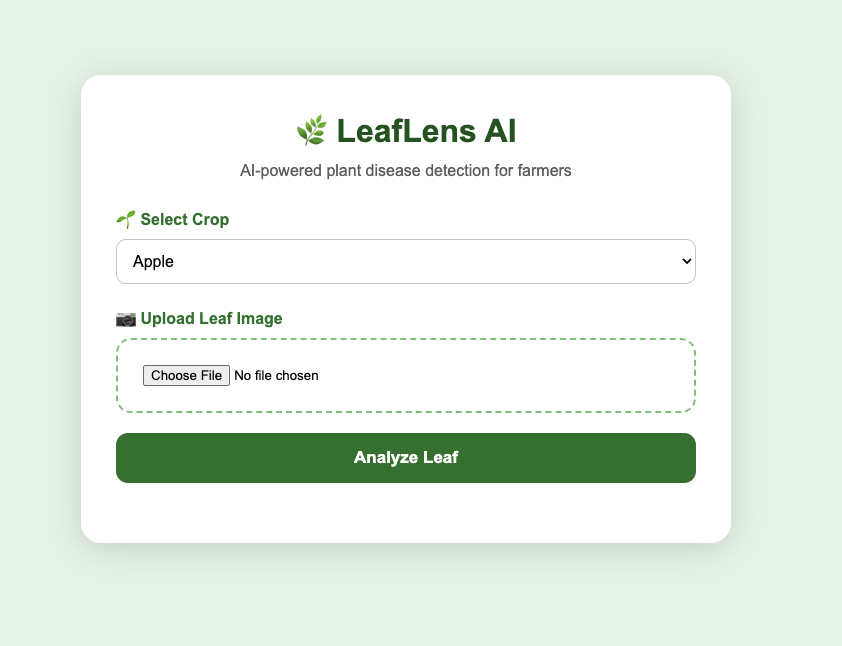
LeafLensAI allows the user to choose the crop that they are scanning, and then to upload an image. From there, I used an AI image classification model to analyze the image and predict what is most likely ailing the plant. After identifying the disease, it would give the user a guide of what the disease is, how to treat it, and other diseases it could be, helping farmers easily understand what disease is affecting their plant. This gives users an idea of what the disease is in case they want to explore it further, and common ways to manage plant health before the problem becomes more severe.
How we built it
I built this website using Replit’s free cloud development environment, primarily using Python as my main language. For the machine learning part, I trained a convolutional neural network using the API called the PlantVillage dataset from Kaggle to get a basic database of the possible diseases that each plant could have. The backend of the website processes images and predictions, while the frontend provides the user with a clean interface, allowing them to view the results almost instantaneously.
Challenges I ran into
One of the biggest challenges that I ran into was when my local environment on my Mac wouldn’t work, since the libraries would never import properly. After spending many hours attempting to troubleshoot the dependency issues, I decided to migrate the project to Replit’s virtual environment; from there, it was a very tedious task and almost caused me to quit this hackathon due to the amount of labor it took. I also faced challenges integrating an AI model with the website, making sure that the predictions were actually accurate. Although these issues were frustrating and time-consuming, it was worth it since I learned important debugging and deployment skills to help me further in later projects.
Accomplishments that I'm proud of
I’m proud that LeafLensAI is the first complete website I ever published and submitted for a hackathon, as I’ve never done it before. Additionally, I created an application that combines machine learning with a functional user interface, one of the first times I ever used artificial intelligence. I’m also proud of making our interface so user-friendly, since I initially struggled at being able to design interfaces for users.
What I learned
I learned about the struggle to make projects using artificial intelligence, and how it is difficult to train models to accurately work as you wanted it to. I also learned how to create website interfaces using platforms like Replit and Canva, broadening my skillset for designing and programming appealing programs. Overall, the project strengthened both my programming skills and understanding of how artificial intelligence can be meaningfully applied to solve real-world problems.
What's next for LeafLensAI
If I were to keep on working on this project, I would first start by learning how to properly train the model to make it more accurate and scanning and identifying what type of plant it is based on the picture provided. I would also implement a feature to contribute your own data to the database, expanding its usefulness past a few common crops for farmers all across the world. In addition, I plan to create an app that has real-time camera abilities to make it more accessible to users instead of a website.
Built With
- ai
- farming
- plants

