-
-

logo
-
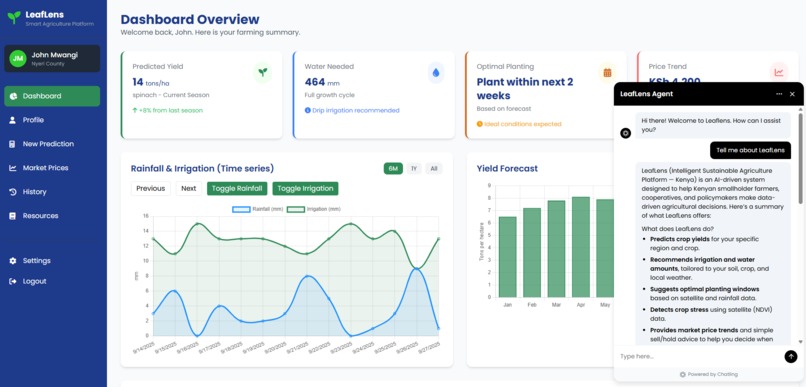
leaflens dashboard


LeafLens, an Intelligent Sustainable Agriculture Platform, was born from a realization that technology could be the bridge between farmers and food security. The inspiration came from observing the everyday struggles of smallholder farmers, those who wake up before dawn, depend on unpredictable rains, and live with uncertainty about whether their crops will survive the next drought. It started with a simple question: could artificial intelligence, a field often associated with automation and data centers, actually make farming more human, more predictable, and more sustainable? That question became the foundation of LeafLens
The idea first emerged while experimenting with a plant disease classification model that allowed users to upload a photo and receive instant feedback on the disease affecting their crops. While the model worked, it revealed a deeper truth: knowing the disease wasn’t enough. Farmers needed a complete system: a companion that could tell them when to plant, how much water to use, what to expect in yield, and when to sell for the best price. This insight shifted the focus from detection to prediction and resource optimization, laying the groundwork for LeafLens.
The development of LeafLens combined rigorous data science with local agricultural knowledge. The methodology followed a clear process: data collection and preprocessing, feature selection, model development, validation, and testing. Data came from multiple credible sources, including Kaggle datasets on crop yields, NDVI vegetation indices, rainfall records, soil properties, and market prices. Using Python-based frameworks, supervised learning models such as Random Forests and Gradient Boosting were trained to forecast yields and estimate irrigation needs, while regression algorithms modeled evapotranspiration to predict optimal water use. NDVI time-series data was analyzed through computer vision techniques to monitor vegetation health, and reinforcement learning was explored to improve predictions based on feedback from real-world usage continuously.
Building LeafLens wasn’t without challenges. The first major hurdle was data quality; agricultural data, especially in Africa, is often incomplete, inconsistent, or localized. Cleaning and aligning datasets across multiple regions required careful preprocessing and validation. The second challenge was accessibility. Designing a system that could run on low-end smartphones or even through SMS required balancing computational power with usability. Another difficulty lay in translating AI predictions into language and actions that farmers could easily trust and act upon, leading to the integration of explainable AI (XAI) principles.
Despite these challenges, the process revealed powerful lessons. It became clear that AI doesn’t replace farmers; it empowers them. Technology alone is meaningless without context, and sustainability requires aligning innovation with real-world human needs. LeafLens was not built to impress with technical jargon but to create tangible change: helping a farmer in Machakos, for example, decide when to irrigate, guiding a cooperative in Kisii to plan its planting season, and enabling a youth farmer in Bungoma to make informed market choices. The journey of LeafLens is still unfolding, but its essence remains simple: to turn uncertainty into insight and insight into impact through the responsible and inclusive use of artificial intelligence.


Log in or sign up for Devpost to join the conversation.