Leadmeta
Inspiration
Finding quality business leads is still surprisingly difficult. Most lead generation tools rely on expensive, static databases that become outdated over time, while manually searching the web is slow and repetitive.
I wanted to build a tool that could discover fresh, publicly available business contacts directly from the live web instead of relying on stored datasets. The goal was to make lead generation faster, more transparent, and privacy-friendly.
What it does
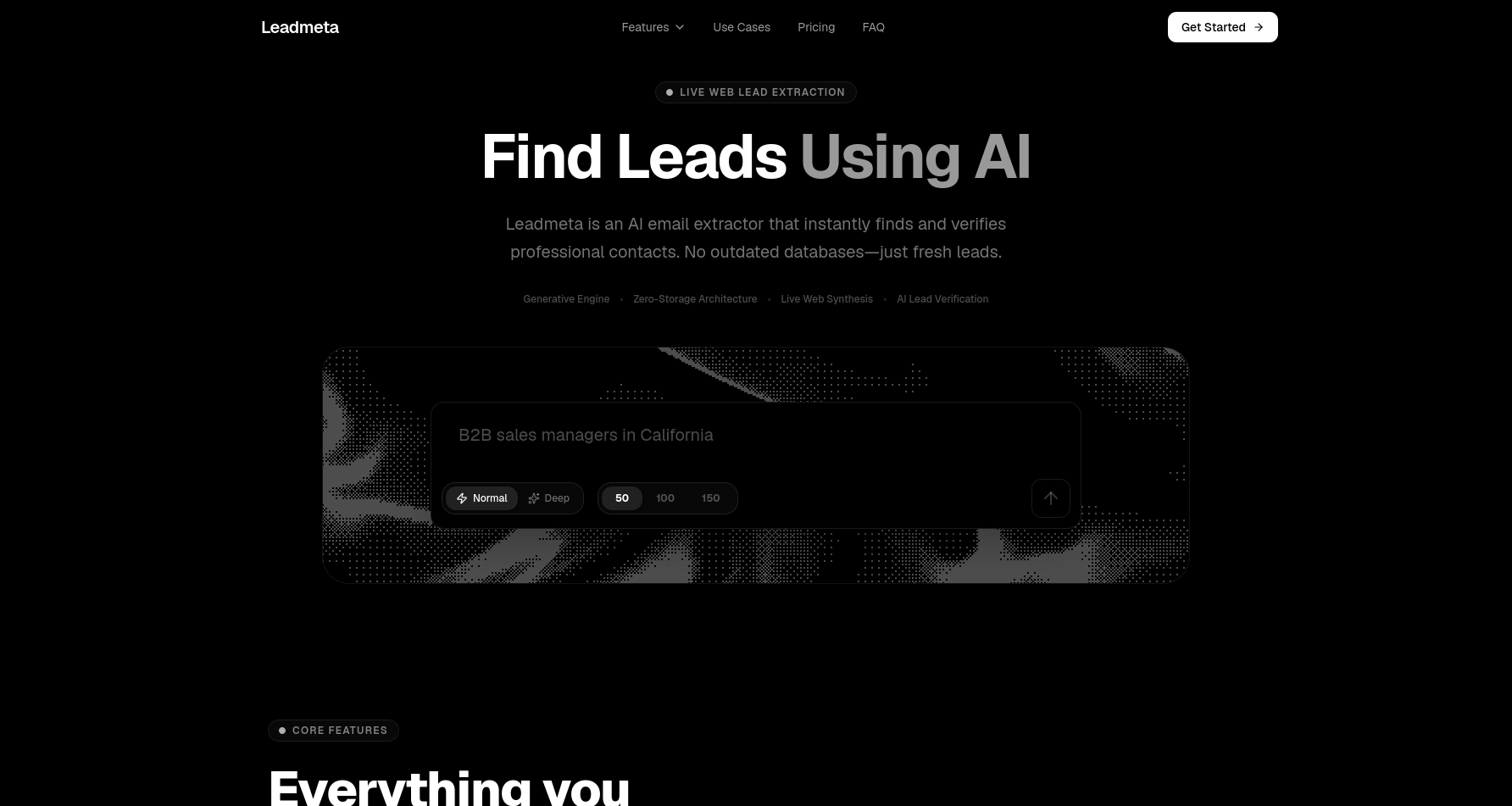
Leadmeta is an AI-powered lead discovery platform that transforms a simple business description into verified leads.
The workflow is simple:
- Describe the type of leads you need.
- AI generates optimized search strategies.
- Leadmeta searches the live web.
- It extracts publicly available email addresses from search results.
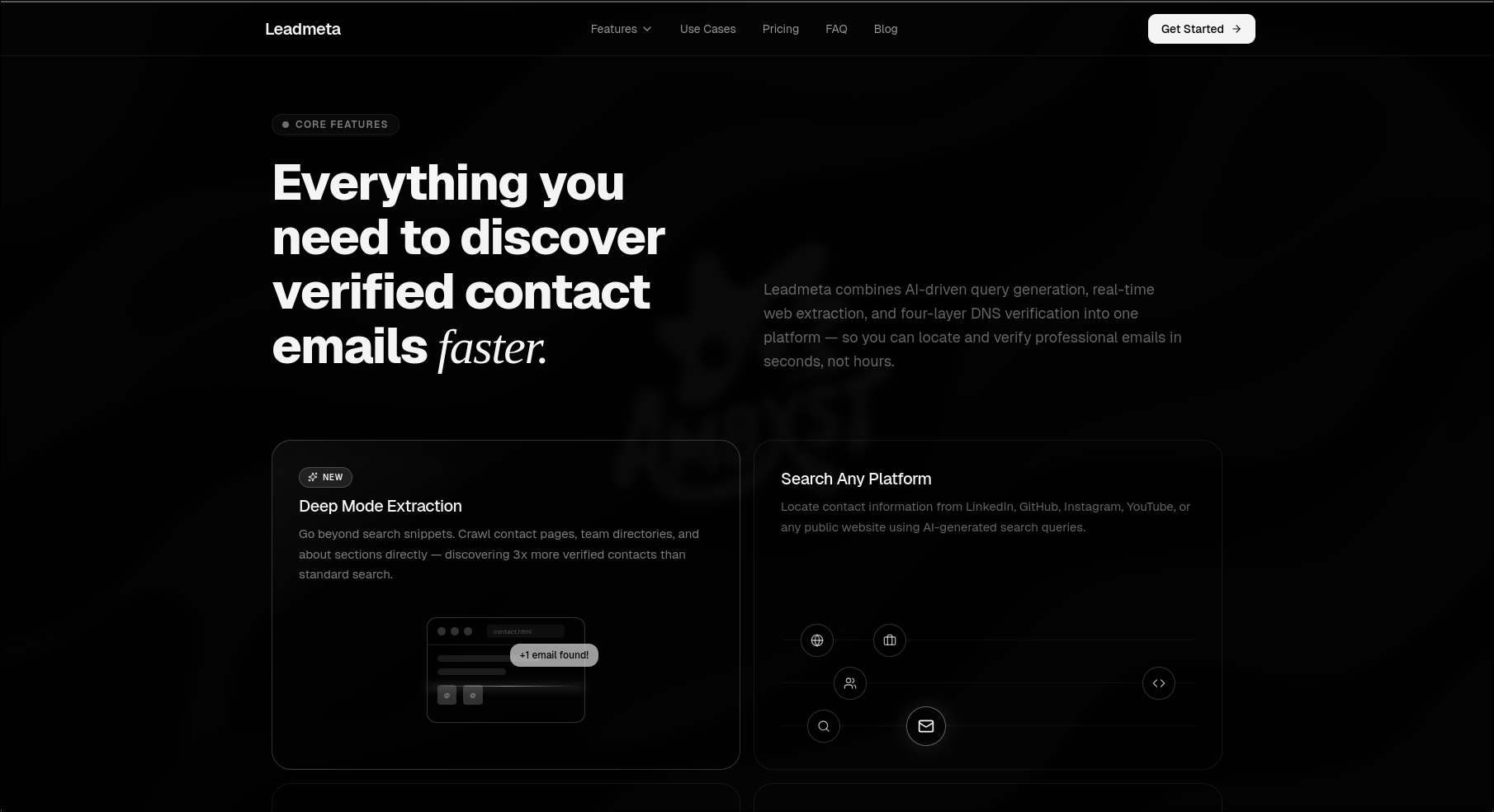
- Deep Mode optionally visits relevant pages to discover additional contacts.
- Emails are verified in the browser.
- Results can be exported as a clean CSV.
Unlike traditional lead databases, Leadmeta discovers information in real time from publicly available sources.
How I built it
Leadmeta is built with:
- Next.js 16
- React 19
- TypeScript
- Tailwind CSS 4
- shadcn/ui
- TinyFish Search & Fetch APIs for web search and deep page extraction
- OpenRouter for AI-powered search strategy generation
- Gemini/OpenAI as optional query-editing assistants
One of the biggest architectural decisions was keeping the application largely stateless. Search results remain in frontend state, while verification runs entirely in the browser, reducing backend complexity and avoiding the need for a database.
For this hackathon, I used Codex extensively throughout development. It helped implement features, refactor components, generate boilerplate, debug issues, and iterate much faster while I focused on product design and architecture. The combination of Codex and GPT-5.6 significantly accelerated development. :contentReference[oaicite:0]{index=0}
Challenges I ran into
One challenge was balancing search quality with speed. Deep crawling can improve lead discovery but also increases latency, so I designed a workflow where Deep Mode is optional and focused on high-value pages.
Another challenge was building a reliable client-side email verification pipeline that combines syntax checks, role-account detection, disposable-domain detection, DNS validation, and scoring while keeping the user experience responsive.
Designing the application without a backend database also required careful state management and efficient client-side processing.
What I learned
This project taught me a lot about building AI-assisted workflows instead of simple AI features.
I learned how to combine LLMs with traditional search pipelines, structure AI-generated queries for better retrieval, design browser-first architectures, and use Codex effectively as a development partner for rapid iteration.
Most importantly, I learned that AI becomes far more useful when it orchestrates existing tools into a complete workflow rather than replacing them.
What's next for Leadmeta
Future improvements include:
- Smarter Deep Mode ranking and prioritization
- Company enrichment beyond email discovery
- CRM integrations
- Team collaboration features
- Better verification signals
- Additional export formats
- Improved search intelligence and relevance ranking
Leadmeta aims to become a modern AI-powered alternative to traditional lead databases by discovering fresh, publicly available business information directly from the live web.
How we built it
Built With
- api
- chatgpt
- codex
- next.js
- typescript


Log in or sign up for Devpost to join the conversation.