-
-
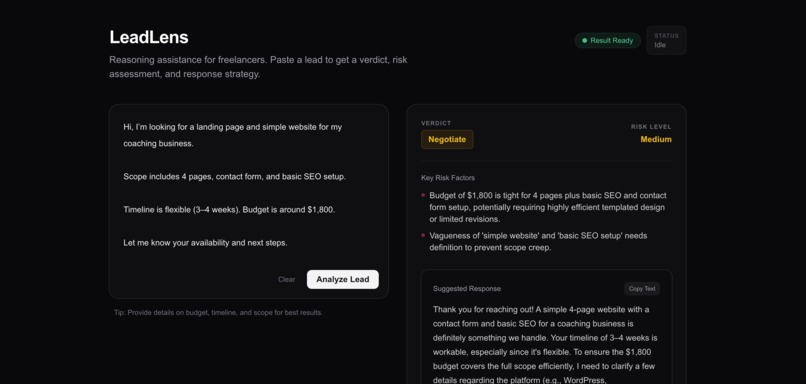
AI-powered lead analysis showing risk level, key concerns, and a ready-to-send response for freelancers.
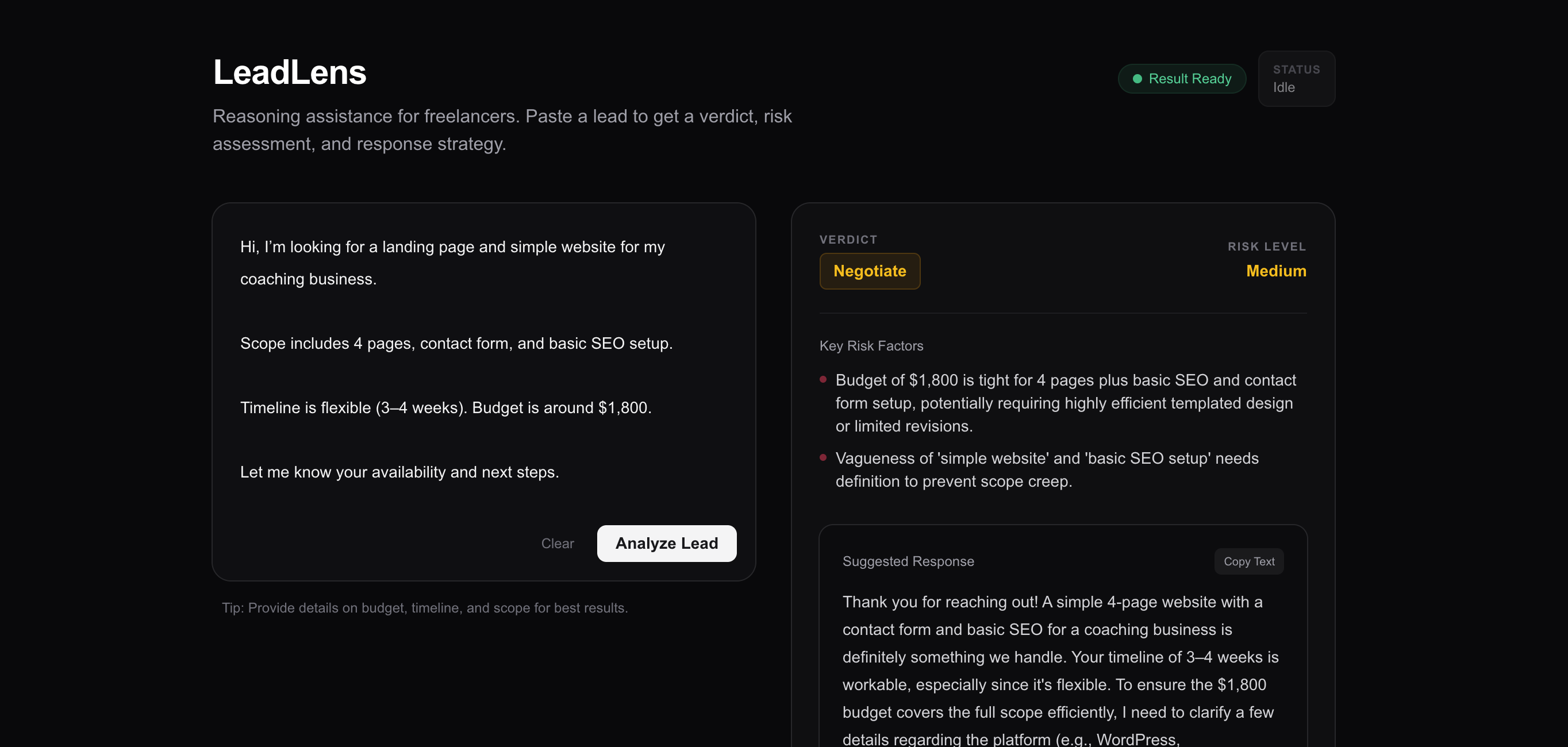
Inspiration
Freelancers receive many inbound leads, but not all of them are worth pursuing.
Some look promising but hide red flags, unclear scope, unrealistic budgets, or urgency traps.
Deciding which leads to accept, negotiate, or decline is a daily cognitive burden that directly impacts income, burnout, and time wasted. This project was inspired by that real-world decision fatigue.
What it does
LeadLens is a Gemini-powered reasoning copilot that helps freelancers make better lead decisions.
The user inputs:
- The client’s inquiry message
- Estimated budget range
- Timeline or urgency
- Project type
- Personal availability
LeadLens then:
- Scores the lead quality on a 0–100 scale
- Detects risk and red-flag signals
- Reasons through trade-offs and constraints
- Recommends a clear next action: pursue, negotiate, or decline
- Generates a suggested reply aligned with the recommendation
How we built it
The application is built as a lightweight web app with a structured input flow and a clear decision output.
Gemini 3 is used as the core reasoning engine. Inputs are provided in a structured format, and Gemini is prompted to analyze multiple constraints simultaneously rather than generating free-form chat responses.
The output is returned as structured data, allowing the system to display scores, reasoning points, detected risks, and recommendations in a clear and actionable way.
How Gemini 3 is used
Gemini 3’s enhanced reasoning capabilities are central to the project.
Instead of summarizing text, Gemini evaluates:
- Budget versus scope alignment
- Urgency versus availability
- Language patterns that indicate risk or ambiguity
- Trade-offs between opportunity and cost
Gemini produces an explicit decision and explains why that decision was made, making the reasoning transparent and trustworthy for the user.
This kind of multi-factor decision analysis would be difficult to implement with traditional rules alone.
Challenges we ran into
The main challenge was designing prompts that consistently produce reliable, structured reasoning rather than generic advice.
Another challenge was balancing transparency with clarity, ensuring the reasoning is detailed enough to be useful without overwhelming the user.
Accomplishments that we're proud of
- Turning an abstract decision problem into a clear, repeatable workflow
- Using Gemini 3 for genuine reasoning rather than surface-level generation
- Producing actionable outputs that freelancers can immediately use
What we learned
We learned how prompt structure and constraint framing dramatically affect reasoning quality, and how structured outputs improve trust in AI-assisted decisions.
What's next for LeadLens
Future iterations could include:
- Historical lead tracking and outcome learning
- Industry-specific reasoning profiles
- Integration with freelance platforms and inboxes

Log in or sign up for Devpost to join the conversation.