Inspiration
What it doe### 💡 The Spark: What Inspired Us
As software engineering students, we constantly look for ways to optimize slow, repetitive real-world workflows. We noticed that small business owners, freelancers, and B2B agencies spend up to 70% of their weekly hours on manual prospecting. They spend endless time scraping directories, copying contact details into spreadsheets, and drafting individual cold emails.
Hiring virtual assistants for this process is expensive and slow. We were inspired to build a fully autonomous, zero-touch machine that solves this bottleneck by handling the entire client acquisition pipeline from discovery to inbox response.
⚙️ The Construction: How We Built It
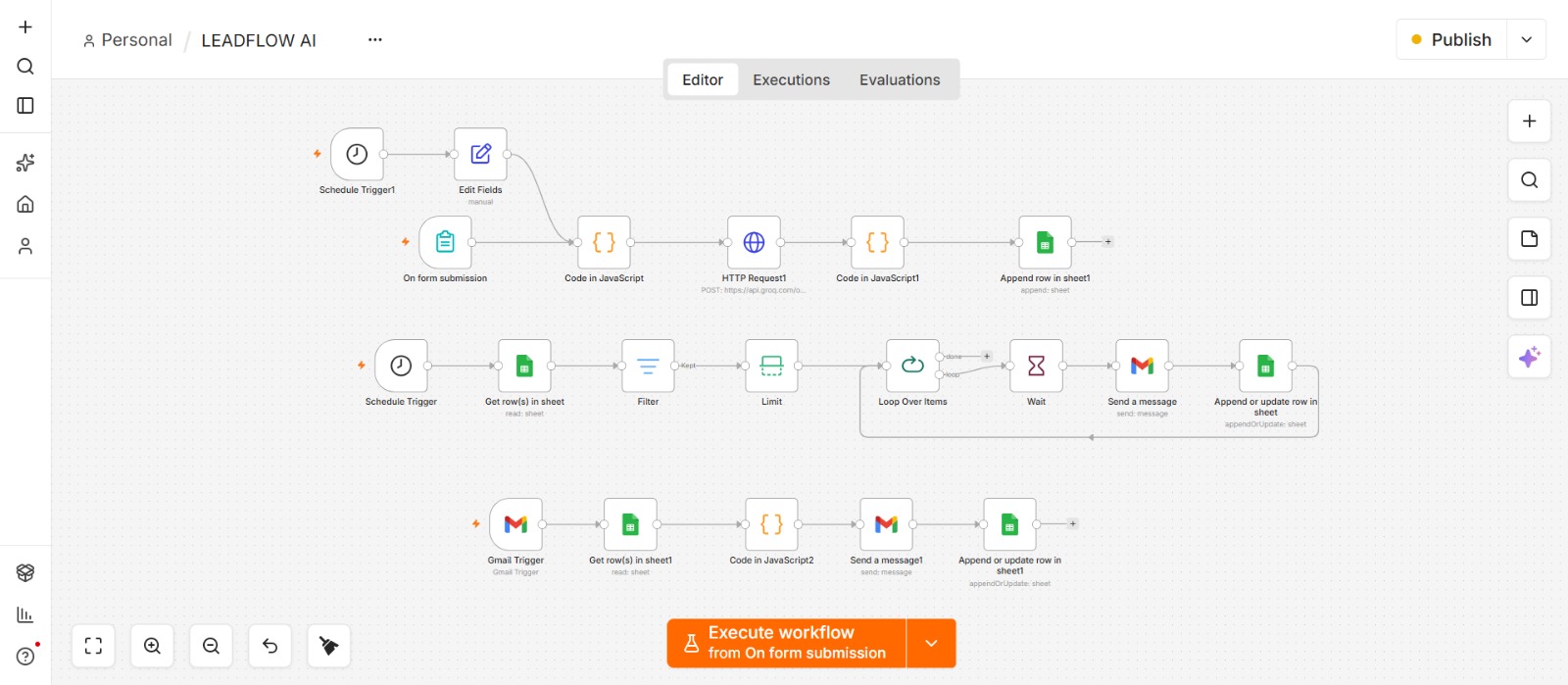
We engineered LeadFlow AI using the n8n automation framework. The core system connects various distinct API data layers into a unified execution thread:
- Live Data Extraction: The system calls the official Google Maps API to extract real-time business profiles based on custom industry filters and location inputs.
- Database Management: Extracted data rows (Name, Website, Phone, Email) are parsed and synced instantly into Google Sheets.
- AI Cognitive Processing: We integrated the OpenRouter API to dynamically feed company descriptions into advanced LLMs (like Claude). The AI writes hyper-personalized, context-aware email copy that matches the recipient's specific business niche.
- Smart Mail Handling: The system dispatches custom emails using Gmail integration and updates database tracking logs (
SENT/NOT SENT). A final webhook actively monitors incoming replies and routes warm prospects straight to the user's personal email for immediate human follow-up.
🚧 Overcoming the Hurdles: Challenges Faced
Building an enterprise-ready automation engine from scratch came with major technical challenges:
1. Domain Reputation & Spam Mitigation
Blasting multiple automated emails simultaneously triggers security filters and blocks sending domains. To guarantee deliverability, we implemented smart throttling delays that mimic natural human behavior. We calculated and enforced a strict operational delay time between each email dispatch.
Using LaTeX notation, our dispatch interval rate ((R)) is defined by the delay time variable ((t_{\text{delay}})):
[R = \frac{1 \text{ email}}{t_{\text{delay}}}]
Where we configured:
[t_{\text{delay}} = 60 \text{ seconds}]
This simple math ensures the system remains safe from strict spam algorithms.
2. Raw JSON Payload Optimization
The raw payloads returned from database extractions were unstructured and often contained missing variables. To keep our database pristine, we programmed custom JavaScript execution nodes inside n8n to scrub, format, and sanitize the data arrays before updating rows.
🎓 The Takeaway: What We Learned
This project taught us that modern software engineering is about intelligent orchestration. We learned how to build robust webhooks, handle REST APIs, optimize prompt data contexts, and safeguard domain deliverability. By connecting modular APIs and Generative AI tools, solo builders can design high-value business systems that scale effortlessly.
Our next milestone is wrapping this backend framework into a dedicated SaaS web application layout so non-technical users can launch automated campaigns instantly. s
How we built it
Challenges we ran into
Accomplishments that we're proud of
What we learned
What's next for LeadFlow AI
Built With
- claude
- google-sheets
- javascript
- n8n
- openrouter

Log in or sign up for Devpost to join the conversation.