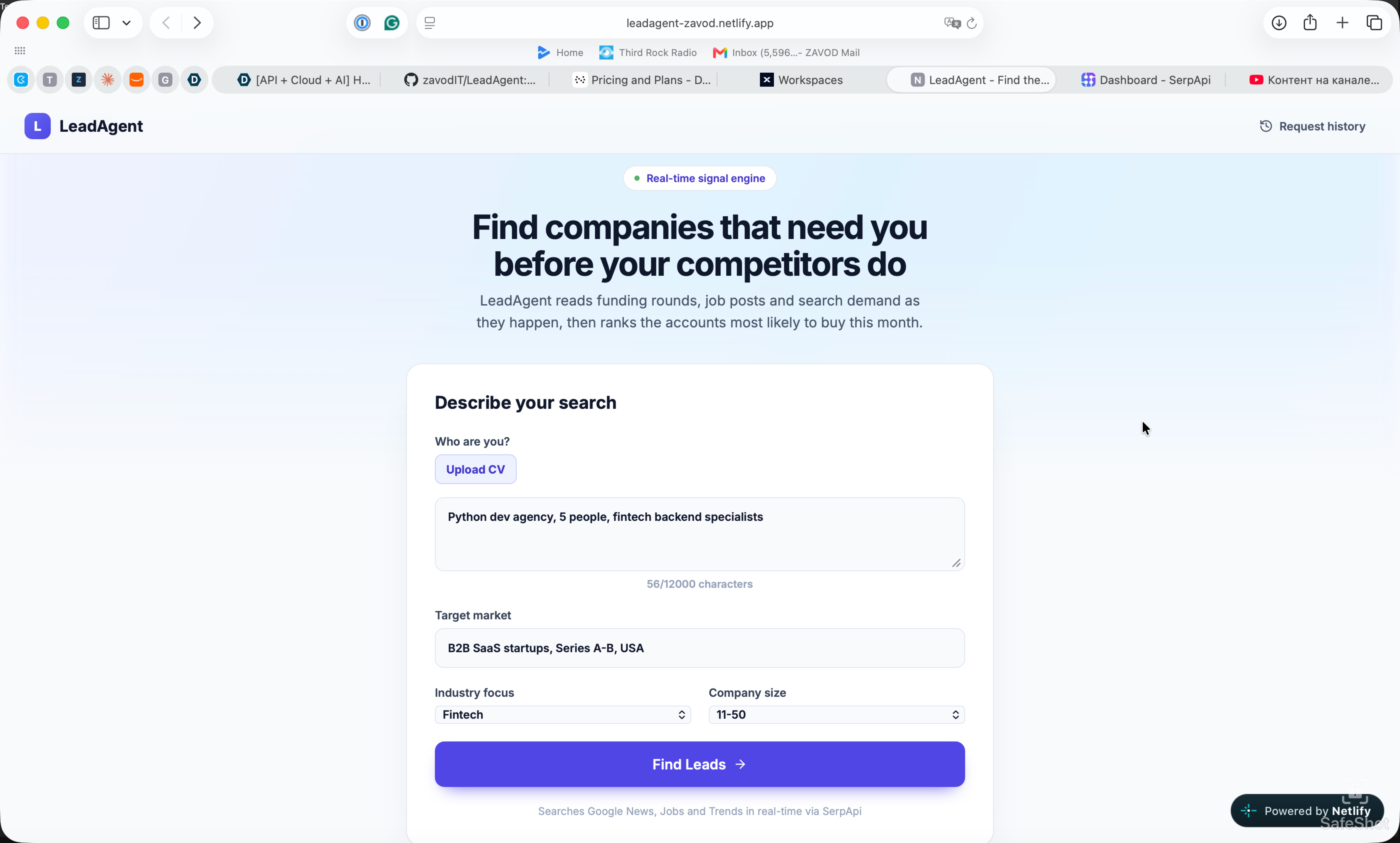
Try it live: https://leadagent-zavod.netlify.app
Source code: https://github.com/zavodIT/LeadAgent
Inspiration
Every week, somewhere in your market, a company raises a funding round, opens five backend roles, or launches a product it isn't ready to support. That is the exact moment they need outside help - and almost nobody reaches out that week. Small agencies and lean sales teams don't have a research department: they either blast generic cold pitches or burn hours manually scanning news and job boards for the two or three companies that are actually in-market right now. We wanted the research itself to be automatic, grounded in real evidence, and fast enough to run before a competitor notices the same signal.
What it does
LeadAgent turns live market signals into ranked, evidence-backed B2B leads with a ready outreach draft - in under a minute.
- Describe your offer, or upload a CV/company profile and let it extract your capabilities automatically.
- LeadAgent scans live signals (funding announcements, hiring surges, product launches) for your target industry and market.
- An AI agent qualifies each result - grounded strictly in the retrieved evidence, scoring fit and urgency, and explaining "why now" with cited sources. It cannot invent a company, a funding round, or a fact that isn't in the evidence.
- Opening a company card auto-enriches it with the real website, logo, description, and social/careers links.
- Each lead gets a drafted first-touch outreach message referencing the actual signal, editable and ready to send.
- The full research history and a downloadable PDF brief are always one click away.
How we built it
- Xano is the entire backend: declarative API endpoints, a Postgres- backed data model (research runs, saved evidence, a lead pipeline table), and an Xano AI Agent that performs the qualification reasoning itself - tool-free, grounded to only the supplied evidence, temperature 0 - with no separate model host or custom server.
- SerpApi powers two distinct calls: the
google_newsengine pulls live funding/hiring/launch signals for the qualification agent, and thegoogleengine (with Knowledge Graph) enriches a chosen company with its site, logo, description, and social/careers links. - Nutrient DWS is used at both ends of the pipeline: the Build API extracts plain text from an uploaded CV/PDF on the way in, and the Processor API renders the final lead report or company brief to a downloadable PDF on the way out.
- React + Vite is the single-page frontend that ties the whole flow together, with every request going straight to the Xano API.
Challenges we ran into
- Keeping the AI qualification strictly grounded - the agent had to be prompted and constrained (tool-free, temperature 0, JSON-only output) to never invent a company, funding amount, or date that wasn't present in the retrieved evidence.
- Deriving a precise search query from free-form input (an offer description or a raw CV) so the signals we retrieve are actually relevant to what the user sells, instead of generic industry noise.
- Handling long resumes and long offer descriptions without blowing past request size limits or diluting the qualification prompt.
- Making PDF generation work within Xano's plan limits by returning the rendered file as base64 instead of relying on server-side file storage.
Accomplishments that we're proud of
A complete, working loop - not a mockup - from a cold market signal all the way to a cited, ranked lead with an enriched company profile, a drafted outreach message, and an exportable PDF brief, running on three sponsor products with no custom backend infrastructure in between.
What we learned
Grounding an AI agent in retrieved evidence (rather than letting it answer from general knowledge) is what makes AI-qualified leads trustworthy enough to actually act on - and that constraint has to be designed into the prompt and the data pipeline together, not bolted on afterward.
Build notes for the sponsor challenges
Xano: LeadAgent replaces the manual work a founder or SDR would otherwise do across a news aggregator, a spreadsheet, and a generic AI chat tool stitched together by hand. We chose Xano because it let us ship the entire backend - API, database, and the AI qualification agent itself - as one declarative, inspectable workflow with no server to provision. We used Claude and Codex (via AI coding agents) to write the Xano workflows, prompts, and frontend. Total build time was roughly 7 hours. Without AI + Xano, wiring a comparable backend (auth, a Postgres schema, REST endpoints, and a grounded LLM orchestration layer) by hand would have taken significantly longer - likely days instead of hours.
SerpApi: LeadAgent's entire signal-discovery step runs on SerpApi - without it we would be scraping Google directly, which is unreliable and against Google's terms. The google_news engine finds the funding/hiring/ launch events that trigger a lead in the first place, and the google engine with Knowledge Graph turns a bare company name into a full profile (site, logo, socials, careers page) in one call, instead of us writing and maintaining our own scraper and HTML parser for each of those steps.
Nutrient DWS: DWS does the heavy lifting on both ends of the pipeline - the Build API turns an uploaded CV/PDF into clean input text, and the Processor API turns the finished research into a client-ready PDF brief - without us writing any PDF-parsing or rendering code ourselves.
What's next for LeadAgent
- Wire the existing lead-pipeline data model (found -> qualified -> to_contact -> contacted -> replied) into the frontend so qualified leads persist and can be tracked over time instead of living only in the current session.
- Add more live signal sources beyond Google News (job postings, search trend data) to widen and sharpen the evidence base.
- Add authentication so research runs and pipelines are per-user rather than anonymous.
Built With
- ai-agent
- css3
- google-news-api
- google-search-api
- html5
- javascript
- llm
- lucide-react
- node.js
- nutrient-dws
- pdf-generation
- postgresql
- prompt-engineering
- react
- rest-api
- serpapi
- typescript
- vite
- xano

Log in or sign up for Devpost to join the conversation.