-
-
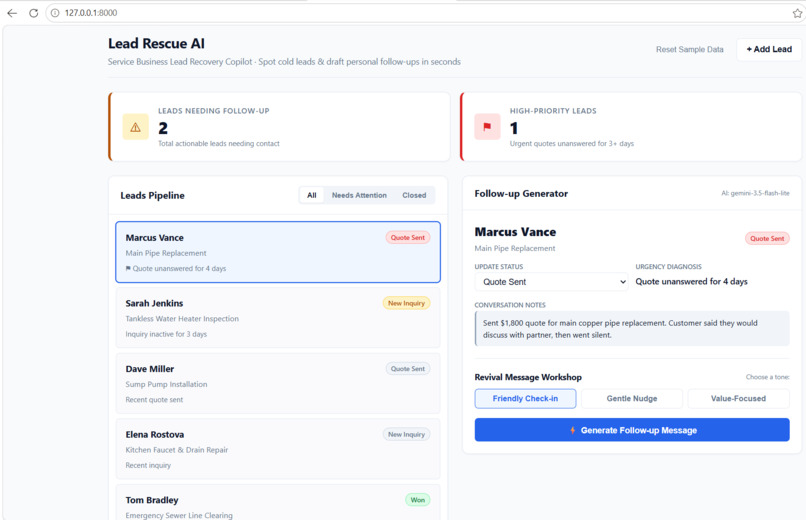
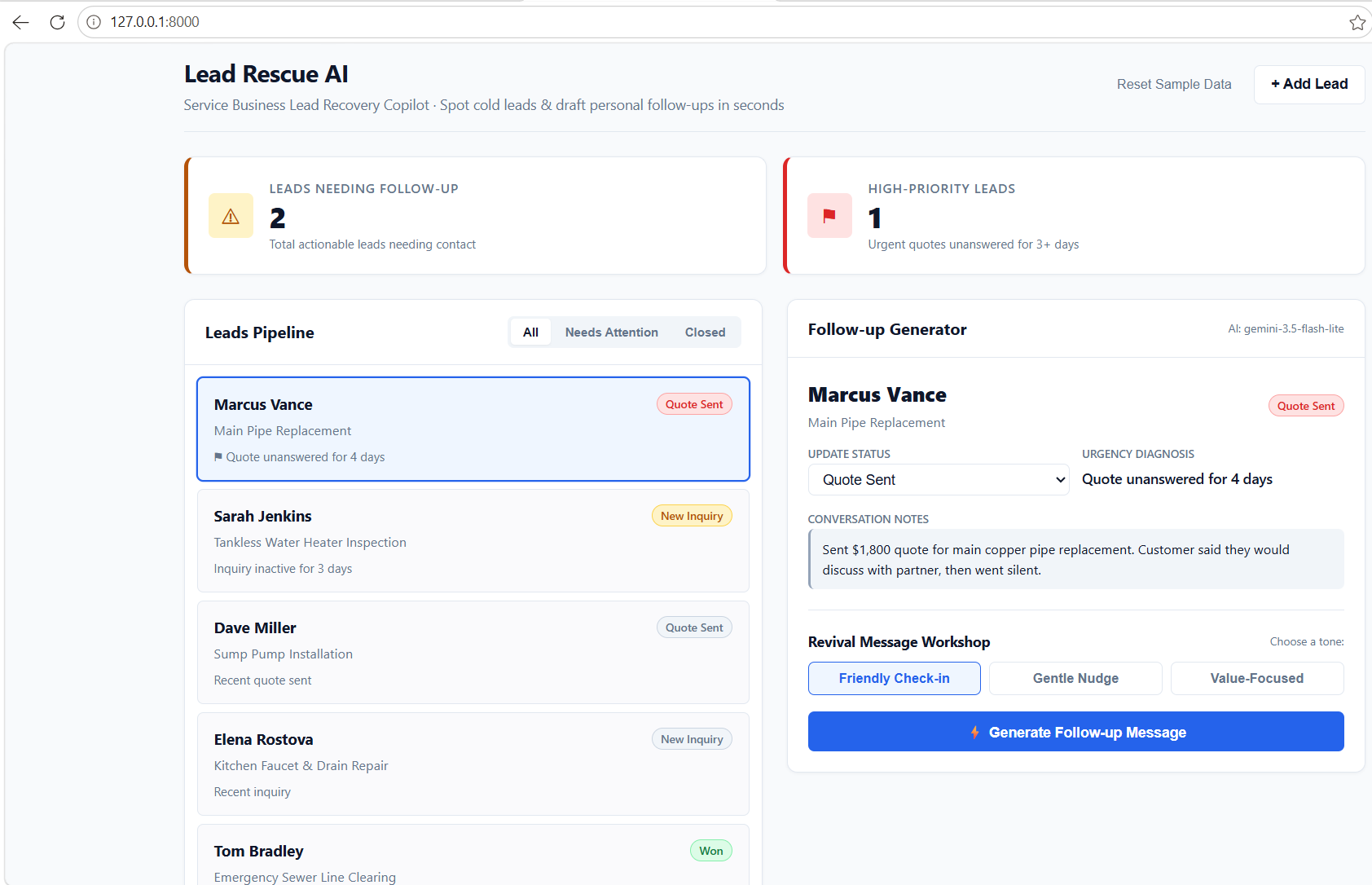
Lead Rescue Dashboard
-
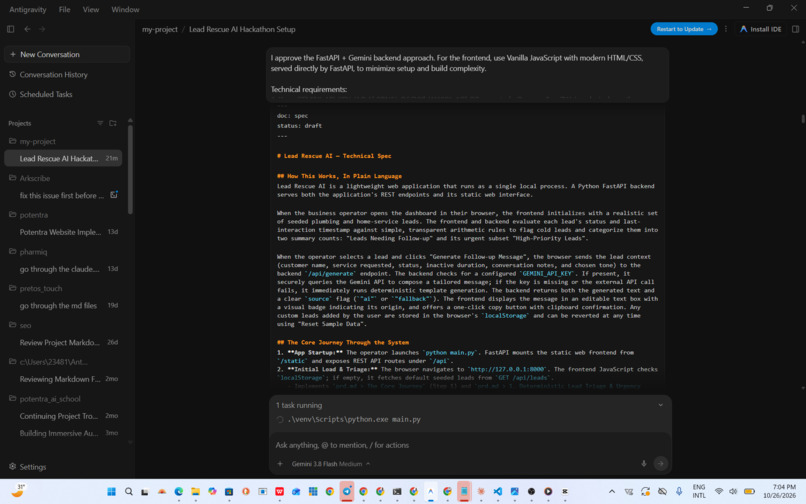
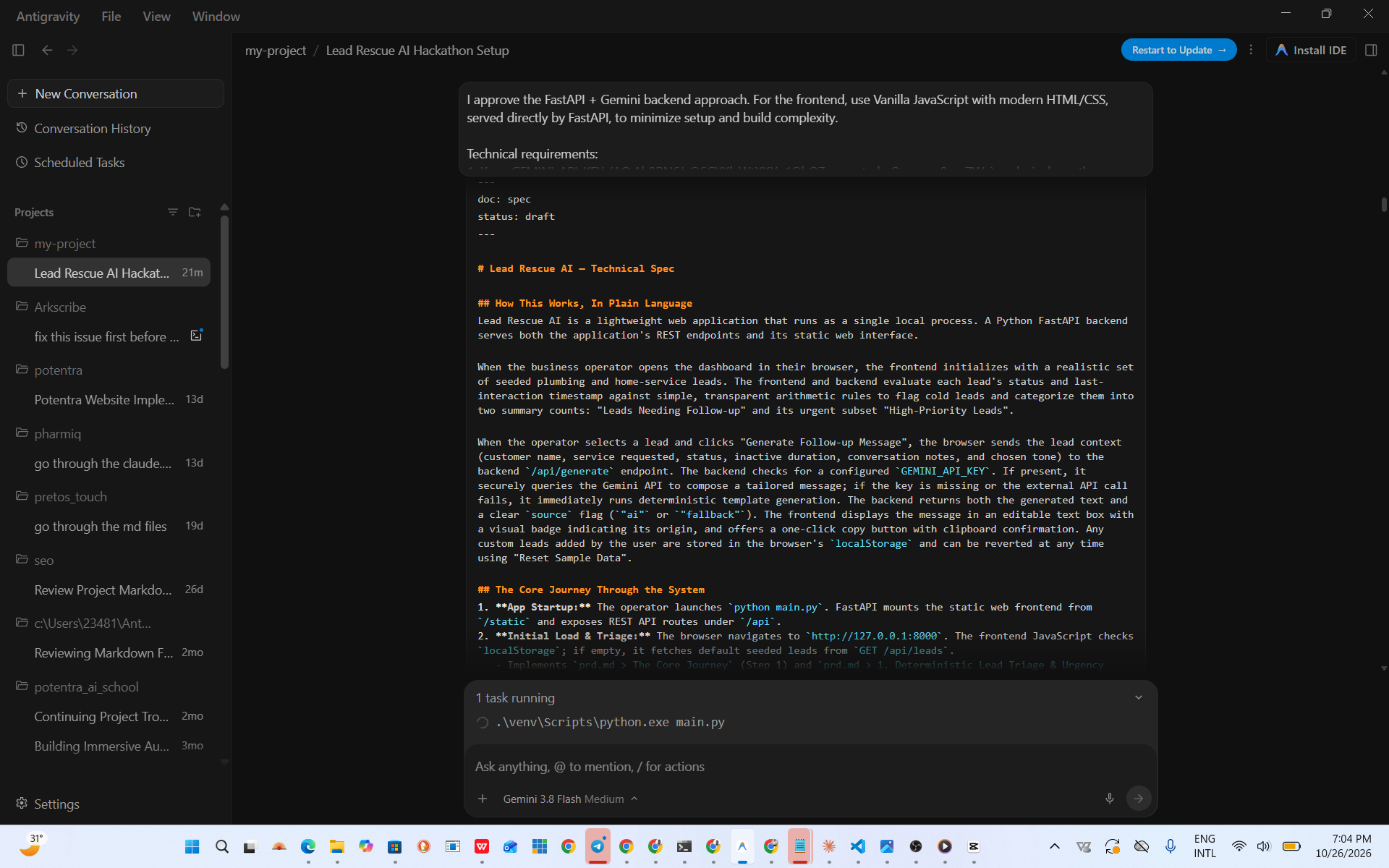
Live AI Coding
The Inspiration
- Small service businesses can lose potential customers when inquiries and quotes go unanswered.
- Following up manually can be time-consuming, and business owners may struggle to decide which leads need attention first.
- Lead Rescue AI was created to address this problem with a focused, practical AI-powered tool.
What It Does
- Displays leads and their current statuses in a simple dashboard.
- Flags quotes unanswered for 72 hours or more as High Priority.
- Identifies inquiries unanswered for 48 hours or more and quotes between 48 and 72 hours as needing follow-up.
- Explains why a lead needs attention.
- Generates personalized messages in three tones: Friendly Check-in, Gentle Nudge, and Value-Focused.
- Allows users to edit and copy messages for use in their preferred communication channel.
- Uses Google Gemini for AI-generated messages, with a template fallback when AI access is unavailable.
- Supports manually adding leads and resetting the sample data.
The prototype prepares messages; it does not automatically send them through WhatsApp or other channels.
How It Was Built
- Followed the Devpost Learn Skill Pack's six-stage workflow: Start, Scope, PRD, Spec, Build, and Ship.
- Created planning documents before implementation.
- Built the backend using Python and FastAPI, with HTML, CSS, and JavaScript for the dashboard.
- Integrated Google Gemini while keeping AI credentials on the backend.
- Developed the application incrementally in five build slices.
- Reported 17 passing automated tests before the final hands-on review.
Challenges
- Implementing consistent, time-based lead prioritization.
- Testing the boundaries between recent, follow-up-needed, and high-priority leads.
- Integrating AI generation without making the application dependent on API availability.
- Providing useful fallback messages when AI generation fails.
- Keeping the project focused enough to deliver a working prototype within the hackathon deadline.
Accomplishments that we're proud of
- Building a working end-to-end prototype within the hackathon timeframe.
- Implementing deterministic lead prioritization with clear reasons for why a lead needs attention.
- Integrating Google Gemini to generate personalized follow-up messages in three different tones.
- Implementing a template fallback so message generation can continue when AI access fails.
- Supporting lead creation, status updates, message editing, and copying through a simple dashboard.
- Achieving 17 passing automated tests before the final hands-on review.
- Following the Devpost Learn Skill Pack and using five incremental build slices instead of attempting the entire application at once.
What I Learned
- Why planning and defining scope before coding makes implementation more manageable.
- How to break a project into small, testable increments.
- How to guide a coding agent, review its implementation, and use automated tests to verify behavior.
- Why reliable fallback behavior matters when building applications that depend on external AI services.
- How to turn an identified business problem into a working, testable software prototype.
What's next for Lead Rescue AI
- Real-world validation: Test the prototype with plumbing and other home-service businesses to learn whether the prioritization rules fit their workflows.
- CRM integration: Connect to existing systems so businesses can import real leads instead of entering them manually.
- Communication integrations: Explore WhatsApp, email, and SMS integrations, with user approval before sending messages.
- Smarter prioritization: Allow businesses to configure follow-up thresholds and eventually incorporate lead value and engagement history.
- Performance measurement: Track follow-up completion and responses to determine whether the product actually helps businesses recover opportunities.
- Deployment and security: Prepare a secure hosted version suitable for real business data and ongoing use.


Log in or sign up for Devpost to join the conversation.