-
-
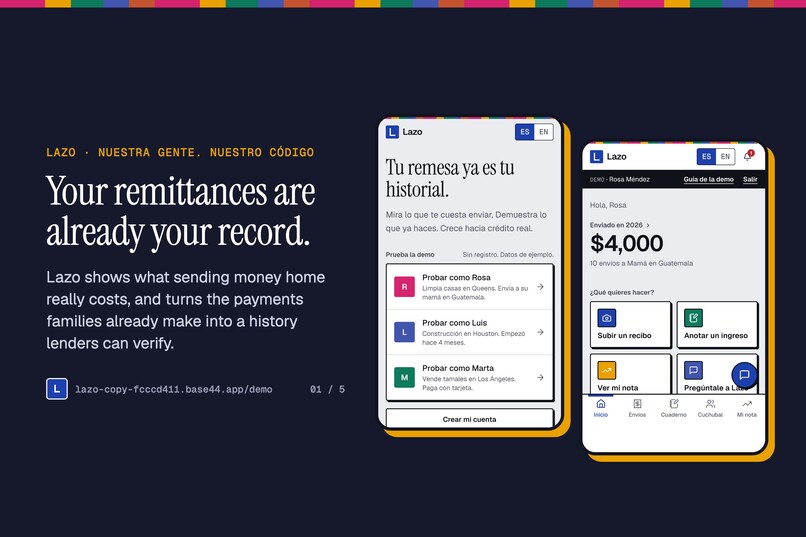
Your transactions = your history.
-
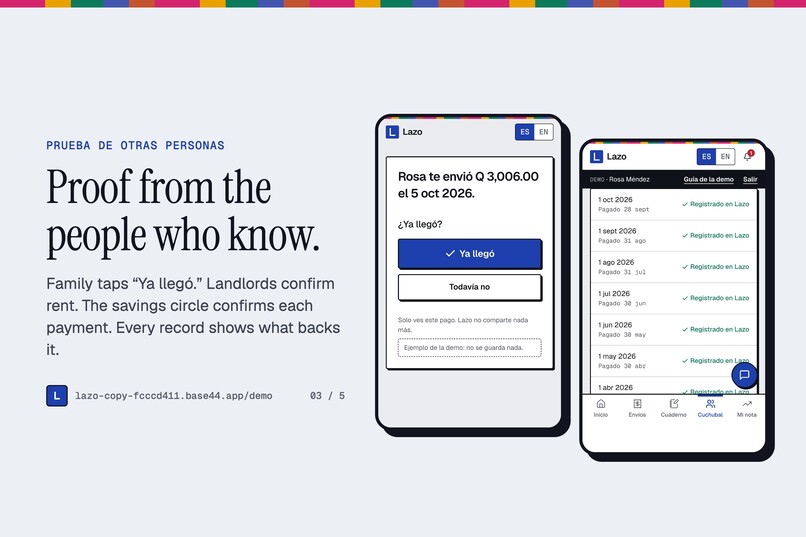
Proofs.
-
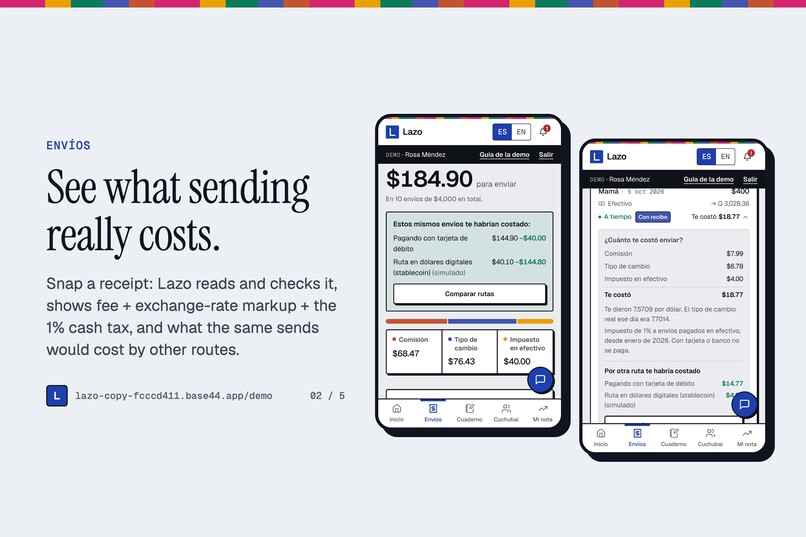
See real costs.
-
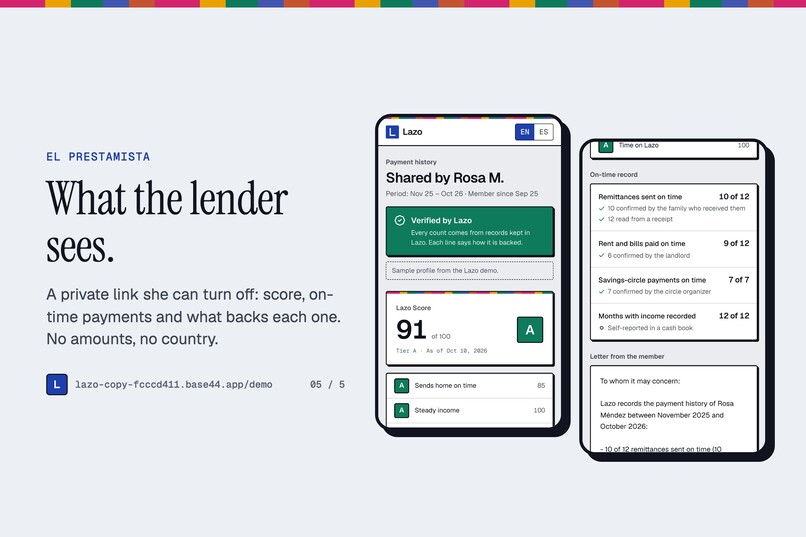
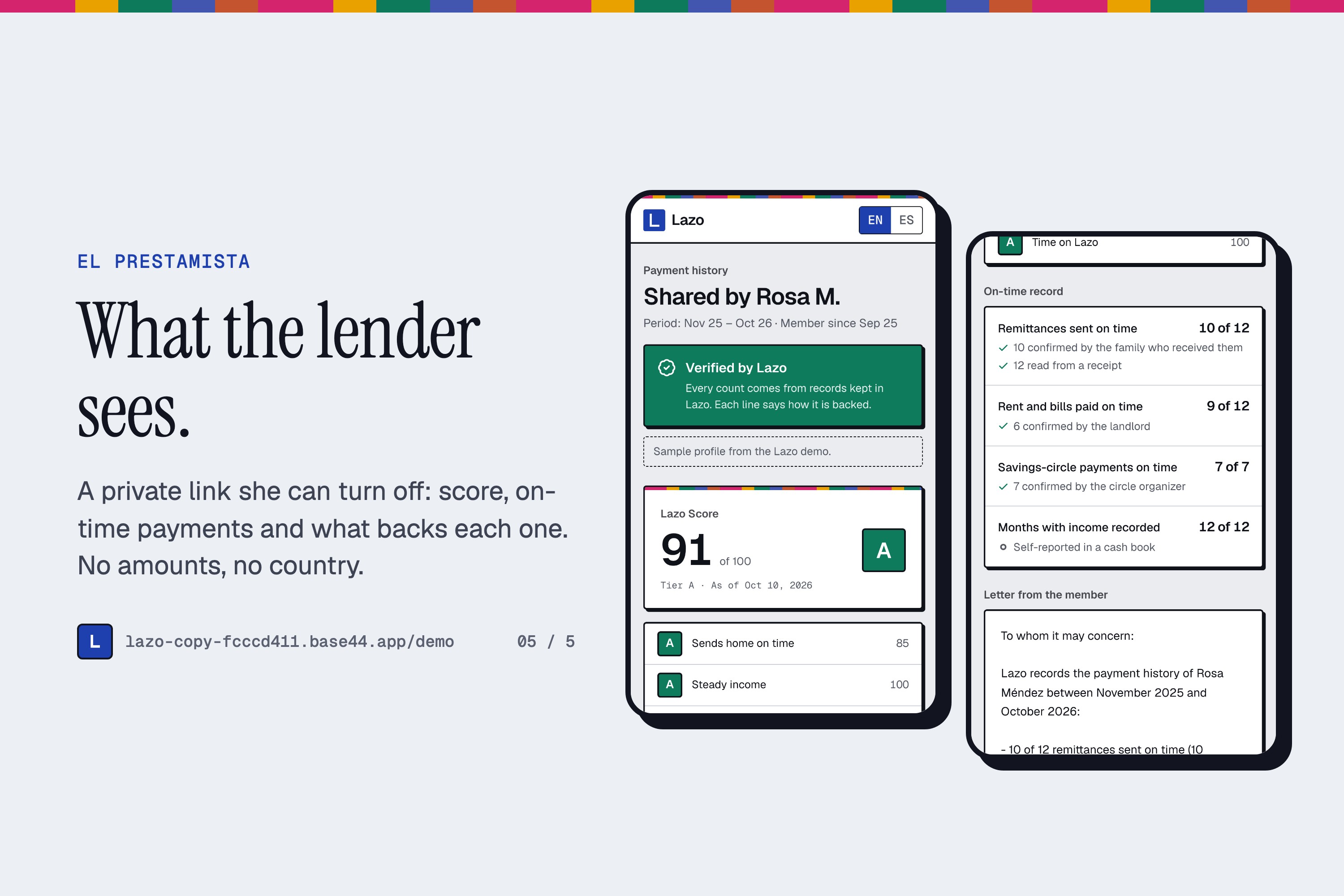
What the lender sees.
-
A private score/
Inspiration
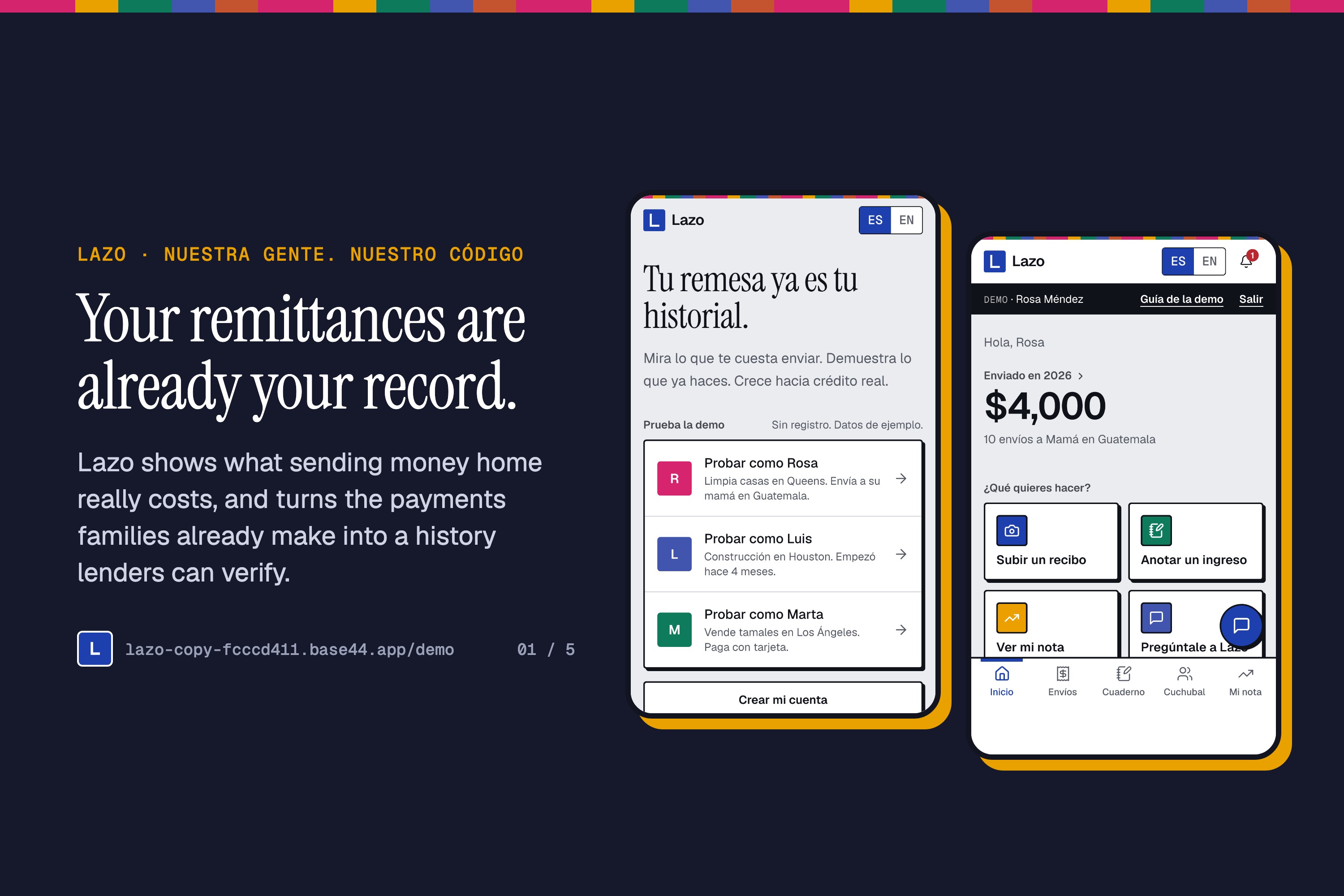
Every month, families in the US send money home to Latin America: $158 billion in 2025, a record. They send it on time, they pay rent, they work in cash and save with friends in cuchubales (rotating savings circles). To a bank, none of it exists: no SSN, no pay stubs, no credit file. The money is already moving responsibly; the system just isn't looking.
What it does
Lazo is a Spanish-first money companion for families who send remittances and live in cash.
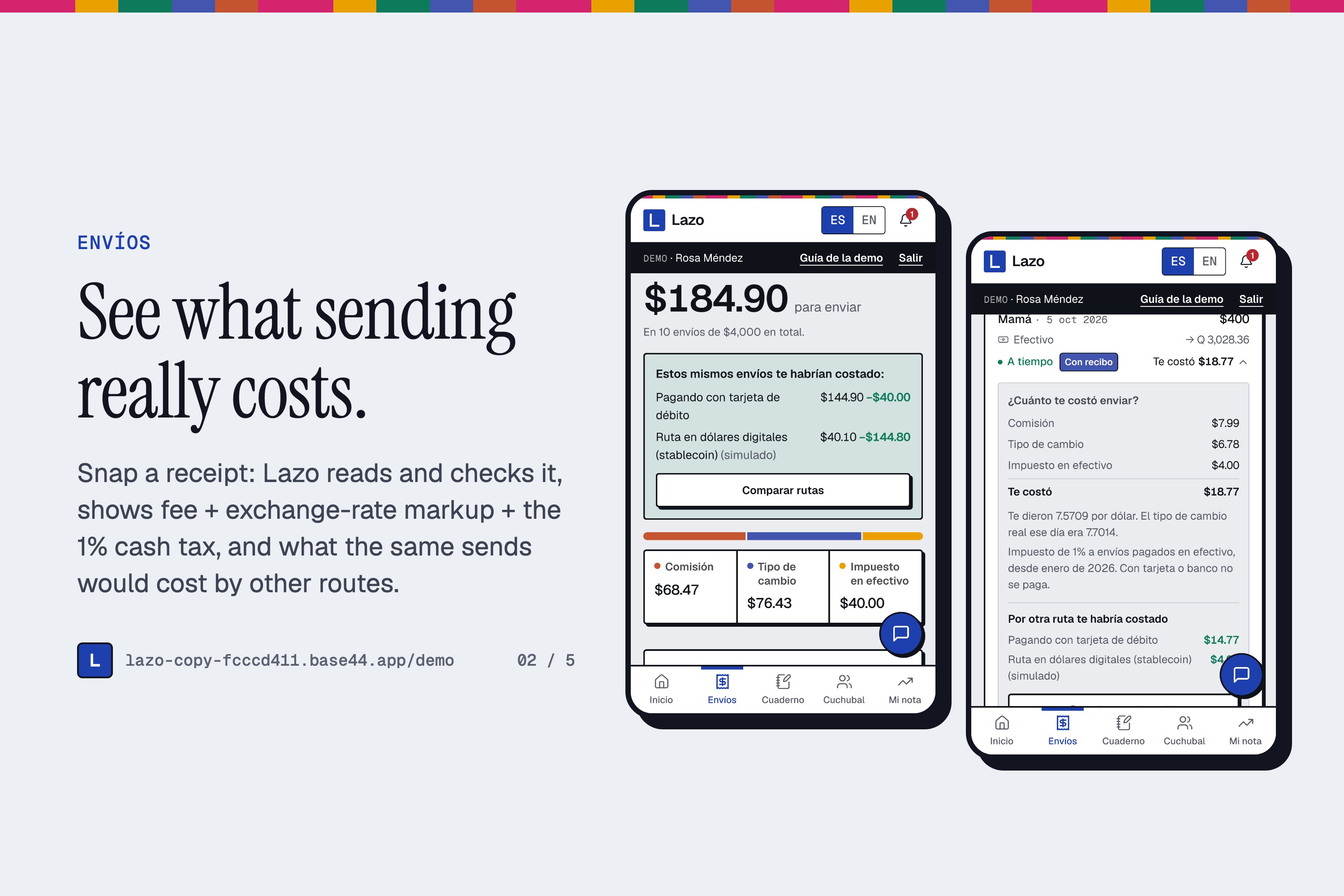
- Ver (See): snap a photo of a remittance receipt and Lazo reads it.
- It checks the receipt: it refuses the same receipt twice and flags math that doesn't add up, a tax line that isn't 1%, a future date, or a rate better than the market that day.
- It shows what the send really cost: fee, exchange-rate markup, and the 1% federal tax on cash-funded transfers since January 2026.
- It compares three ways to send the same amount (your current route, paying by debit card with no cash tax, and a simulated digital-dollar route) and shows what the cheapest one would save over a year.
- Exchange rates refresh every hour, with a 30-day chart and an alert on days the rate is 1% better than the monthly average.
- Probar (Prove):
- Log cash income by typing or by photographing a notebook page. Rent and bills record their due dates.
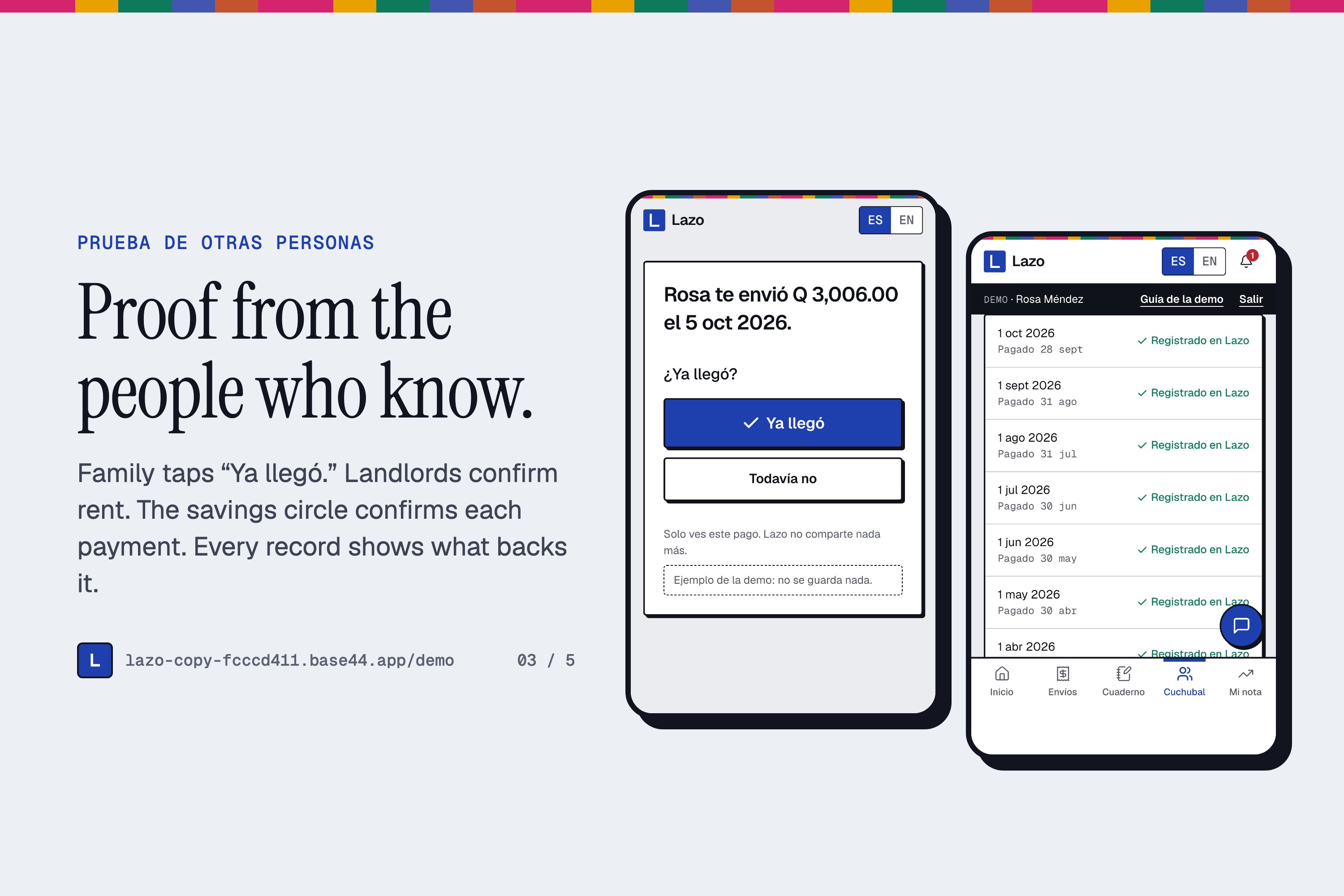
- Run a savings circle: invite by WhatsApp, members mark payments, the organizer confirms them, and reminders go out 2 days before each due date.
- Family back home taps "Ya llegó" from a WhatsApp link, and a landlord confirms rent with one tap.
- Every record shows what backs it: anotado (self-reported), con recibo (read from a receipt), or confirmado (confirmed by another person).
- Crecer (Grow):
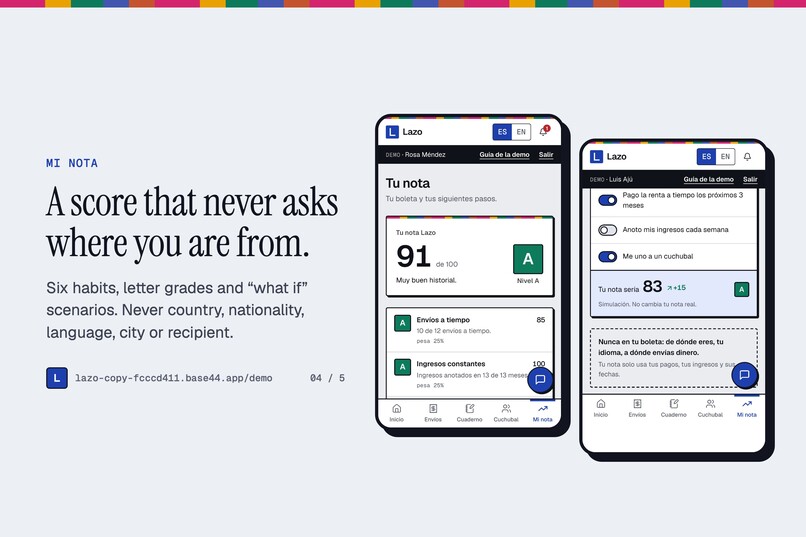
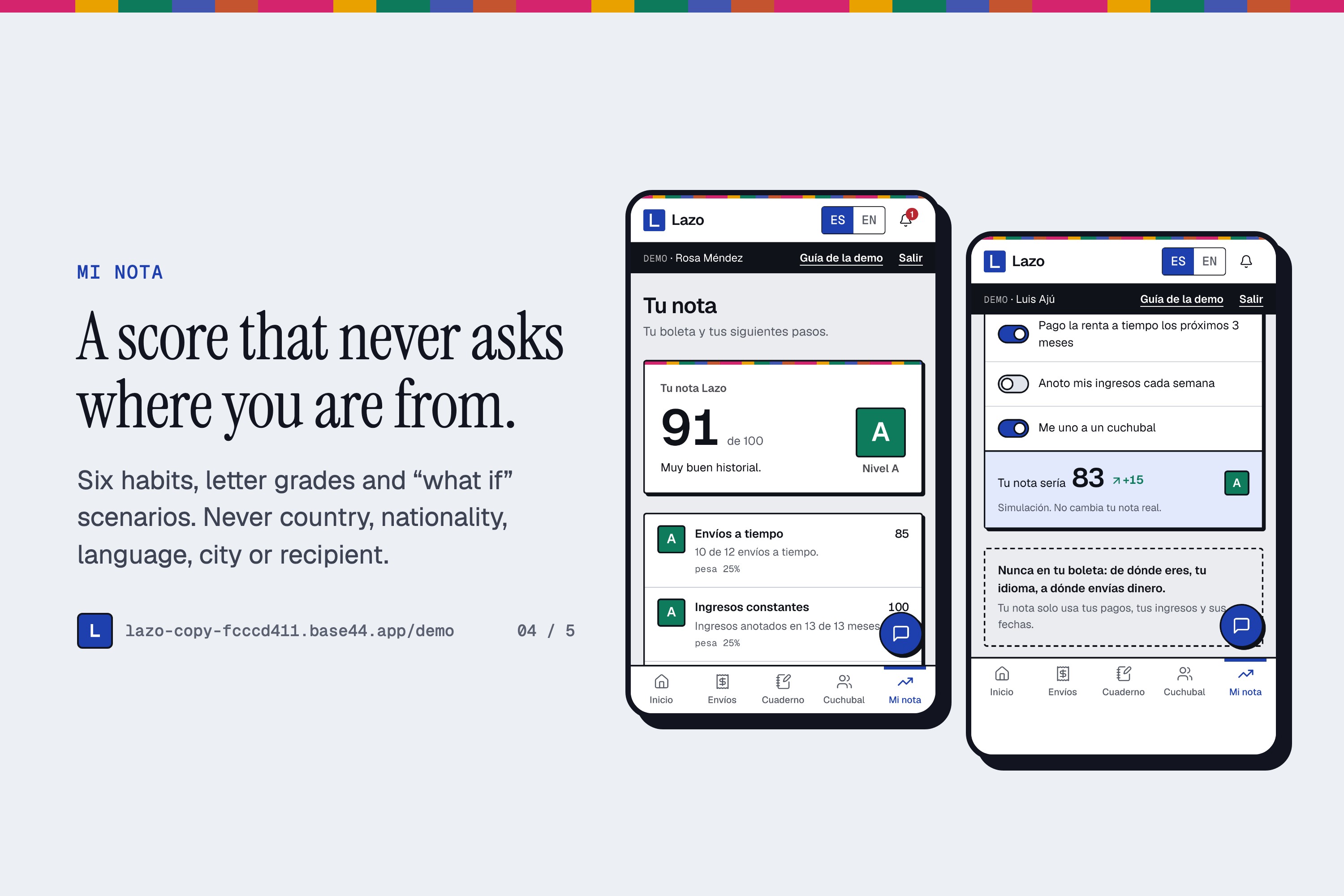
- A report-card score with a letter grade for each habit, and "what if" scenarios such as "what if I pay rent on time for 3 months?"
- A payment-history letter in Spanish and English.
- A private link for a credit union or landlord, shared from the score or the letter: score, on-time counts, what backs each number, and a contact button. The member can turn the link off at any time.
- Lazo, the assistant, answers in plain Spanish using the member's own numbers. It checks suspicious messages for scam signs with a live web lookup, and it only saves something after asking "¿Lo guardo?".
- Aprende (Learn) explains digital dollars, including the risks, and has a practice wallet labeled SIMULACIÓN. It compares a practice send with the member's usual route.
Lazo never asks about immigration status or ID numbers, and stores recipients as nicknames like "Mamá". Receipt photos go to private storage, are read once through a link that expires in 5 minutes, and are never attached to your records. Family and landlord links show a single payment and expire in 30 days. "Borrar todo" deletes every record, removes your name from other people's savings circles and closes your account.
How we built it
We built Lazo during the event on Base44, writing the code with Claude Code through the Base44 CLI and deploying to Base44 hosting. It runs on:
- 18 entities for the data.
- 15 backend functions:
- score and what-ifs
- exchange rates and good-day alerts
- receipt reading and checking
- the letter
- family and landlord confirmations
- the lender page
- savings circles
- the assistant, scam check and web search
- full account deletion
- Base44 workflows for hourly rates and daily savings-circle reminders.
- Base44's built-in AI and private file storage to read receipts and notebook pages.
Exchange rates come from free public APIs. The letter is written by the AI from counts only, and we check that every number in the letter matches the record; if one doesn't, Lazo uses a plain template instead.
The cost of each send is plain math, so every number is explainable:
$$ \text{cost} = \text{fee} + \text{amount} \times \frac{r_{\text{market}} - r_{\text{provider}}}{r_{\text{market}}} + \text{cash tax} $$
The score is plain math too: six weighted habits, each scored from 0 to 100.
$$ \text{score} = 0.25\,P + 0.25\,C + 0.20\,B + 0.15\,V + 0.10\,T + 0.05\,R $$
where $P$ is sending home on time, $C$ is steady income, $B$ is bills on time, $V$ is a savings cushion, $T$ is community (savings-circle payments) and $R$ is time with Lazo. It deliberately never uses country, nationality, language, city or where the money goes.
Challenges we ran into
- Remittances alone are a weak credit signal. A CFPB study found remittance history adds little predictive value on its own and can correlate with ethnicity, which is a fair-lending risk. So we don't score where money goes; we score whether people keep the schedule they set, alongside rent, cash income and savings-circle payments.
- Trust without a bank. Self-reported numbers are easy to dismiss. Every record therefore shows what backs it: read from a receipt that passed our checks, or confirmed by the family that received the money, the landlord or the circle organizer. The lender sees those counts, not just a total.
- Designing for fear. Recent fights over sharing taxpayer data with immigration enforcement make families wary of any app. Every choice (no status questions, nicknames, private photos, expiring links, a delete that really deletes) came from asking "what's the least we can keep?"
- Cash leaves no trail. Most of our users have no bank deposits to show, so the cash book had to be as easy as typing a number or snapping a photo of a notebook.
- Time. We had one day. We cut real lending, crypto yield and onchain letters to ship a demo that works end to end.
What we learned
The problem isn't that these families lack financial history; it's that their history is invisible.
We also learned how expensive "small" costs are. At a typical ~4% to send, a family sending \$400 a month loses about
$$ \$400 \times 12 \times 4\% \approx \$192 \text{ a year,} $$
plus \$48 more if they pay in cash (the 1% tax). In our demo, Rosa paid \$184.90 to send \$4,000 this year, and a cheaper route would save her about \$177 a year. Across the US–Latin America corridor, that's roughly \$6 billion a year (our estimate).
What's next
- Partner with a credit union or CDFI that already lends to ITIN holders, so the Lazo record turns into real credit.
- Emergency advances paid directly to a hospital or school back home, backed by a transparent community guarantee fund.
- Dollar savings for families abroad through a regulated partner, and verifiable letters anchored onchain.
- Voice in Spanish, and support for Indigenous languages like K'iche' and Mam.
Try it
- Live demo (no sign-up, includes a sample receipt): https://lazo-copy-fcccd411.base44.app/demo
- Create an account: https://lazo-copy-fcccd411.base44.app/registro
- Code: https://github.com/0xgasc/lazo
Sources: Inter-American Dialogue, IDB, Banco de Guatemala, CFPB, Pew Research Center, FDIC.

Log in or sign up for Devpost to join the conversation.