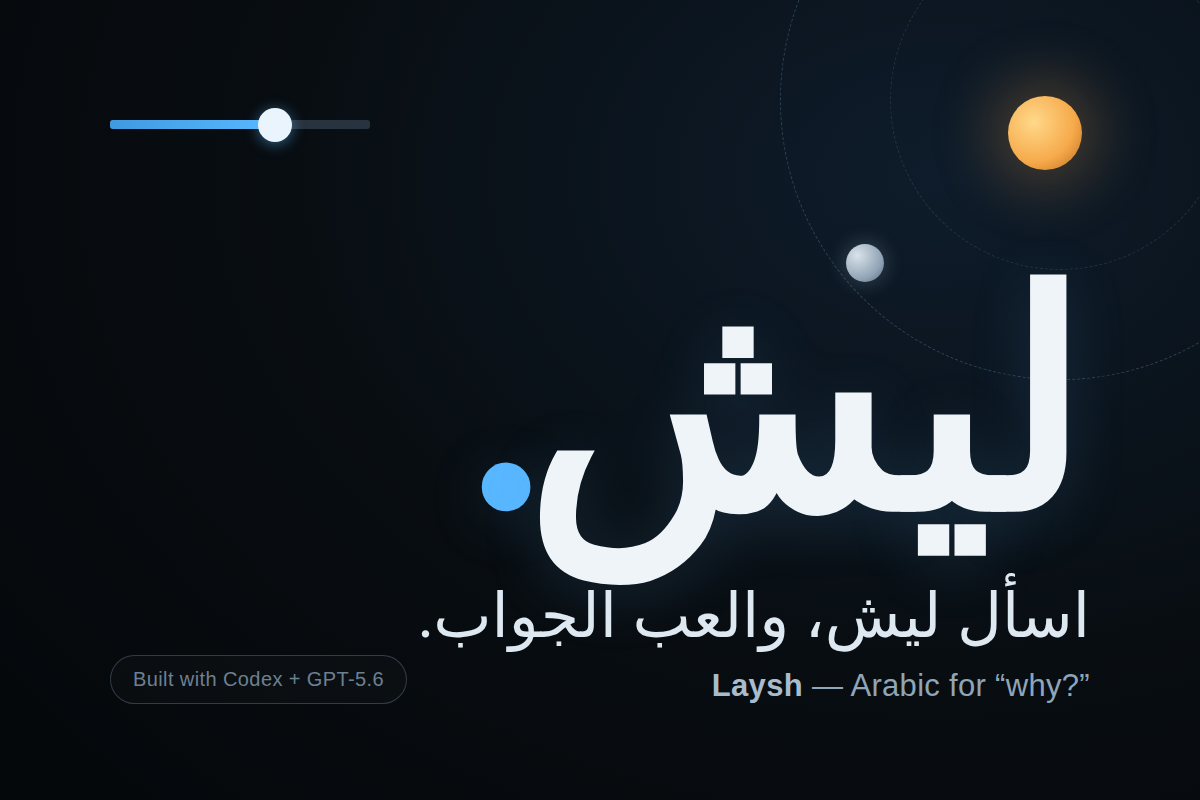
# Laysh (ليش) — Ask why. Play the answer.
## Inspiration
Arabic-speaking learners can always find a definition — what they rarely get is the cause. A paragraph can tell a child why the moon changes shape; it cannot let them see it. Laysh starts from the question children never stop asking — “ليش؟ / why?” — and turns the explanation itself into something they can predict, change, observe, and explain. Arabic is treated as a first-class language, not a translation layer.
## What it does
Laysh is an Arabic-first, fully bilingual (RTL) science experience for learners 13+. Ask any question in Arabic or English: Laysh answers in one honest line, then builds a focused interactive simulation when the concept can be represented truthfully. Six builder-reviewed lessons — Moon phases, buoyancy, pendulum period, a simple circuit, sound pitch, day/night — open instantly, each with a predict-first prompt, live controls, precise assumptions and units, and an expandable verification receipt. Every lesson downloads as one self-contained HTML file that runs with the network switched off.
In the Moon lesson, the drawing is not a decoration: drag the phase angle $\theta$ and the illuminated fraction follows the physics,
$$f = \frac{1 - \cos\theta}{2}$$
— the number and the picture are computed from the same solved state.
## How we built it
The builder owned product direction, pedagogy (predict → observe → explain), acceptance standards, and reviewed every lesson scientifically and linguistically. In one continuous primary Codex thread, Codex authored the repository: closed schemas, a trusted simulation shell, replayable SSE jobs, deterministic verification gates, a bounded heal loop, browser automation, a responsive bilingual UI, tests, and deployment — as granular, dated commits.
GPT-5.6 is the runtime, not just a build tool. gpt-5.6-luna normalizes intent and returns the answer plus a fixed module spec
in one structured call; gpt-5.6-sol generates the restricted simulation module and heals failed drafts from exact gate diagnostics
(at most twice). Thousands of deterministic checks — scene geometry, collision, clearance, viewport framing, scientific fixtures, and
a real browser probe — run with zero model calls in verification. No non-GPT-5.6 model exists anywhere in the runtime path.
## Challenges we ran into
- Honesty as architecture. Generated UIs love to look right. We refused that: a simulation that fails any gate is never labelled verified — the learner still gets a documented text answer instead of a broken toy.
- Killing example-specific fixes. Early on, defects surfaced in reference lessons and the temptation was to patch the example. We adopted a hard rule: fix the pipeline, never the instance — every reference lesson became a regression test regenerated by the system itself, enforced by a CI guard.
- Geometry that holds everywhere. Readable Arabic and stable layouts across RTL/LTR, mobile and desktop, forced a shared scene-geometry gate (collision, clearance, viewport) applied to every generated artifact — mathematically, not by eyeball.
- Fail-open hunting. The release gate itself was audited adversarially: we closed cases where missing evidence could slip through as a pass, and bound sanitized reports to their raw measured evidence.
## What we learned
That trust is a product feature. Learners (and judges) don't need a model to promise correctness — they need receipts: deterministic checks, honest build stages on screen with no fake progress bars, and artifacts whose served bytes provably match their reviewed source. And that Codex works best when the human owns the decisions and the standard, and the agent turns them into tested code.
## What's next
Opening the generation path to more domains, teacher packs built on the offline artifacts, and growing the verified library with every new question learners ask.
Live demo: https://laysh.mlki.app · Code: https://github.com/NexuChat/laysh · Video: https://youtu.be/KRztDZH5BEQ
Primary Codex Session: 019f7998-9378-72b2-b590-ee10e632ce81 · OpenAI Build Week 2026 · Education
Built With
- codex
- css3
- fastapi
- gpt-5.6
- html5
- javascript
- playwright
- python
- sse
- systemd

Log in or sign up for Devpost to join the conversation.