-
Icon/ thumbnail
-
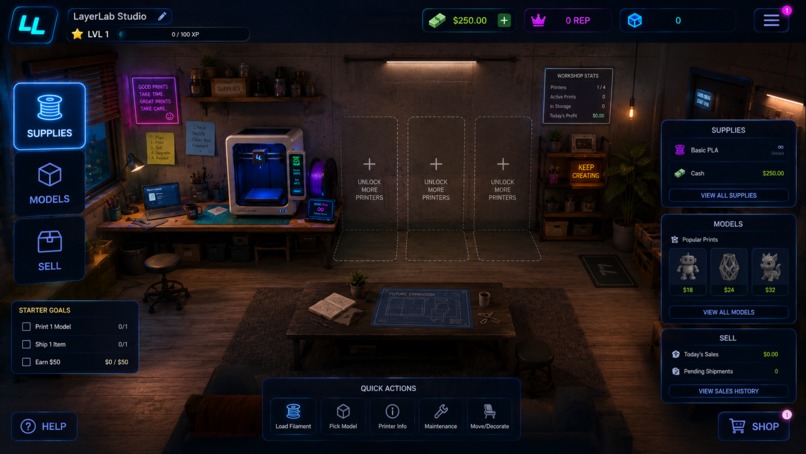
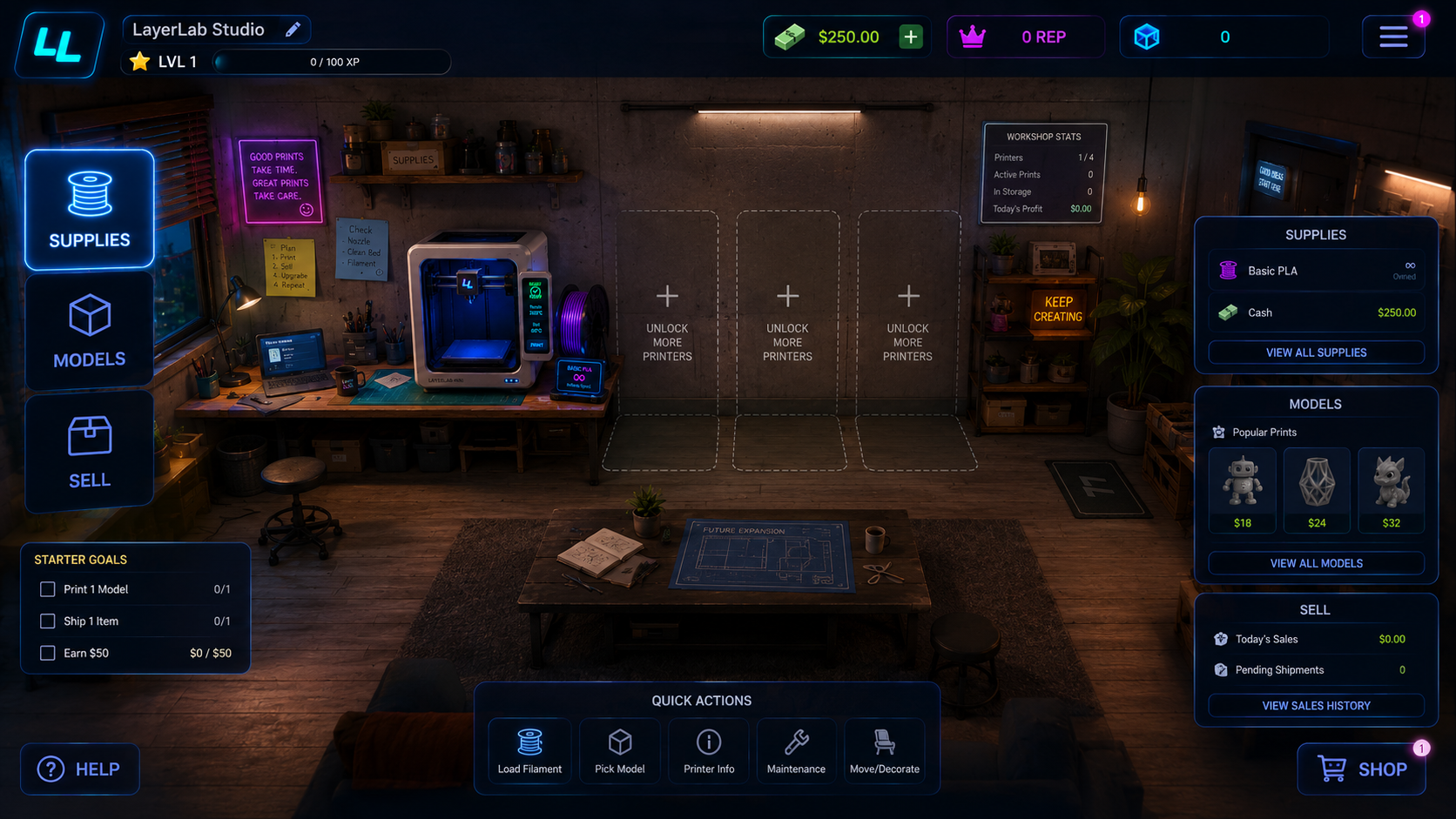
Cozy Bedroom Workshop (Level 1)
-
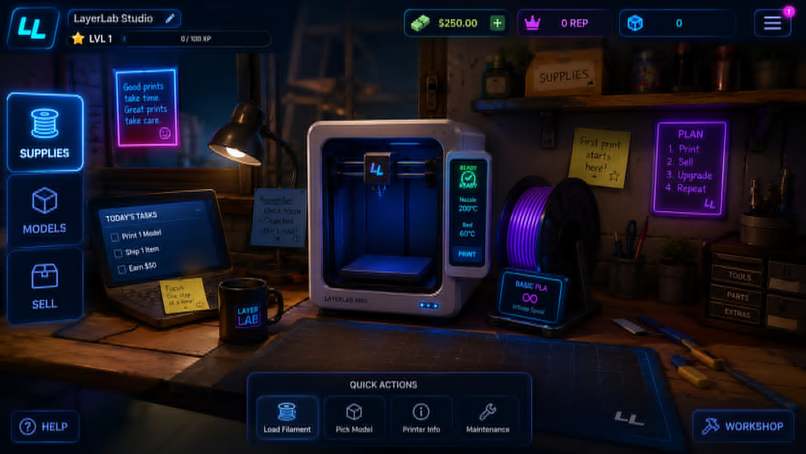
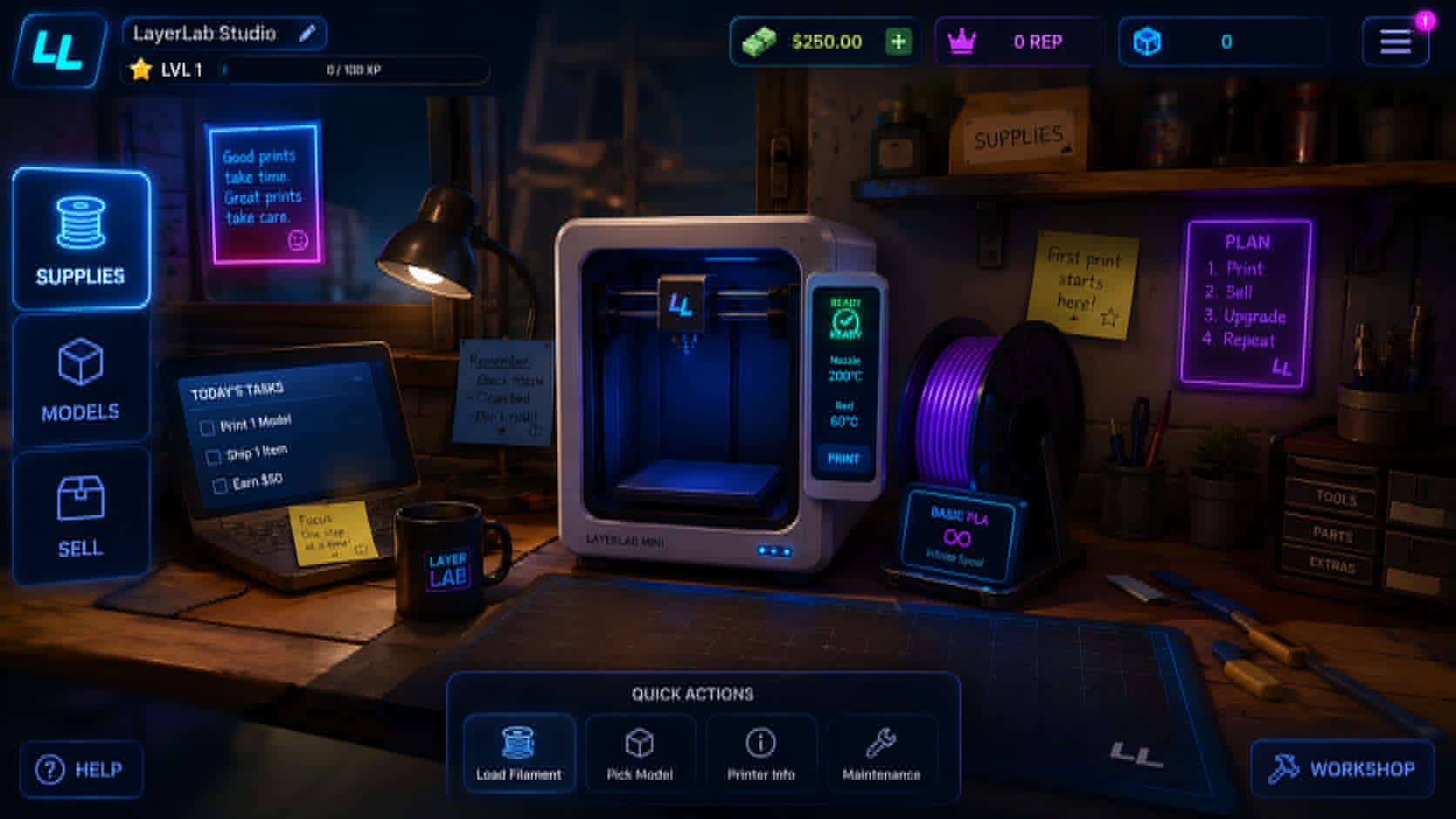
Another Level 1 UI shot
-
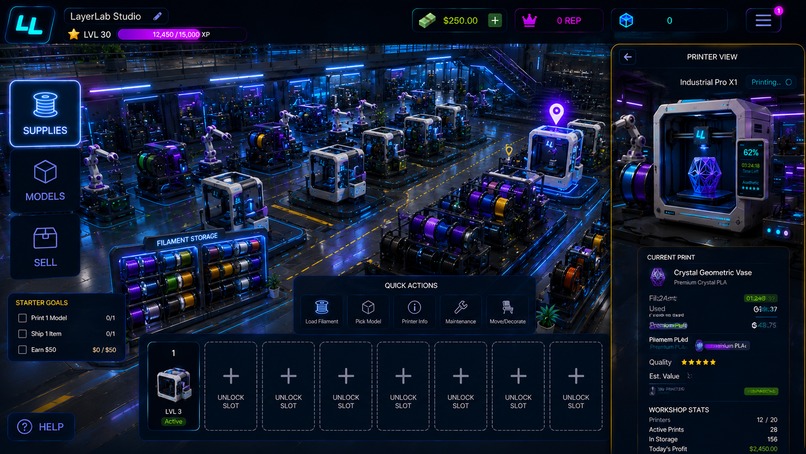
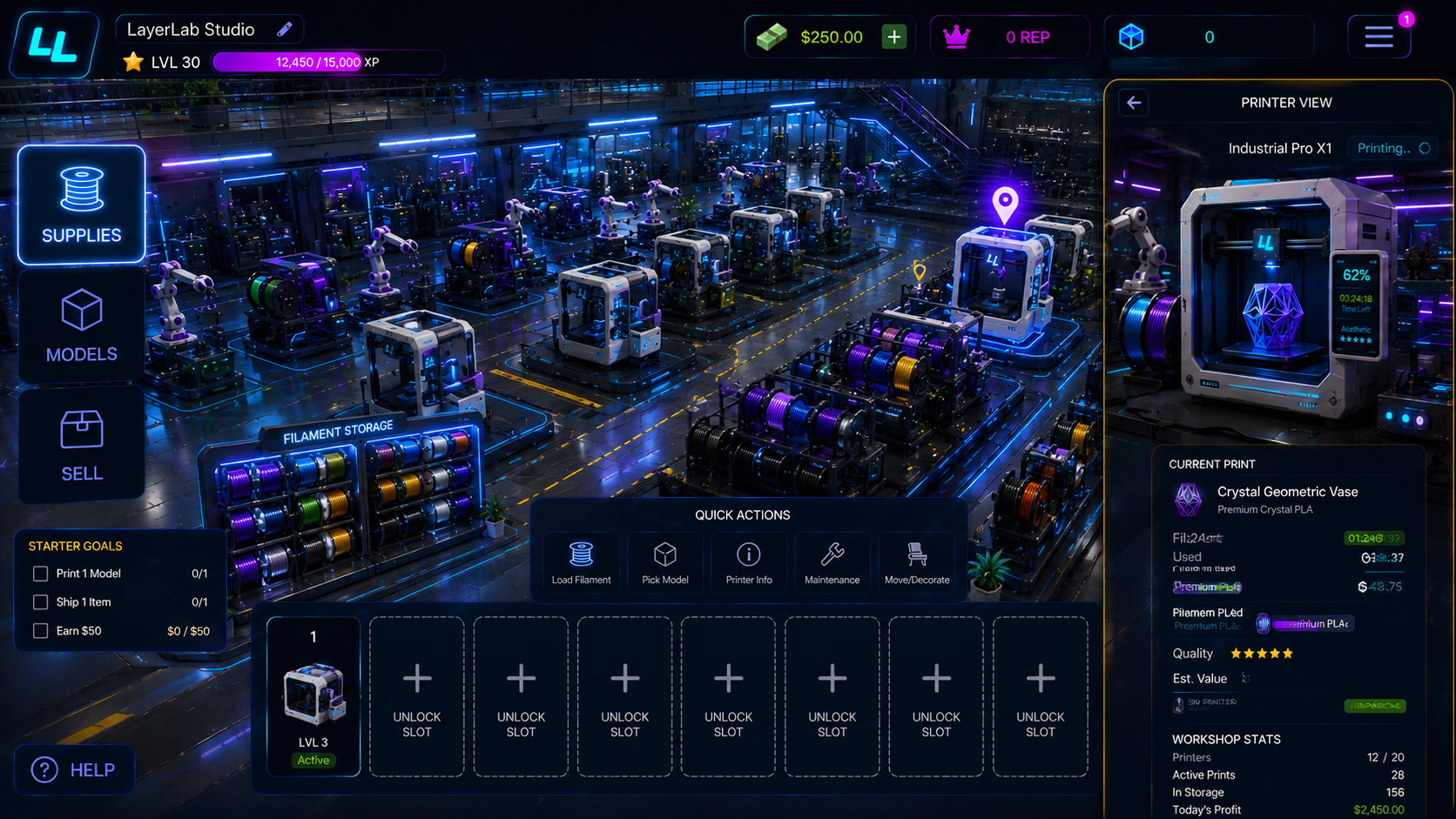
Mid/Late Game Factory
-
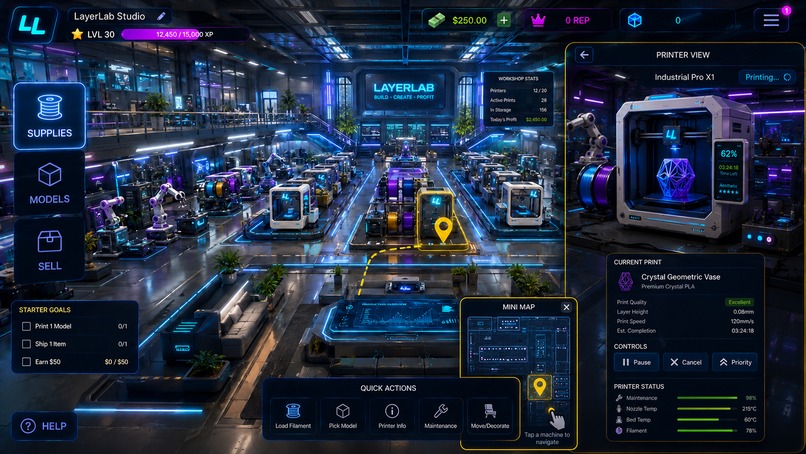
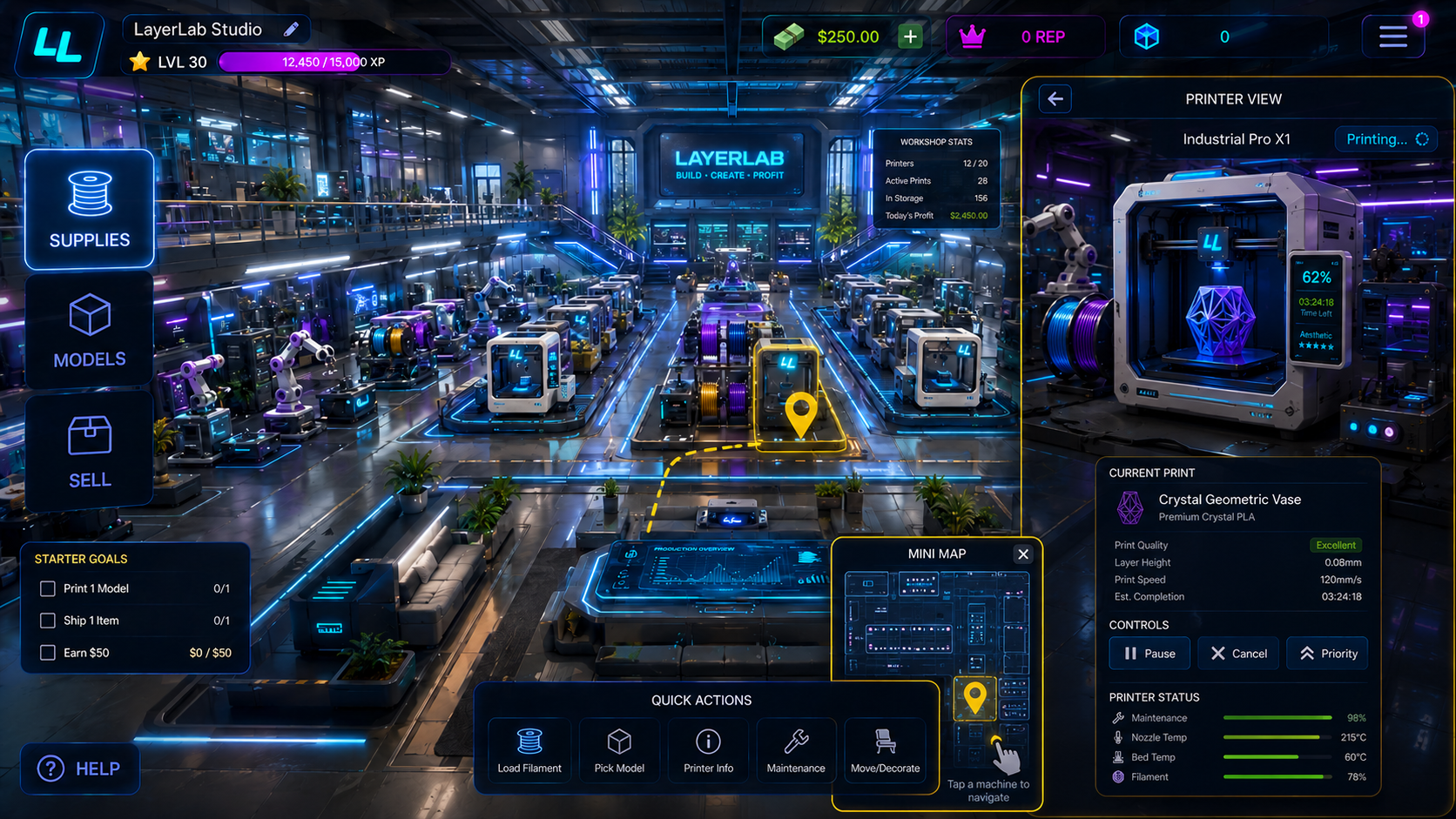
Advanced Factory/Empire Shot
Inspiration
I have wanted to build a cozy tycoon game for as long as I can remember. When I started thinking about what theme would make it feel genuinely fresh, the answer was sitting right on my desk: a 3D printer mid-job, filament spooling, progress bar climbing.
I am personally addicted to 3D printing. Not just the machines themselves, but the entire creative process behind them. I design many of my own prints, experiment with different colors and materials, and love the feeling of turning an idea into something real that I can hold in my hands. For years, I focused on creating digital worlds and games for people to explore, but 3D printing introduced something different: the ability to create physical objects from nothing more than imagination and a design file. There is something incredibly satisfying about watching an idea materialize layer by layer into a real, tangible creation. It never gets old.
3D printing is also having a moment. The technology is moving from hobbyist garages into schools, studios, and small businesses. The culture around it, makers, designers, and the creator economy, is exploding. Layer Lab is built at the intersection of all of that: a game that captures the real feeling of going from one temperamental machine on a bedroom desk to something the whole world wants to buy from.
I will be honest about the personal side of this too. I am actively looking for work in game design and this competition felt like the right moment to prove what I can do. Not just to the judges, but to myself. I set out to complete every artifact, hit every requirement, and deliver something I would be proud to put my name on. The motivation to actually finish, and finish well, came from knowing that a prize could change things for me right now. I gave this everything I had.
I also want to thank my children and my girlfriend for their support throughout this project. They encouraged me to keep pushing forward, listened to more ideas about Layer Lab and other concepts than they probably ever expected to hear, and motivated me to give this competition everything I had. Their support played a big role in helping me complete every artifact and create something I am genuinely proud of.
What it does
Layer Lab is a cozy 3D printing empire builder for mobile. You start with a single low-end printer, one infinite starter spool of Basic PLA, and a tiny workspace. You print models, fulfill customer contracts, unlock rare filament materials, and reinvest your earnings into new printers, automation systems, and workshop expansions.
The workshop itself is the progression system. It visibly transforms around you, from a dim cramped bedroom hobby corner into a glowing neon-lit fabrication empire. Every upgrade changes how you work, not just how fast you go. New printer tiers unlock overnight production runs, multi-material support, and automation hooks. Rare filaments like holographic, bioluminescent, and reactive color-shifting materials create aspirational milestones and collectible motivation. The room tells your story without a single stat screen.
How I built it
Layer Lab was built as a full pre-production package across four documents:
- Game Design Document covering concept, target player, core gameplay loop, progression systems, what makes it fun, future vision, and creative direction
- Player Journey Map showing the first 15 minutes as a visual flowchart of scene beats, decision points, difficulty curve, and emotional arc from curiosity to ownership
- Visual Concept Package including color palette, art direction, UI wireframes, annotated screen mockups, workshop progression comparisons, and visual identity summary
- Production Plan covering MVP definition, 4-phase build sequence, first-playable milestone description, behavioral testing signals, change-direction triggers, and technical architecture notes
Every design decision was made with mobile-first play in mind. The near top-down perspective, large readable touch targets, and lightweight holographic UI panels that never fully cover the workshop were all designed to make Layer Lab feel comfortable during both quick check-ins and longer play sessions.
Challenges I ran into
The hardest design challenge was figuring out when to let go. A cozy game lives and dies by its pacing. Too much friction early and players leave. Too little and there is nothing to earn. Getting the offline progression curve right, keeping it intentionally limited early so players build a real emotional connection to their workshop before automation takes over, took a lot of iteration on paper before it felt right.
The other challenge was making the workshop feel personal without making it overwhelming. The visual identity had to communicate progression instantly without numbers, which meant every filament color, every lighting change, every printer upgrade needed to carry meaning on its own. Designing that visual language, where color equals rarity and the state of the room equals your progress, was the most rewarding part of the whole project.
Accomplishments that I'm proud of
The thing I am most proud of is that all four documents tell one consistent story. The filament progression in the Visual Concept Package matches the material unlock system in the GDD. The Phase 1 build milestone in the Production Plan matches exactly what the Player Journey Map shows at the 2-minute mark. The early workshop tone described in the GDD matches what you see in the UI mockups. That coherence did not happen by accident. It came from designing the game as a system first, and the documents as evidence of that system.
The "What makes Layer Lab original" section also took real work to get right. The answer is not a feature list. It is this: Layer Lab makes the workshop the character. You are not optimizing a pipeline. You are building a brand, one visible upgrade at a time.
What I learned
I learned that a cozy game is harder to design than a stressful one. Stress is easy to manufacture, just add timers and penalties. Cozy has to earn its satisfaction through visible progress, clear goals always just ahead, and the feeling that your time was well spent. Every system in Layer Lab had to answer one question: does this make the player feel like a builder, or does it make them feel managed?
I also learned that the production plan is where ideas get real. Writing the first-playable milestone as a lived 90-second experience, the player taps the spool, selects Basic PLA, watches the progress bar fill, taps Sell, watches currency land in the HUD, forced every earlier design decision to prove it was actually buildable.
What's next for Layer Lab
The next version of Layer Lab expands into a living creator economy. Player workshop visits, community blueprint sharing, cooperative production events, seasonal expos, global leaderboards, and player-driven filament marketplaces would turn a solo experience into something social and ongoing.
I would also love to introduce community blueprint competitions where players submit ideas for new models, themes, or collections. Winning designs could be adapted into official in-game blueprints, giving players a direct hand in shaping the future of the workshop catalog while celebrating the creativity at the heart of the maker community.
The bedroom desk becomes an industrial empire one validated loop at a time.
Craft the future one print at a time.


Log in or sign up for Devpost to join the conversation.