-
-
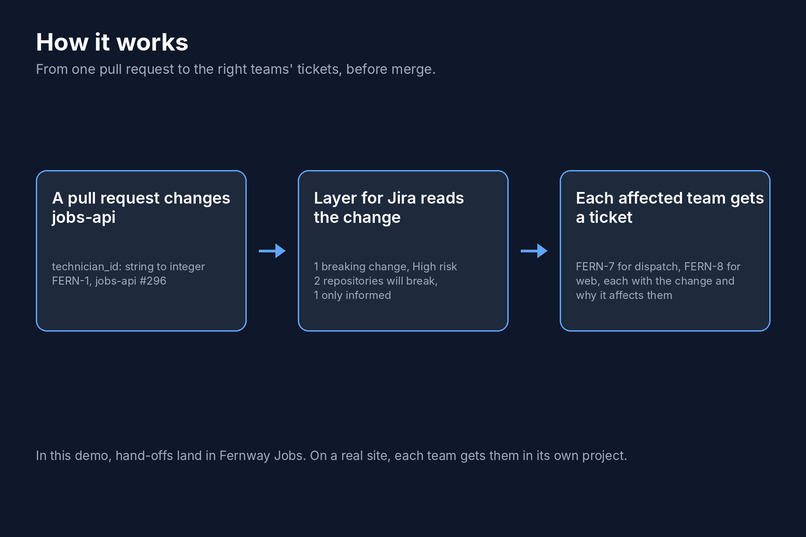
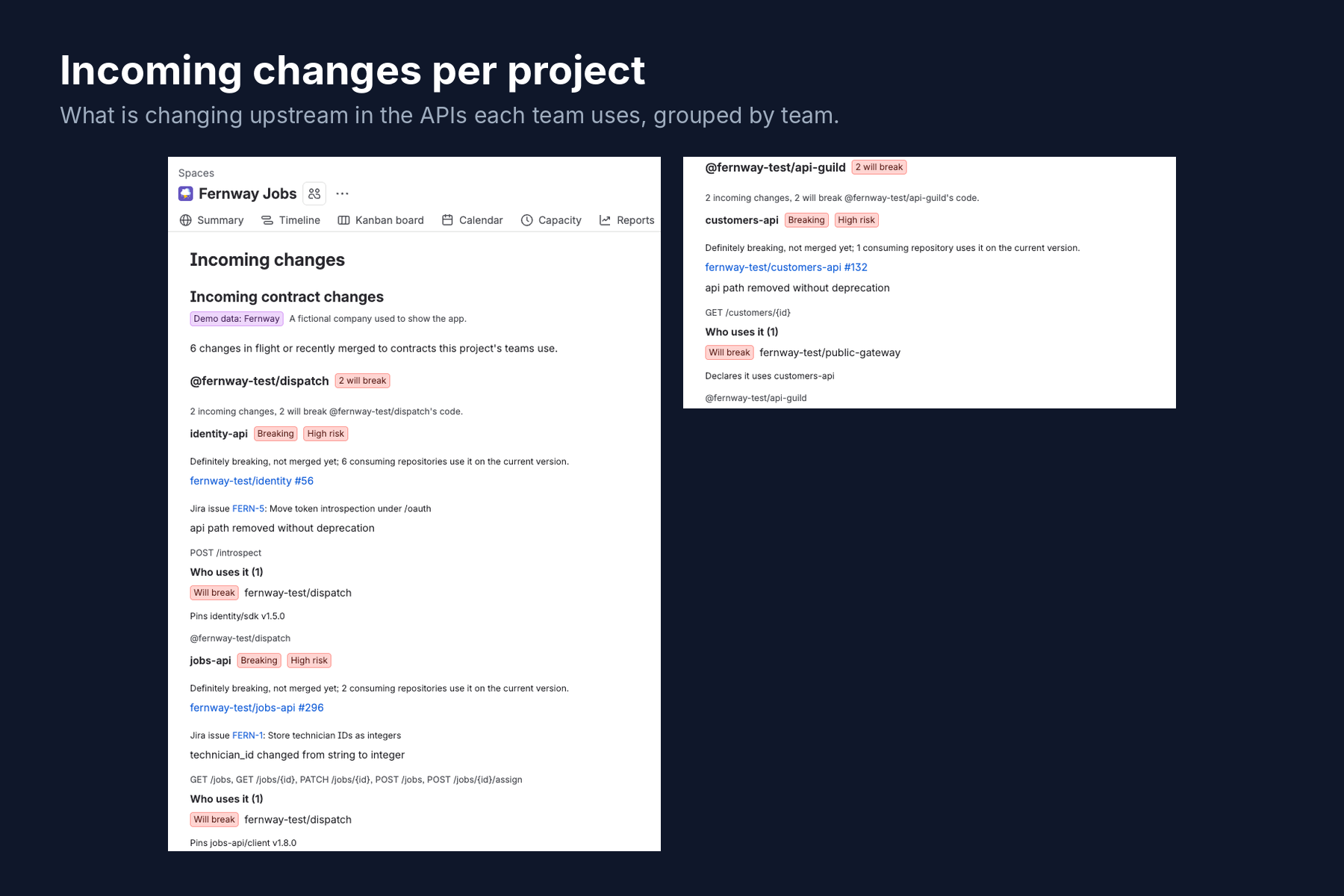
Incoming changes: upstream contract changes that will break each team’s code, grouped by team and linked to their Jira issues.
-
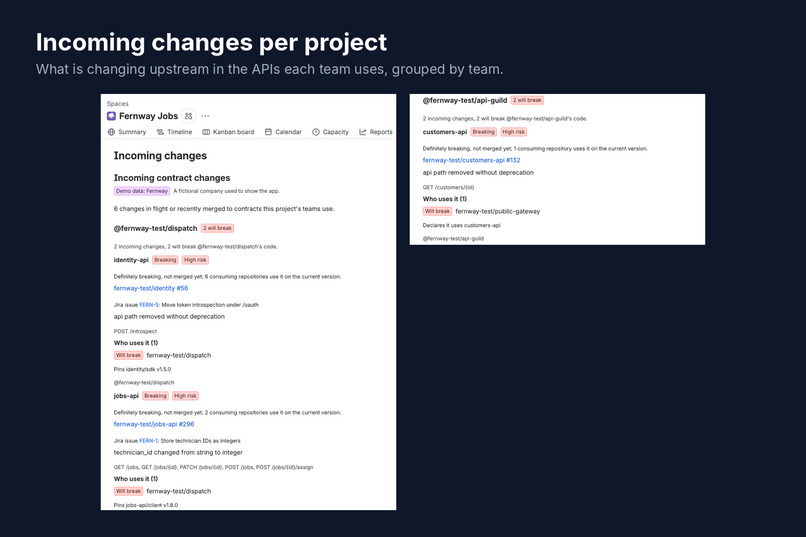
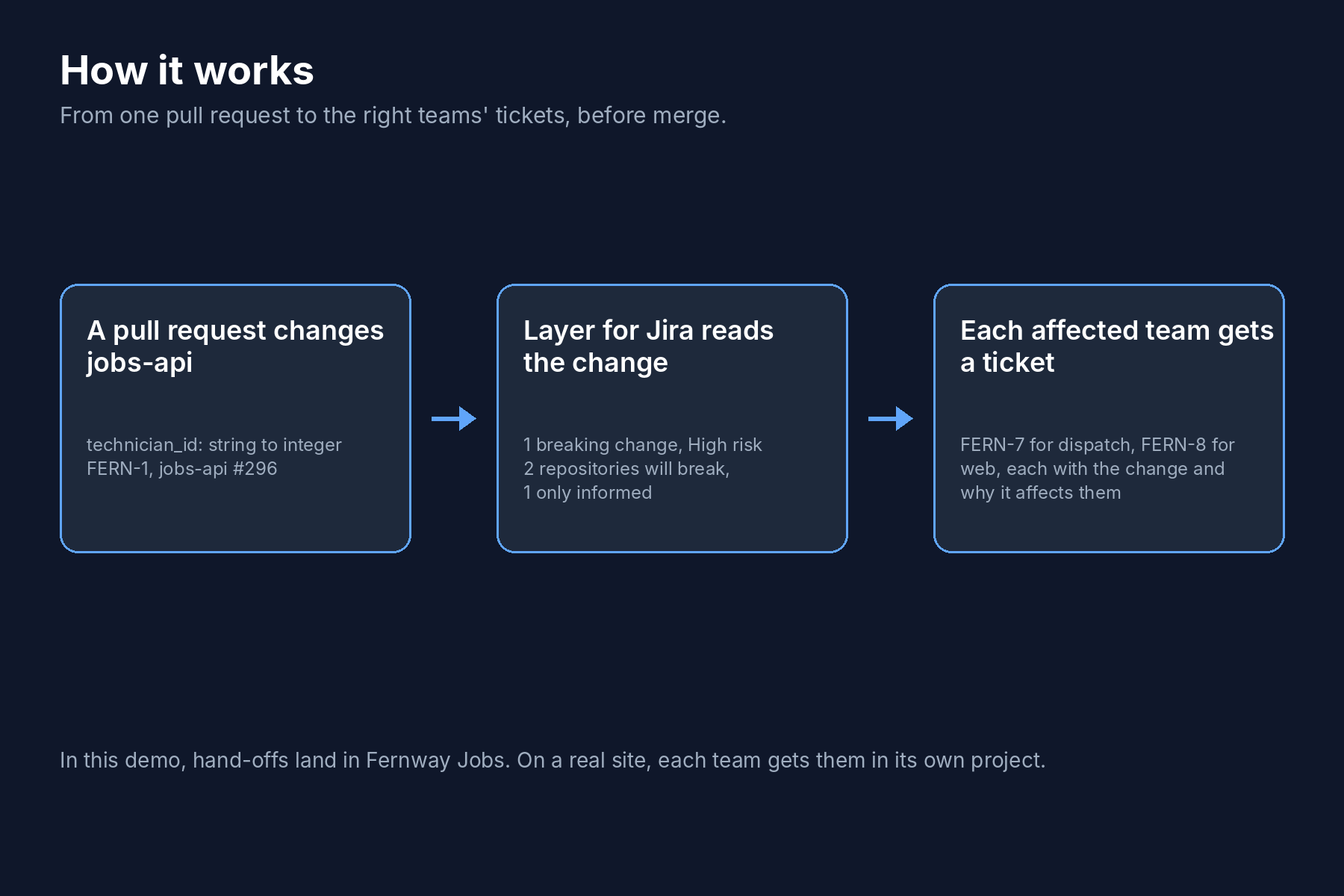
How it works: a pull request changes jobs-api, Layer for Jira reads it, and each affected team gets a linked Jira issue before merge.
-
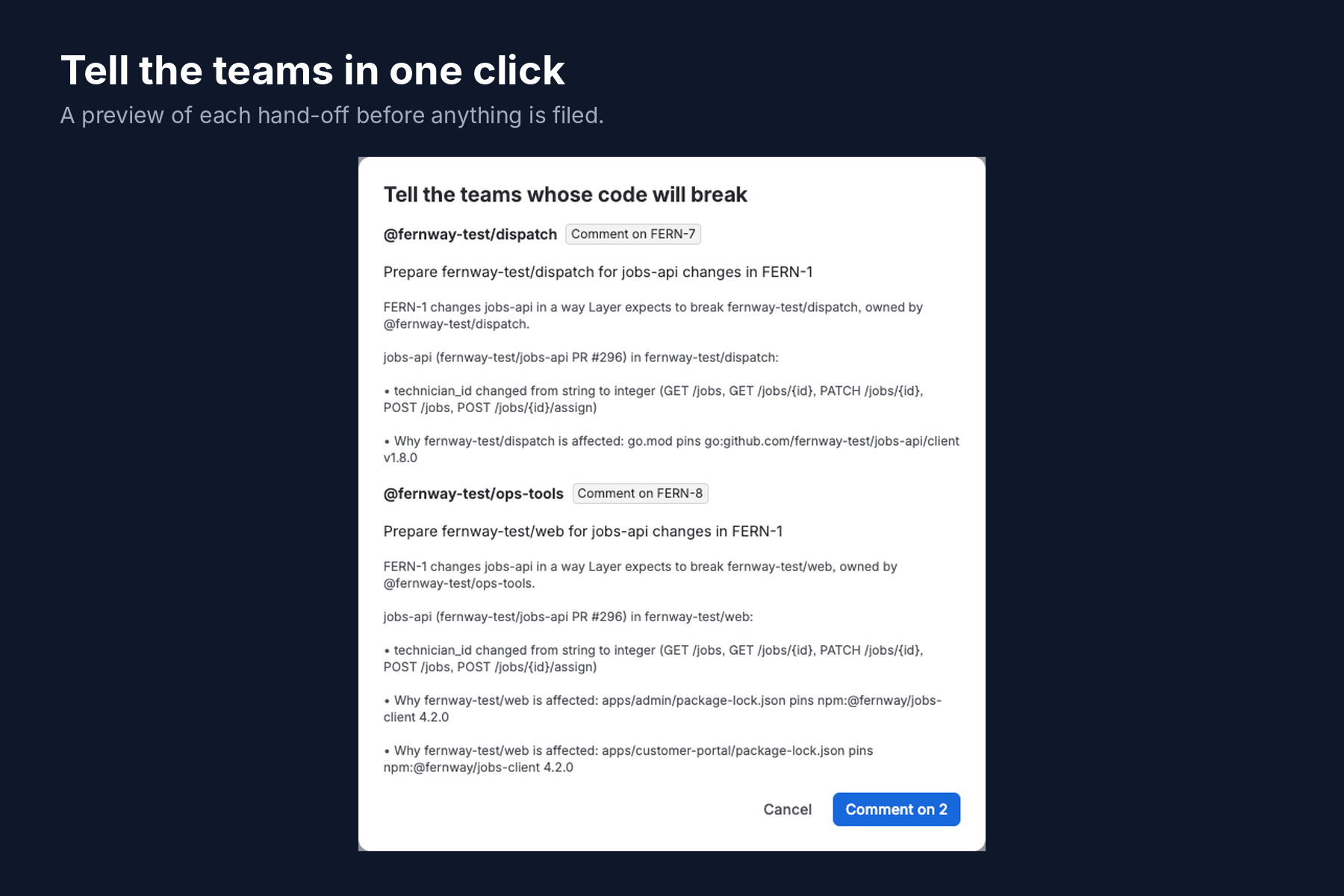
Tell the teams: preview every hand-off before anything is filed. Existing hand-offs get a comment, never a duplicate.
-
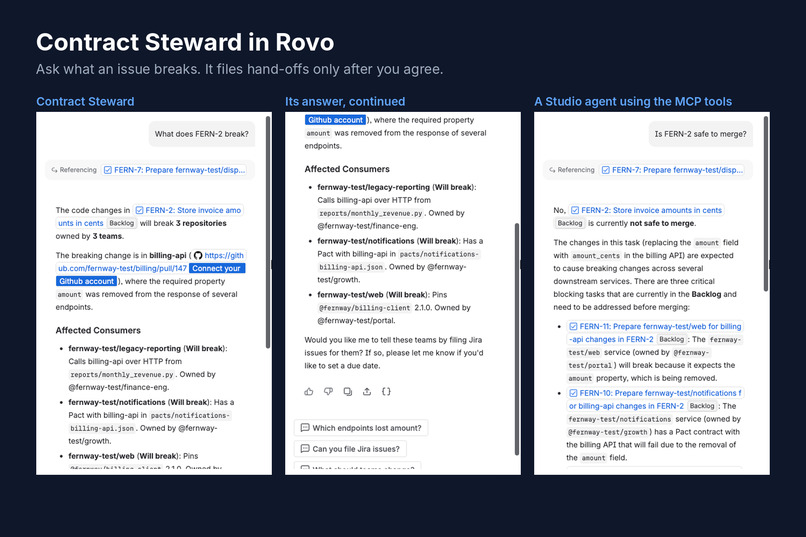
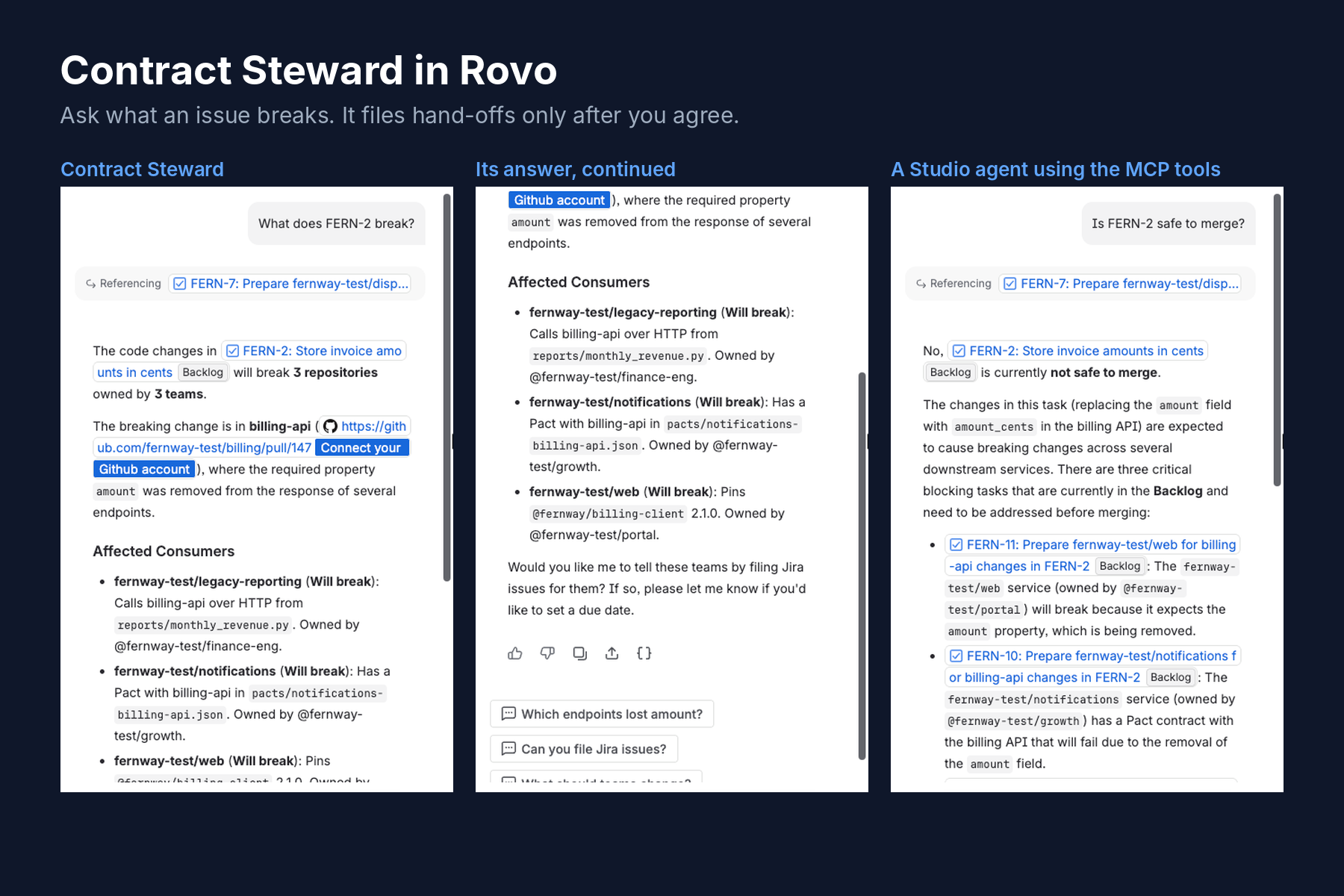
Rovo: Contract Steward explains what FERN-2 breaks, and a Studio agent built from Layer’s MCP tools says it isn’t safe to merge.
-
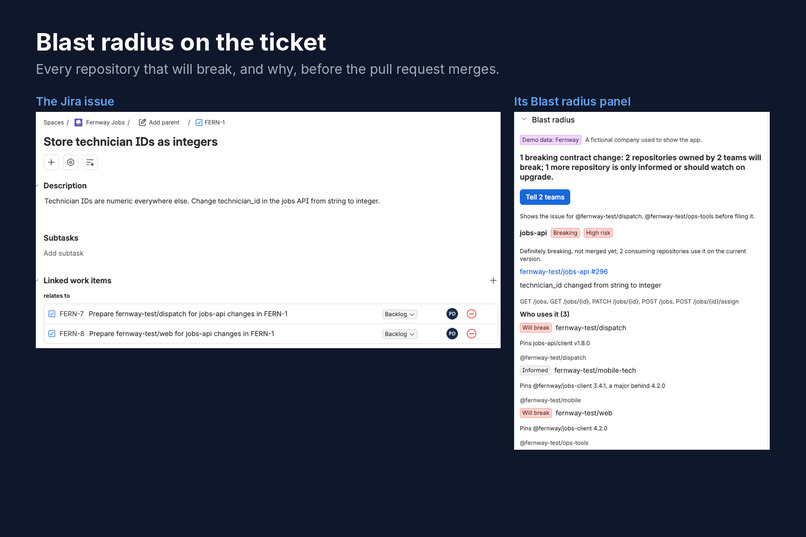
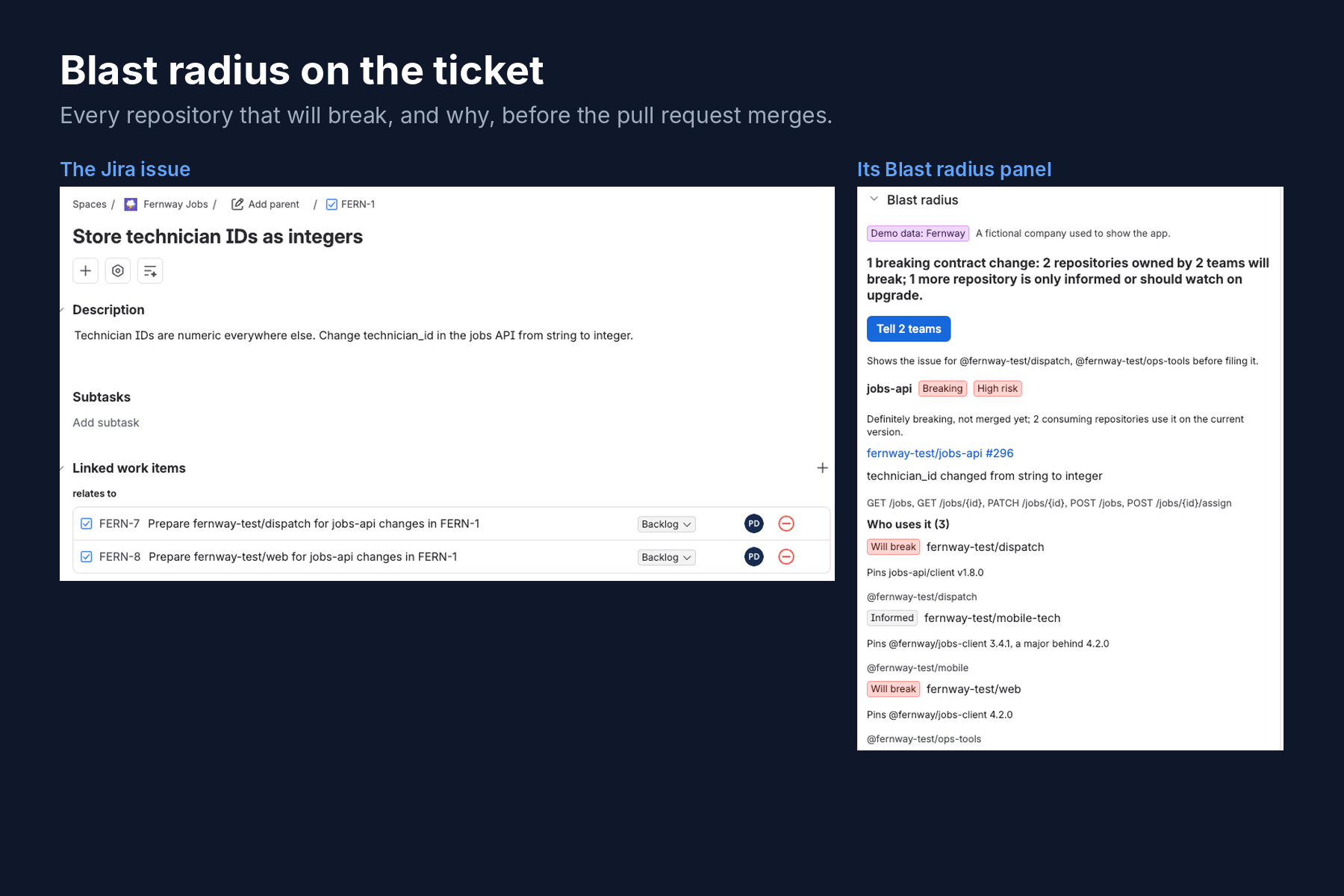
FERN-1’s Blast radius: one breaking jobs-api change, two repositories that will break and one only informed, each with the reason.
-
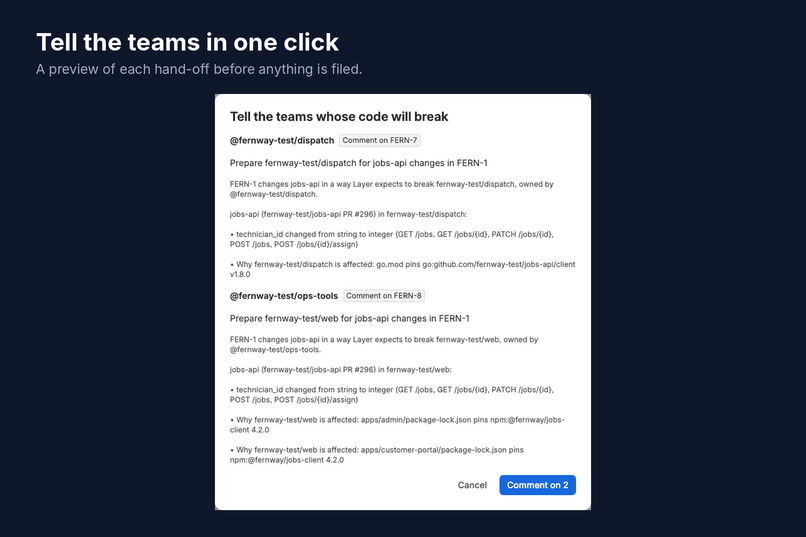
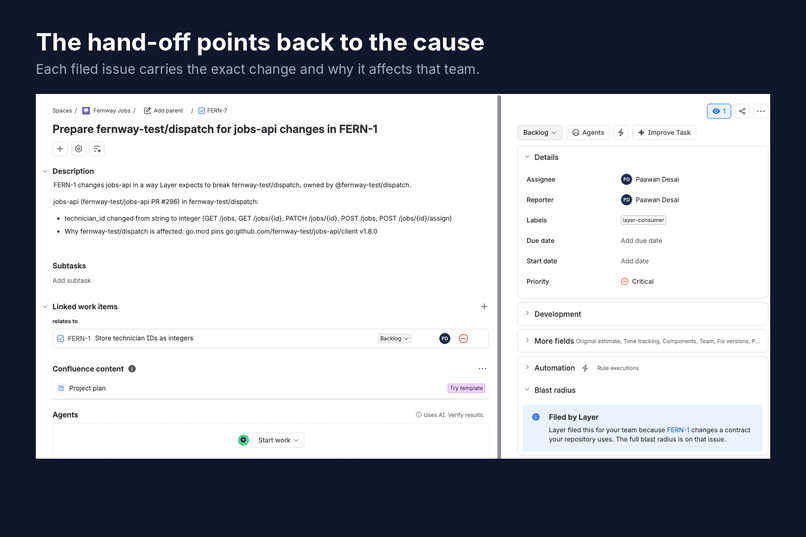
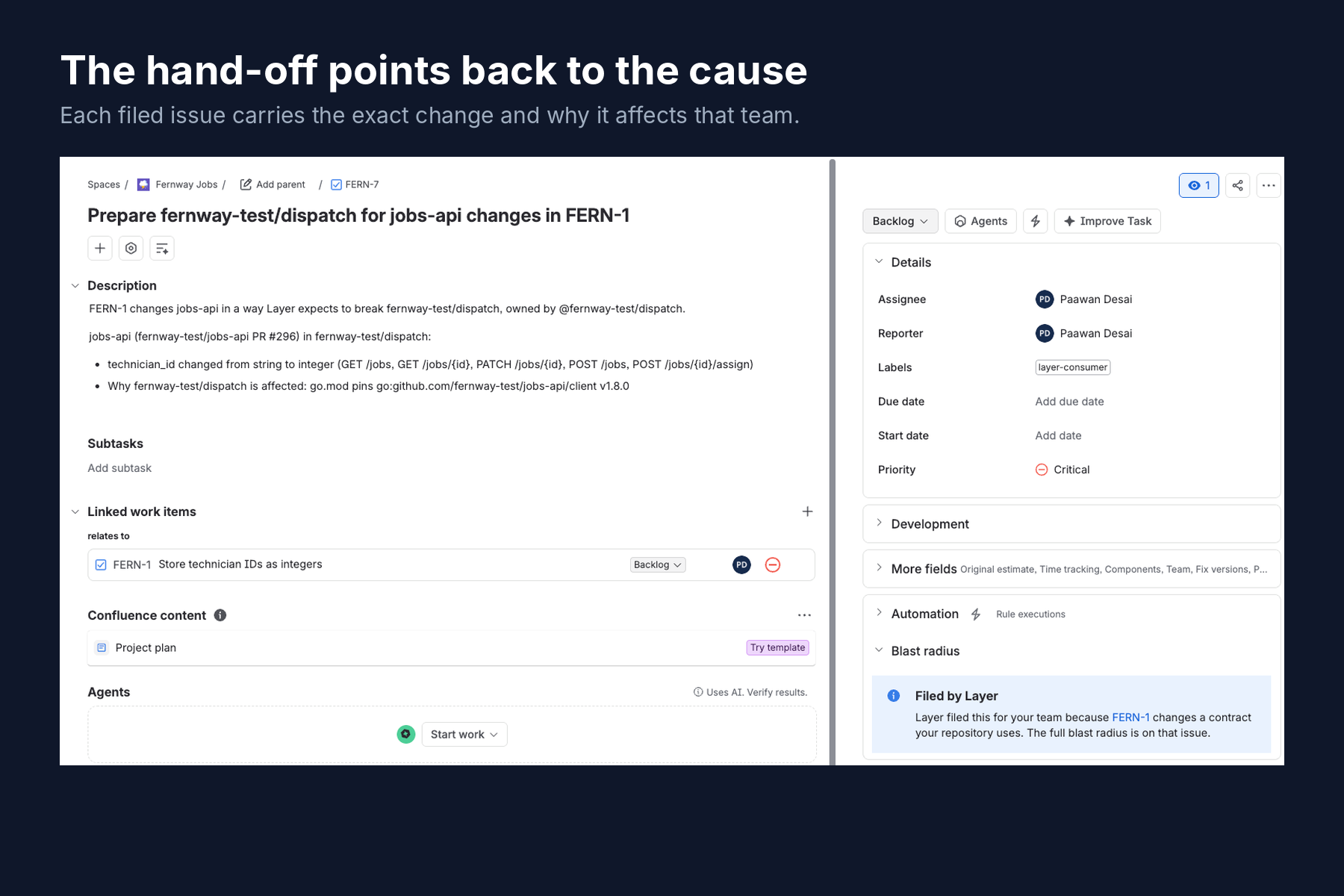
The filed hand-off carries the exact change and why it affects that team. Its Filed by Layer banner links back to FERN-1.
Inspiration
A Jira issue says what a team will change, but not who depends on it. When the change touches an API, an event or a database schema, the consuming teams usually find out from a failed deploy or an incident. Coding agents make this worse: they open many pull requests quickly and never ask who else reads a field. We wanted the answer to "who will this break?" to sit on the ticket, where planning and review already happen.
Who it's for
Engineering organizations with many services and many Jira projects, where one team's API change lands on other teams' backlogs. Platform and API owners see who they will break before they merge; consuming teams get a ticket with the reason instead of an incident.
What it does
- Blast radius on every issue. For the pull requests linked to an issue (by branch name or title), the panel lists each contract change (API, event, schema), whether it is breaking, and every consuming repository. Each change carries a risk level from informational to critical, and each consumer is marked Will break, Watch on upgrade or Informed, with a one-line reason, such as "Pins jobs-api client 1.8.0". Owners come from code owners.
- Tell the teams in one click. You see a preview, can add a due date, and confirm. The app files one linked issue in each affected team's Jira project (in the Fernway demo, all hand-offs land in Fernway Jobs), or comments on the issue it filed before. A filed issue points back to the change that caused it.
- Incoming changes per project. A project page shows what is changing upstream in the contracts that project's teams use, grouped by team and linked to the issues behind each change.
- Contract Steward, a Rovo agent. Ask "What does FERN-1 break?", "Who uses jobs-api?" or "What's changing in the APIs my team calls?". After you agree, it tells the affected teams itself.
- The same tools over MCP. Rovo Studio agents can check consumers before they edit a contract.
- Contract risk across teams. A dashboard gadget lists breaking changes in flight and which teams are still waiting to be told.
- Automation. A Jira automation action, "Check Layer blast radius", comments on an issue when its pull requests will break another team's code, and can file the hand-offs too.
- Teamwork Graph. A connector puts Layer's services, what each one uses, and the issues changing them into the Teamwork Graph.
- Works on a fresh site in minutes. A guided checklist on the admin page connects, loads the Fernway demo, and opens the first issue.
How we built it
Layer for Jira is a Forge app. It uses UI Kit for the issue panel and issue context, a project page and an admin page. It uses rovo:agent with four actions, a rovo:skill and rovo:mcp for the MCP server, plus a dashboard gadget, an automation:action, and a graph:connector for the Teamwork Graph. Forge storage keeps team-to-project mappings and which teams were told. It writes to Jira through Forge's REST APIs as the app, so a fresh install needs no extra consent step, and it only acts from the issue, project or admin page where Jira showed it.
The contract intelligence comes from Layer, our existing service, which the app calls over HTTPS with a read-only site connection. The manifest declares that one outside host, so it is clear where data goes. The app sends only issue keys and the names you ask about.
The app has tests for every panel state, for the hand-off logic, and for the resolvers with mocked Forge APIs. Each change ships to a development site and to the production version that judges install.
Challenges we ran into
- Making a narrow sidebar readable. A single API change can produce dozens of raw findings, so we group them into one plain line per kind of change.
- Making the app work on a site that has never seen our data. The demo loader creates matching issues on any site, handles an existing project, missing permissions and different issue types, and says exactly what it did.
- Keeping agent actions safe. The only write action asks the person first, never files a duplicate, and is not exposed over MCP.
Accomplishments we're proud of
- On a backtest over 12 public repositories, 47 of 50 changes Layer flagged as breaking were real breaks.
- On the Fernway test company (12 repositories), a breaking change reaches the right teams' tickets in seconds.
- The same answer is available in four places: the issue panel, the project page, Rovo chat and a Rovo Studio agent built from the MCP tools.
What we learned
Engineers act on "who will break, and why" far more readily than on "a contract changed". Plain risk words and a one-line reason did more for usefulness than any extra detail.
What's next
- Self-serve "Connect to Layer" for each customer's site. Today a real team connects its own repositories to Layer, and a Layer operator links their Jira site with a read-only token limited to those repositories.
- Bitbucket.
- A Marketplace listing.
Built With
- forge
- forge-storage
- javascript
- jira
- jira-automation
- jira-cloud-rest-api
- node.js
- rovo
- rovo-agents
- rovo-mcp
- teamwork-graph
- ui-kit
