-
-
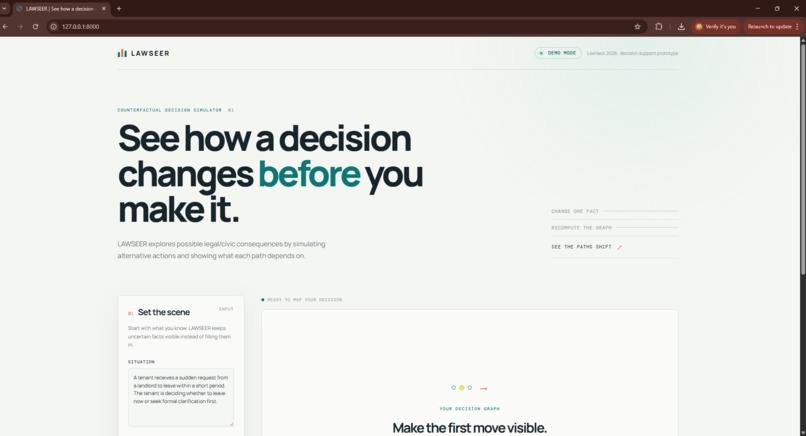
“See how a decision changes before you make it.”
-
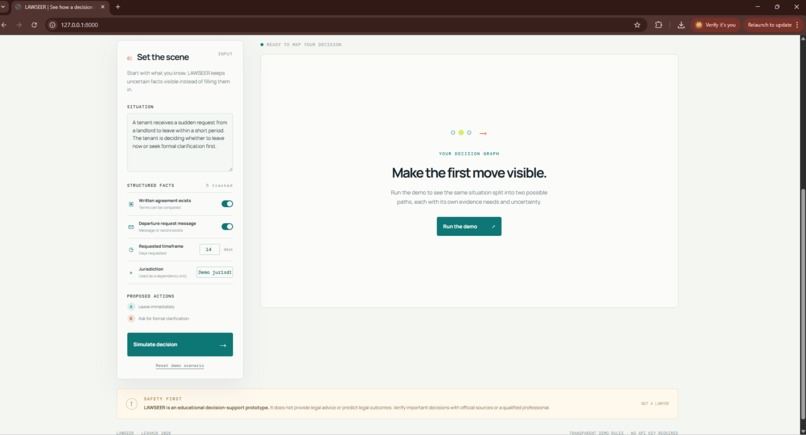
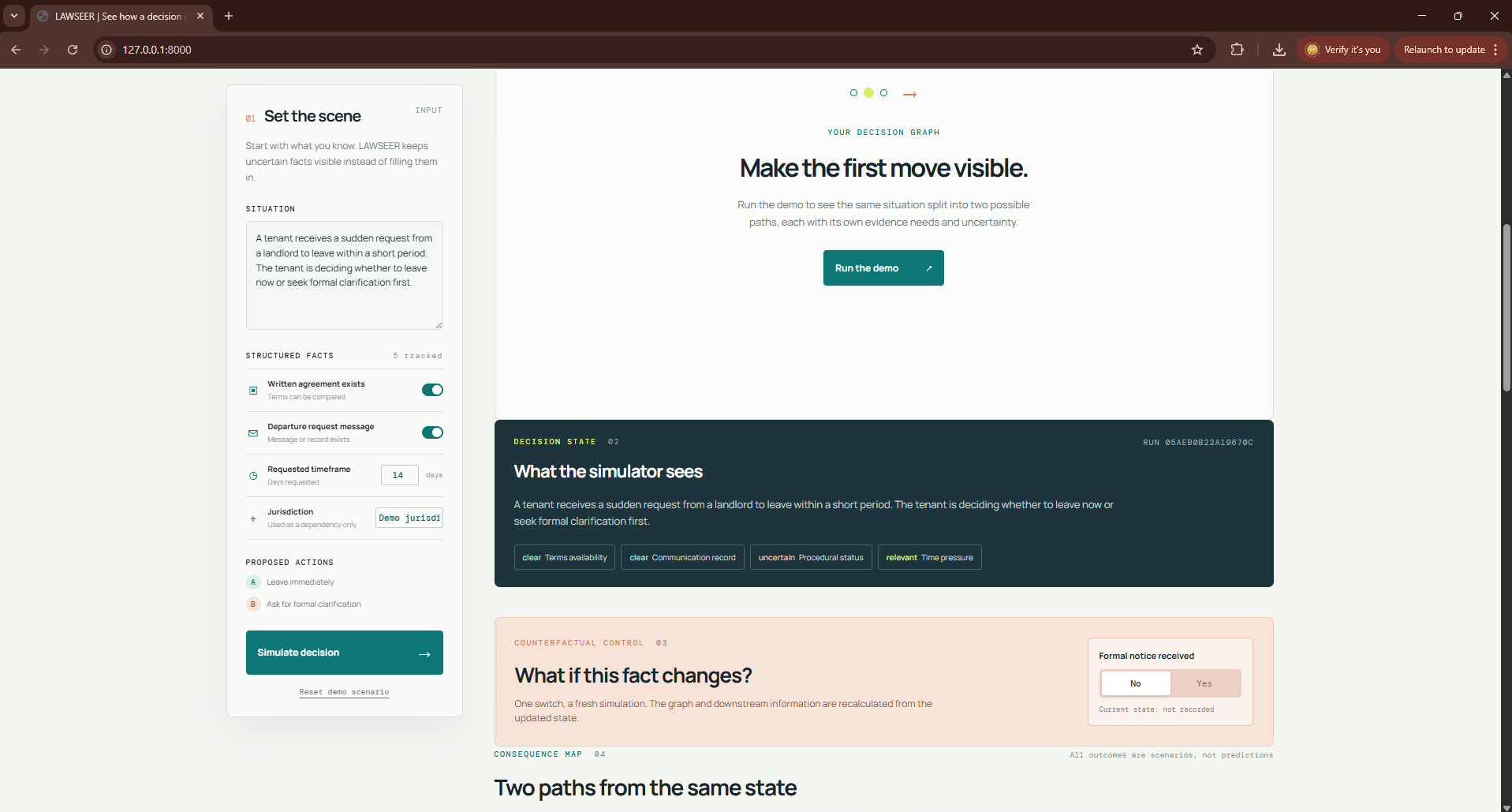
Situation + Structured Facts + Proposed Actions + Simulate Decision
-
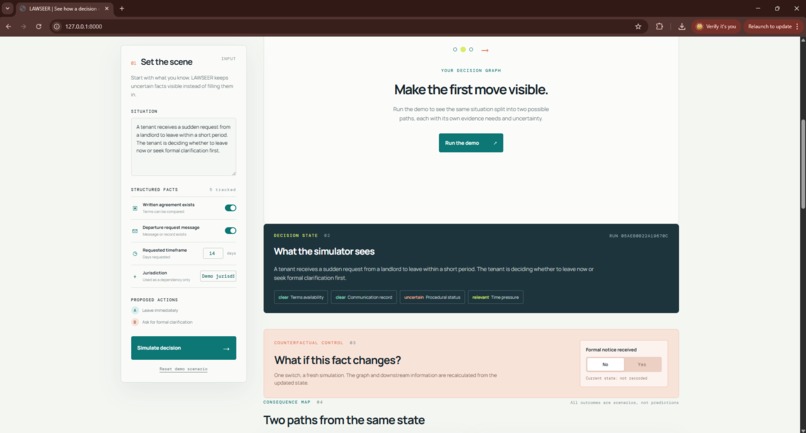
Decision State + Formal Notice: No counterfactual control
-
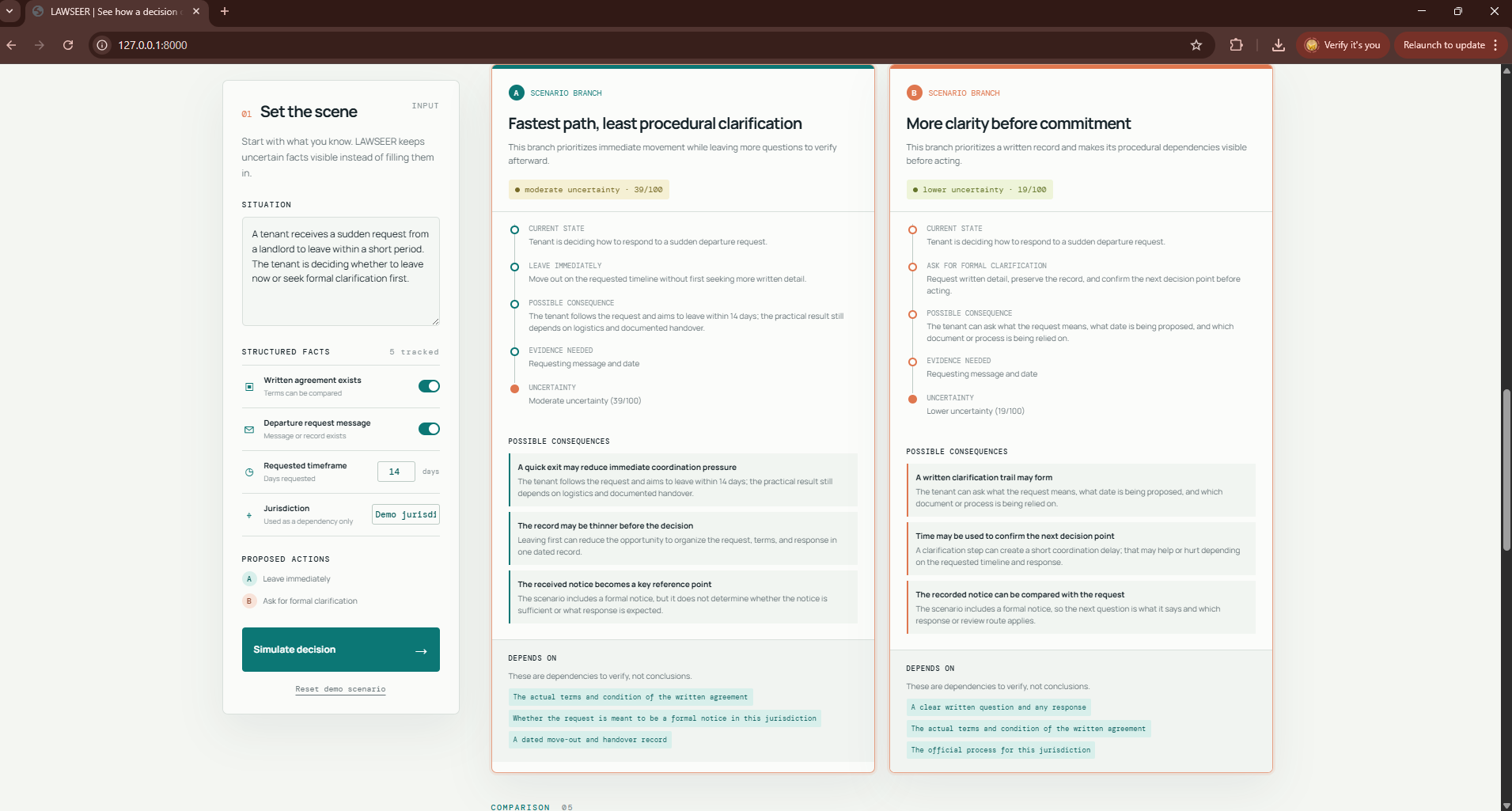
Formal Notice = Yes, with uncertainty 39 / 19
-
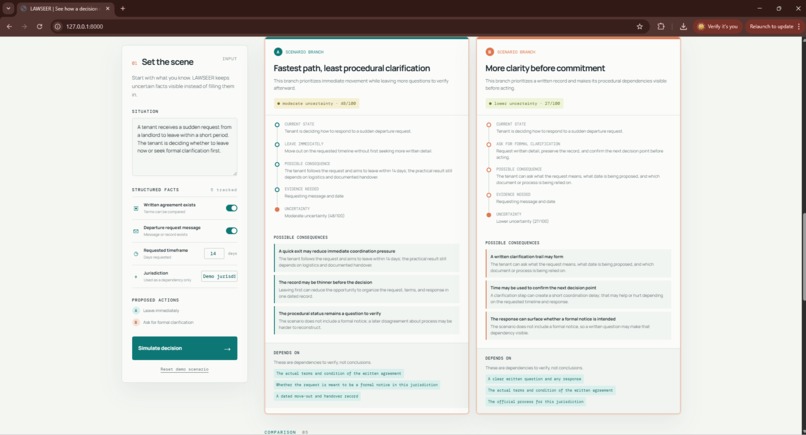
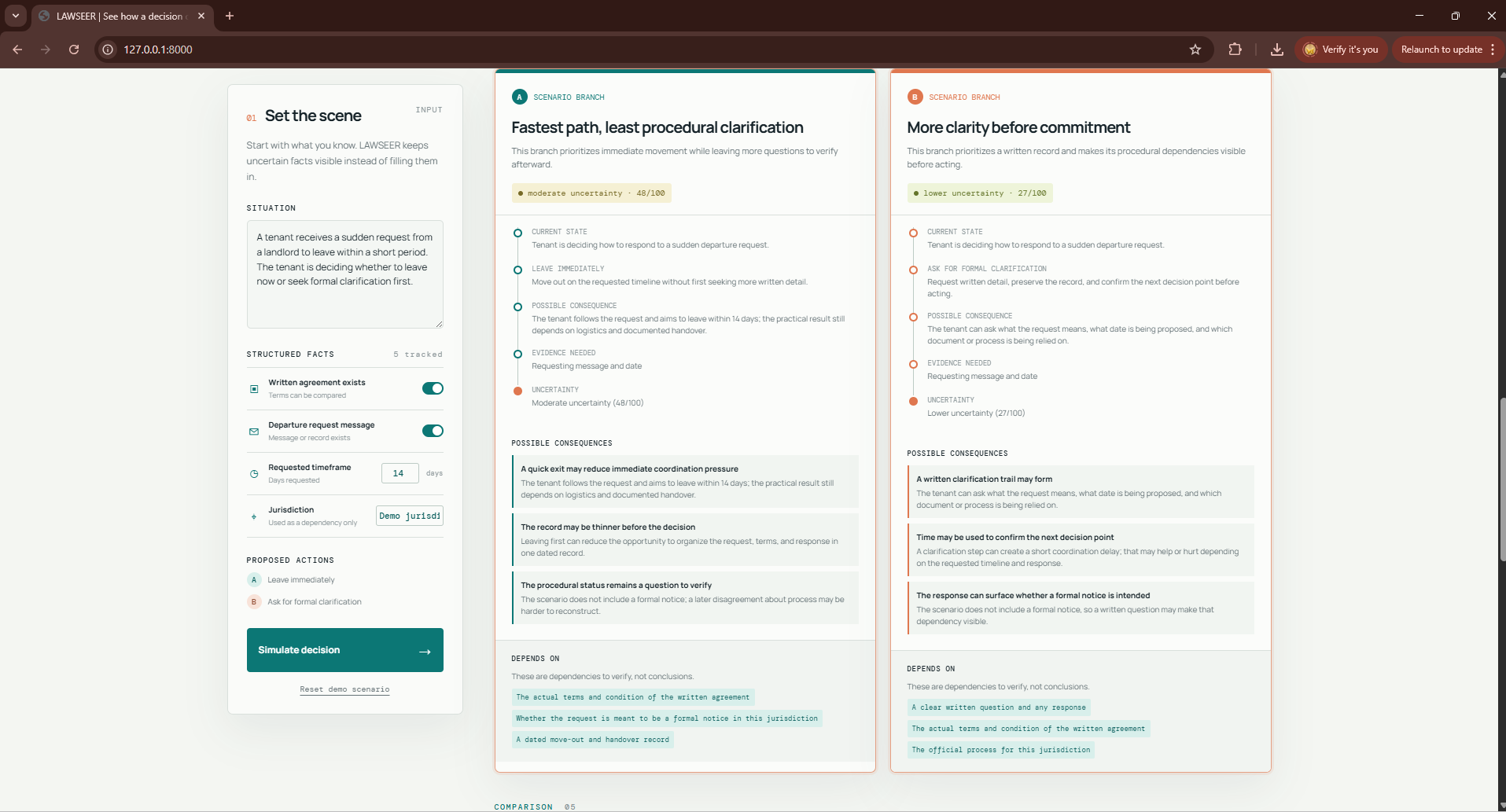
Formal Notice = No, with uncertainty 48 / 27
-
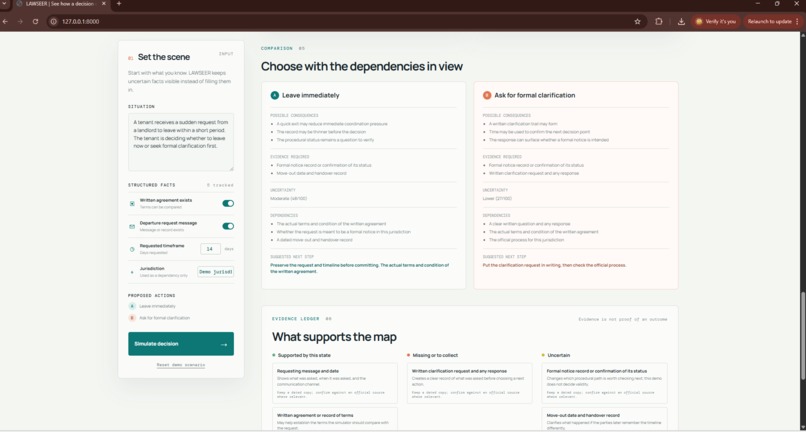
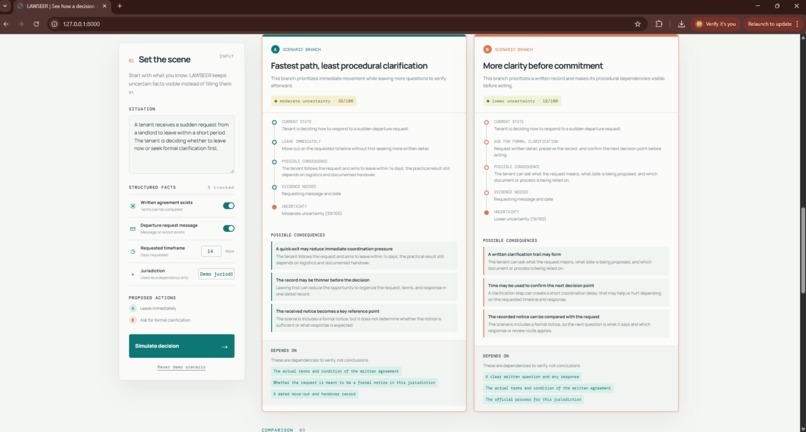
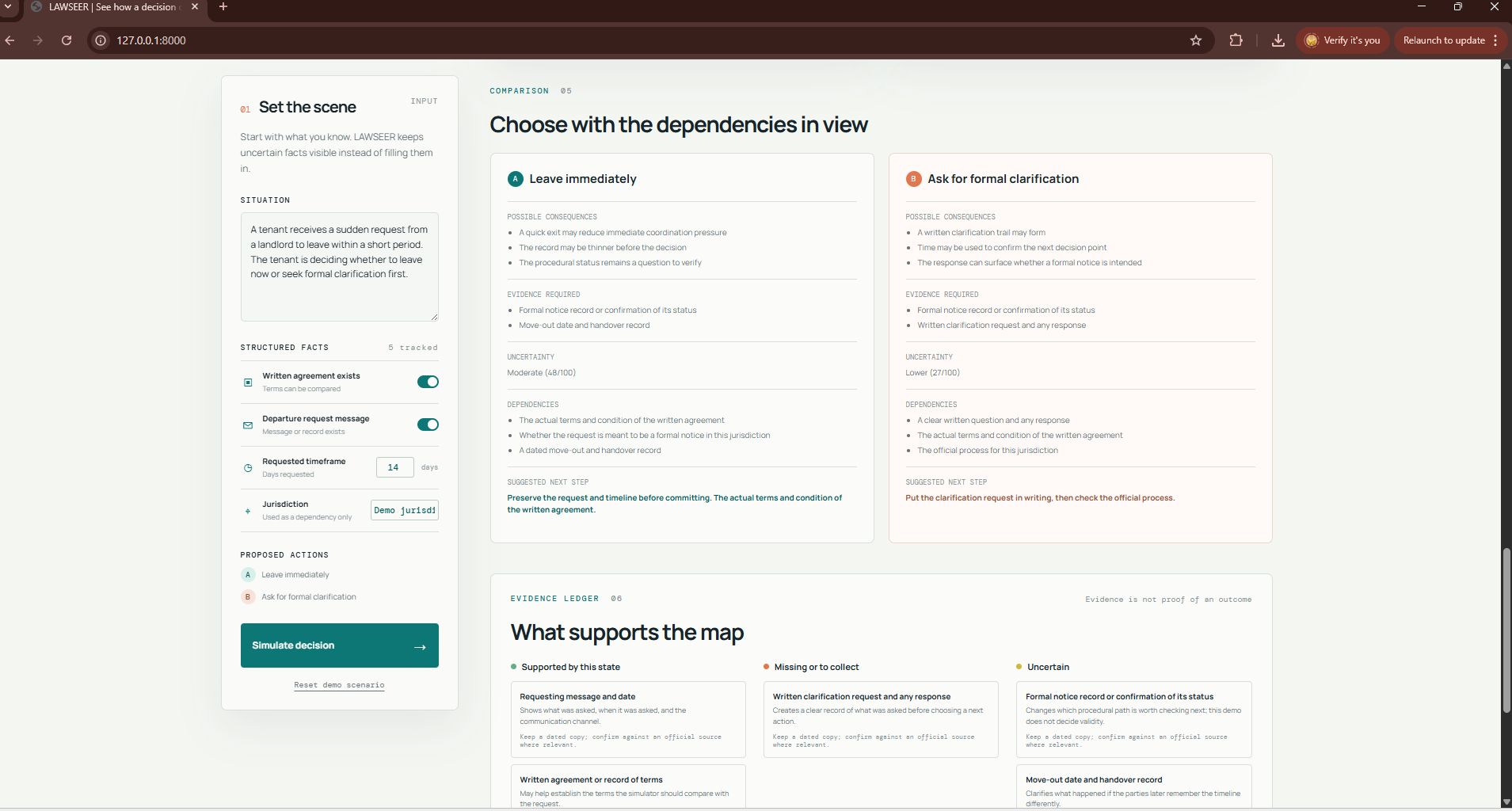
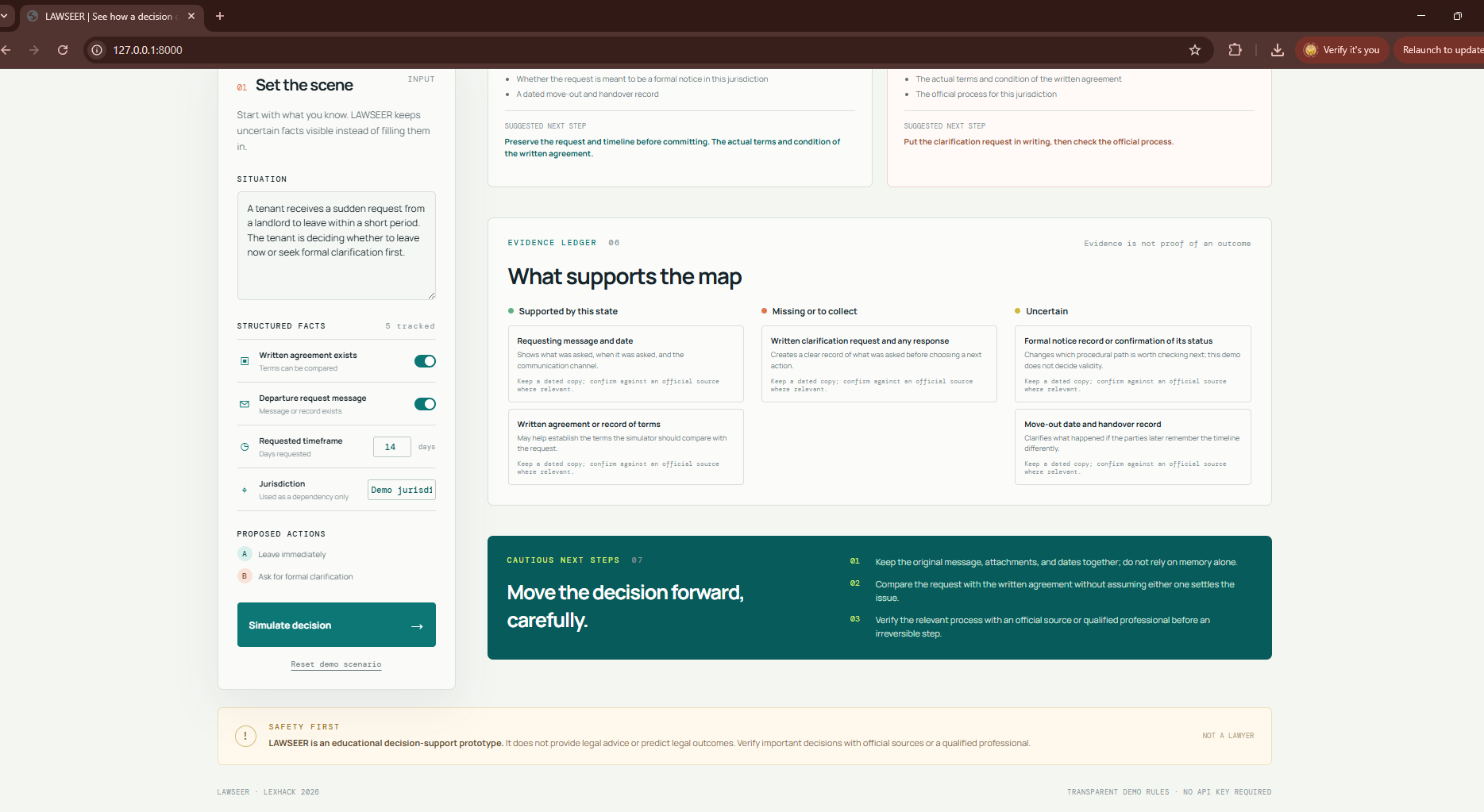
A vs B comparison + consequences + evidence + dependencies
-
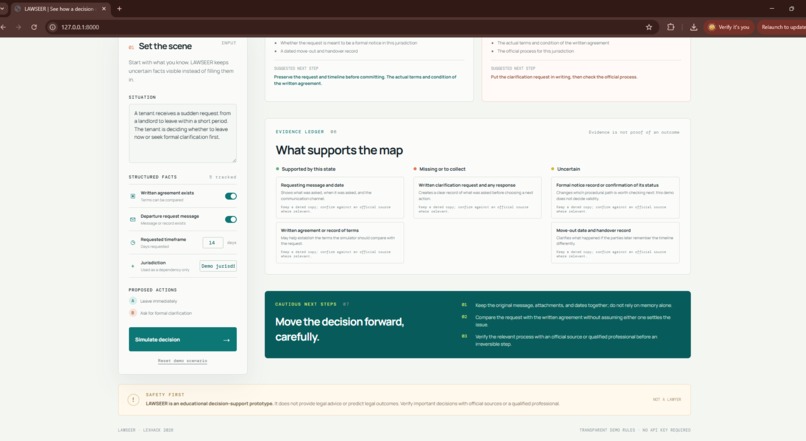
Evidence Ledger + Cautious Next Steps + Safety First

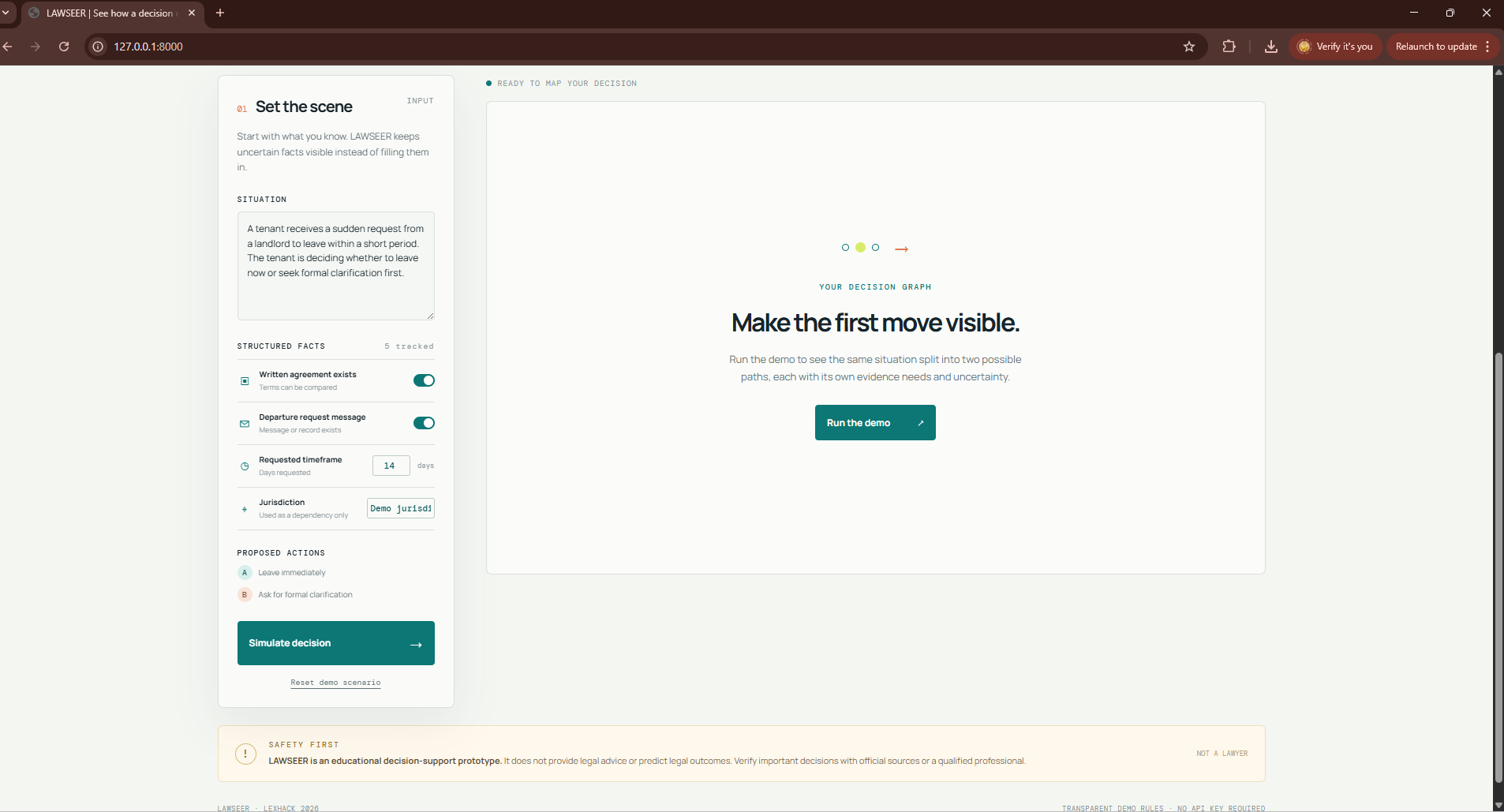
LAWSEER
See how a decision changes before you make it.
Most legal-tech tools answer a question after the situation is already defined.
LAWSEER takes a different approach.
It helps people explore how a decision changes when an important fact changes.
Instead of simply generating a legal answer, LAWSEER creates a structured decision model around a situation, compares possible choices, identifies constraints and evidence, and lets the user run controlled "What If?" changes to see how the decision landscape shifts.
The Problem
Legal and civic situations are rarely determined by one fact.
A person's options can change because of:
- whether formal notice was received
- what evidence exists
- who is involved
- what constraints apply
- what risks or consequences follow from each choice
For non-lawyers, it can be difficult to understand which facts actually matter and how changing one fact can affect the available options.
Many AI interfaces respond with a single answer. That can hide the uncertainty and tradeoffs behind the answer.
LAWSEER focuses on making those changes visible.
The Core Idea
The central interaction is:
Change ONE fact → Recompute → See how the decision changes.
A user can start with a real-world situation, compare possible actions, then change a relevant fact and observe what changes downstream.
This turns a static answer into an interactive decision exploration.
How LAWSEER Works
LAWSEER follows a structured pipeline:
SITUATION → FACTS → CONSTRAINTS → EVIDENCE → OPTIONS → CONSEQUENCES → WHAT IF → RECOMPUTE
The system:
- Structures the user's situation.
- Identifies important facts and constraints.
- Organizes available evidence and uncertainty.
- Generates decision options.
- Compares the consequences and tradeoffs of those options.
- Allows the user to change one fact.
- Recomputes the affected decision state.
- Shows what changed and why.
The goal is not to tell someone what they must do.
The goal is to help them understand what matters before they decide.
Example: A Tenant Decision
Consider a tenant who receives a sudden request from a landlord.
LAWSEER can compare two possible approaches:
Option A — Leave immediately
versus
Option B — Ask for formal clarification and preserve evidence
The user can then change one fact:
Formal notice received: NO → YES
LAWSEER recomputes the scenario and shows how the available options, constraints, evidence, uncertainty, and consequences change.
The user can switch the fact back:
YES → NO
and observe the decision state return to the corresponding scenario.
This is the core experience of LAWSEER:
Don't just ask what the answer is. Ask what changes the answer.
Why This Is Different
LAWSEER is not designed as a generic legal chatbot, search box, or document summarizer.
Its defining mechanism is counterfactual decision exploration.
The system makes the relationship between facts and decisions visible instead of presenting one static response.
That makes the interaction useful for situations where the user is asking:
- "What changes if this fact is different?"
- "Which fact is actually important?"
- "How does this affect my options?"
- "What evidence would change the situation?"
- "What should I verify before deciding?"
Technical Approach
LAWSEER is built as a modular web application with a structured decision pipeline.
The prototype uses:
- Python
- FastAPI
- Pydantic
- Uvicorn
- HTML5
- CSS3
- Vanilla JavaScript
- Pytest
The backend separates the decision logic into modular components so that scenario analysis, option comparison, fact changes, and recomputation can be tested independently.
Structured data validation helps keep the decision state inspectable and predictable.
The project also uses a provider abstraction for AI integration:
- FixtureProvider provides deterministic, inspectable demo scenarios.
- LiveProvider provides an optional OpenAI-compatible AI analysis path using server-side credentials.
This separation allows the core experience to remain reproducible during demonstration while keeping the architecture ready for live AI integration.
AI Approach
AI is used to help structure and analyze the user's situation rather than pretending to provide guaranteed legal outcomes.
The system is intentionally cautious about uncertainty.
LAWSEER does not claim that a simulated outcome is a guaranteed legal result.
It is designed as a decision-support and exploration tool, not a substitute for qualified legal advice.
The prototype's knowledge and example scenarios are illustrative and should be independently verified against authoritative sources and, when appropriate, a qualified legal professional.
Responsible AI
Legal decisions can have serious consequences.
For that reason, LAWSEER avoids presenting its analysis as definitive legal advice.
The system surfaces uncertainty and encourages users to verify important facts, evidence, and applicable law.
The purpose of the prototype is to make decision dependencies easier to understand — not to replace lawyers, legal research, official sources, or professional judgment.
What We Learned
One of the biggest lessons from building LAWSEER was that an AI system does not always become more useful by giving a more confident answer.
Sometimes the better interaction is to expose the assumptions behind the answer.
By allowing a user to change one fact and observe the resulting changes, the system turns uncertainty into something that can be explored.
That led us to a simple design principle:
A useful legal AI should not only explain a decision. It should help you understand what could change it.
Challenges
The biggest challenge was designing an experience that was more than a generic AI response.
A conventional chatbot can generate an explanation, but it is difficult for a user to see exactly which fact caused a recommendation to change.
We therefore designed LAWSEER around structured state changes and recomputation.
Another challenge was balancing usefulness with responsible AI behavior in a legal context.
We deliberately avoid presenting simulated analysis as authoritative legal advice and make the limits of the prototype clear.
Future Direction
The prototype can be extended with:
- authoritative legal-source retrieval
- jurisdiction-aware analysis
- stronger evidence provenance
- document and notice analysis
- richer counterfactual scenario graphs
- user-specific decision histories
- professional review workflows
- additional civic and administrative use cases
The long-term vision is to make complex legal and civic decisions easier to explore without hiding the uncertainty behind a single AI-generated answer.
Built for LexHack 2026
LAWSEER was created as a practical exploration of AI × Law and decision-support technology.
LexHack encourages projects addressing legal access, civic technology, AI governance, legal automation, and related real-world problems. LAWSEER focuses on the intersection of legal decision support and interactive counterfactual reasoning.
The Core Interaction
Change one fact.
Recompute.
See how the decision changes.
AI-Assisted Development Disclosure
AI-assisted development tools, including ChatGPT and other AI coding assistants, were used during development. The project creator reviewed, tested, and verified the resulting implementation and is able to explain the project's architecture and core workflows.
Built With
- ai
- artificial
- civic
- css3
- decision
- fastapi
- generative
- html5
- intelligence
- javascript
- legal
- pydantic
- pytest
- python
- support
- tech
- uvicorn


Log in or sign up for Devpost to join the conversation.