Inspiration
The inspiration for Lawgorithm came from the need to simplify legal documents and make them more accessible to everyone, especially for individuals who may not have a legal background. We wanted to leverage advanced AI capabilities, specifically Google Gemini, to transform complex legal language into simpler terms and provide insights into risky clauses.
What it does
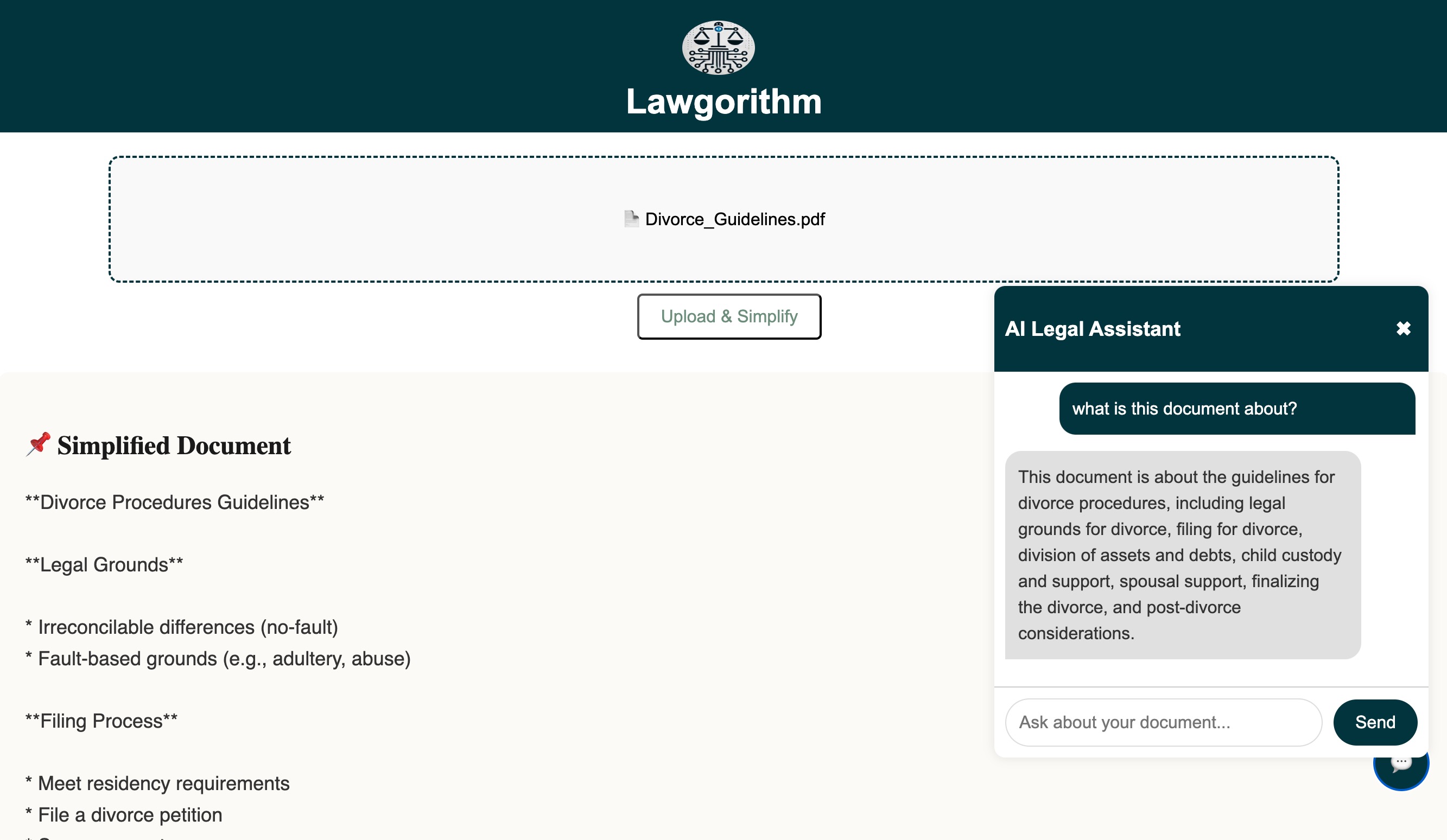
Lawgorithm is an AI-powered platform that simplifies legal documents, extracts key legal terms, and identifies potentially risky clauses. Users can upload a variety of legal documents (like PDFs or images), and the app processes the text, generating summaries, key terms, and flags clauses that might pose legal risks. Additionally, users can ask specific questions about the document via a chatbot interface, which responds based on the content of the document.
How we built it
We built Lawgorithm using a combination of FastAPI for the backend, Google Gemini (Gemini-1) for advanced AI text processing, pytesseract for OCR-based text extraction from images, and PyMuPDF (fitz) for extracting text from PDFs. We used React for the frontend. The backend handles file uploads, text extraction, and AI-based simplification, and the chatbot interface answers user queries based on the processed document text.
Challenges we ran into
Handling different file formats was challenging at first because we needed to ensure the seamless extraction of text from various file types, including images and PDFs. This required integrating multiple libraries and addressing various edge cases to accommodate different document structures. Additionally, integrating Google Gemini required more work as its usage for legal text simplification, making sure it could process large and complex documents effectively.
Accomplishments that we're proud of
We are proud of successfully integrating Google Gemini to simplify complex legal language and identify key legal terms. Also, we are proud of creating a responsive chatbot that can answer questions about the uploaded legal document, powered by Gemini.
What we learned
We learned how to effectively utilize Google Gemini's generative AI capabilities to process and simplify complex legal language. By utilizing AI, we were able to bridge the gap between complex legal jargon and everyday understanding. The project taught us how to manage unstructured data using AI for both text extraction and understanding. This gave us valuable experience in working with optimal character recognition (using pytesseract) and document parsing (using PyMuPDF). Lastly, we learned how to implement a chatbot powered by Google Gemini, which was an insightful experience. We learned how generative AI models can provide dynamic, user-specific responses based on document content, offering personalized explanations and insights.
What's next for Lawgorithm
The next steps for Lawgorithm include developing a front-end interface to allow users to easily understand information, implementing more robust error handling and feedback to ensure that users receive clear guidance when issues arise, and working on solutions to handle multiple users concurrently by potentially integrating session management or a database to track individual user data.

Log in or sign up for Devpost to join the conversation.