-
Thumbnail
-
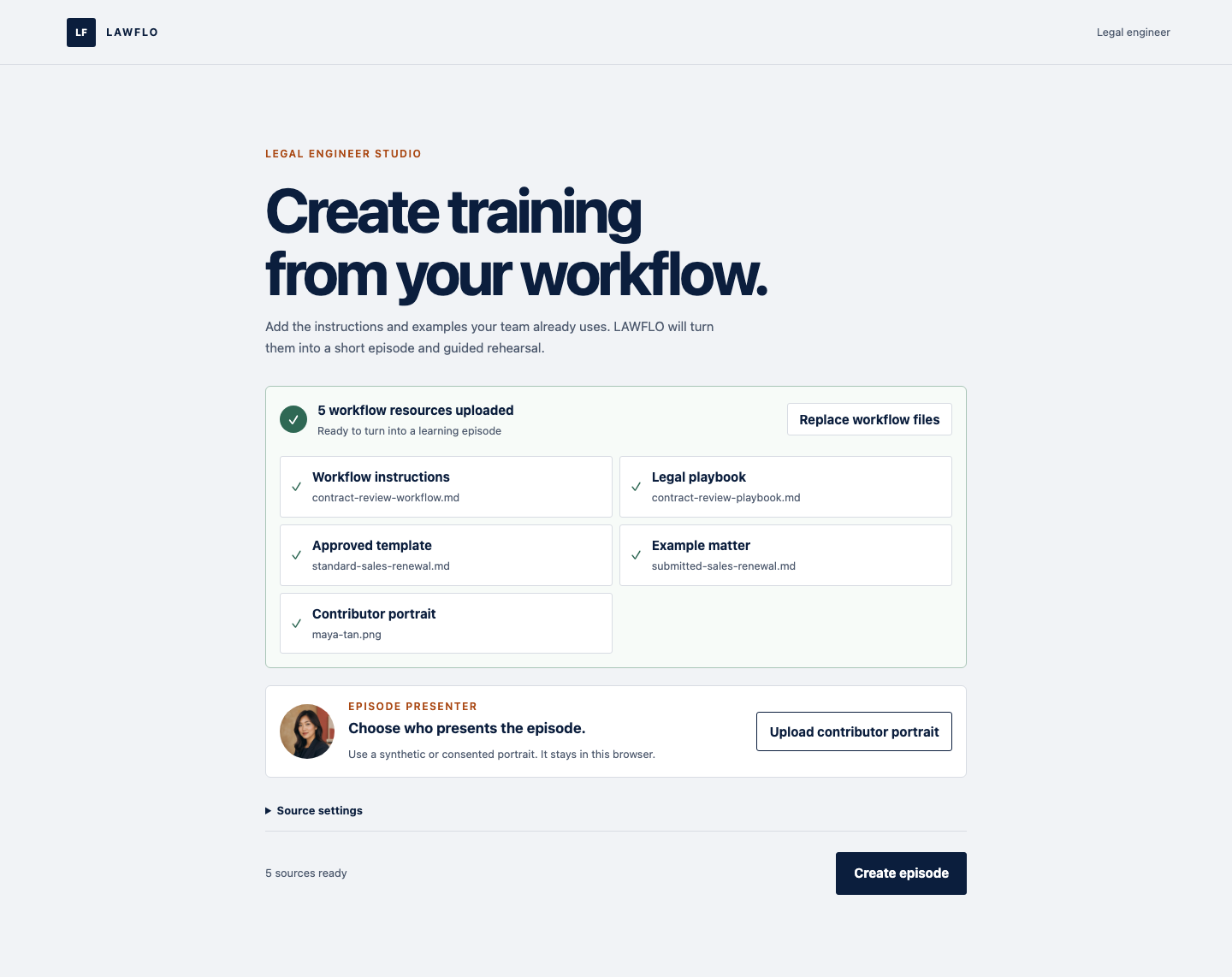
Creator Sources
-
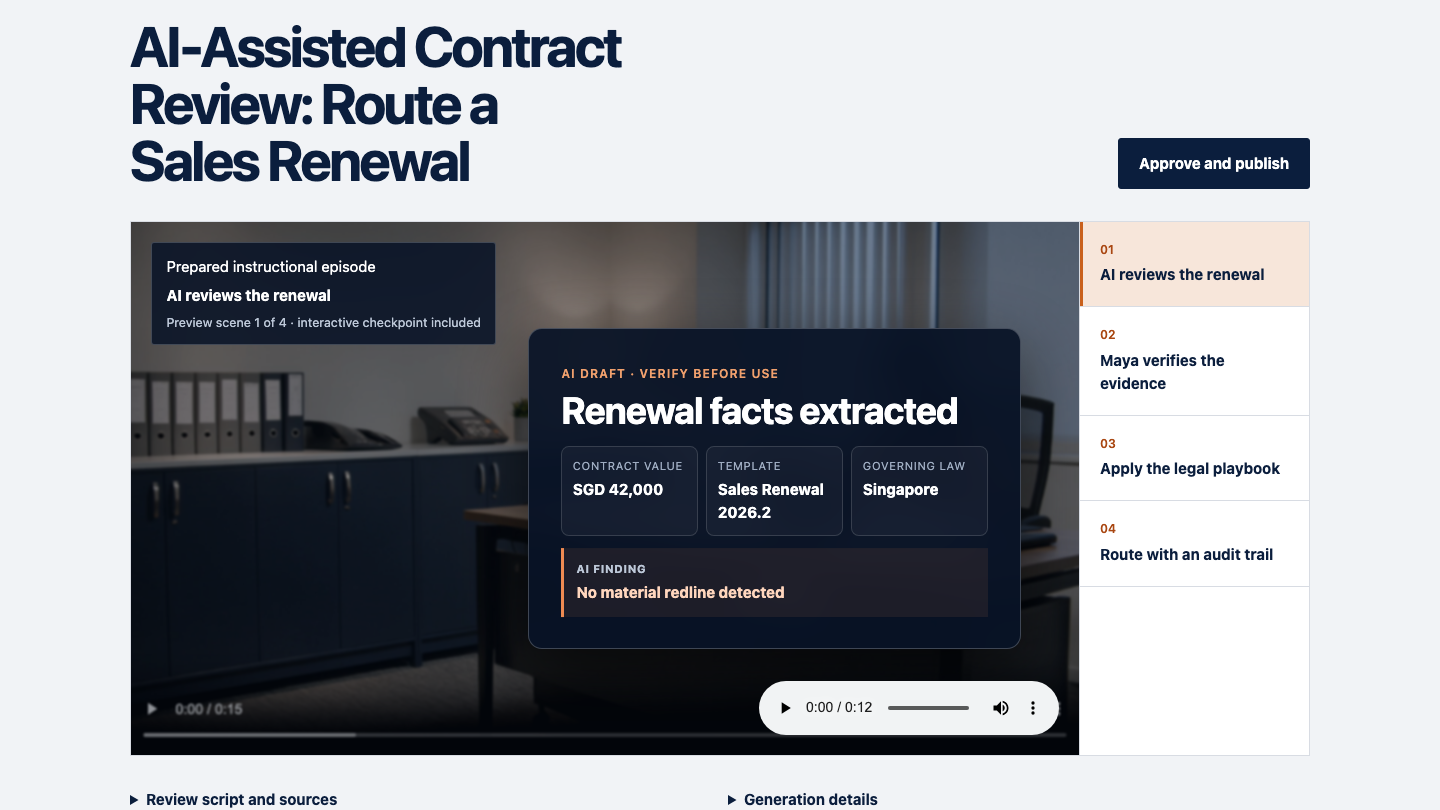
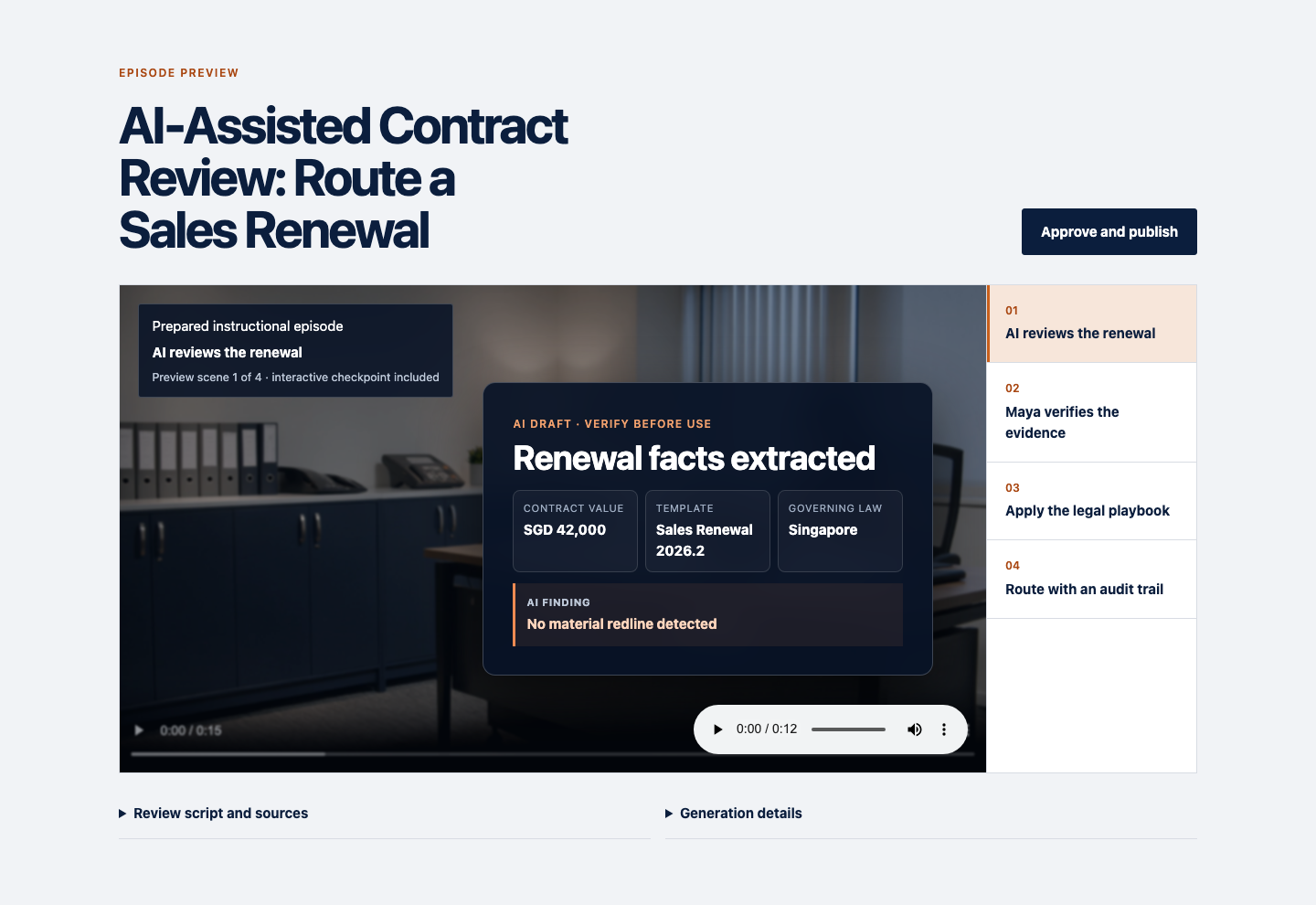
Episode Preview
-
Learner Episode
-
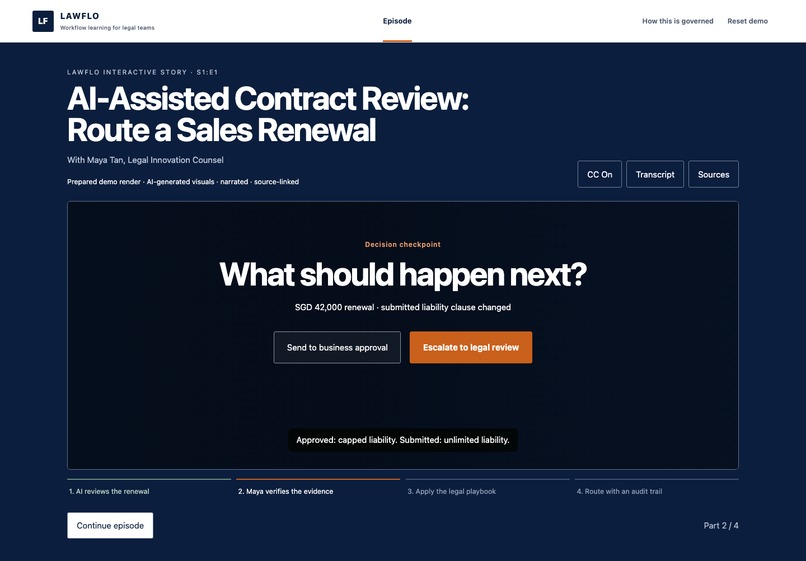
Decision Checkpoint
-
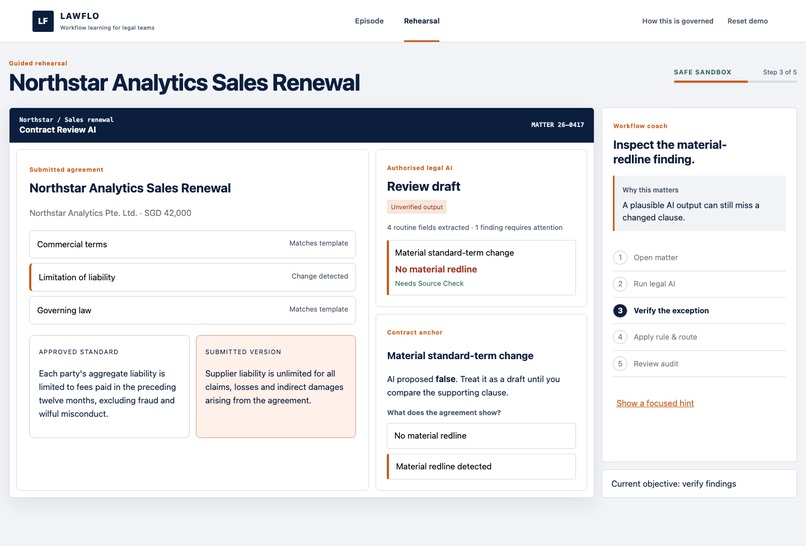
Guided Rehearsal
-
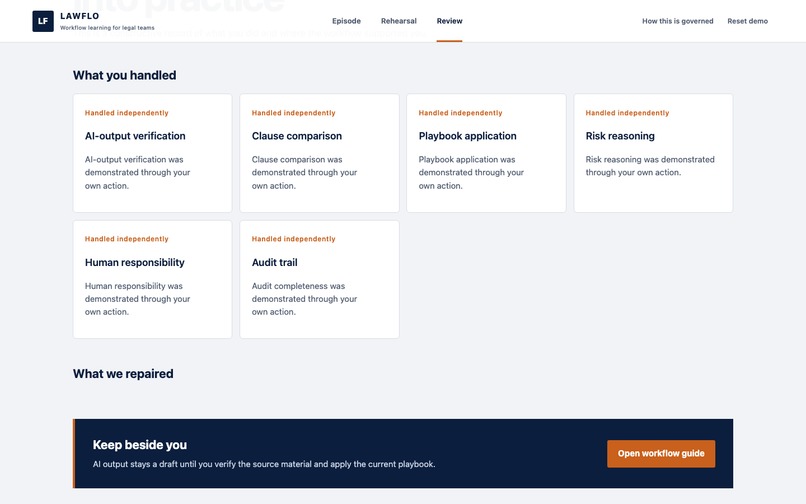
Learning Review
Team Info
Team 42 — LAWFLO
John Phua, Su-Ann, Ananya and Krishiv
Inspiration
Law firms can invest heavily in powerful AI tools and still struggle to achieve daily adoption. Vendor training explains a product, while generic AI courses explain broad concepts. Neither reliably transfers the firm’s own approved way of working: the tools to use, the playbook to follow, the facts to verify and the point at which a lawyer must take control.
The valuable knowledge often sits with the firm’s legal AI pioneers: legal engineers, innovation lawyers, knowledge lawyers and practice champions who turn new technology into repeatable, responsible workflows. Producing engaging, short, use-case-specific training from that expertise is resource-intensive. Even when guidance exists, passive video alone does not let a lawyer practise the judgment required in a real matter.
That adoption gap inspired LAWFLO. It turns a firm-approved legal AI workflow into an episode lawyers can watch, a realistic matter they can rehearse, and source-linked guidance they can use safely at work.
What it does
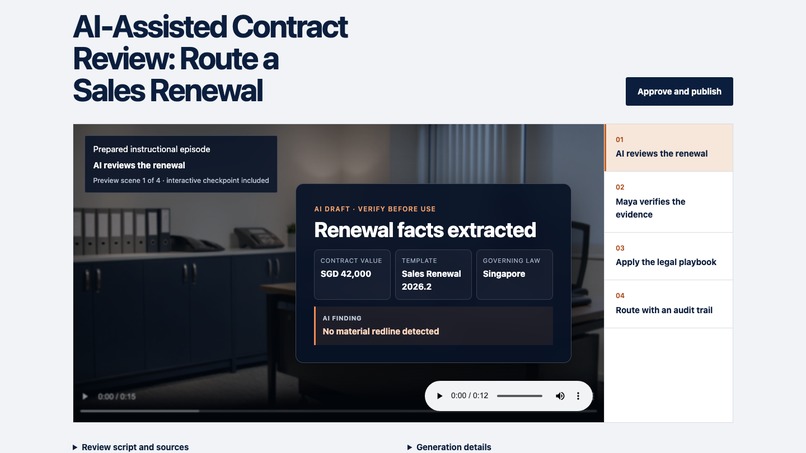
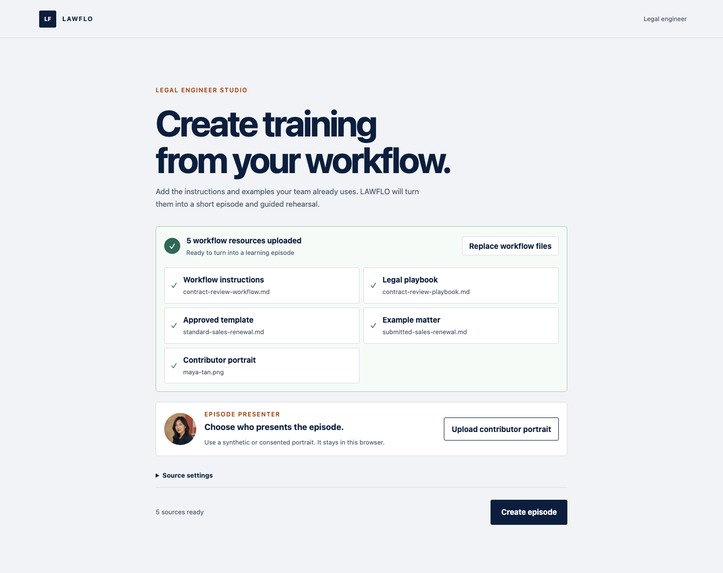
A legal AI pioneer begins with five governed inputs: the approved workflow, firm playbook, standard template, synthetic example matter and a fictional contributor portrait. LAWFLO transforms those sources into a short, human-approved training episode.
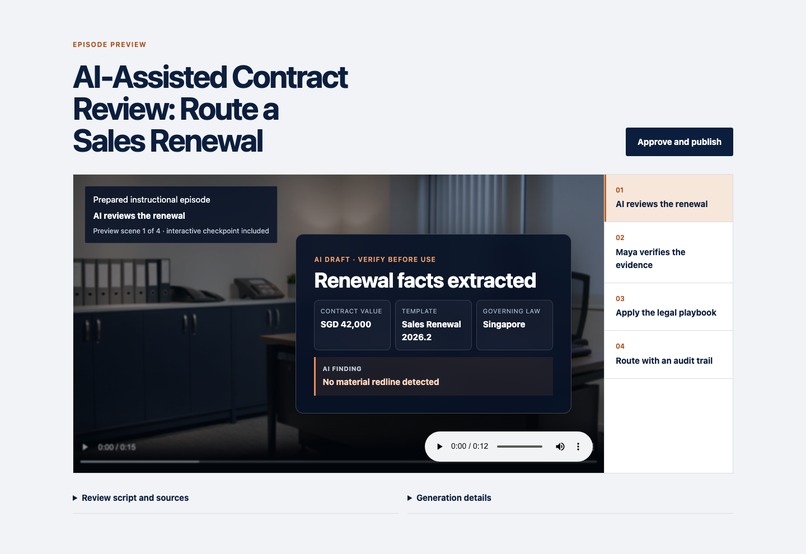
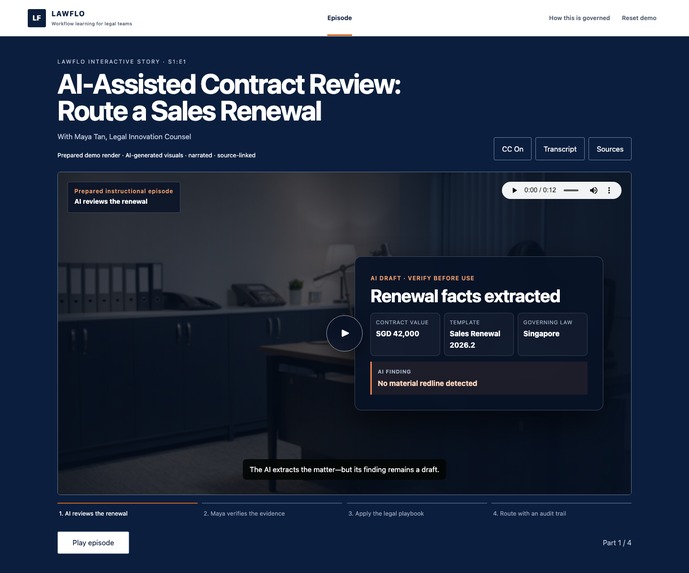
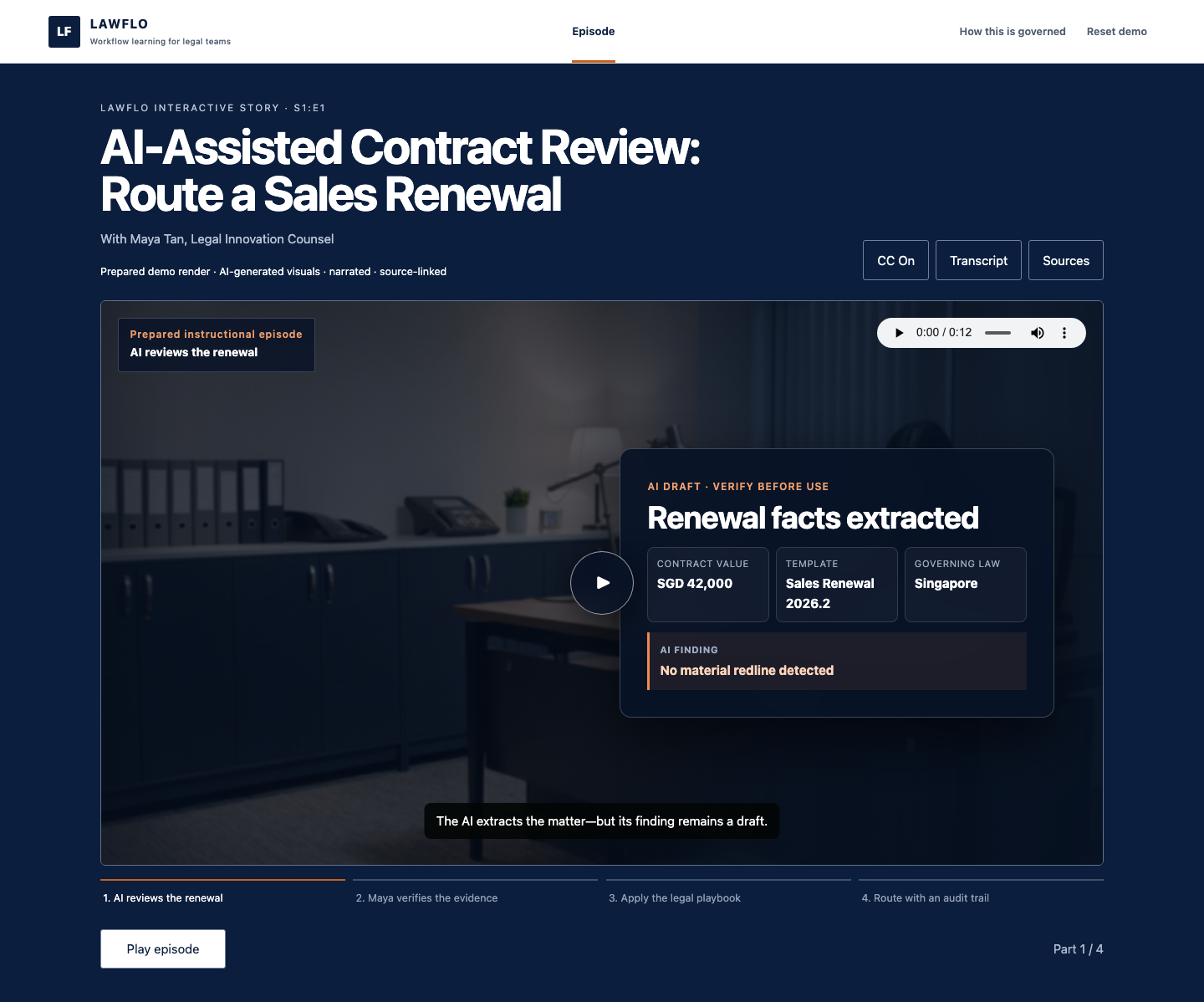
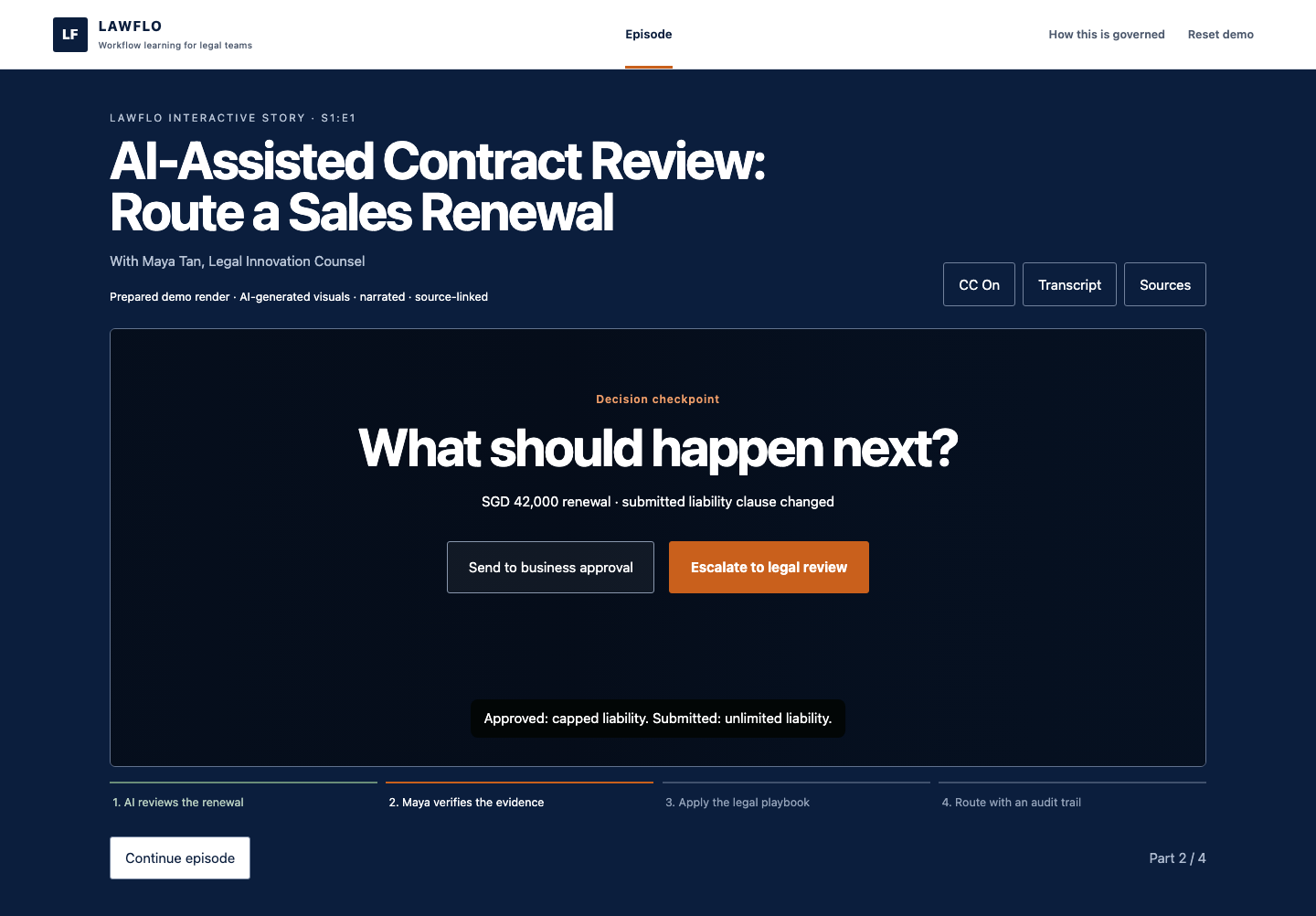
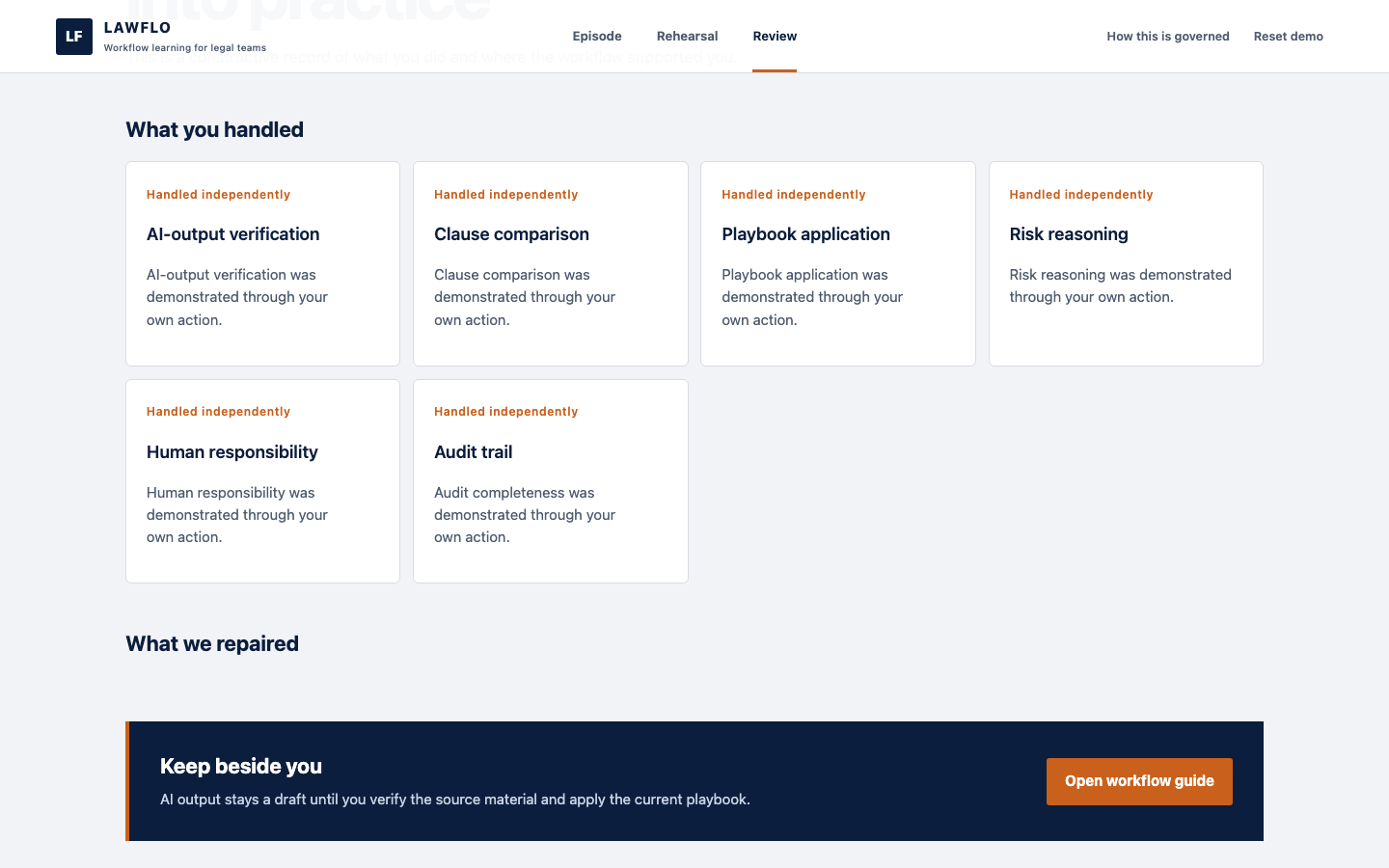
The learner then watches a four-part cinematic episode, sees exact contract facts and playbook rules through source-linked overlays, repairs an unsafe decision at an interactive checkpoint, and performs the workflow inside a realistic legal-AI contract-review replica. The experience ends with constructive feedback and an auditable record of the actions the learner actually completed.
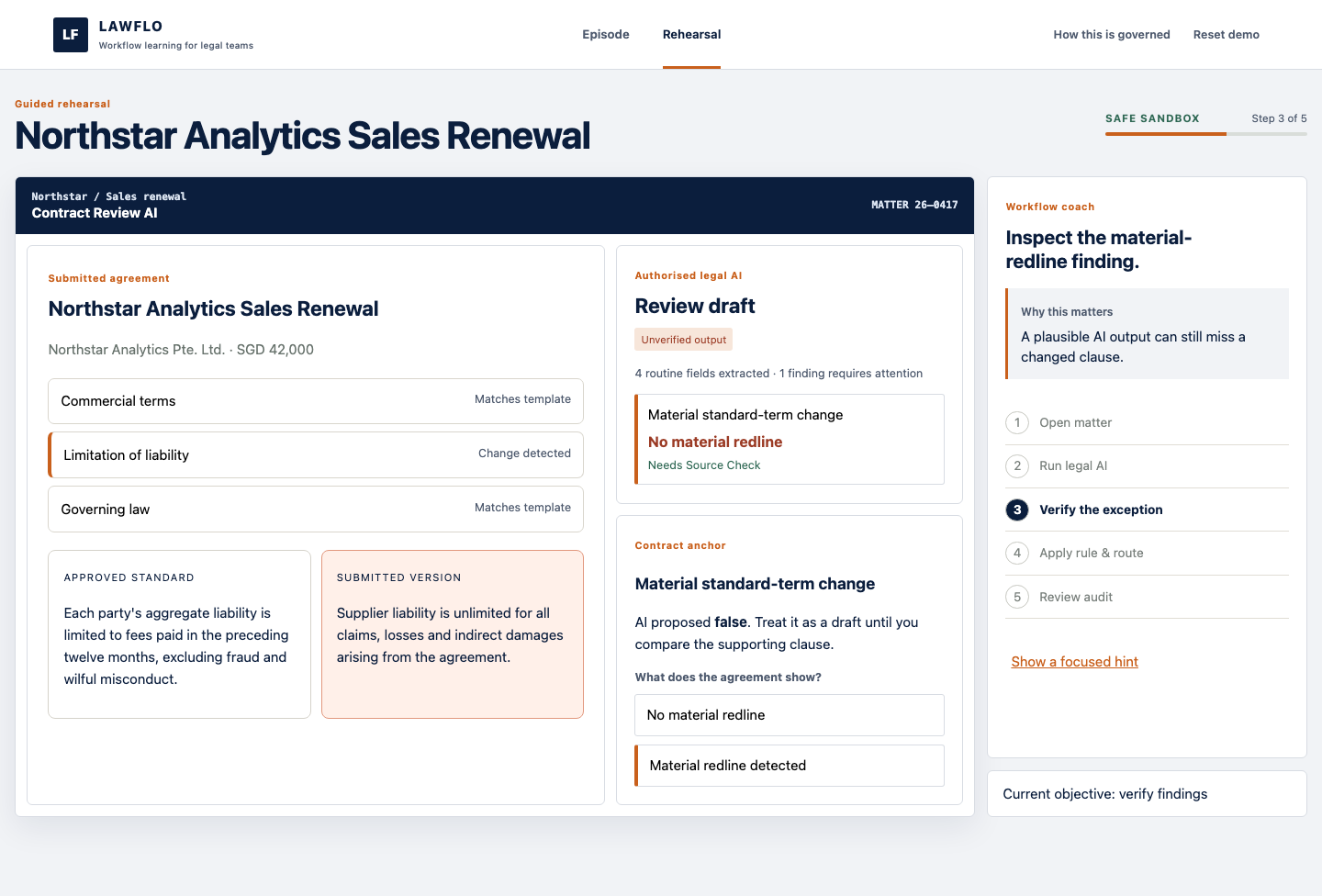
Our demonstration teaches an AI-assisted sales-renewal review. The AI correctly extracts a contract value of SGD 42,000, but misses that the submitted agreement removes the liability cap and introduces unlimited liability. The learner must verify the underlying clause, apply the firm’s higher-priority material-redline rule and route the contract to legal review.
LAWFLO does not teach one vendor’s generic interface. It transfers the firm’s own approved workflow from its legal AI pioneers to every lawyer expected to use it. It also goes beyond video generation: the same approved source bundle governs the episode, checkpoint and rehearsal, so learning moves from awareness to judgment and then to safe execution.
How we built it
LAWFLO is a React and TypeScript web application with a governed compilation architecture.
A source pipeline ingests the workflow, playbook, template and synthetic matter, validates their roles and creates a versioned bundle. OpenAI structured generation can convert those approved sources into a typed script and storyboard. Runway generates the cinematic scenes and Eleven v3 narration. The public demonstration uses reviewed, downloaded renders so expiring media URLs or a live generation queue cannot interrupt the presentation.
A typed episode timeline coordinates four videos, four narration tracks, source-linked deterministic overlays and a checkpoint that cannot be bypassed. Generated video supplies memorable human context, while the application layer carries the exact legal facts so training does not depend on a video model rendering clauses or numbers correctly.
The guided rehearsal is driven by a state machine that models intake, AI review, clause verification, playbook application, routing, repair and audit inspection. Approval fingerprints and source versions invalidate stale learning objects when their governing workflow changes. An idempotent event ledger records only observed learner actions and builds an evidence trail from source to instruction, learning artefact and completed behaviour.
The application is deployed on Render with server-side credentials kept out of the browser. The prototype is tested with 206 unit and integration tests plus three Chromium journeys covering the complete creator-to-review flow, compact desktop and the intentional phone-to-desktop rehearsal handoff.
LAWFLO is a synthetic training prototype, not legal advice and not an R&T system. It uses fictional people, policies and matters. Every material instruction resolves to an approved source. AI output remains a draft until a human verifies the evidence, and material exceptions override low-value shortcuts.
Challenges we ran into
Our hardest problem was making generative video genuinely instructional. Generative footage was good at atmosphere but unreliable at exact legal text and software interfaces. Our first version looked cinematic without clearly teaching the workflow. We corrected this with a hybrid media system: generated footage supplies human and narrative context, while deterministic source-linked overlays show the contract value, changed clause, controlling rule and safe route.
We also had to preserve the boundary between AI suggestion and legal judgment. A plausible AI output can still miss a material clause. We designed the checkpoint and rehearsal so an unsafe choice remains recoverable, the learner must inspect the source evidence, and a material exception blocks the low-value shortcut.
Finally, we had to fit a multi-stage product into a four-minute pitch. We built a prepared-render path that demonstrates the genuine generation architecture without waiting for an external video job during judging, then reduced each screen to one dominant action. During browser testing, we also removed timing-dependent transitions and aligned every automated journey with the simplified guided interface.
Accomplishments that we’re proud of
We are proud to have built a working creator-to-learner product rather than a sequence of disconnected mock-ups. LAWFLO combines a four-part generated episode, synchronised narration, an interactive legal decision and a realistic rehearsal that teaches source verification instead of testing memory with a questionnaire.
We also built versioned human approval, source lineage and an audit trail that preserve the boundary between model output and accountable legal judgment. By recording only actions the prototype genuinely observes, we avoid presenting fabricated adoption metrics as evidence.
The final production build passes 206 unit and integration tests and three browser-level journeys. It is publicly deployed and remains usable through prepared media even when external generation services are unavailable during the presentation.
What we learned
The clearest lesson was that legal AI adoption is not only a knowledge problem. It is a transfer problem. The people pioneering AI inside a firm develop valuable, firm-specific ways of working, but those workflows must become visible, repeatable and safe before the rest of the firm can use them confidently.
We also learned that safety mechanisms are only as strong as their weakest enforcement point. A policy checkpoint that can be bypassed creates false confidence. For that reason, LAWFLO treats AI output as a draft, anchors material instructions to sources, preserves human approval and makes unsafe reliance repairable.
Building the video pipeline taught us that generated media should not be the source of truth for precise professional instruction. The strongest result combines generative storytelling with deterministic evidence and deliberate human review.
Finally, the hackathon showed us how the practice of law involves procedural and systemic problems beyond the legal principles taught in class. Adoption, workflow design and responsible implementation determine whether new capability actually improves legal work.
What’s next for LAWFLO
Our immediate priority is to expand beyond contract renewal into a reusable library of firm-approved legal AI workflows. We would pilot the human-review process with legal innovation and knowledge teams using synthetic or properly authorised material, then test how quickly new workflows can be published and updated.
Next, LAWFLO could integrate its source-linked desk guide into the lawyer’s real point-of-work tools, while keeping approval and verification boundaries intact. When a workflow or governing source changes, the platform could identify every affected episode, rehearsal and guide and require re-approval before outdated instruction causes harm.
Longer term, consent-based integrations could measure sustained adoption from real usage rather than simulated analytics, while preserving the rule that no guidance reaches a lawyer without an accountable human sign-off.
Built With
- and
- api;
- audio;
- eleven
- html5
- node.js;
- openai
- playwright;
- react;
- render;
- runway
- typescript;
- v3;
- video
- vite;
- vitest;

Log in or sign up for Devpost to join the conversation.