-
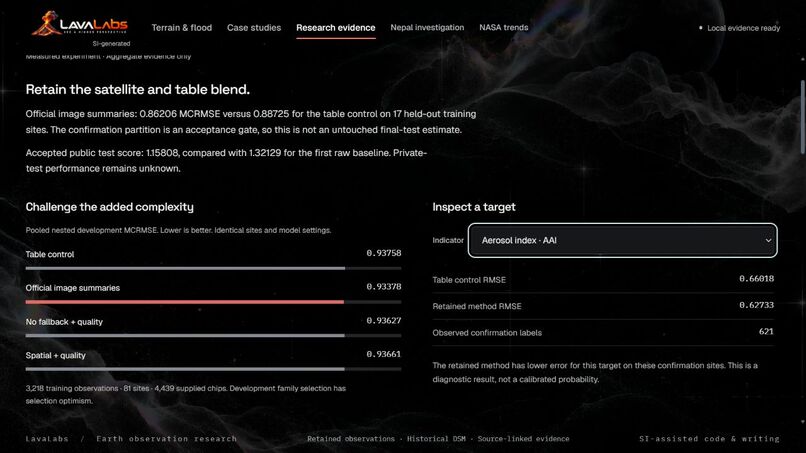
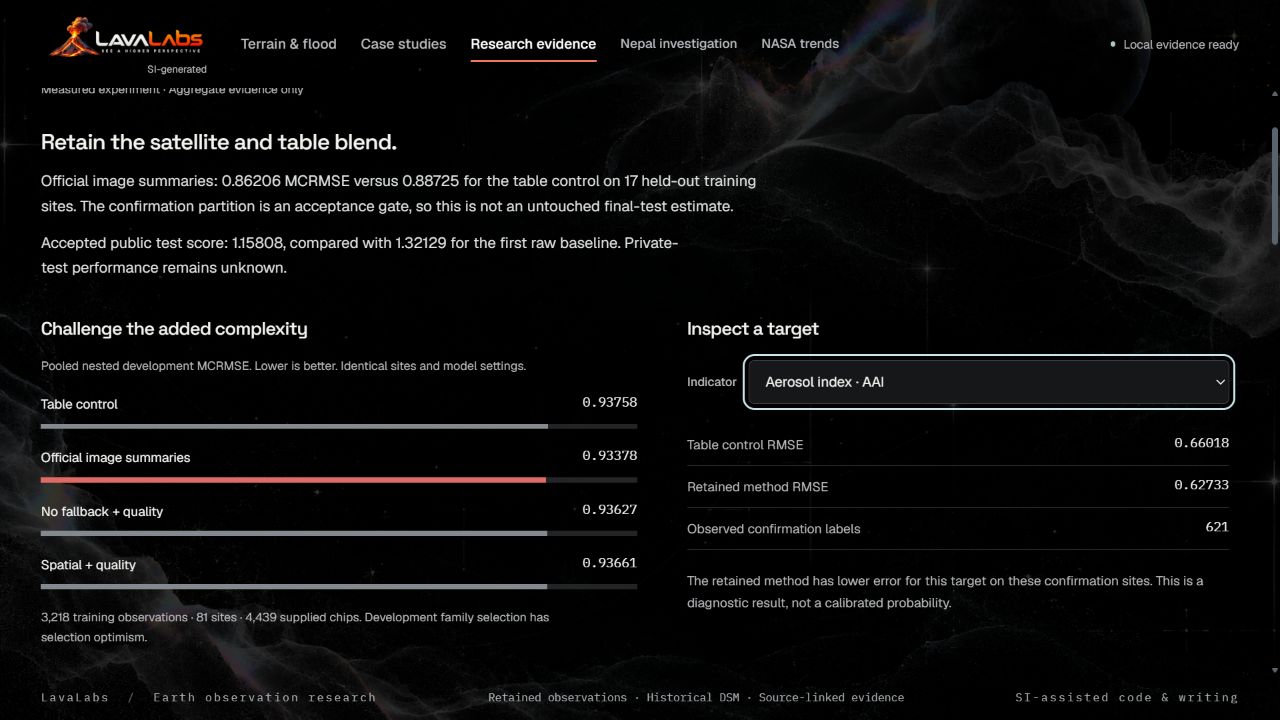
Measured feature-family comparison and AAI confirmation error. Aggregate evidence; private prediction outputs.
Inspiration
Satellite data can show a landscape clearly while leaving the atmospheric signal difficult to interpret. OBSCURA makes that problem concrete: predict five hidden atmospheric and thermal indicators at unseen facilities, using incomplete labels and anonymous satellite windows. We built LavaLabs Atmospheric Lab to make the prediction, its evidence and its limitations inspectable together.
What it does
LavaLabs predicts the five supplied standardized targets: methane, nitrogen dioxide, carbon monoxide, aerosol index and thermal/fire activity. It combines the competition's weather, season, terrain and spectral inputs with image summaries, then exports all 1,221 test observations in the exact required format.
Inside LavaLabs' Research Evidence workspace, an interactive panel compares the measured feature families, lets reviewers inspect each target's confirmation error and label support, and links to the aggregate receipt and research PDF. It prioritizes the next research actions: verify transfer, inspect missing-observation support, then promote improvements that survive their controls. Restricted chips and row-level predictions remain private on Kaggle.
How we built it
We first established a genuine scored table baseline, then processed all 4,439 supplied fourteen-layer Sentinel-2 chips. Four controlled feature families share fixed regularized HistGradientBoosting models and identical development sites: table-only; table plus the official 54 image summaries; a no-cloudy-fallback variant with quality flags; and a sixteen-feature spatial extension.
Training masks missing labels separately for each target. Site groups remain disjoint. Three outer development folds evaluate a three-inner-fold selection of conservative, target-specific mixtures. A separate 17-site partition accepts or rejects the development-selected recipe. The small mixture grid permits a training-mean fallback when stronger model responses are unsupported. We freeze source, configuration, runtime versions, scores and prediction hashes for replay.
Measured results
Our retained image-and-table mixture scored 1.15808 public MCRMSE, improving on the first raw table submission's 1.32129 by 12.35% lower error on the public subset. Both submissions were accepted by Kaggle. Private-test performance remains unknown.
On the matched development comparison, the official-summary mixture achieved 0.933783, versus 0.937579 for the table mixture. On the separate acceptance sites it achieved 0.862056, versus 0.887252. These are different evaluation populations from the raw baseline's whole-training CV; they are not interchangeable scores. Confirmation is an acceptance gate, so its selected result is not an untouched final-test estimate.
The custom no-fallback/quality and spatial variants scored 0.936270 and 0.936608 in development. Neither beat the official-summary control, so neither was retained. Only fourteen chips fell below the fixed selected-pixel threshold. That result gives us a concrete direction: preserve the stronger control and investigate model transfer before expanding image complexity.
Challenges and lessons
The first raw baseline scored 0.966382 in site-grouped training validation and 1.32129 publicly. This transfer gap is a material finding. With withheld dates and locations, we cannot establish which shift caused it or emulate true future-period validation. Sparse methane labels, target-dependent error and the difference between model selection and evaluation all affect what a score can support.
A read-only code review found two issues in the initial experimental controller: a custom method could pass the table comparison while losing to the official image control, and an extractor-only change could reuse a stale cache. We corrected both, added regression fixtures and replayed the private notebook from scratch. Saved version 372947210 reproduced the scores and prediction hash. The software checks also cover target masks, site separation, unsigned-band arithmetic, synthetic TIFF extraction, finite exports and held-out-label leakage.
What is original, and what is reused
LavaLabs' Scientific Noir identity and the earlier SATQuery flood, NDVI and terrain work predate OBSCURA. They provide interface infrastructure and an evidence-review approach. They are not atmospheric validation or additional training observations. NDVI, elevation and slope already appear in the supplied inputs; we do not claim their combination alone is new.
The official image-summary recipe and regularized estimator settings are adapted from Zelzy's Apache-2.0 starter and are credited. Our OBSCURA work is the modular prediction/export pipeline, controlled cloud/spatial comparisons, nested mixture selection, conservative acceptance controller, reproducibility checks and aggregate evidence interface. The custom feature hypothesis produced a useful negative result; no direct gas retrieval or field-calibrated alert is claimed.
Built with and disclosure
Python, NumPy, pandas, scikit-learn, SciPy, Rasterio/GDAL, threadpoolctl, Kaggle Notebooks, FastAPI, HTML, CSS and JavaScript. OpenAI Codex assisted source implementation, synthetic tests, research synthesis, analysis automation, interface work and writing. Competition observations retain organizer provenance. No generated labels, external environmental acquisitions, recovered facility identities or fabricated performance figures were added.
Next steps
One fixed Ordered CatBoost comparison on the same 83 inputs completed in a saved Kaggle run: development MCRMSE 0.931200 versus 0.933783, with two of three fold wins, but public MCRMSE 1.16407 versus 1.15808. The additional run required 90 CatBoost fits and 758.7 seconds. We preserved both validated candidates, recorded that reversal, and stopped model search. Longer-term work should evaluate transfer on newly permitted sites and periods, quantify uncertainty and measure analyst usefulness before any operational interpretation.
Built With
- catboost
- kaggle
- python
- scikit-learn
