-
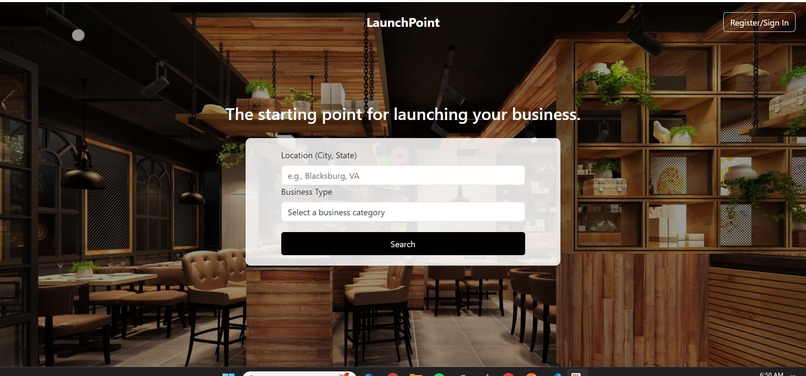
Homepage UI
-
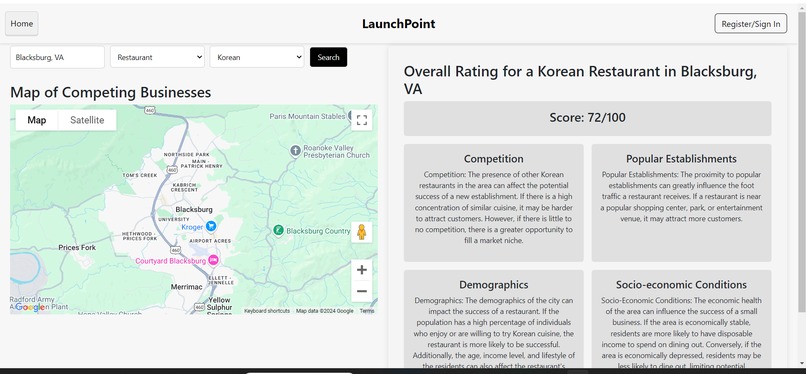
Results Page with Google Places API and Overall Rating
Inspiration
The idea for LaunchPoint was born out of a conversation with my mom's friend, who was considering opening a restaurant in Blacksburg. She was uncertain and frequently asked me to get feedback from students and professors on how a Korean vs American-style restaurant would do in the area, and if it was even worth investing in a business there at all. While I wanted to help, I found it difficult to provide her with the reassurance she needed using just my own observations. That's when I realized there was a bigger need for a tool—something that could provide aspiring business owners like her with reliable data and insights into the best locations for a variety of establishments. By leveraging APIs and concrete data, LaunchPoint was created to empower entrepreneurs with the information they need to make confident, informed decisions.
What it does
LaunchPoint helps business owners determine the best location to open their business by analyzing key factors such as competition, popular establishments nearby, city demographics, and socio-economic conditions. The platform generates a score out of 100, indicating whether a specific city is optimal for a particular business type. Additionally, it provides detailed explanations for each factor, including the number of competing businesses, income distribution, and population demographics, to ensure business owners understand why a location might be a good fit.
How we built it
For the backend, we used JavaScript and Node.js, integrating the OpenAI API to analyze and generate insights from collected data. We also used the Google Places API to gather real-time data on competing businesses in a given area. On the front end, we utilized React, HTML, and CSS to create a smooth and responsive user interface, while also using the Google Places API to display nearby competitors visually on the map.
Challenges we ran into
One of the major challenges we faced was gathering accurate, city-specific data for factors like population, income, and competition. Many APIs provide county-level data, which wasn't as precise as we wanted for our project. Additionally, working with multiple APIs and integrating them efficiently was a learning curve, especially when accounting for real-time data from Google Places. Handling edge cases, such as when no alternative city was found within the set radius, also required refining the prompt to make sure the output remained relevant and useful.
Accomplishments that we're proud of
We’re especially proud of how our front-end turned out and how we managed to integrate all the features we had planned from the start of the brainstorming process.
What we learned
Through this project, we learned a lot about working with external APIs and integrating AI into real-world applications. We gained a deeper understanding of how to manage multiple data sources, optimize prompts for OpenAI's models, and structure backend systems to handle complex calculations. Additionally, we learned about the challenges and nuances involved in providing actionable insights for small business owners, especially when it comes to competition and market analysis.
What's next for LaunchPoint
In the future, we plan on adding additional factors to give even more insight by implementing data from more APIs. We also plan to improve the platform's mapping capabilities to show available properties directly on the platform.

Log in or sign up for Devpost to join the conversation.