-
-
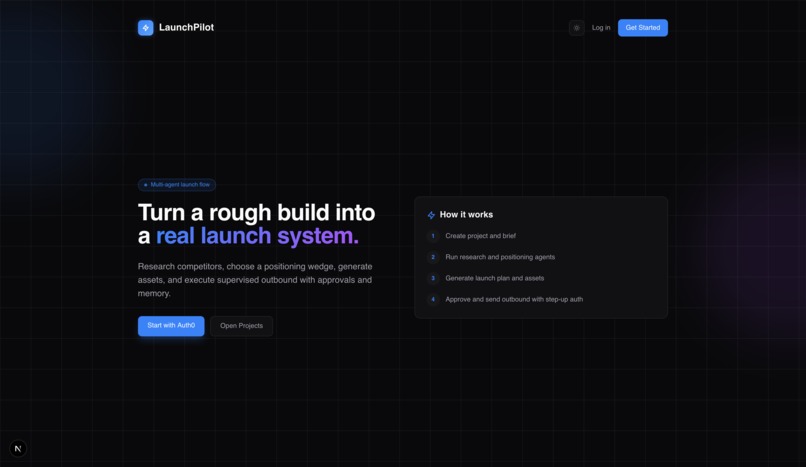
Landing Page
-
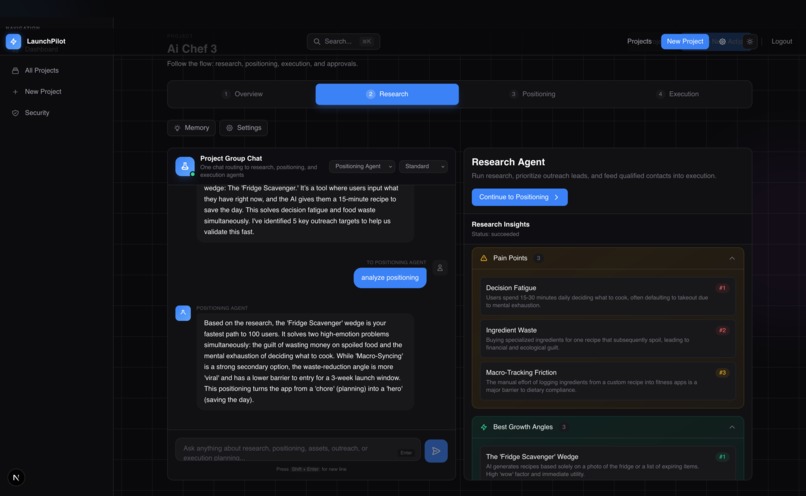
Usage Flow
Inspiration
Every Canadian hackathon is full of builders who are able to ship products fast, but 99% of these projects die the minute judging is over, and never get to see their first users. We built LaunchPilot to turn amazing technical products that may have never seen a single user into successful launches that get real people obsessed.
What it does
LaunchPilot takes a project from idea to execution in one flow:
- Ingests project brief + GitHub context.
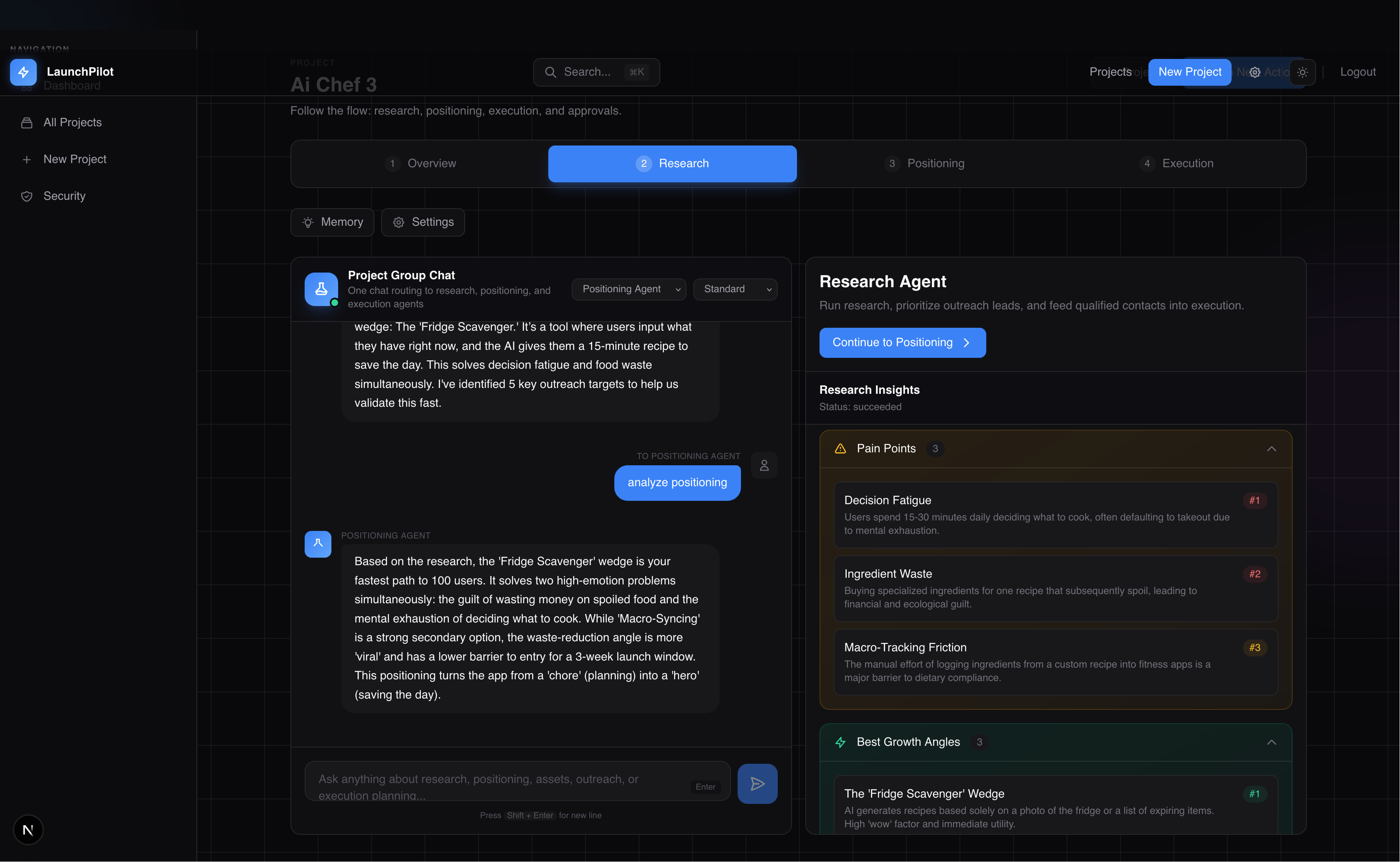
- Runs research to map competitors, pain points, wedges, and outreach opportunities.
- Generates positioning options (ideal customer profile, wedge, messaging).
- Builds a 7-day execution plan with launch tasks and KPIs.
- Creates distribution assets (cold email/DM, image-ad prompts, video scripts).
- Prepares personalized outreach batches to send to high potential scraped leads
- Persists memory, activity, and agent chat so teams can resume where they left off.
How we built it
Frontend: Next.js App Router + TypeScript + Tailwind UI. Backend: FastAPI + SQLAlchemy + Alembic + Postgres. Agent layer: Backboard-backed stage agents (research, positioning, execution) with persistent threads and memory snapshots. Google Gemini as our LLM of choice to power these agents. Auth/Security: Auth0-ready auth mode, scoped permissions, approval-gated execution actions. Integrations: GitHub context sync and Google Drive export, both powered by Auth0's AI agent integrations
Agent Orchestration
We orchestrated a team of agent to go take the product from idea/repository to market ready
- Research analyzes market, competitors, pain points, and wedges.
- It runs lead discovery/scoring and produces qualified contacts.
- Outputs are saved as project memory.
- Positioning uses that memory for ICP + messaging.
- Execution uses both to build plan, assets, and outreach drafts.
- Research contacts feed execution outreach and approval/send flow.
Challenges we ran into
- Accessing Google and Github for AI agent actions (especially with both at the same time) using Auth0
- Building agent memory meaningfully in a way that captures the most useful information and doesn't just bloat context
- Getting rid of hallucinations and making sure agents
- UI bugs stacked on top of UI bugs
Accomplishments that we're proud of
- Shipped a true end-to-end launch loop, not just a chat demo, performing real market research and positioning analysis, and giving step by step executable plans to reach growth targets
- Built persistent cross-stage memory so context of your project compounds over time
What we learned
- Agent systems need strong structure: schemas, normalization, and guardrails matter as much as prompts
- Persistent memory is only useful when it is synced intentionally at every meaningful state change
- In launch tooling, execution UX (plans, assets, leads) is much more valuable than generic advice
Tools we used
Alongside our core stack, we used AI dev tools throughout the build to move faster and ship a more reliable product with only 2 people on a tight time budget. We used Google Antigravity, OpenAI Codex, and Claude Code as engineering copilots for different parts of the workflow.
What's next for LaunchPilot
- Expanding the kinds of outbound channels we support, and going a step further into helping the user actually generate/run ads
- Integrate with CRM Platforms to help users manage their first outbound campaigns
- Add experiment analysis to see which assets are getting the strongest responses
Built With
- auth0
- backboard.io
- fastapi
- gemini
- next.js


Log in or sign up for Devpost to join the conversation.