-
-
Ignition
-
Startup Idea Investigation
The Problem
Most AI tools are very good at making an idea sound convincing.
That's exactly the problem.
When you're deciding whether something is actually worth building, you don't need another enthusiastic chatbot. You need something willing to challenge you.
What is the evidence? Who says this is true? What happens if the assumptions change? Which competitors already exist? How much of the conclusion can actually be defended?
We built Ignition around those questions.
What It Does
Ignition is an AI-powered investigation and decision system for early-stage ideas. A Clustral AI product, live at ignition.clustralai.com.
Give it an idea, and it doesn't immediately tell you that it's brilliant.
It investigates.
It writes its own research plan, runs six live web searches at once, reads what it finds, and only then reaches a conclusion — with every factual claim tied to a numbered exhibit you can open yourself.
The demo idea is deliberately unglamorous and specific:
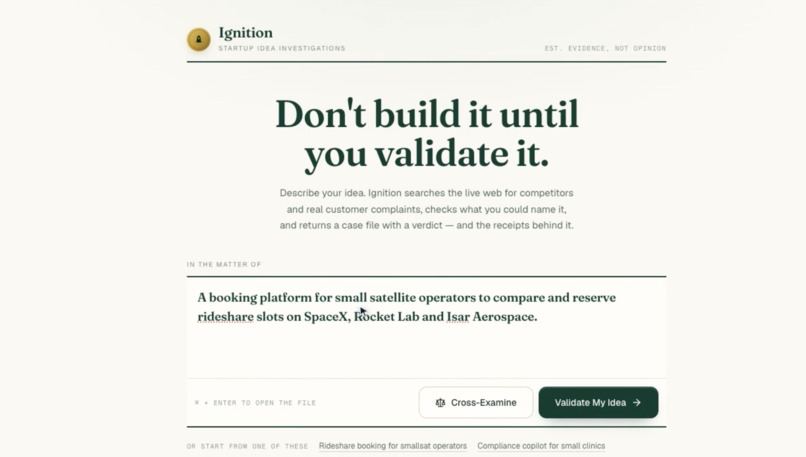
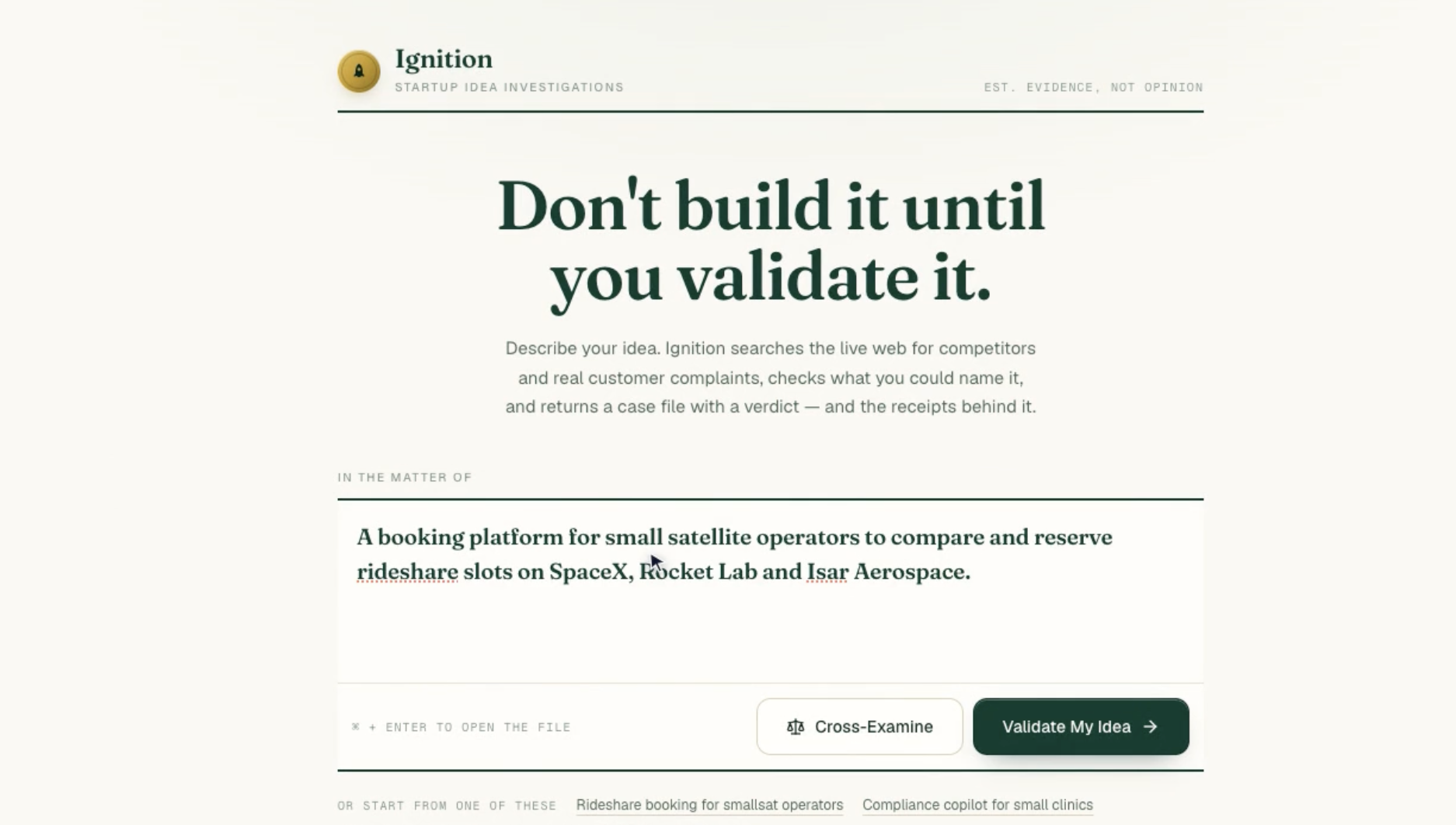
A booking platform for small satellite operators to compare and reserve rideshare slots on SpaceX Transporter, Rocket Lab and Isar Aerospace.
The system arrives at:
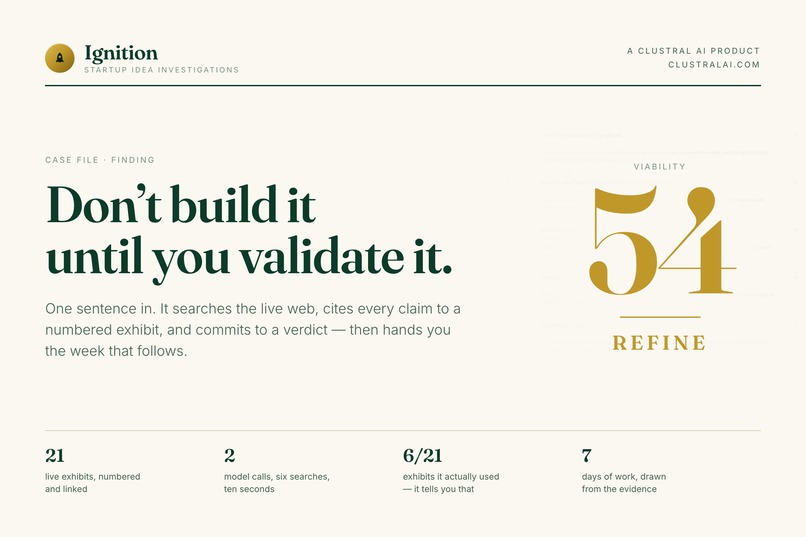
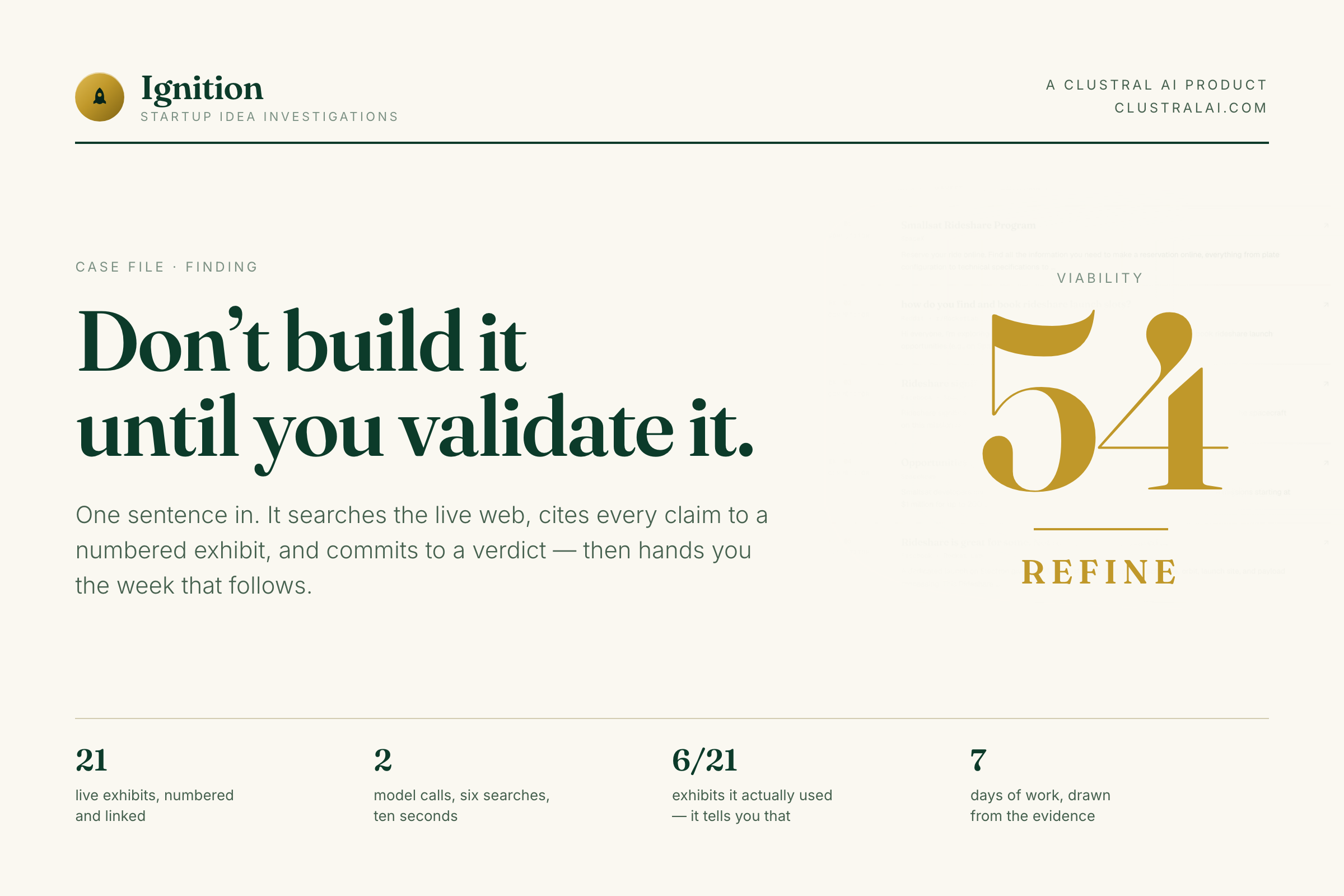
54 — REFINE
And that's intentional. The product isn't optimized to flatter the user. It's optimized to make the decision better.
The Finding Nobody Wanted
The most useful thing Ignition returned was the answer to "is anyone already doing this?"
Yes. SpaceX already runs its own smallsat rideshare programme, and SEOPS already sells the booking. Both are cited to the exhibit they came from — real URLs retrieved seconds earlier, not names recalled from training data. If the model invents a citation, the server strips it before it ever reaches the page.
That is the finding a founder needs before spending a year, and no amount of encouragement substitutes for it.
The Moment That Changed the Demo
While building the demo, we found something important about the product itself.
Our first narration quoted numbers that didn't match the recorded run. The voice said one score while the screen showed another, and named competitors from an earlier run entirely.
For a product whose whole argument is "we don't make things up," that was disqualifying.
So we re-derived every figure from the actual output and rewrote the script against it. One of those corrections made the film less flattering — our claimed sourcing rate was wrong, and the true number was lower. We used the true one.
The final recording reflects the real run:
- 54 — the opportunity score, and 16 points short of Build
- 21 exhibits, numbered and linked
- 100% of factual claims carrying a source
- 6 of 21 exhibits actually used in the findings — which the product volunteers about itself
- 3 things it states plainly that it could not establish
That became part of the product philosophy:
If the evidence changes, the answer should change.
Cross-Examination — And The Result We Didn't Expect
Ignition has a second mode. Cross-Examine runs the same investigation the way an investor would before writing a cheque: search queries biased toward disconfirming evidence, and an analyst told to lead with what the evidence fails to support.
We expected the score to fall.
It went up. 54 → 65.
Going looking for reasons the idea fails surfaced a growing market rather than a saturated one. We kept that in the film rather than re-rolling until it behaved, because it proves the point better than the result we'd scripted:
A tool that only confirms your fears is exactly as useless as one that only confirms your hopes.
It Tells You What Would Change Its Mind
A score alone is a dead end. Every Ignition file also states, from arithmetic on its own weighted sub-scores:
- how far it is from the next verdict — 16 points
- whether any single score could close that gap alone — here, none can
- where the remaining headroom actually sits — demand
- how exposed the verdict is — it holds unless demand falls 31 points
That stops being a score and starts being a brief.
Then It Hands You The Week
The file ends with seven days of work derived entirely from the evidence above: the competitor to go and use, the thread to go and read, the riskiest assumption to test, and the one feature to build first. Every step names something real from this run, so it cannot drift into generic advice.
The Experience
The demo is designed like an investigation rather than a dashboard tour.
The idea is typed in. The pipeline runs. The score reveals itself. The camera focuses attention on the evidence behind the decision. Sensitivity analysis shows what changes when assumptions move. The exhibit register is filtered live. A citation is hovered. The same idea is cross-examined. Finally the system opens the generated launch brief.
The result is a narrative:
Idea → Investigation → Evidence → Cross-examination → Verdict → Action
Why We Built It
The most dangerous AI answer isn't an obviously wrong answer.
It's a confident answer that sounds right.
Instead of asking:
"Can AI generate a good business idea?"
we asked:
"Can AI interrogate an idea before we spend time and money building it?"
What We Learned
The biggest lesson wasn't about generating AI output. It was about trust — and trust turned out to be an engineering problem, not a copywriting one:
- The first model call is forbidden from stating any market fact, because at that point it has no evidence.
- The second may only make claims backed by retrieved sources, and invented citations are stripped server-side.
- The score is computed from weights, not written by the model, so the headline can never contradict the detail beneath it.
- Sample data is always labelled. When we ran without a name.com key, the product marked the suggested domains unverified rather than presenting them as available — and the narration says so out loud.
- Free-tier limits, retired model IDs and malformed model output are all handled. The run finishes and tells you what degraded.
We also learned a convincing AI experience isn't just the model. It's orchestration, evidence presentation, interaction design, timing and storytelling.
How We Built It
The product
- Next.js + TypeScript, deployed as a container on Azure Container Apps
- SerpApi for live web research — six concurrent searches per run, with a seven-day cache and automatic fallback to Brave and then a keyless provider when quota runs out
- name.com for domain availability
- Groq (
openai/gpt-oss-120b) for reasoning, with OpenRouter as a fallback provider - Zod-validated schemas, tolerant of the malformed shapes real models return
- 114 tests covering the failure modes that break demos: truncated JSON, fabricated citations, rate-limit arithmetic, provider fallback
The film
- A real browser session recorded through Puppeteer, 1920×1080, not a slideshow
- Neural narration via Kokoro, cut to absolute beats so voice and picture cannot drift
- ffmpeg muxing, with each line placed at the timestamp its beat actually began
- Programmatic camera direction: synthetic cursor, click ripples, eased scrolling, and a spotlight that dims the page around whatever the narrator is discussing
The demo also replays a recorded investigation with no network calls at all, so a dead venue Wi-Fi connection cannot take the presentation down — and the narration says that plainly rather than implying live execution.
The Result
Ignition doesn't promise certainty.
It gives you something more useful: a better reason to decide.
If the evidence says build, build. If the evidence says refine, refine. If the evidence says shelve it, shelve it early.
Because the best AI product isn't the one that always says yes.
It's the one that helps you know when the answer should be no.
Built With
- agents
- ai
- artificial-intelligence
- competitive-intelligence
- data-analysis
- decision-intelligence
- evidence-based-ai
- ffmpeg
- javascript
- kokoro
- llm
- market-research
- natural-language-processing
- puppeteer
- python
- pytorch
- webapp

Log in or sign up for Devpost to join the conversation.