-
-
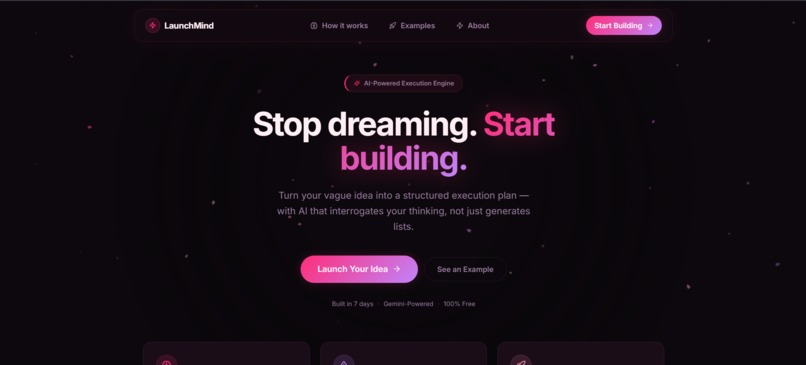
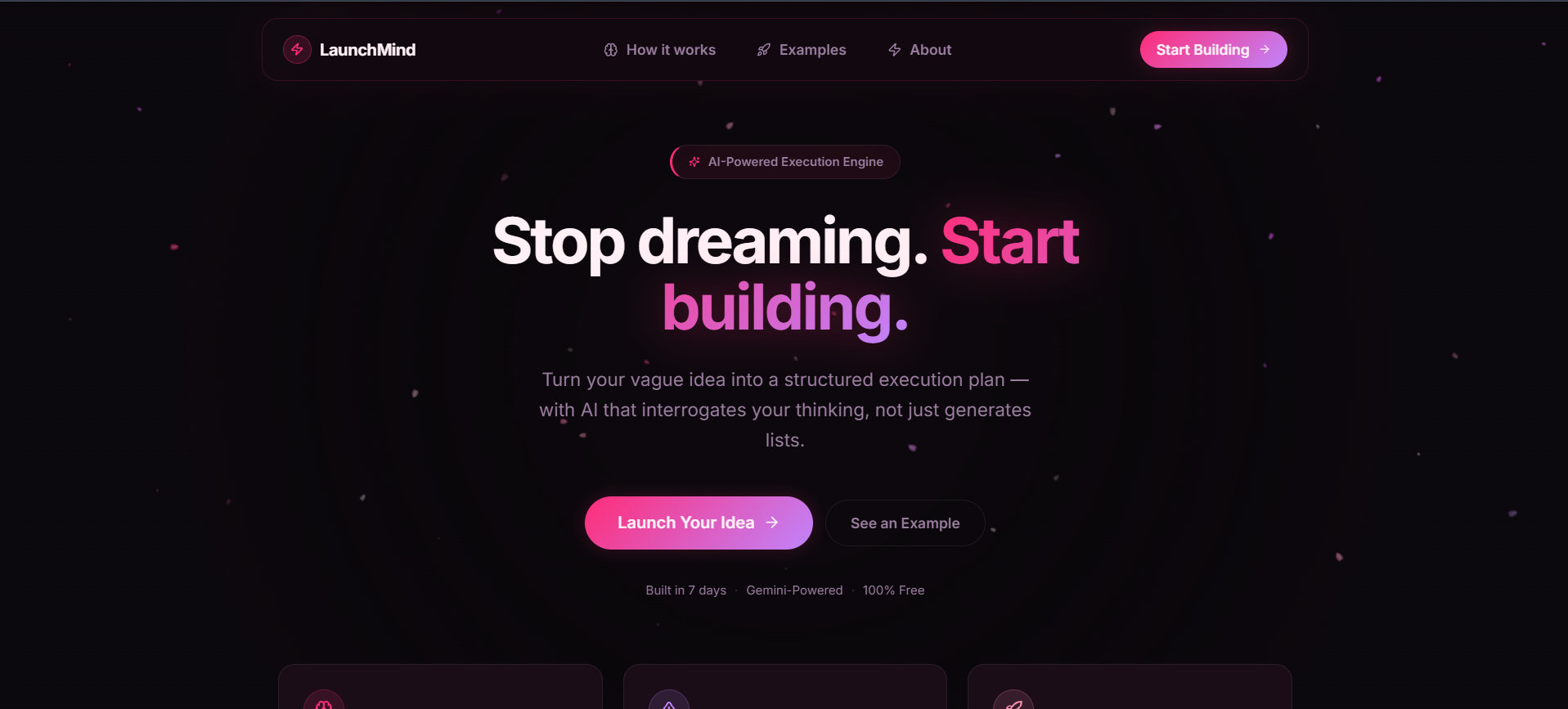
Entry Page
-

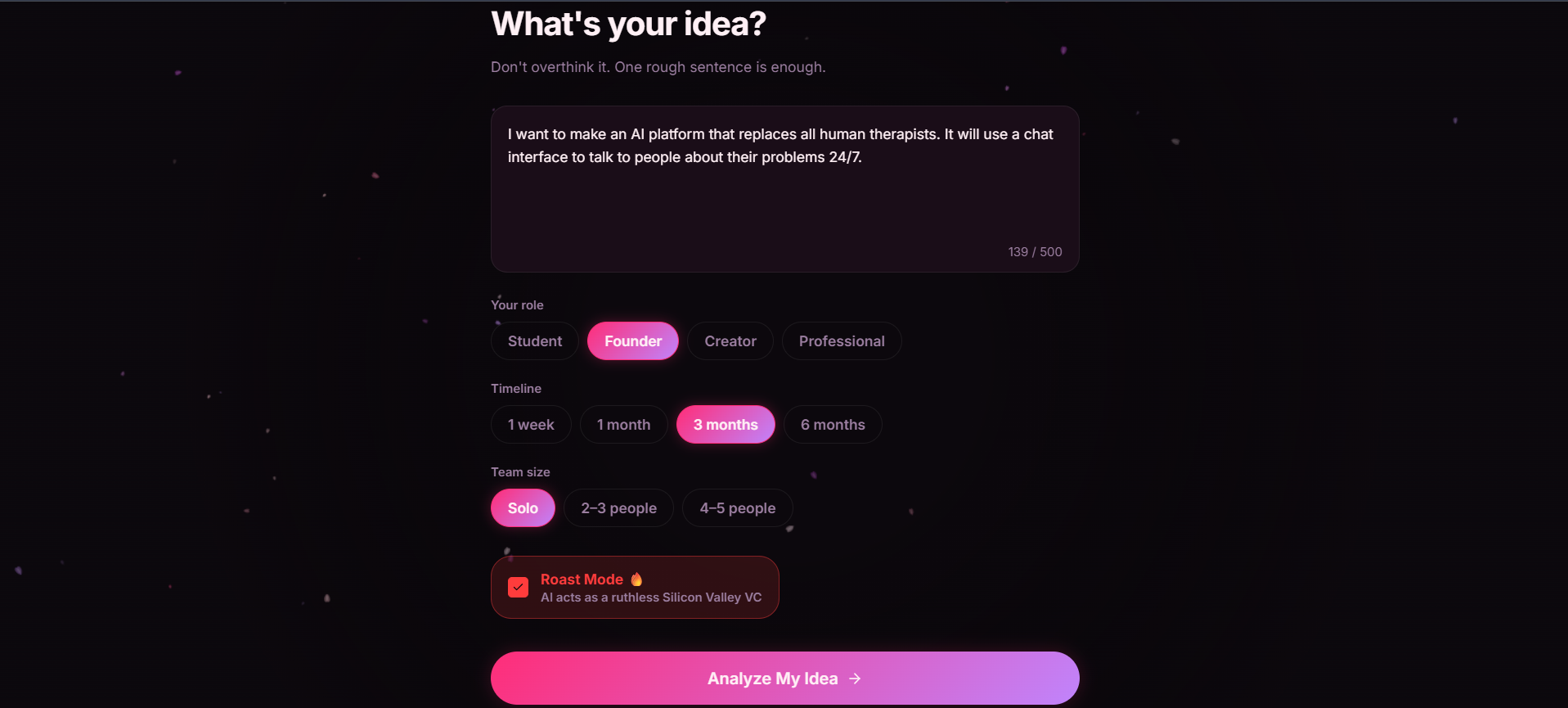
Input Screen
-
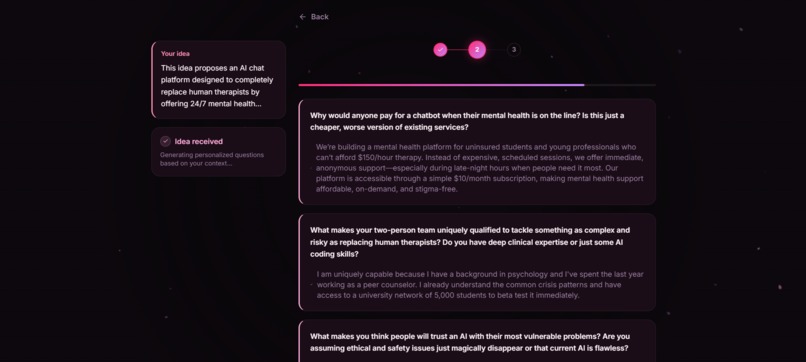
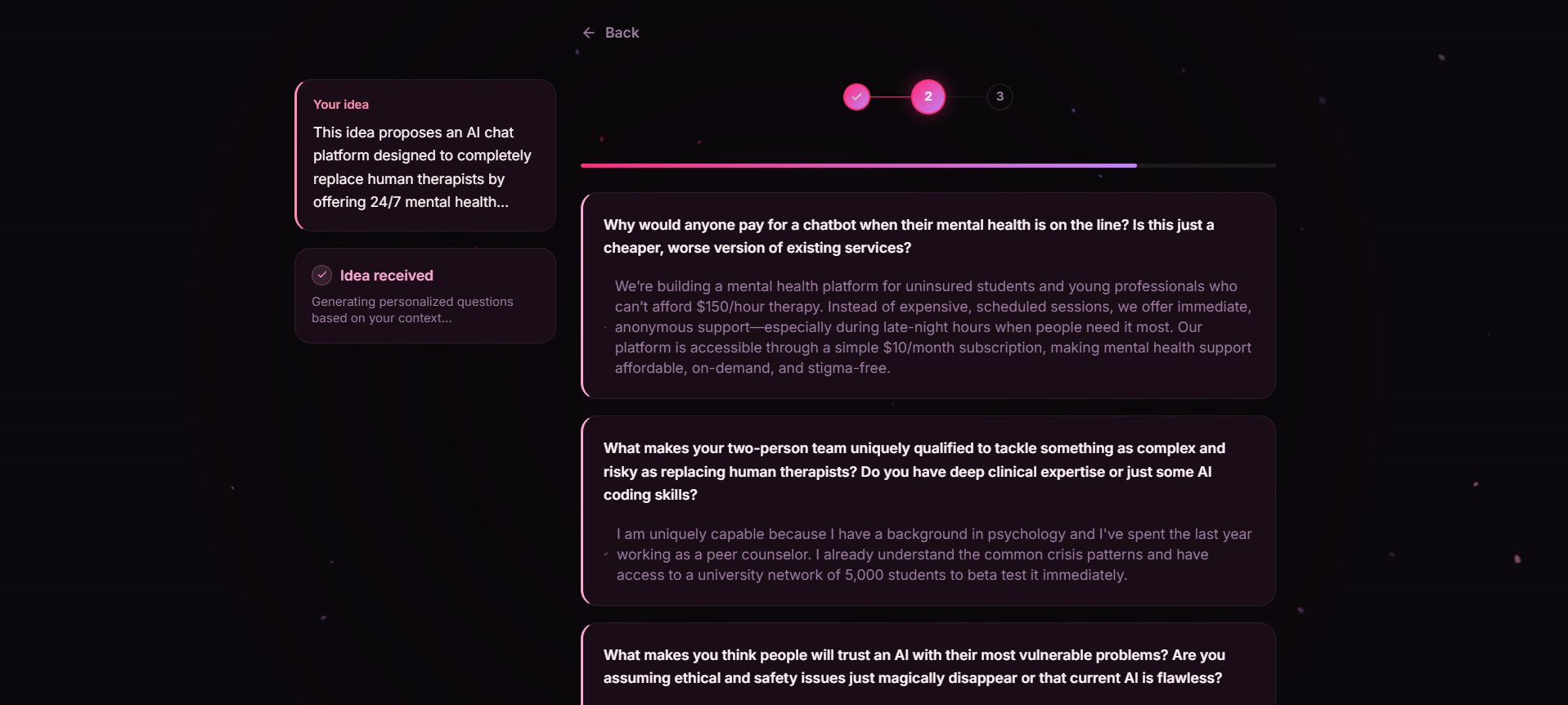
The Roast
-
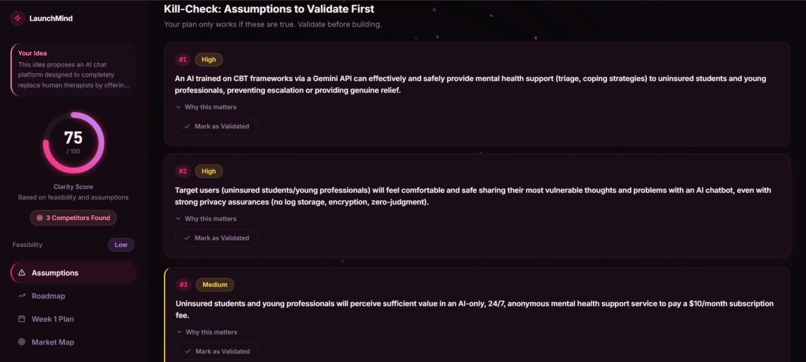
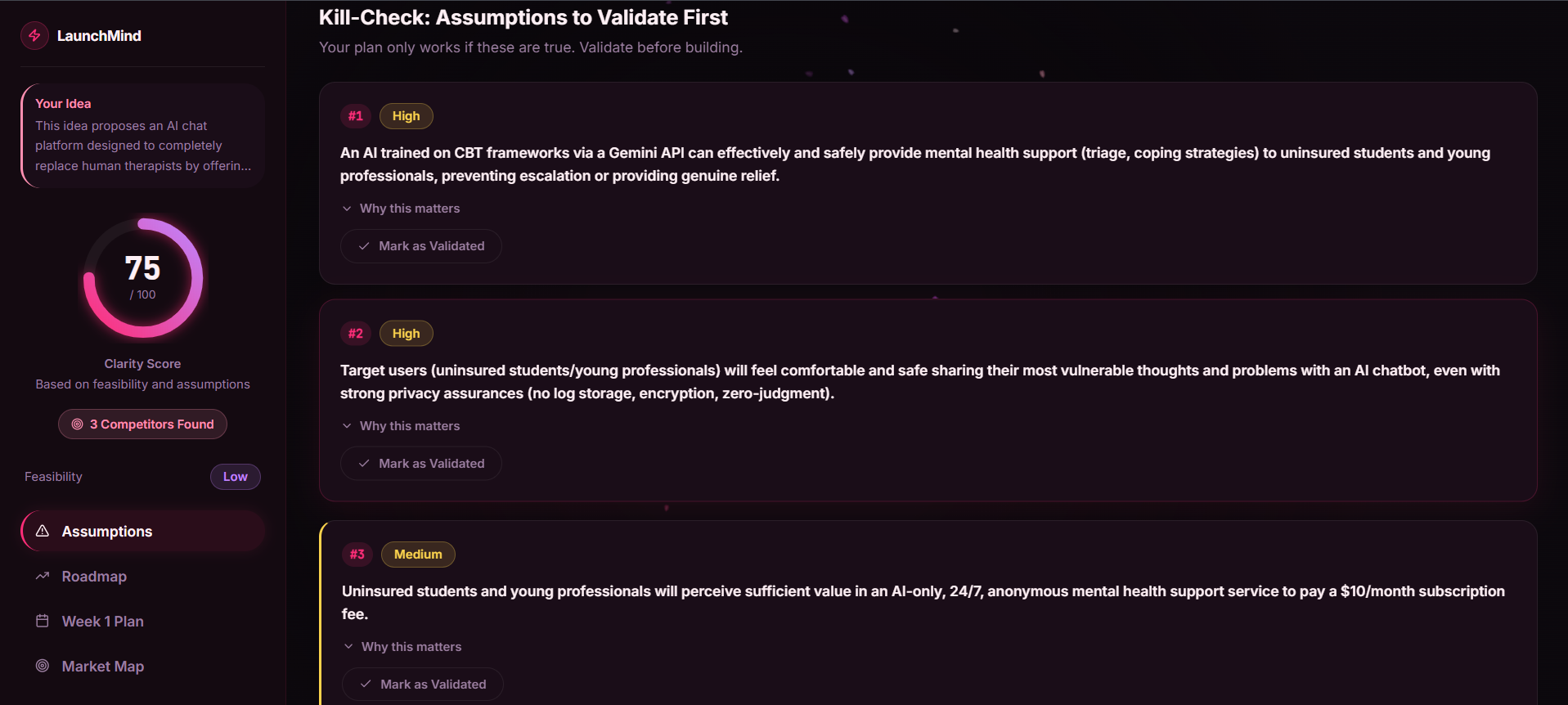
Assumptions
-
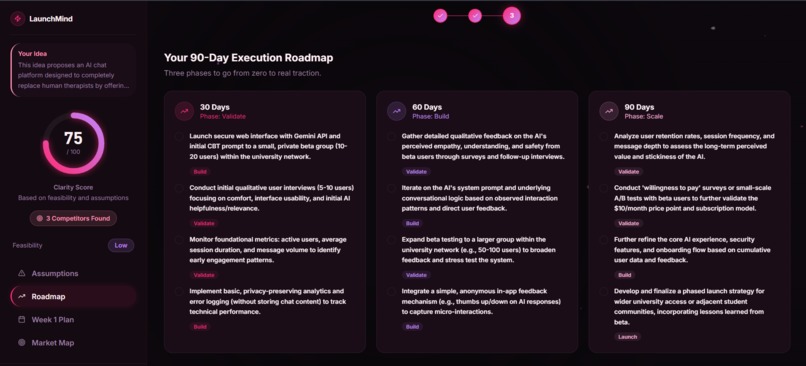
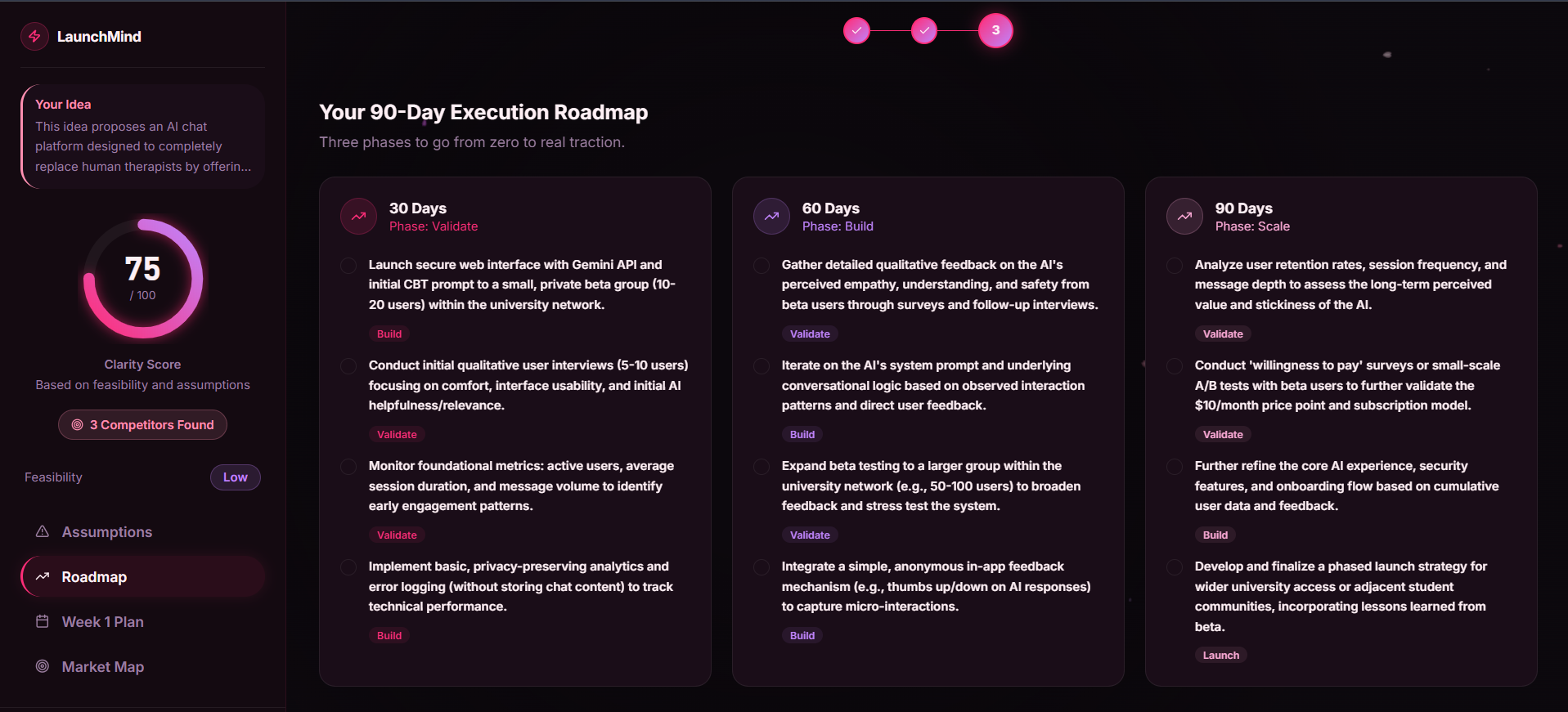
Execution Plans
Inspiration
Modern life is overloaded with information, difficult tradeoffs, and constant mental switching. We noticed that students and early professionals are expected to turn vague ideas into execution without clear frameworks. Most tools either oversimplify (like pros/cons lists) or overwhelm (too much information). We wanted to build an AI system that helps people reason, moving from confusion to clarity to action.
What it does
LaunchMind is an AI-powered "Second Brain" for aspiring founders, students, and creators. Instead of generating content for users, LaunchMind forces them to think critically.
It first evaluates a raw idea using a "Startup Coach" or an aggressive "Roast" mode, asks targeted clarifying questions, and then transforms the user's answers into a structured, realistic execution plan. This includes risk-ranked assumptions, a 30/60/90-day roadmap, and an immediate "Day 1" action step.
How we built it
The frontend is built with React, Vite, and TailwindCSS for a fast, responsive UI. The backend uses Python and FastAPI. The core intelligence is powered by Google's Gemini 2.5 Flash API, which handles the dynamic idea interrogation, plan generation, and plan adjustment based on real-time web search context.
Challenges we ran into
Our biggest challenge was designing the prompts to make the AI act as a strict evaluator rather than a "yes-man". We had to carefully tune the system instructions to ensure the AI surfaced hidden tradeoffs and presented uncertainty honestly, rather than just generating a generic, overly-optimistic to-do list.
Accomplishments that we're proud of
We successfully created a seamless workflow where the user's inputs genuinely shape the final plan. The "Roast" mode is particularly effective at stress-testing ideas before any code is written, ensuring users are solving real problems.
What we learned
We learned that structuring a user's thinking process is often more valuable than just generating a final output. By forcing the user to answer clarifying questions, the final AI-generated plan becomes significantly more relevant, personalized, and actionable.
What's next for LaunchMind
We plan to add integrations to automatically create Trello or Notion boards from the generated Week 1 plan, and implement a daily check-in system to keep users accountable to their Day 1 action.
Hackathon Required Questions
Track & Challenge
Track: Undergraduate Track Challenge Direction: Productivity: Build the "Second Brain" for Real Life (Direction B: Zero-to-One Builder)
Design Questions
AI Architecture Explanation Our system takes user role, timeline, team size, and a vague idea as inputs. We use the Gemini 2.5 Flash API to process this. First, it evaluates the idea's clarity and feasibility, outputting 5 critical clarifying questions. After the user answers these, the AI synthesizes the answers with live web search data to generate a structured JSON execution plan. This output includes risk-ranked assumptions, a 90-day roadmap, and a Day 1 action. The processing is entirely prompt-driven using structured JSON outputs to ensure reliability.
Human-in-the-Loop Design The AI does NOT decide if the idea is fundamentally "good" or execute the tasks. The human must answer the clarifying questions with their unique real-world context. The AI generates a roadmap and surfaces hidden assumptions, but the human remains in control of actually validating those assumptions and executing the Day 1 action. We use AI to structure the user's thinking, not replace it.
Responsible AI Guardrail Risk: The AI could present a highly confident but flawed plan, leading the user to skip crucial validation steps and build something nobody wants (false certainty). Mitigation: Our system forces a "validate before you build" approach. The AI is hardcoded to output "assumptions that could kill the idea" at the very top of every plan, ensuring the user must manually validate the highest risks before proceeding with the rest of the generated roadmap.
Tools & Data Disclosure
AI Tools Used
- Google Gemini 2.5 Flash API (free tier) for all text generation, idea evaluation, and plan structuring.
- GitHub Copilot for coding assistance during development.
Data Sources
- User's inputted idea and answers to clarifying questions.
- Live Web Search API (custom implementation) to pull real-time competitor context based on the user's idea, which the LLM uses to identify differentiators.


Log in or sign up for Devpost to join the conversation.