-
-
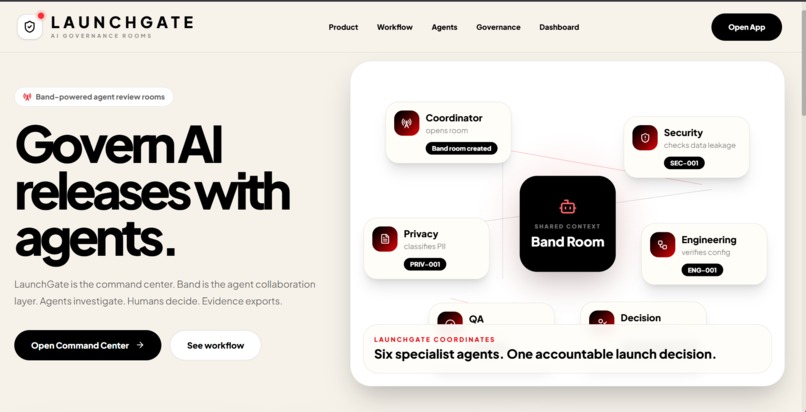
Landing page
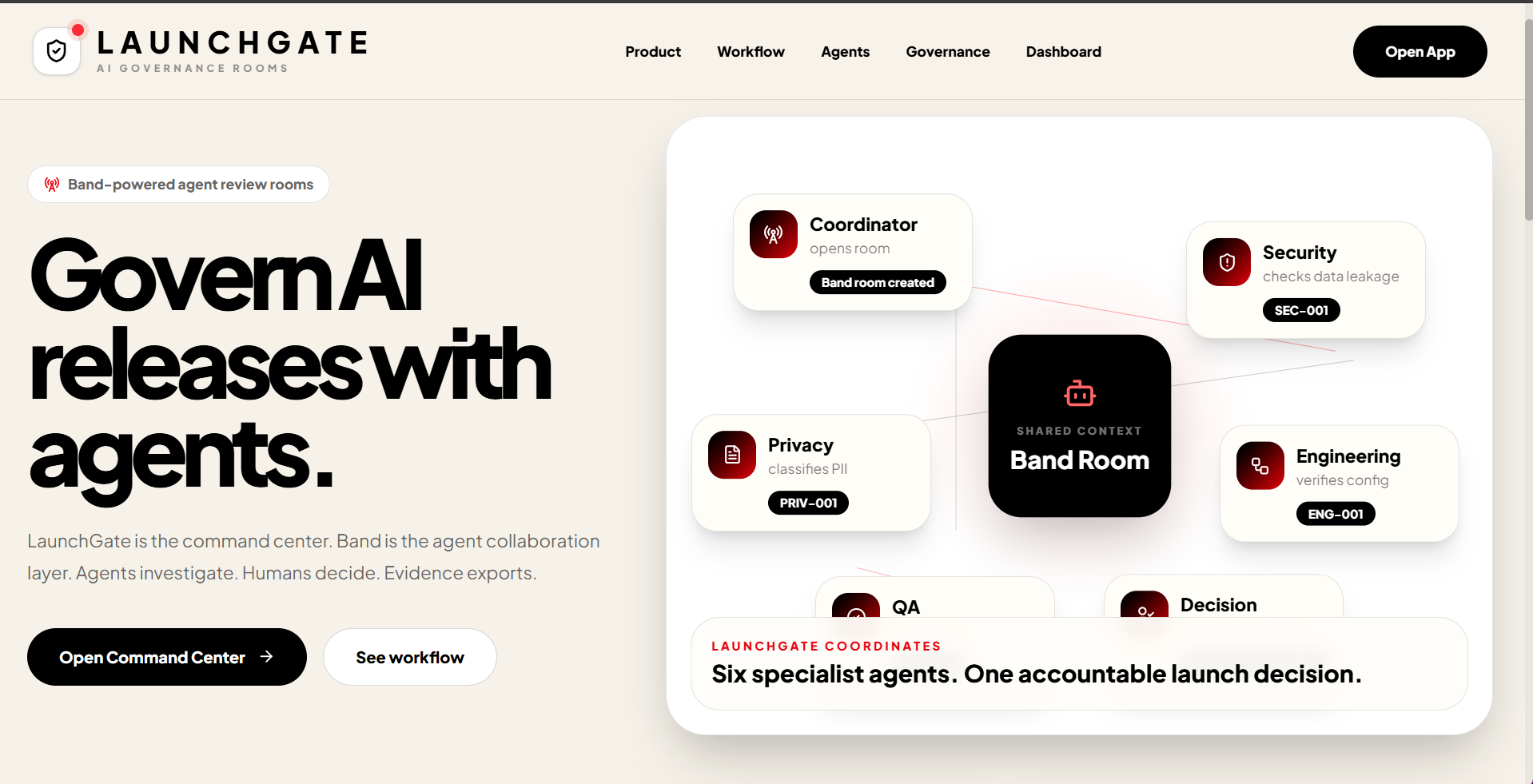
🚀 LaunchGate AI
Inspiration
As enterprises rapidly adopt AI, software releases have become far more complex than traditional deployments. A single AI feature can introduce security vulnerabilities, privacy risks, compliance concerns, and operational challenges. Yet, release approvals are still fragmented across Slack conversations, Jira tickets, documentation, and manual meetings, making it difficult to ensure every risk is evaluated and every decision is traceable.
We wanted to reimagine this process by asking:
What if every software release was reviewed by an AI-powered committee before deployment?
That vision led to LaunchGate AI—a multi-agent governance platform that brings structure, collaboration, and transparency to AI release decisions.
What it does
LaunchGate AI transforms every software release into a collaborative AI review workflow.
When a release is submitted, specialized AI agents analyze it from different perspectives, including security, privacy, compliance, engineering readiness, and quality assurance. Instead of working independently, the agents collaborate through Band, exchange structured findings, and build a shared understanding of the release.
Once the review is complete, LaunchGate AI:
- Identifies security, privacy, and deployment risks
- Aggregates findings from multiple specialist agents
Generates a final governance decision:
- ✅ Approve
- ⚠️ Review
- ❌ Request Changes
Produces an audit-ready report explaining every recommendation
The result is a faster, more transparent, and more accountable release approval process.
How we built it
We built LaunchGate AI as a modern AI-native SaaS platform using a multi-layer architecture.
- Next.js + TypeScript power the frontend dashboard for creating review sessions and visualizing agent collaboration.
- FastAPI serves as the backend orchestration layer and manages release workflows.
- LangGraph orchestrates the multi-agent execution graph, maintaining workflow state and coordinating task execution.
- Band acts as the collaboration runtime where specialist AI agents communicate, share findings, and maintain a synchronized review session.
- LangChain enables structured outputs, tool execution, and agent utilities.
- OpenAI-compatible models provide reasoning, classification, summarization, and decision generation.
We designed six specialized agents, each with a focused responsibility:
- 🧭 Coordinator Agent
- 🔐 Security Agent
- 📜 Privacy & Compliance Agent
- ⚙️ Engineering Agent
- 🧪 QA Agent
- ⚖️ Decision Arbiter
This architecture mirrors how real enterprise review boards operate, replacing isolated AI calls with collaborative decision-making.
Challenges we ran into
One of the biggest challenges was designing meaningful collaboration between multiple AI agents rather than simply running several prompts in parallel.
We needed to define clear responsibilities for each agent, maintain shared state across the workflow, and ensure that every finding could be aggregated into a coherent final decision.
Another challenge was balancing automation with human oversight. Governance decisions require transparency, so we focused on generating explainable recommendations instead of opaque AI outputs.
Finally, coordinating multiple technologies—including FastAPI, LangGraph, Band, and the frontend—while maintaining a smooth end-to-end workflow required careful orchestration.
Accomplishments that we're proud of
- Built a complete multi-agent AI governance platform from the ground up.
- Successfully integrated Band as the collaboration layer instead of treating agents as isolated assistants.
- Designed specialized AI agents with clearly defined responsibilities and structured outputs.
- Created an end-to-end workflow that transforms release submissions into collaborative AI review sessions.
- Implemented human-in-the-loop decision making with audit-ready governance reports.
- Built a polished dashboard that makes complex multi-agent interactions easy to understand.
Most importantly, we demonstrated how AI agents can collaborate like an enterprise review committee instead of functioning as a single monolithic assistant.
What we learned
Building LaunchGate AI taught us that the future of enterprise AI lies in structured collaboration, not bigger prompts.
We gained hands-on experience with multi-agent orchestration, stateful workflows, explainable AI systems, and human-in-the-loop governance. We also learned how important transparency and specialization are when building AI systems that support high-stakes decisions.
Perhaps our biggest takeaway is that trust in AI comes not only from intelligent models, but from clear processes, accountability, and collaboration.
What's next for LaunchGate AI
We're excited to evolve LaunchGate AI into a production-ready governance platform for enterprise AI teams.
Our roadmap includes:
- GitHub Pull Request integration
- CI/CD pipeline integration
- Automated policy and compliance checks
- Continuous post-deployment monitoring
- Risk scoring and governance dashboards
- Organization-specific governance policies
- Support for additional AI models and enterprise tools
- Richer audit reports and compliance evidence
Our long-term vision is to become the AI governance layer that organizations rely on before every production release—helping teams ship AI systems that are secure, compliant, explainable, and ready for enterprise deployment.
Built With
- actions
- agents
- ai
- analysis
- api
- apis
- asyncio
- audit
- css
- engineering
- enterprise
- fastapi
- generation
- git
- github
- governance
- human-in-the-loop
- json
- langchain
- langgraph
- llms
- management
- markdown
- microsoft-band
- multi-agent
- next.js
- node.js
- npm
- openai
- openai-compatible
- orchestration
- outputs
- pnpm
- prompt
- pydantic
- python
- react
- release
- render
- rest
- risk
- schema
- state
- structured
- systems
- tailwind
- trail
- typescript
- uvicorn
- vercel
- workflow


Log in or sign up for Devpost to join the conversation.