Inspiration
Having an idea is easy. Getting it onto the internet is not.
Founders bounce between a naming doc, a registrar search, pricing surprises, DNS settings, and a blank website. Each tool does one piece. The gap between “I have an idea” and “people can find this” is where a lot of launches stall.
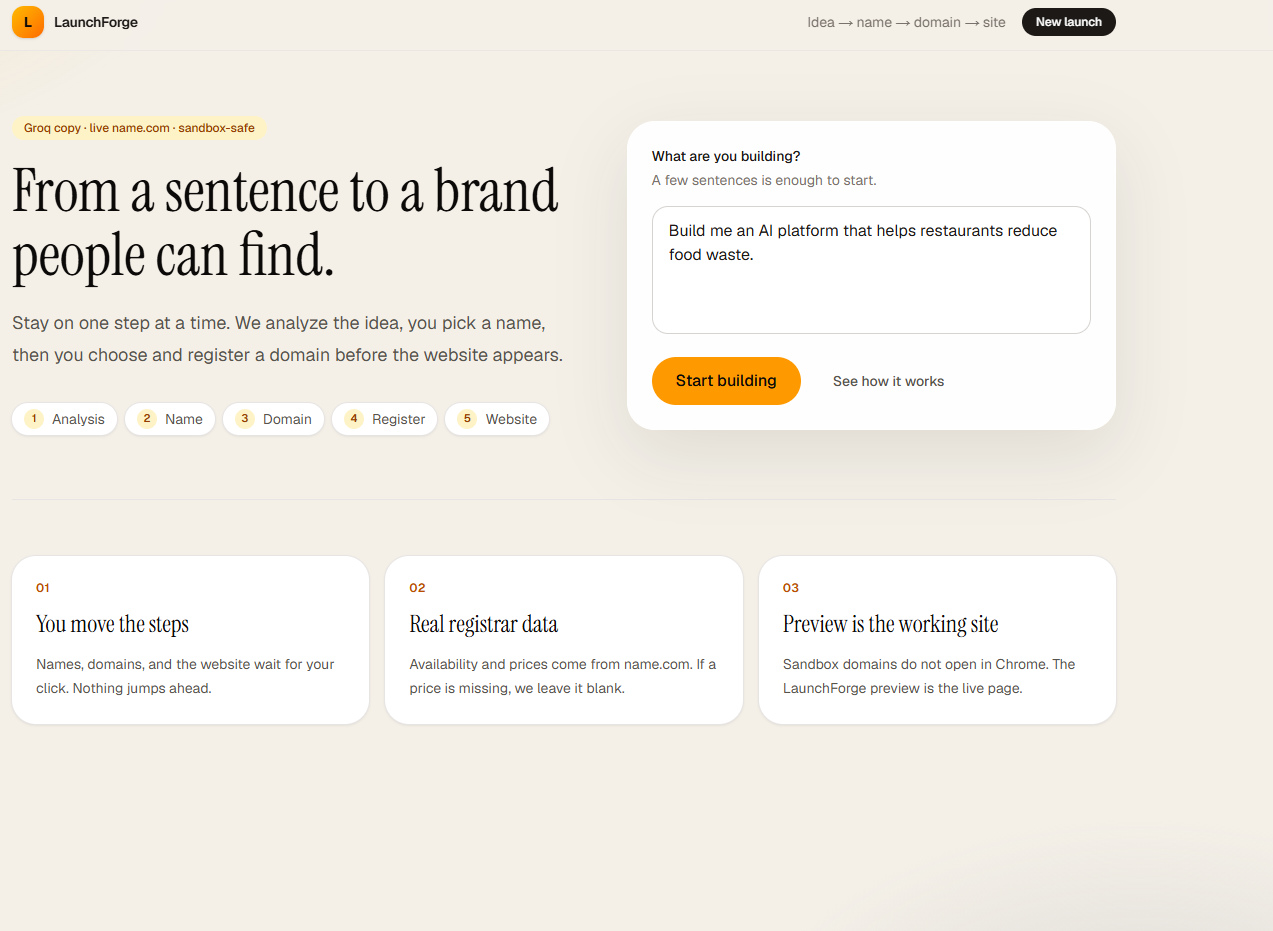
We wanted one guided path: describe the business, pick a name, claim a real domain, and walk away with a site you can actually show. Groq would understand the idea. name.com would be the domain infrastructure — not a mock, not a generated string, live inventory.
What it does
LaunchForge is an AI startup launch agent. You type a few sentences about what you are building. It then:
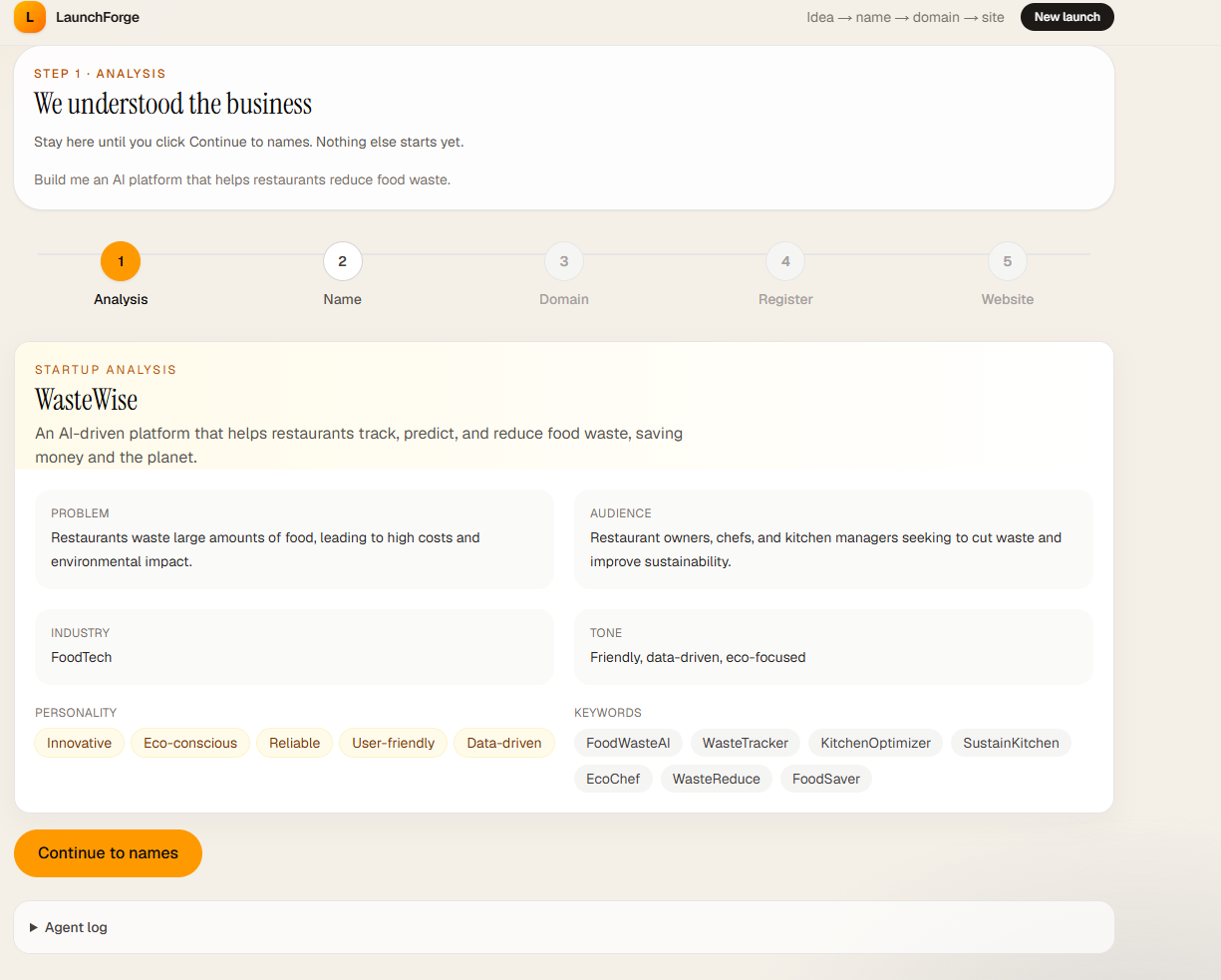
- Analyzes the startup — problem, audience, industry, tone, keywords, and brand personality
- Generates brand names — scored candidates with reasoning, not a random word list
- Searches live name.com inventory — real availability and purchase/renewal prices
- Ranks domains — hybrid AI + rules (brand fit, memorability, TLD, pronunciation, price)
- Registers a domain — explicit confirm, registrant contacts, sandbox-safe by default
- Configures DNS and email — root A,
wwwCNAME, SPF, optional Google verification,hello@forwarding - Generates a landing page — copy in Aurora, Editorial, or Signal templates, with in-app and full-page preview
You stay in control. Names, domains, and the website wait for a click. Nothing jumps ahead.
Sandbox domains are not public on the internet. The LaunchForge preview at /site/[sessionId] is the working site for the demo.
How we built it
- Next.js App Router + TypeScript + Tailwind CSS for the product UI and API routes
- Groq for structured startup analysis, brand generation, domain ranking, and landing-page copy (Zod schemas, with heuristic fallbacks if the model fails)
- name.com CORE API for the real domain lifecycle: hello/auth check, keyword search, exact availability, pricing, idempotent registration, DNS records, contacts, email forwarding, and webhooks
- An in-memory launch session so the agent can show live step status (analyze → brands → search → rank → register → DNS → site) without losing the founder’s progress on retries
The important design choice: LaunchForge is not an AI domain-name generator. The model proposes brands. name.com decides what is actually available and what it costs.
Challenges we ran into
- Real registrar data is messy. Prices, premium flags, and purchase types do not always come back clean. We show live prices when the API returns them and leave them blank when it does not, instead of inventing numbers.
- Registration has to be explicit. Auto-buying a domain from an AI suggestion is a bad idea. We added a confirm step, registrant contacts, TLD requirement checks, and
X-Idempotency-Keyso retries do not double-register. - AI output is not always JSON. Groq responses are validated with Zod. If ranking or site copy fails, we fall back to deterministic heuristics so the launch does not die mid-flow.
- Sandbox vs. the public web. A registered sandbox domain will not open in Chrome. We had to make the in-app preview the real “live site” and explain that clearly in the product.
Accomplishments that we're proud of
- An end-to-end path from one sentence to a ranked, priced, registered domain and a generated website
- name.com used as infrastructure across search, availability, pricing, registration, DNS, email, and webhooks — not a single search call
- Hybrid ranking that combines Groq scores with fixed rules, plus a fallback when AI is down
- A workspace that keeps session state, so a failed register or DNS call can be retried without starting over
What we learned
- Domain APIs are a product surface, not a backend detail. Availability, price, TLD rules, and confirmation all belong in the UI.
- Structured AI (schemas + repair + fallbacks) is more useful than a single prompt that “just works.”
- Founders need control. An agent that waits for the next click is more trustworthy than one that races ahead.
What's next for LaunchForge
- Custom-domain deployment so the generated site actually serves on the registered domain
- Persistent sessions (not in-memory) so launches survive a server restart
- Production name.com mode with clearer warnings before a real purchase
- More templates and a shareable public launch page
Built With
- dns
- domains
- groq
- name.com
- next
- node.js
- react
- typescript
- zod

Log in or sign up for Devpost to join the conversation.