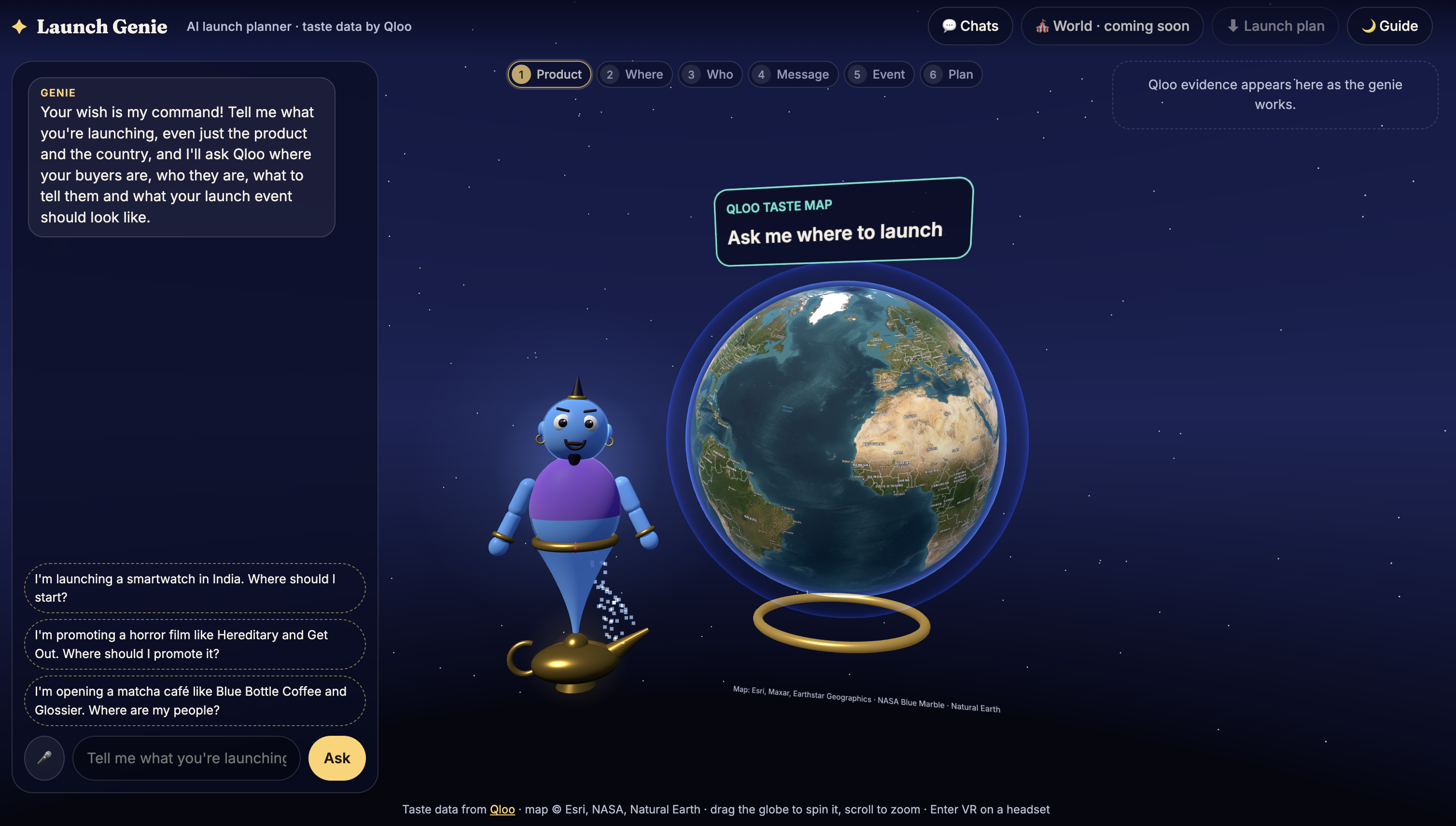
Inspiration Marketers, founders and film studios decide where to launch, who to target and what a launch event should feel like largely by guesswork. Ask a general AI and it answers confidently, but it doesn't actually know where a particular audience lives or what they love. It guesses big cities and obvious brands. Qloo's taste graph does know, so I wanted a launch planner that answers from that data instead of from guesses, and one you can simply talk to.
What it does Launch Genie is a cartoon genie you talk to, in the browser or on a Meta Quest headset. Tell it what you're launching ("jewelry like Swarovski, in India") and it works through the launch with you, step by step:
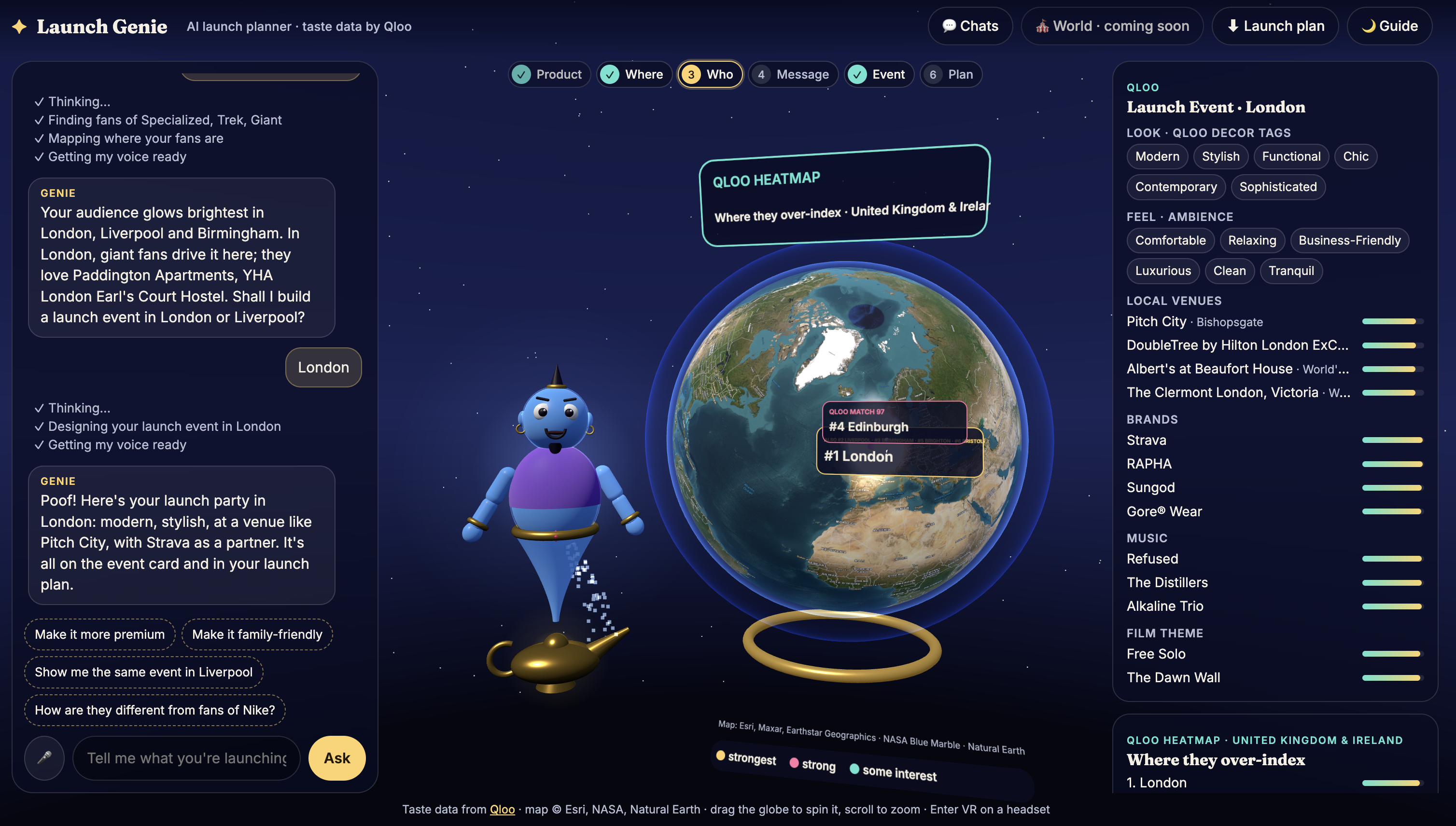
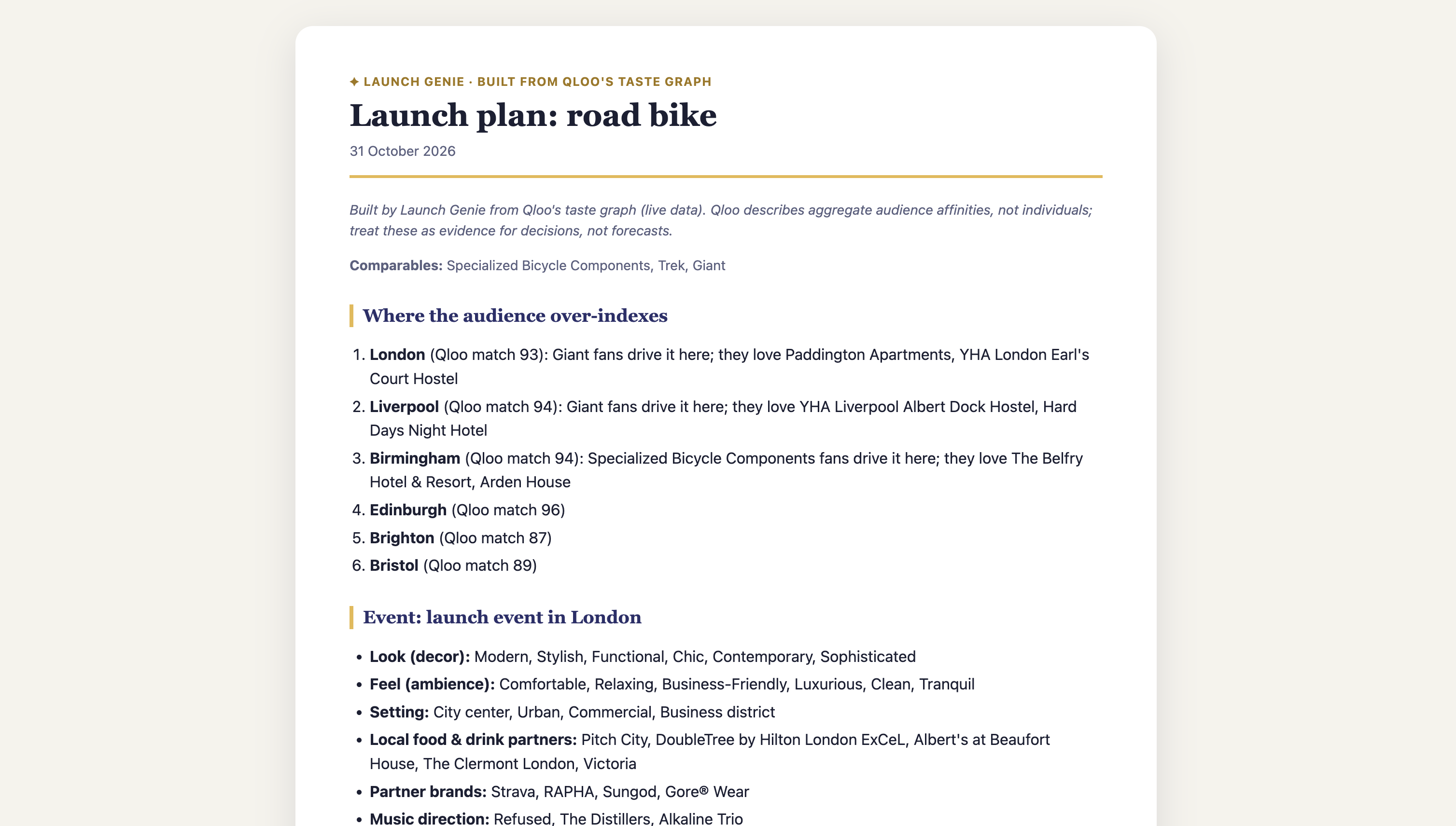
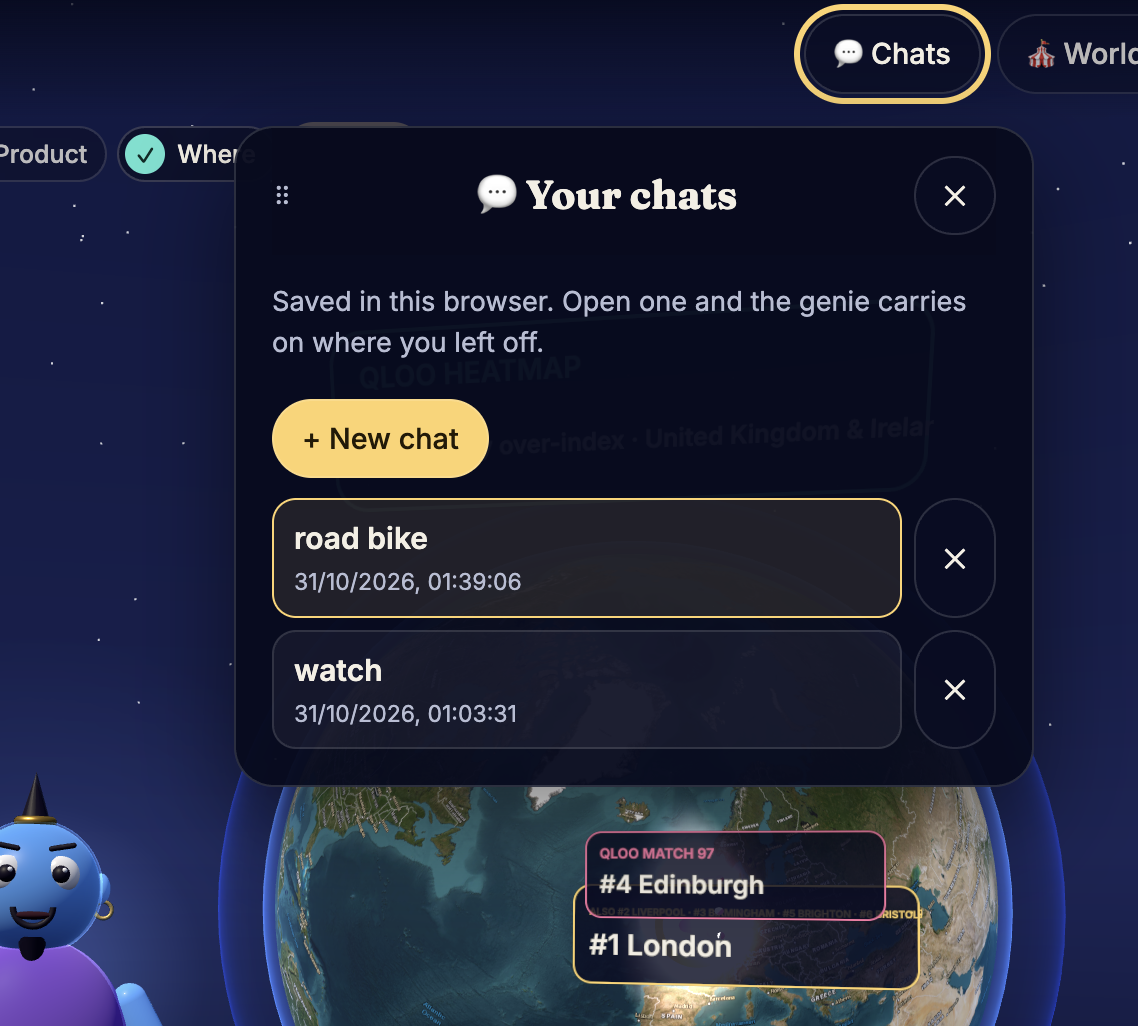
Where to launch: the genie picks well-known brands that your buyers already love. Qloo's heatmap then lights up a live 3D globe where those fans over-index, with the top cities ranked and the local venues behind each one. Who they are: the films, music, TV shows, brands and podcasts this audience over-indexes on, plus their age and gender skew. What to say and where to advertise: the values and words they respond to, and the shows and podcasts to buy media on. Who to partner with: local brands, venues and artists that this crowd loves, city by city. The launch event: a pop-up or launch party designed from Qloo's venues, partner brands, music, films, décor and mood tags. You can tweak it ("make it premium", "family-friendly", "move it to London") and it is redesigned from fresh Qloo data. The launch plan: everything gathered into one printable document. Every answer is grounded in Qloo. The genie speaks only what Qloo returned, evidence cards appear as it talks, and every claim is checked against Qloo's results. Conversations are saved so you can pick up any launch later. In VR you get the same genie: a menu within reach, a chat panel, a 3D keyboard, hand tracking, and Luna, a moon-robot guide who shows you around.
How we built it The agent: an LLM on Groq (gpt-oss-120b), with Cerebras as an automatic backup. It understands the user, plans which Qloo calls to make, and phrases the answer. It has 12 tools built on the Qloo API: /search to resolve the comparable brands and films; /v2/insights, used for the heatmap, entity insights by city, demographics and tag insights; /v2/tags, /v2/trending and /v2/analysis/compare; ask_qloo, which can reach any Qloo endpoint, with guard rails. Guard rails around the model: the server itself runs the first step (picking comparables, then the map), and handles explicit event requests and tweaks, so these never depend on the model remembering to; a review step sends an answer back to the model if it invents event details, names cities or ages before Qloo has returned any, or asks the user for brands; a fact checker marks each claim as backed by Qloo or not. The stack: a FastAPI server that streams the agent's steps live ("Finding fans of Swarovski…"); three.js and WebXR for the globe, the genie and VR, on a live satellite map reprojected in a web worker; Wit.ai and Groq for the genie's voice, and Whisper for listening (falling back to on-device Whisper). Reused from earlier work: the 360° viewer comes from my earlier project, Step Inside. The genie, the agent, every Qloo integration and the VR experience were built during the hackathon. Challenges we ran into Free AI limits: Groq's free tier allows 8,000 tokens a minute, which a single conversation can use up. I added Cerebras as an instant fallback, made the requests smaller, and made sure a hand-over never loses the Qloo results already fetched. Ambiguous search results: searching Qloo for "Oculus" returns the horror film first, "Apple Watch" returns a repair shop, and "Samsung Galaxy Watch" returns a guide book. I wrote scoring that prefers the exact name or its brand, and the type of thing the product actually needs. Free models drifting: they would sometimes stall ("Shall I design it?"), ask the user for brands, or invent cities and ages. Deterministic first steps and a review hook fixed this more reliably than prompt rules did. Live data quirks: the heatmap's affinity rank saturates, so cities are ranked by affinity weighted by population. Accomplishments that we're proud of It knows things a plain AI doesn't. For a Swarovski-style jewelry launch in India, an AI alone suggests Tanishq and A.R. Rahman, while Qloo shows these fans over-index on Christian Dior and Selena Gomez. It's a real conversation, by voice, with memory, ending each answer with a suggested next step and one-tap replies. It works the same in a browser and in VR. Every fact it speaks traces back to a Qloo call. What we learned Language models are good at language, not taste. Qloo is what makes the answers specific and true. Guard rails beat prompt rules. Steps the server runs itself, plus a review of each answer, were far more reliable than telling the model what not to do. Taste data surprises you. Its most useful answers are the non-obvious ones, so the product's job is to show the evidence behind them. What's next for Launch Genie Step inside your launch event: walk through it as a 360° world. Three agents already exist for this: a curator turns Qloo's facts into a scene, a painter paints it, and a critic checks the result. It's waiting on a stronger 360° image model. Talk to your customer: pitch your product to a persona built from Qloo's audience data and hear how they react. Competitor gap map: the globe shows where your audience is strong and a competitor's is weak. When to launch: Qloo trend curves showing when interest peaks. Creator matchmaker: podcasts, artists and public figures your audience loves, city by city, with outreach drafts.

Log in or sign up for Devpost to join the conversation.