-
-
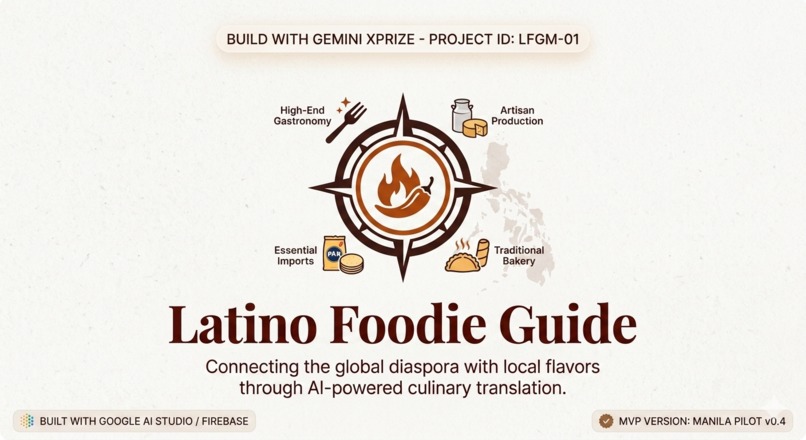
A secure, AI-powered platform connecting the global Latin diaspora with essential culinary goods and local culinary ecosystems.
Inspiration
Living as part of the Venezuelan diaspora in Manila, Philippines, I witnessed a unique challenge faced by migrant communities worldwide: the geographical and cultural isolation of our culinary heritage. While there is a vibrant network of local Latin creators—ranging from a head chef at a Michelin-awarded fusion restaurant to home-based artisan cheese makers and undocumented micro-entrepreneurs selling traditional corn flour—they operate in silos.
Migrants struggle to find comfort food due to local ingredient variations and language barriers, while local creators lack the visibility to reach them. Latino Foodie Guide was inspired by the need to build a secure, intelligent bridge that contextualizes culinary nostalgia into local realities while protecting the privacy of vulnerable, informal micro-economies.
What We Learned
During our initial field research in Manila, we learned that a generalized, country-wide solution disperses impact. To achieve true commercial viability, a project must be deeply hyper-local. We also uncovered a critical paradox: the micro-entrepreneurs who most need commercial traction are often the most vulnerable regarding regulatory status.
Therefore, we learned that privacy cannot be an afterthought; it must be built into the core architecture. We discovered that by using generative AI, we could completely decouple a merchant's physical location and identity from the public facing directory, using proximity-based routing and secure communication channels instead of traditional map exposure.
How We Built It
The project was engineered with efficiency and scalability in mind, built entirely on top of the Google and Firebase ecosystems using AI-assisted development tools.
- Frontend & Hosting: Built as a Progressive Web App (PWA) deployed via Firebase Hosting, allowing instant, multi-platform access (Android and iOS) via a simple URL without the friction or regulatory barriers of app store deployments.
- Database & Security: Structured using Cloud Firestore's NoSQL document model. Merchants are grouped into clean collections (
users,merchants,market_analytics), using strict Firebase Security Rules to enforce anonymity. - AI Engine: Powered by Gemini 1.5 Flash through the Google AI Studio SDK. Gemini acts as a "Nostalgia Translator," processing colloquial user cravings (e.g., specific regional ingredients) and mapping them to available local substitutes or nearby artisan vendors in the database.
Challenges We Faced
The primary hurdle was managing the trade-off between user discoverability and merchant safety. Traditional marketplace models rely on precise geolocation and public contact data. Overcoming this required rethinking our backend architecture to ensure no raw address or personal identifier is ever exposed on the client side.
Additionally, as a non-traditional developer leveraging generative AI for 100% of the codebase, ensuring strict data formatting (such as enforcing clean JSON outputs from LLM calls to feed our Firestore database) required meticulous system prompt engineering. We successfully mitigated this by implementing strict validation schemas, turning a technical constraint into an incredibly robust, scalable operational model.
Built With
- 1.5
- ai
- css3
- gemini
- javascript
- pwa
- studio

Log in or sign up for Devpost to join the conversation.