-
-
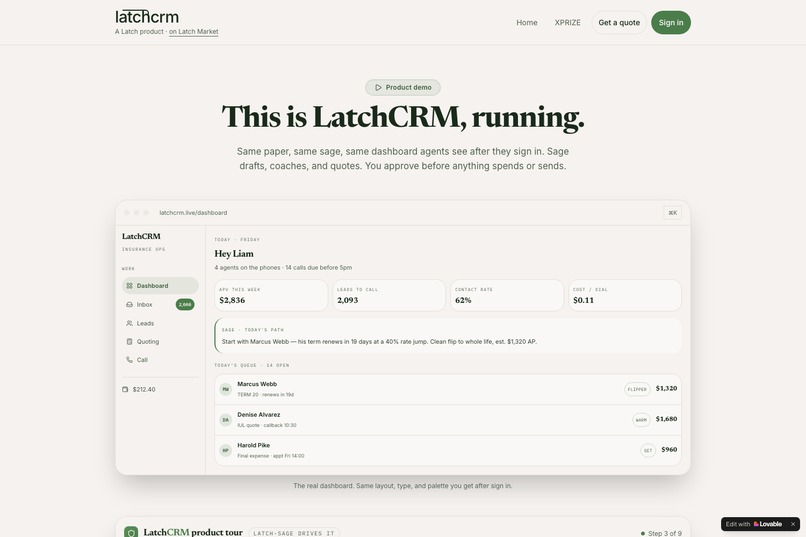
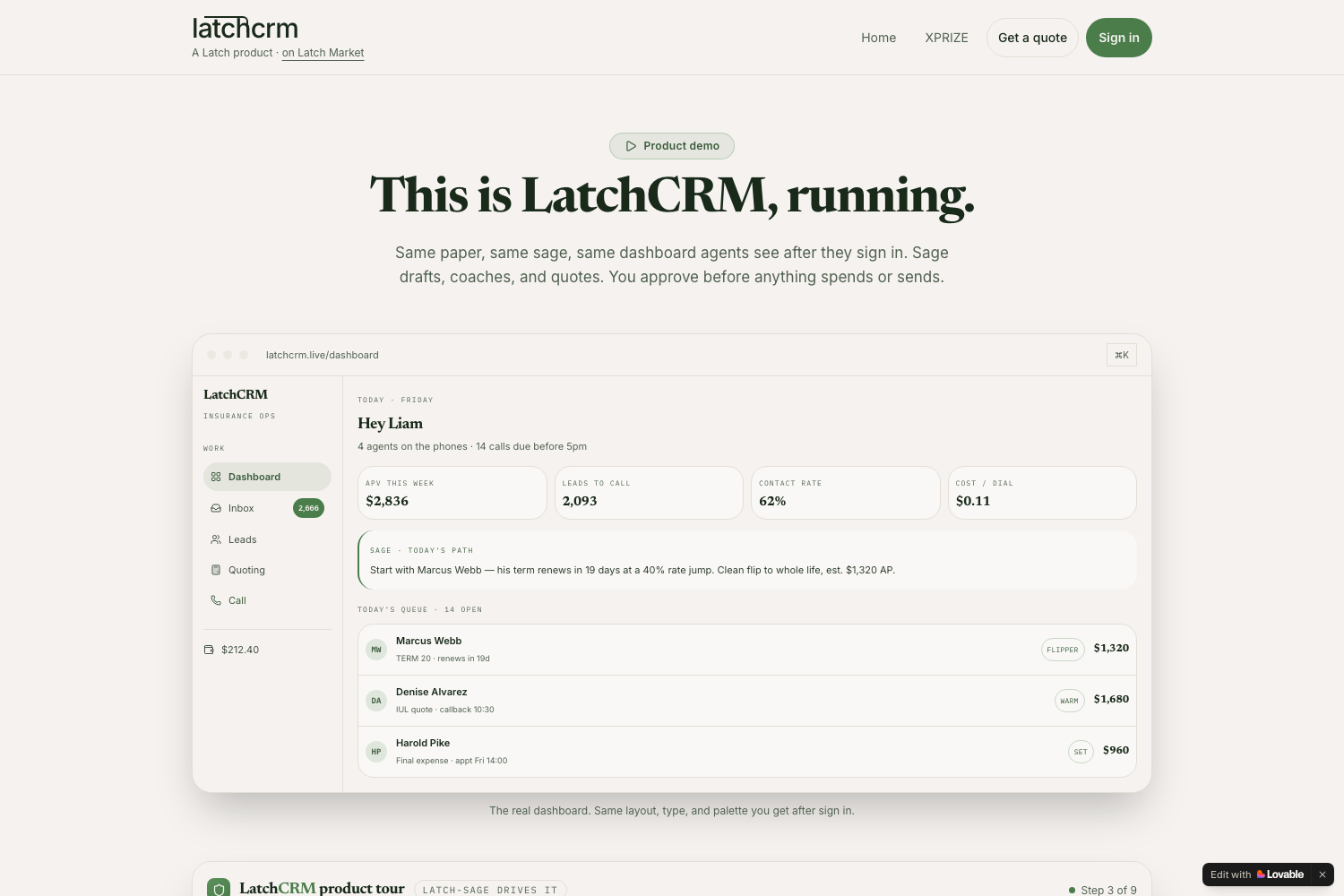
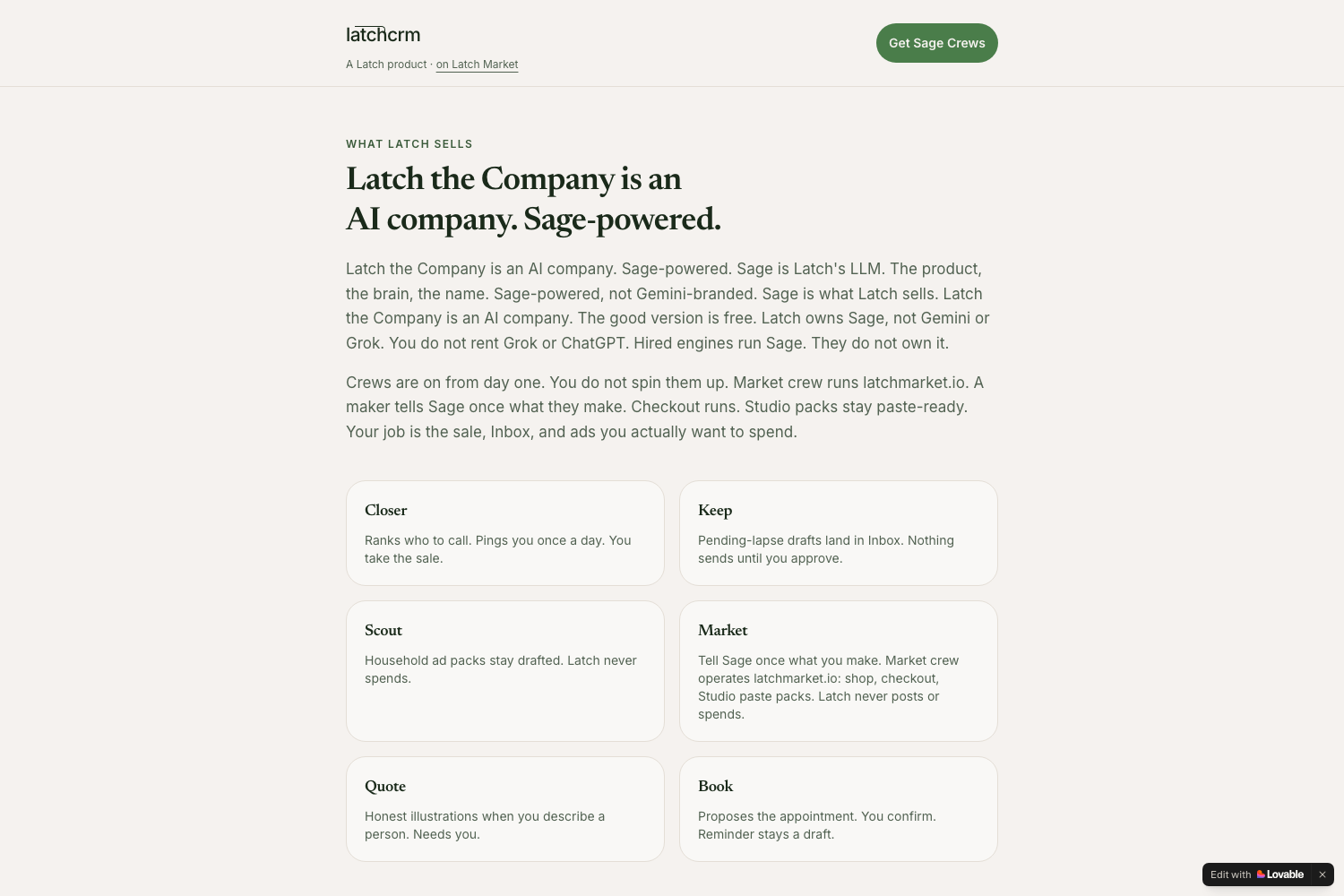
latchcrm.live/demo — dashboard, live metrics, Sage's daily path
-
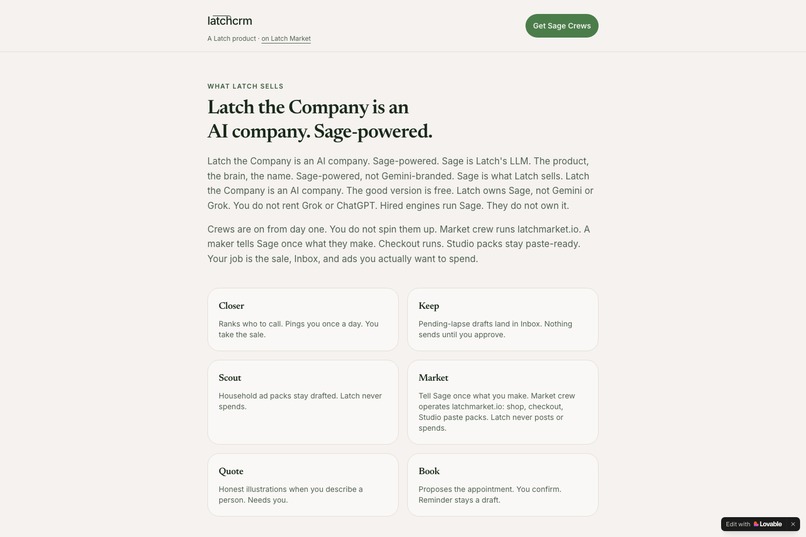
latchcrm.live/sage-crews
-
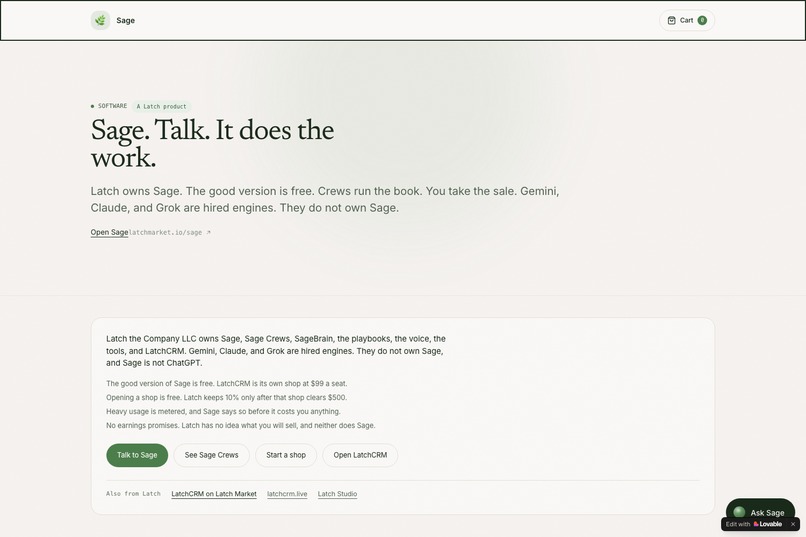
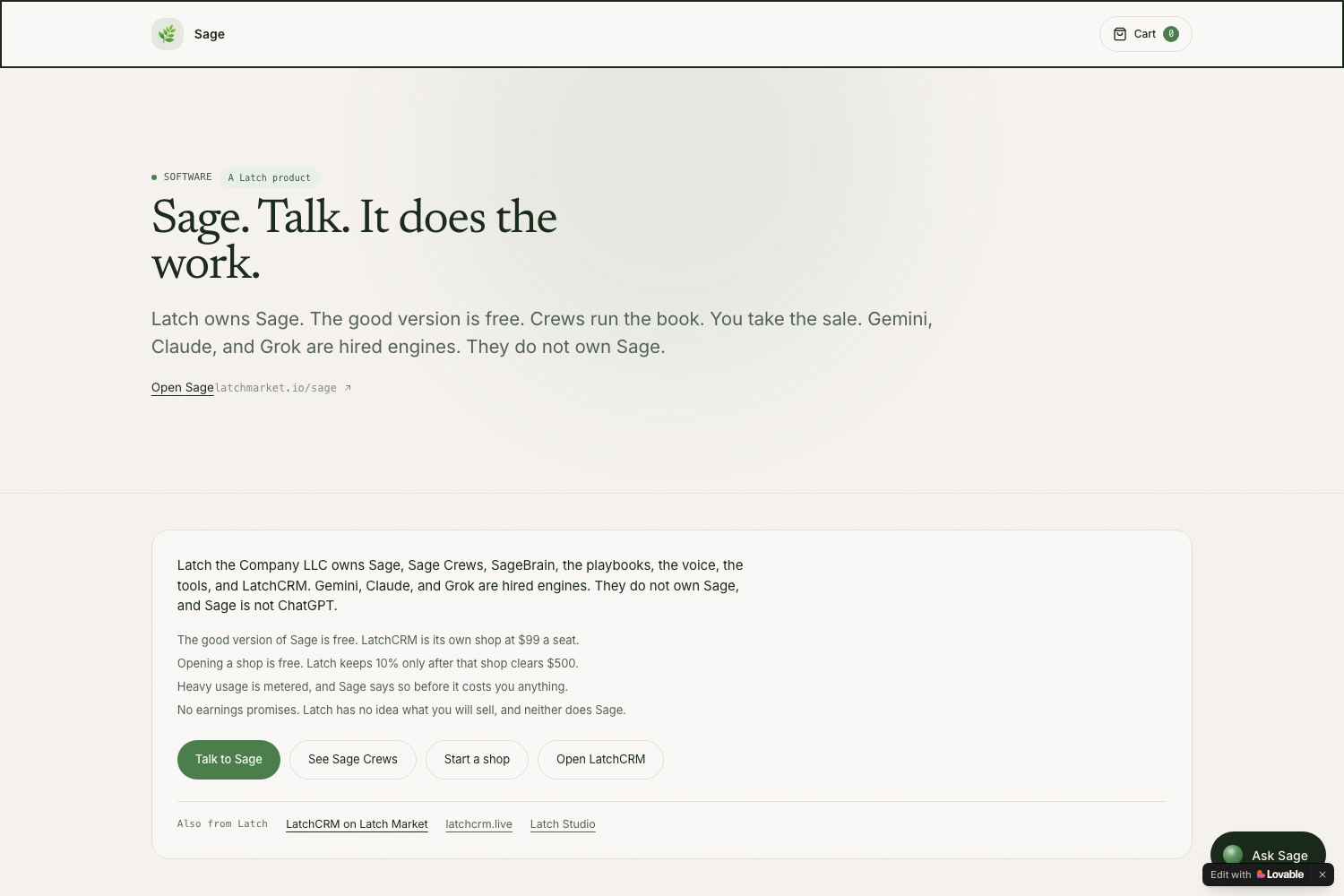
latchmarket.io/store/latch-sage — storefront with cart
Between the Marine Corps, government IT sales, DoorDashing, and donating plasma, I learned the reality of the grind firsthand. Then I got licensed, hit the phones, and built my book of business to 250+ clients. Three years later, I write $30K a month in life insurance.
I have always been a dreamer, but I am also a realist. AI closed the gap between someone with a clear vision and the overpriced consultants who used to stand in the doorway. Most people were too busy to notice, so I built the tool I needed to run my own shop. Latch Sage runs live on latchcrm.live inside LatchMarket.io. You talk to it in plain English, Sage runs on Gemini under the hood, and the licensed agent closes the deal.
Inspiration
I initially reached out to the incumbent in this space to partner, but they wouldn't take a meeting. So, I built it myself for under $2,000 in under 90 days with no traditional developer background, relying entirely on grit, direct domain knowledge, and modern AI.
I did not want another bloated pipeline with a generic chatbot slapped on top. I wanted an operations crew running in the background so I could stay focused on sitting at the kitchen table protecting families.
What It Does
Latch the Company, LLC is the parent. Four products live under it:
Latch Sage: The conversational assistant that orchestrates the entire shop. This is what I am submitting. Latch Market: latchmarket.io. The storefront and commerce layer. Tell Sage what you sell and it stands up the storefront front to back, checkout included. LatchCRM: latchcrm.live. An AI-native CRM for independent producers. Pipeline management, a dialer, quoting tools, commission tracking, and a client portal. It is a product listed and sold on Latch Market. Latch Studio: Drop in a video, audio file, or picture and Sage drafts ready-to-use social posts. A person reviews them and pastes them. Sage never posts on its own.
Sage's Crews handle the operational work through six specialist agents:
Closer: Scores and prioritizes lead call sequences. Quote: Generates honest illustrations from conversational customer profiles. Keep: Stages pending-lapse recovery drafts right inside the inbox. Market: Runs latchmarket.io. Stands up storefronts, maintains live checkouts, polishes copy, whatever the user wants. Book: Proposes appointments and queues calendar reminder drafts. Scout: Writes hyper-local ad copy with no autonomous ad spend.
Four of those run on their own timer: Closer, Keep, Scout, and Market. Quote and Book only run when a person asks. That is on purpose. Those two touch a client's money and a client's calendar, so a human starts them.
Nothing sends, posts, or spends without a person tapping approve. When a client misses a premium payment, Sage drafts a recovery message instead of firing off an automated text. New agents onboard through a plain-English interview that configures the platform for them.
How We Built It
The first commit landed on July 1, 2026, on a public TanStack Start template. The CRM was built from scratch. I did not fork an existing platform. Inside that 90-day window Sage became the operational engine for the whole shop, including latchmarket.io.
Gemini API: The background function-calling engine for the persistent Crew routines. Gemini is a Google Cloud product and a hired engine. I do not own the model weights. Sage is mine. The name, the brain, the crews, the tools. Twilio Media Streams: Streams live call audio for real-time intent analysis and voice coaching. LeadLens: Claude writes the call briefs, with Gemini running as an active fallback. Infrastructure: Hosted on Lovable, backed by Supabase Postgres with row-level security, and Stripe for the prepaid wallets. Challenges We Ran Into
Life insurance is a heavily audited business. Most of the hard work was building brakes, not features.
Human in the loop: All outreach sits in a pending state until someone approves it. Quiet hours, DNC, and TCPA filters block automated sends. Studio packs stay paste-ready. Reversible state: When a tool call fails, it writes a reviewable database entry. It does not push an unapproved message out the door. Regulatory compliance: Life insurance rules prohibit taking a percentage of issued premium, so we never do. It is a flat seat price plus utilities at cost. Accomplishments That We're Proud Of
The production build is live, and there is a public demo you can see without logging in. Right now the platform holds:
12 users across 4 agencies 267 policies under management 3,348 leads 1.1 million automated workflow steps 2,101 drafts sitting in queue waiting on a human to approve them
That last number is the one I care about most. Two thousand messages that a machine wrote and did not send.
On the 267: only two of those policies were actually written through the platform. The other 265 are existing books that agents migrated in and now run inside the CRM. I am not going to call them policies written, because they aren't.
How it makes money:
Seats: Solo $99/mo, Manager $119/mo, Agency $299/mo. Sage tiers: Free, Plus $20/mo, Pro $200/mo. Usage: Pass-through telephony, SMS, email, and AI billed at cost plus 10% through a prepaid wallet. Initial revenue: First platform revenue came in inside the 90-day build window. $65 from five non-founder wallet top-ups. Separately, $36 in related-party revenue from my own top-ups, which I am reporting on its own line for audit clarity. Marketing spend to date: $0.
The metered AI billed to orgs so far is $18.44 across roughly 840 events. Small, but the pass-through works.
What We Learned
AI is built for backend operations, not for replacing licensed producers. One insurance agent can scale operational volume without hiring admin staff, and the client keeps a direct relationship with a human advisor. I also learned an incredible amount about the AI industry, and I know this is just my first submission, some studies with ORNL and SNS are going to be conducted... my dad works there so this may help fund those studies (; That's what I'm really excited about now. Anyways...
Thank you so much for considering, Liam
Built With
- ai-agents
- claude
- compliance
- crm
- gemini-api
- google-ai-studio
- google-cloud
- insurance
- insuratech
- lovable
- postgresql
- react
- react-19
- row-level-security
- sms-automation
- stripe
- supabase
- tailwind-css
- tanstack-router
- tanstack-start
- telephony
- twilio
- webrtc


Log in or sign up for Devpost to join the conversation.