-
-
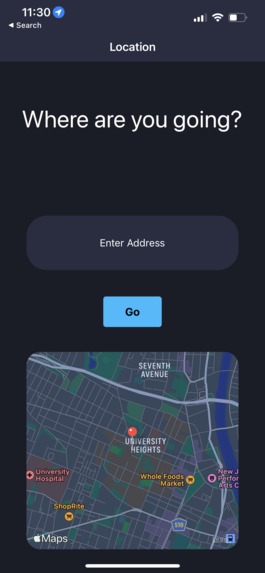
Homescreen/where are you going
Inspiration
When Ari sent a package to his family in North Carolina for an Indian festival, the package turned out to be very expensive (quoted by USPS & UPS). It was more than 30 dollars to send a very small package a couple states down. What was even more surprising was that the east coast is very interconnected with highways it should be a seamless to deliver a package from the NYC metro area to the Raleigh Durham metro area. With further research, he was surprised to find out that the most expensive portion for any business to consumer or consumer to consumer delivery is the "last-mile" portion. Though the last portion is the shortest part of the package's trip, it can make up upwards of 50% of the total cost.
What it does
LastMile is an app that allows for everyday driver to make money and deliver packages to people or companies that are on their predetermined route. Take a look outside onto any highway and see how many cars and people are travelling the exact same path as your package needs to. Why do we need another service, another car, and another inefficient system when deliveries can be crowdsourced. Our app solves this by asking an everyday driver, where they are currently driving to and if there is a package delivery that our algorithm has deemed to be the on-the-way, the opportunity is offered to the driver. This situation would allow for the users to get awards for delivering these packages and for companies to avoid the large expenses of a normal last mile delivery. The app will only reveal packages that can be delivered by the user within a certain differential added kilometers of the original distance matrix.
How we built it
By using React Native, Geoaplify, Bing Maps API, and Expo, a functional app was developed to create a very scalable app. Expo and react-native, in particular, was very important because it allowed the app be cross-functional in IOS and Android. Additionally, this was very important as neither member in the team had access to a Macbook for native ios app development. Expo was also exteremely important as it allowed for seamless testing. Bing Maps API and Geoaplify proved to be a strong replacement to the paid Google Maps API while also still being able to get a Distance Matrix with actual roads and calculate an estimated time and mileage to finish all travel.
Challenges we ran into
We ran into countless challenges throughout the course of this hackathon, but we only were able to create this app because of these challenges. Early on, we found out that Google Maps API costs money and led us into a scramble to find alternatives. We were even very close to changing our idea because of this roadblock. However, through thorough research, we found the aforementioned alternatives. We also began to use firebase as our real-time cloud-based database system to keep track of all of the shipments, companies, drivers, packages, and more. However, there simply was not enough time to have that implemented without giving up important functionality that was necessary for the basic prototype of the app.
Accomplishments that we're proud of
Developing an iOS app without a Macbook at all. Having a proper maps Api calculating the distance and time needed to deliver packages.
What we learned
We had learned a lot about databasing, using React Native, React, Expo, and sending requests to API's in general. We also learned a lot about asynchronous code executions
What's next for LastMile
LastMile has tons of future additions to be implemented such as making users sign in and put in collaterals to pick up packages. Another addition would be to have the driver upload a photo of the delivery arriving at the location to prevent stealing. Finally, we hope to create an app for companies to add packages and rewards which can then be accessed by users in LastMile to be delivered, therefore creating a complete ecosystem.


Log in or sign up for Devpost to join the conversation.