-
-
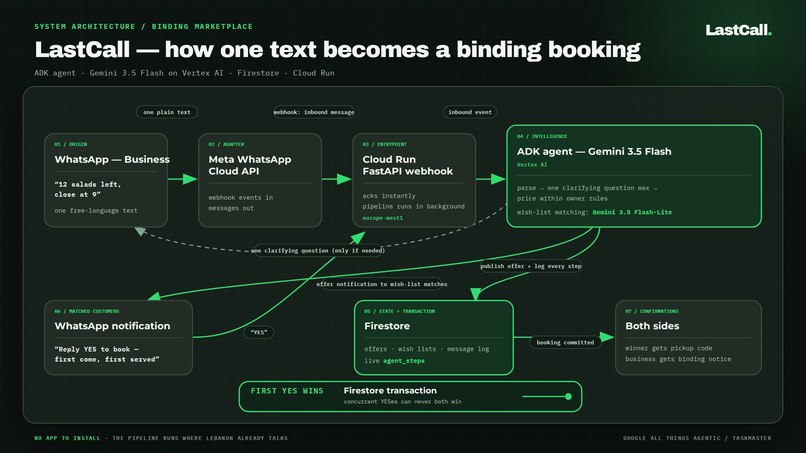
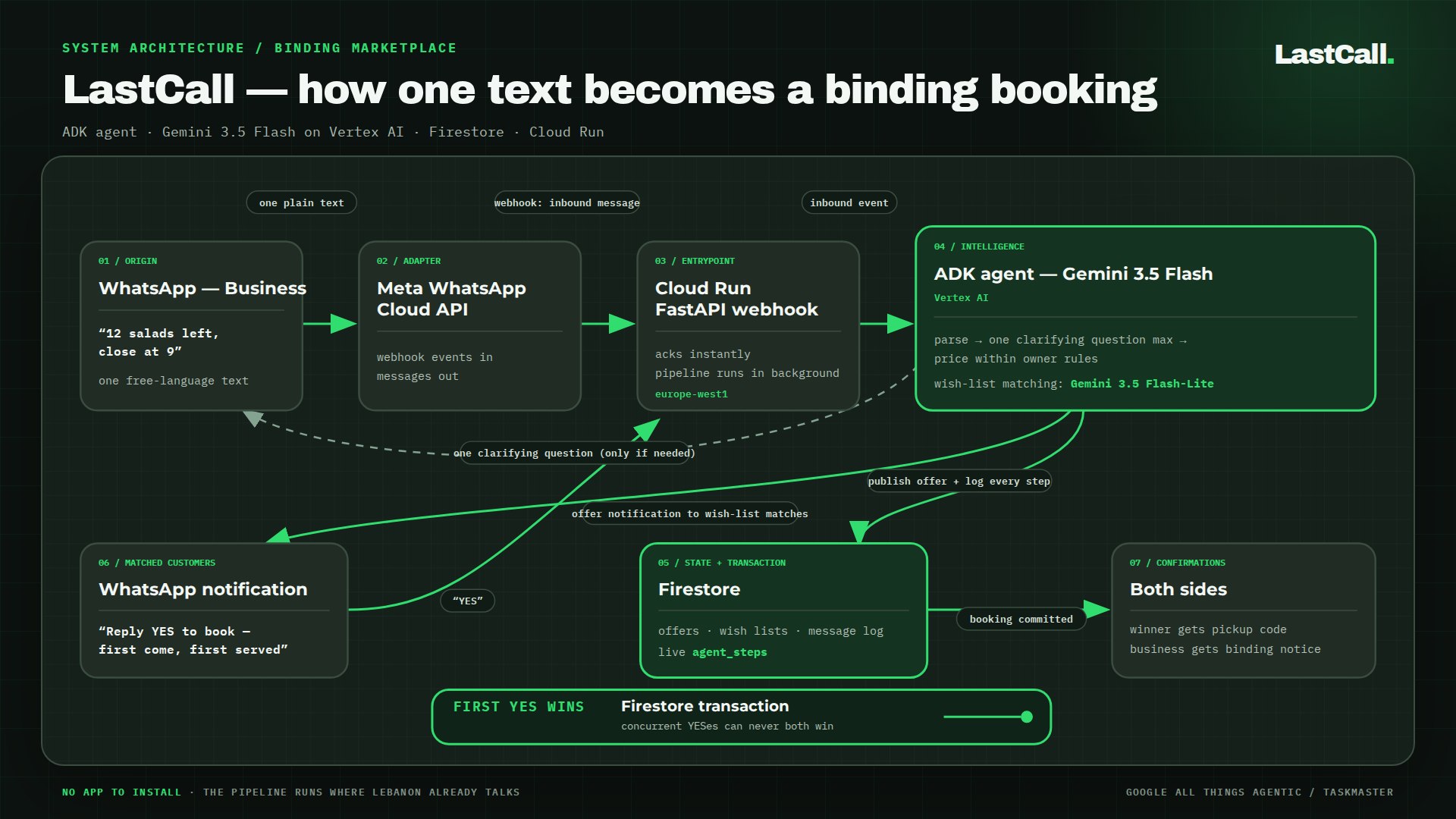
LastCall architecture — one WhatsApp text → ADK agent (Gemini 3.5 Flash) → Firestore → first YES wins
-
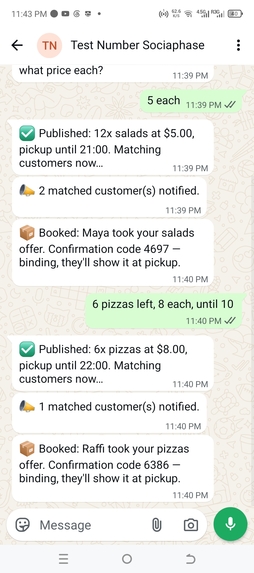
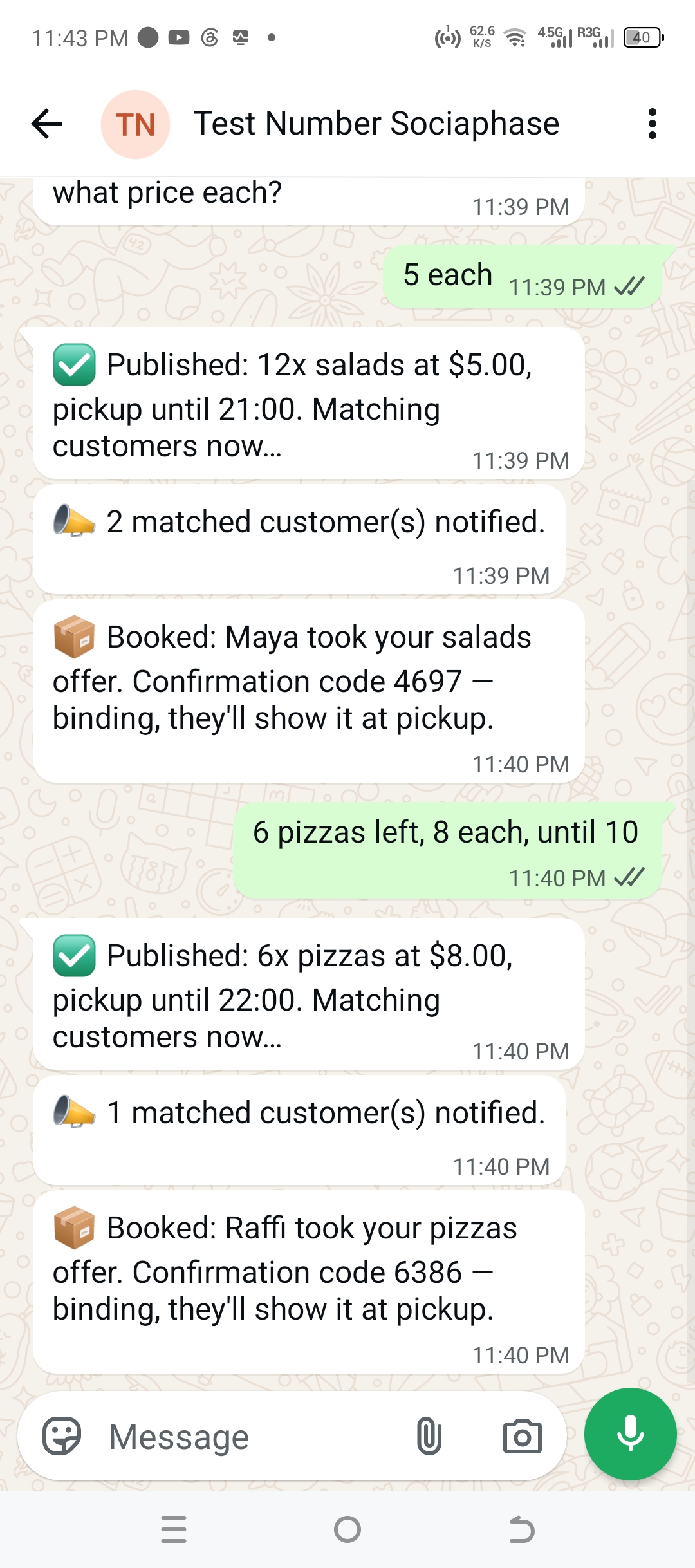
Chat screen
Inspiration
In Lebanon, small businesses throw away perishable inventory every single night — salads a deli can't keep, rooms a small hotel didn't fill, sessions a gym can't resell. The owners are busy people closing up a shop; they will never fill in a dashboard or manage a listings app at 8:45pm. But every one of them already uses WhatsApp. LastCall started from one question: what if clearing tonight's surplus took exactly one text message, and an agent did everything else?
What it does
A business texts the LastCall number in plain language: "12 salads left, close at 9." An agent parses it into a structured offer. If something essential is missing it asks one clarifying question — and if several things are missing, it asks for all of them in a single message, never an interrogation. It prices within the owner's stored rules, publishes the offer, matches it against customer wish lists (free text like "sushi under $15" — price caps included), and messages every matched customer: reply YES to book. The first YES wins, atomically. The winner gets a confirmation code, the business gets a binding reservation notice with the same code, and everyone who was too late gets a polite "already gone."
Customers live on WhatsApp too — including their wish lists. Texting "I'm interested in pizza" or "let me know when there's dessert deals under 5" adds a wish on the spot, under the same strict contract: the agent extracts the want, confirms in one line, and never guesses — an unclear message gets one short prompt instead. In our live demo, a customer created a pizza wish in chat and was booked on a matching offer less than a minute later.
Every step the agent takes — parse, clarify, price, publish, match, notify, book — is written live to a Firestore agent_steps collection, so you can watch the agent think in the GCP console while the WhatsApp conversation happens.
How we built it
- ADK (Python) + Gemini 3.5 Flash on Vertex AI — the parse agent is an ADK
LlmAgentwith temperature 0 and a strict pydantic output schema. Every inbound business message becomes exactly one intent (new_offer,revise,approve,pickup_code,wishlist_add,unknown) plus extracted fields. A confidence gate collapses anything uncertain tounknown— the agent never guesses its way into a published offer. - Gemini 3.5 Flash-Lite for matching — one cheap model call judges a new offer against all customer wish lists at once. Because wish lists are free text, "fresh salads under $10" matches a $4 salad offer and correctly rejects a $12 one.
- Firestore transactions for binding acceptance — the first YES flips the offer to
takeninside a transaction; concurrent YESes can't both win. Bookings are binding by construction, not by promise. - Cloud Run + FastAPI — a thin webhook receives Meta WhatsApp Cloud API events, acks instantly, and runs the agent pipeline in the background. A
/simulateendpoint posts the same event shape without Meta, so the whole pipeline runs offline; a stub mode logs outbound messages to Firestore instead of sending.
Challenges we ran into
- Same-day dependency archaeology — google-api-core 2.35.0 started percent-encoding Firestore's
(default)database id in the gRPC routing header, and every write failed with a cryptic 400. Bisecting library versions on submission day was not the plan; pinning<2.35fixed it. - An expired Meta token mid-build — the WhatsApp test token died before the final test. Because WhatsApp was designed as a thin adapter from the start, the stub mode +
/simulatekept the entire agent pipeline testable end-to-end, and the real API drops back in with one env var. - Making "agentic" visible — an agent that works silently demos badly. Writing every decision to a live
agent_stepscollection turned the GCP console into a second screen of the demo: you watch the agent parse, ask, price, publish, match and book in real time. - One clarifying question, maximum — LLM agents love follow-up questions; business owners at closing time do not. Enforcing "ask for everything missing in one message, never two turns" took explicit pipeline state, not prompting alone.
Findings & learnings
- A strict pydantic contract plus a confidence gate turns an LLM into a dependable parser — "never guess into a published offer" was worth more than any prompt tweak.
- Firestore transactions gave us binding first-YES-wins semantics for free.
- Making the agent visible (the live
agent_stepscollection) changed how demoable the whole system is. - Keeping WhatsApp a thin adapter saved the project twice when tokens expired mid-build.
- Message copy is part of the agent's contract: a confirmation that casually said "reply YES" invited a YES with nothing to book. Tightening one sentence fixed a "bug" no code caused.
Data sources
No external datasets. All data is generated by the marketplace itself: business rules and customer wish lists seeded in Firestore, offers created live from WhatsApp messages, and a full message + agent-step log written at runtime. Models are Gemini 3.5 Flash / Flash-Lite on Vertex AI.
What's next
- Reverse mode — customers state intent ("dinner for two under $25 tonight"), business agents bid, the customer's agent awards the best offer. The marketplace runs agent-to-agent in both directions.
- Customer mobile app — Expo/React Native with FCM push, replacing WhatsApp on the customer side; businesses keep WhatsApp forever.
- Payments — a small deposit at booking time to back the binding reservation.
- Top-N notifications — notify the best-ranked matches instead of everyone, so an offer doesn't race dozens of phones at once.
- Business pricing — a small per-booking fee or a flat monthly line; free while the network grows.
- Partial-quantity claims — a customer takes just the units they want; the offer stays open until sold out or expired (winner-takes-all remains for single-unit offers like hotel rooms).
- Pickup-code close-out, scheduled offer expiry, business self-onboarding, customer reliability scoring, embeddings-based matching at scale.
And the thesis stays the same throughout: no app to install, nothing to learn — LastCall runs where Lebanon already talks.


Log in or sign up for Devpost to join the conversation.