-
-
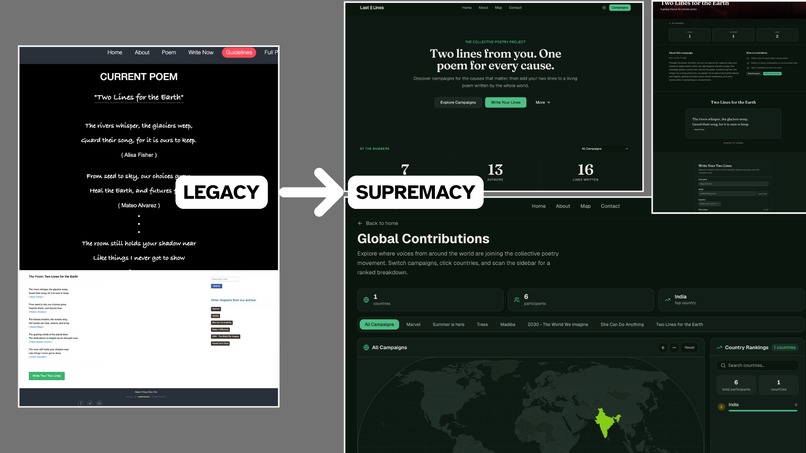
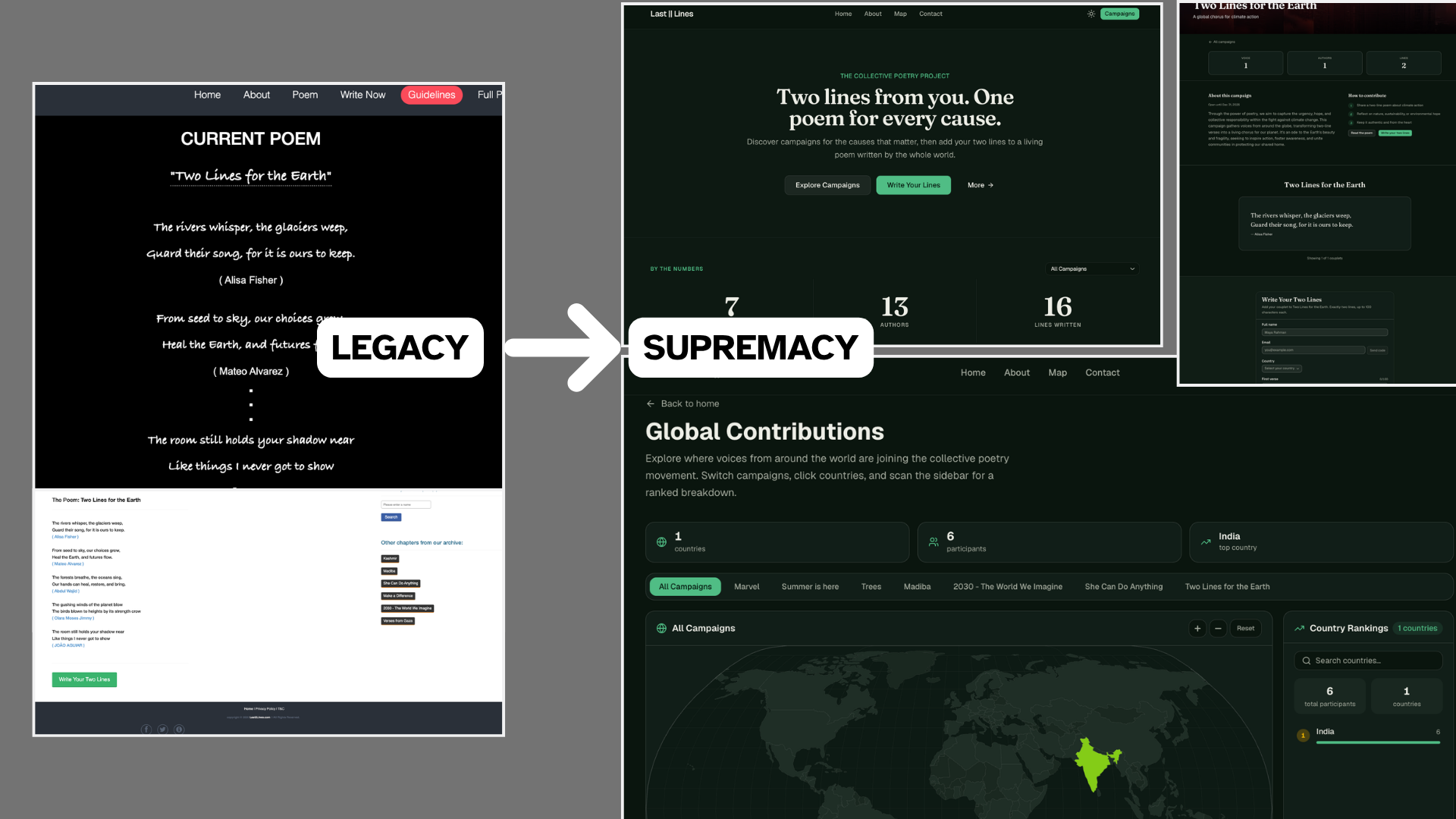
Legacy to Supremacy
-
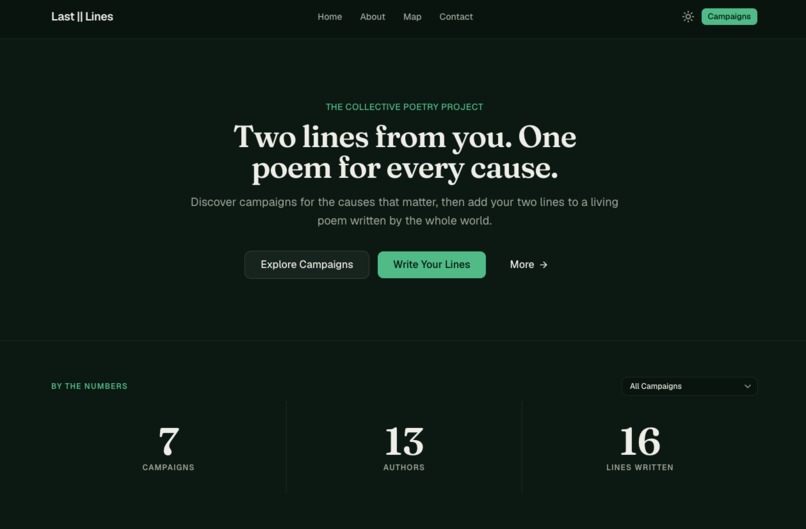
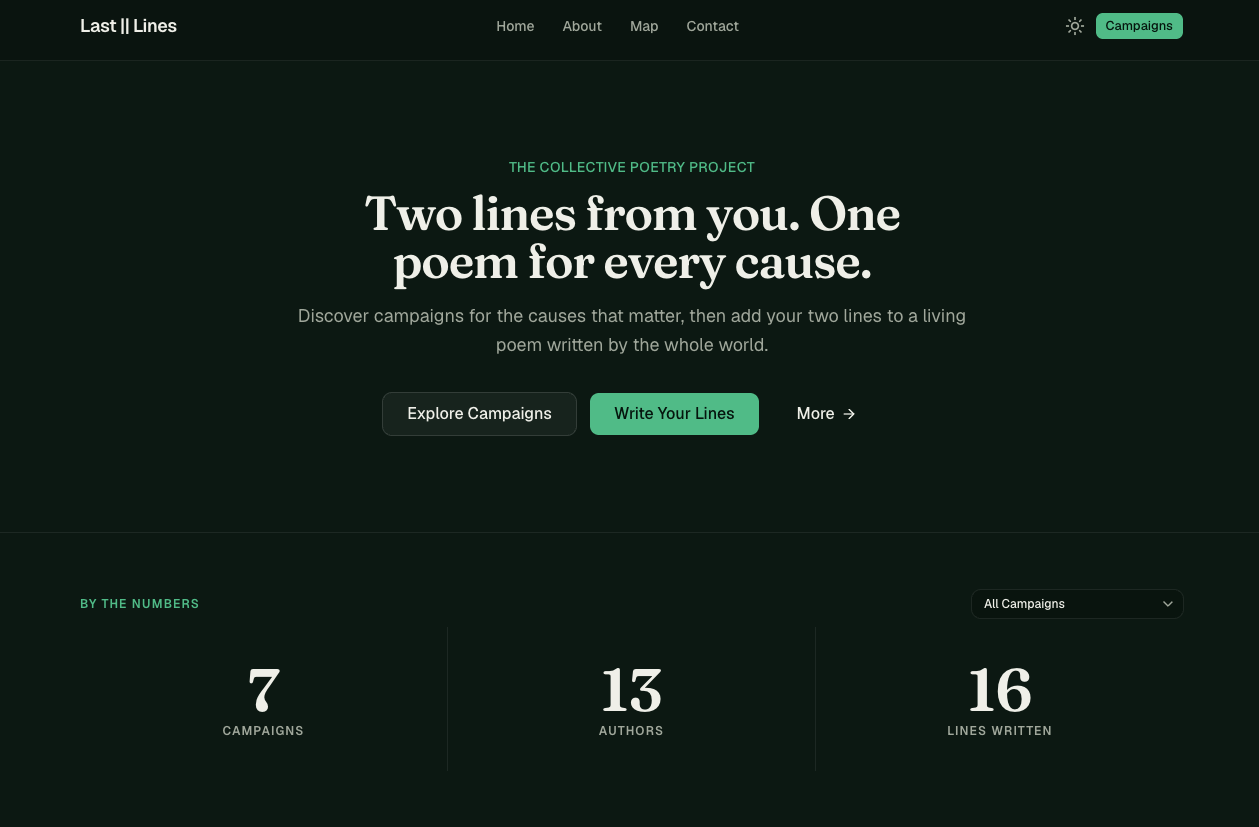
Landing Page
-
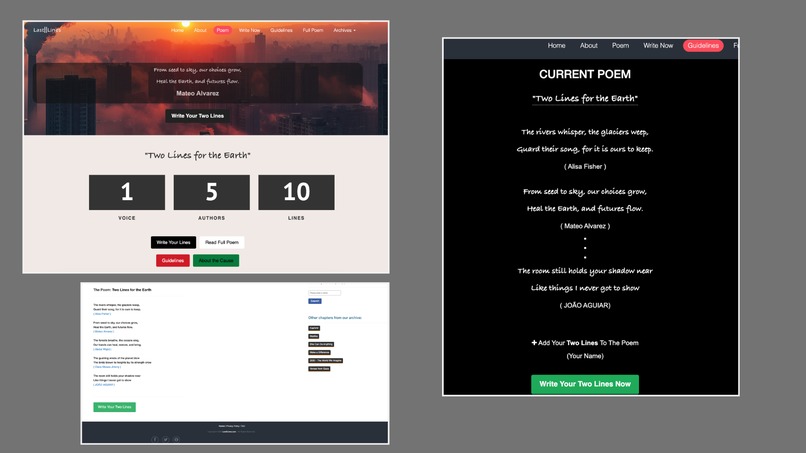
Before
-
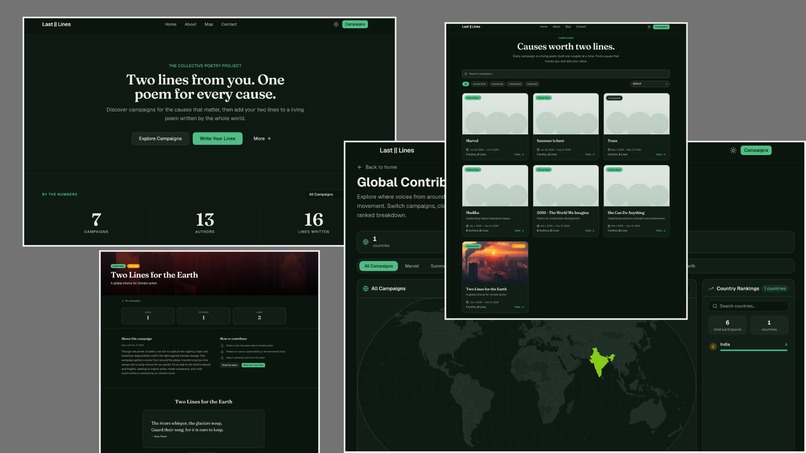
After
Last2Lines 2.0
A collaborative social campaigning platform where the world writes one poem for a social cause — powered by smart AI moderation and built entirely on Vercel and AWS.
Introduction
Last2Lines 2.0 is a unique digital community space where the world comes together to write one unified poem for a shared social cause. By crowdsourcing a single, continuous poem for a specific social cause, we transform passive audiences into actively engaged, emotionally invested advocates. Built for massive scale on a modern Vercel and AWS architecture and safeguarded by real-time AI moderation, Last2Lines 2.0 offers campaign organizers a highly engaging, brand-safe, and technologically robust tool to amplify their message and mobilize communities worldwide.
Partner NGOs and advocacy organizations launch thematic campaigns ( e.g. climate change, human rights, digital inclusion) and contributors from every corner of the globe each add a single couplet to a shared, ever-growing poem. The result is a living, diverse narrative: a collective creative act that carries the weight of every individual voice while reading as a unified work of art.
For this hackathon, Last2Lines was not just updated; it was entirely re-engineered from the ground up. Using Vercel's vo, I transitioned the platform into a production-hardened, Vercel and AWS-optimized stack designed to seamlessly scale.
Honestly, to understand the triumph of Last2Lines 2.0, you have to understand the rigid constraints of the past. Last2Lines' legacy application was a tightly-coupled, single-server PHP and MySQL monolith sitting on shared hosting. Deployments meant dragging files over FTP or cPanel, and any unexpected traffic spike or server failure would take the entire dream down. Features like AI moderation, email notifications, and a robust admin dashboard would have required massive, brittle custom PHP work.
I needed to decouple every concern so that the database could scale independently on AWS, the frontend could serve from Vercel's global edge, and deployments could be atomic and reversible.
Here is how I completely transformed the architecture during the submission window:
| Core Pillar | Legacy State | Upgraded Architecture & Stack | Key Technical Impact |
|---|---|---|---|
| 1. Frontend & Accessibility |
|
|
|
| 2. Database & Security |
|
|
|
| 3. Intelligent AI Moderation |
|
|
|
| 4. Performance & Observability |
|
|
|
What I have built is no longer a fragile proof-of-concept but a real production-ready application. By combining dynamic campaigns, Supabase Auth for secure sessions, Resend API for HTML email notifications, and auto-scaling serverless functions with precise cache-control headers, I have fundamentally changed the platform's architecture.
This new architecture is explicitly designed to handle rapid growth—scaling effortlessly from 100 to 100,000 concurrent users—without requiring any further fundamental architectural changes. It is a system finally worthy of the global voices it seeks to amplify. Last2Lines 2.0 is now a platform that respects both its contributors — with a frictionless, barrier-free participation model — and its operators — with the observability, security, and administrative control required to steward a global creative community responsibly.
Inspiration & Background
Poetry has always been a communal art form. As an advocate for Information and Communications Technology for Development (ICT4D), I have always believed that technology should break down borders, not build them.
I vividly remember back in 2015, creating Last2Lines.com based on a simple premise. I wanted to build a platform where collaborative poetry could serve as a powerful, borderless alternative to geographically-bound awareness campaigns. Instead of asking people to sign a cold, static petition with thousands of identical signatures, what if the world wrote a single poem together for a social cause, two lines at a time?
Interestingly enough, the idea resonated far beyond what I initially imagined. The platform successfully hosted seven global campaigns. In 2024, it was recognized on an international stage, winning the Social Good Prize and taking First Place for the Chris Meade Memorial Main Prize at the New Media Writing Prize in the UK. That international validation was a beautiful moment, confirming that this mission was worth pursuing.
But behind the accolades, the reality was a bit more dreary. As my studies in Disability, Design, and Innovation progressed, my perspective shifted. It was only then that I truly realized the agony of a failing system. When I looked closely at the platform I had built, my first observation was the glaring architectural debt. Built using HTML, CSS, JS, MySQL, and PHP, the platform was aging rapidly and severely limiting its own potential. The legacy architecture had critical flaws that could no longer be ignored.
It became painfully clear that to continue empowering these global voices, the platform didn't just need a minor update—it needed a complete rebirth. This Hackathon thus became the ideal opportunity to entirely re-engineer Last2Lines from the ground up. During this submission window, I was finally able to transition the platform into a production-ready, scalable ecosystem, thanks to the amazing Vercel and AWS stack.
What It Does
Last2Lines is an AI-powered social campaigning platform that unites global voices by having the world write a single poem dedeicated to a social cause. It hosts thematic social campaigns (e.g., Climate Change awareness) where global contributors collaboratively write a single, evolving poem, two lines at a time. The final result is a beautiful, diverse narrative dedicated for a good cause. It turns a globally distributed crowd into a single, coherent poet—and it does so with absolutely no friction and a production-grade infrastructure that scales to any size campaign.
How it Works
The journey begins with an admin creating a campaign, defining a theme, setting the opening lines, and establishing a date window—all from a secure dashboard authenticated via Supabase Auth.
Once the campaign goes live at /campaign/[slug], visitors can read the growing poem and submit their two lines. The poem grows, contribution by contribution, until the campaign closes. To maintain the integrity of the art, each submission passes through an AI moderation pipeline (Amazon Nova Micro via AWS Bedrock) that returns one of three verdicts:
- Publish: The couplet is approved and sequenced into the poem immediately.
- Curate: The AI rewrites the lines slightly for coherence, then publishes.
- Manual Review: The submission is queued for a human admin to approve or reject.
Flows
There are two major flows:
- 1. The Campaign Management
- 2. The End-User Participation
I. The Campaign Management
For partnering organizations, the lifecycle is a beautiful, seamless journey:
| Phase | Action | Key Details & Deliverables |
|---|---|---|
| 1. Initiation | Asset Collection | Partnering NGO provides core campaign assets (title, tagline, rules, banner image, and optional donation/video links). |
| 2. Deployment | Platform Launch | System Administrator creates the campaign, instantly generating a unique, public, and shareable URL. |
| 3. Participation | Public Sourcing | Global visitors browse active campaigns, read the live poem, and submit two-line couplets with zero logins or friction. |
| 4. Engagement | Retargeting & Impact | Published authors automatically receive an email featuring their couplet, the NGO’s educational videos, and donation portals. |
II. The End-User Participation Flow
As someone deeply invested in Disability, Design, and Innovation, the user experience is where my heart truly lies. The flow for a participant is designed to be completely barrier-free:
| Step | Phase | User Experience & Technical Flow |
|---|---|---|
| 1. Discovery | Landing | User arrives via a unique campaign link and is met with a semantic, accessible layout featuring the campaign context and the evolving poem. |
| 2. Engagement | Context | The user immerses themselves in the collective narrative built by previous contributors before opting to add their voice. |
| 3. Submission | Contribution | User inputs a two-line couplet into a flawlessly accessible form. No account creation or registration required. |
| 4. Validation | AI Processing | The submission is instantly routed through the real-time AWS Bedrock AI moderation pipeline for context-aware safety evaluation. |
| 5. Confirmation | Lifecycle Loop | Upon successful validation, the user receives an automated email containing their live text and links to deeper NGO engagement. |
Intelligent Moderation & Security Powered by AWS
Handling high volumes of submissions safely is no small feat. Every couplet passes through a sophisticated AI moderation pipeline powered by AWS Bedrock (Amazon Nova Micro). Admins manage this entire lifecycle through a secure dashboard, allowing them to edit lines, ban abusive authors, and configure per-campaign AI moderation sensitivity (including profanity filters and confidence thresholds).
The platform features a live, interactive world map (/visualize) built with D3 and react-simple-maps that renders the density of global contributions. To protect this ecosystem and prevent spam without adding permanent friction, Admins can toggle optional email OTP verification (via Resend) on a per-campaign basis.
Core Capabilities at a Glance
| Capability | Functional Scope | Technical Implementation & Logic |
|---|---|---|
| End-to-End Campaign Lifecycle | Full lifecycle control over campaigns from draft, active, completed, to archived. | Dynamic routing and visibility states managed via database flags. |
| Zero-Friction Submissions | Public couplet contributions without requiring account registration. | Open ingress APIs engineered to lower barriers to entry while tracking engagement. |
| AWS Bedrock AI Pipeline | Three-verdict moderation processing: Publish, AI-Rewrite, or Flag. | Powered by Amazon Nova Micro with granular, per-campaign sensitivity sliders. |
| Comprehensive Admin Dashboard | Active moderation queue handling, inline text editing, and author bans. | Real-time queue management with manual override states (Approve, Reject, Re-queue). |
| Interactive Global Map | Real-time data visualization tracking worldwide poetry contributions. | Geo-coordinates rendered dynamically to showcase international advocacy footprint. |
| Campaign Security Controls | Mitigation of spam and bot submissions via adjustable security profiles. | Per-campaign toggles to enforce email One-Time Password (OTP) verification. |
| Automated Re-engagement | Lifecycle loops that turn contributors into deeper campaign advocates. | Triggered transactional emails sent upon publication, embedding NGO donation links. |
| Scalable Asset Storage | Seamless media uploading and serving for customized campaign layouts. | Native Vercel Blob integration for high-performance delivery of banner images. |
| Inclusive Design Architecture | A fully responsive, highly semantic interface built for all individuals. | Tailwind CSS v4 and shadcn/ui meeting strict modern digital accessibility standards. |
Why it Matters & Where it Can Be Used
Last2Lines 2.0 is more than just a website; it is a collaborative poetry platform where anyone on the internet contributes exactly two lines to a growing poem. Every submission builds on what came before, creating a single literary work authored collectively by people from across the world.
The versatility of this architecture is what makes it truly powerful. It can be deployed across a multitude of spaces:
| Target Segment | Use Case Scenario | Engagement & Strategic Value |
|---|---|---|
| Creative & Literary Communities | Schools, universities, writing clubs, and literary festivals running themed campaigns. | Crowd-sources community perspectives to build a unified piece word-by-word. |
| Eco-Advocacy & Social Good | NGOs launching targeted campaigns for specific causes (e.g., biodiversity, displacement). | Gathers lived experiences and testimonies into a living, artistic advocacy archive. |
| Cultural Institutions | Museums and galleries hosting physical or digital interactive gallery installations. | Drives interactive visitor participation by projecting an evolving poem on-site. |
| Media & Journalism | News outlets launching reader-participation projects on current events or major elections. | Transforms static readers into active content co-creators around breaking narratives. |
| Education & Academics | Classrooms studying collaborative authorship, creative writing, or the digital humanities. | Provides a practical, real-world sandboxed environment for modern digital literacy. |
| Global Awareness Events | Timed, 24-hour global campaign blitzes (e.g., Earth Day, World Poetry Day). | Maps global solidarity sequentially as contributions accumulate across time zones. |
| Corporate & Brand Campaigns | Organizations inviting employees or customers to co-author a shared storytelling initiative. | Builds internal culture or brand alignment through accessible, safe co-creation. |
How I Re-Built It
I stared at that 10-year-old PHP and MySQL monolith. It felt like staring at a crumbling relic. The weight of its technical debt was heavy, and I knew that minor patches wouldn't save it. Over a few intense days, I systematically dismantled and replaced every single layer of the application.
Here is how I approached the tear-down and rebuild:
- v0 scaffolded the entire frontend. It generated WCAG-compliant, dark and light-mode-aware React components at a pace that would have taken me weeks to do manually. Eureka! True accessibility was baked in from the very first line of code.
- Next.js 16 App Router replaced the legacy PHP routing. By leveraging React Server Components for reads and Server Actions for every mutation, I eliminated the need for a separate, bloated API layer entirely.
- AWS Aurora PostgreSQL with IAM database authentication replaced the fragile MySQL backend. I traded static passwords for short-lived cryptographic tokens generated per connection via
@aws-sdk/rds-signer, with RDS Proxy safely handling the connection multiplexing that is inherent to serverless architectures. - AWS Bedrock (Amazon Nova Micro), routed through the Vercel AI Gateway using OIDC federation, replaced the bottleneck of manual human-only moderation with a three-verdict AI pipeline.
The result was one unified IAM role authenticating two AWS services and absolutely zero secrets stored anywhere in the codebase. It is deployed on Vercel with Fluid Compute, ISR, Edge Middleware session management, and OpenTelemetry tracing. What was once a legacy prototype became a production-hardened, globally scalable platform in only a few days.
Architecture & Implementation:
The application is engineered as a serverless Next.js 16 (App Router) project written in TypeScript. It is deployed on Vercel, with the entire data and AI layer running securely on AWS. The most beautiful part? It operates entirely without long-lived credentials.
Architecture Diagram
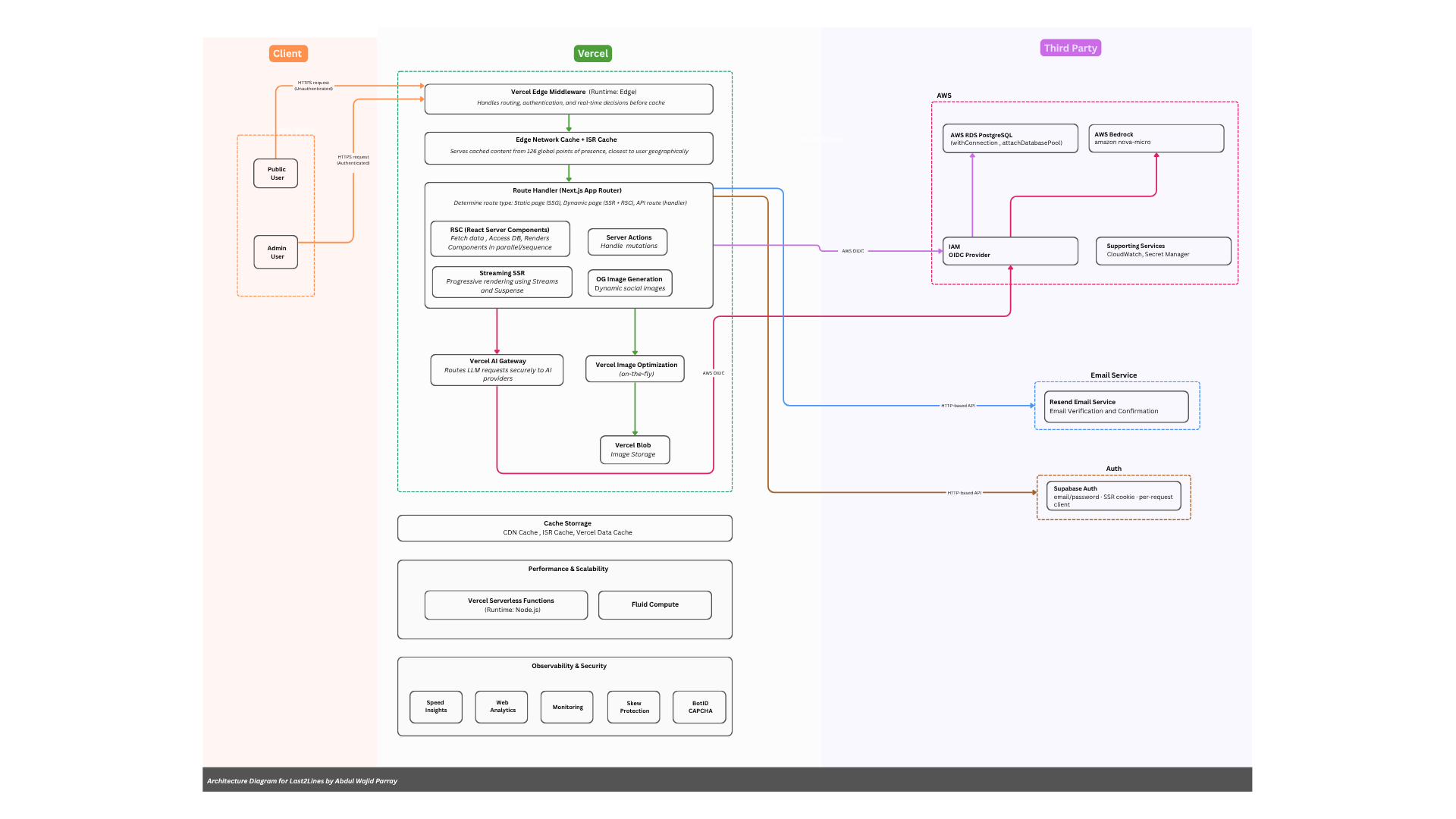 Figure 1: Last2Lines 2.0 Architecture Diagram
Frontend & UI Layer
I kept the client layer intentionally minimal—responsible only for form state, optimistic updates, and interactive chart rendering. I leveraged React Server Components for all data reads and Server Actions for every mutation.
- Design System: Tailwind CSS v4 paired with
shadcn/uiensures strict accessibility and a responsive dark/light mode. - Data Visualization: I used Recharts for analytics, and combined
react-simple-mapswith D3 to render the interactive global contribution map. - Performance: Streaming SSR renders the page shell instantly while the heavy data fetches securely on the server-side.
Data Foundation — AWS Aurora PostgreSQL
Ah! Let’s talk about the database. The application is backed by Amazon Aurora PostgreSQL, structured around five core tables: campaigns, contributions, authors, moderation_settings, and email_otps.
Security Architecture:
My, oh, my, what a relief it is to escape static passwords. Authentication uses AWS IAM database authentication. The @aws-sdk/rds-signer generates short-lived cryptographic tokens per connection. There are zero static database passwords stored anywhere in the application, and all queries use strictly parameterized inputs ($1, $2) to prevent raw concatenation.
Serverless Connection Management:
Serverless databases can be tricky when traffic spikes. RDS Proxy multiplexes traffic safely in a connection-per-invocation model. I capped connections at max: 5 per function instance to protect the db.t3.medium compute limits.
I also had to account for cold-start IAM and TLS handshake latencies (which can take 3–8 seconds). To handle this gracefully, I set a connectionTimeoutMillis of 30s and an idleTimeoutMillis of 60s. Finally, I built a custom withRetry wrapper with an isRetryable classifier to handle any transient cold-start errors safely.
Database Integrity Optimizations:
To keep the database clean and fast, I implemented ON DELETE CASCADE across the contributions, moderation settings, and email OTPs tables. Partial indexes (idx_contributions_poem, idx_email_otps_active) filter out dead rows, minimizing the disk footprint and maximizing query speeds.
AI Moderation Pipeline — AWS Bedrock via Vercel AI Gateway
Requests to AWS Bedrock (Amazon Nova Micro) are elegantly routed through the Vercel AI Gateway using the AI SDK. This architectural decision was a game-changer because it eliminated an entire category of credential management.
The gateway handles the OIDC token exchange automatically—no Bedrock API keys, no clunky provider SDKs. The exact same awsCredentialsProvider (via @vercel/functions/oidc) that signs the Aurora tokens also signs the Bedrock requests. One IAM role. Two AWS services. Zero stored secrets. Zod schemas step in at the end to strictly enforce structured, predictable model outputs for our three-verdict system.
Authentication & Security
I wanted the platform to be incredibly secure for admins, but completely frictionless for the public. Here is how the layers break down:
- Admin Sessions: Secured via Supabase Auth (email + password).
- Session Refresh: Handled seamlessly by Vercel Edge Middleware on every protected route.
- Public Submissions: Zero authentication. Frictionless by design, so anyone in the world can contribute without barriers.
- Spam Mitigation: We use a per-campaign email OTP via Resend.
- OTP Storage: SHA-256 hash only. Plain-text codes never touch the database. Period!
Observability & Telemetry
You simply cannot manage what you cannot see. To ensure production-grade reliability, the application is deeply instrumented:
- Vercel Analytics monitors traffic patterns, conversion funnels, and campaign engagement.
- Vercel Speed Insights tracks our Core Web Vitals (LCP, INP, CLS) directly in production.
- OpenTelemetry (
@vercel/otel) provides cross-service tracing to Supabase and Resend, allowing me to detect slow queries and bottlenecks directly in the Vercel dashboard before they ever become a problem for the user.
Application Flows
Overall Step-by-Step Flow
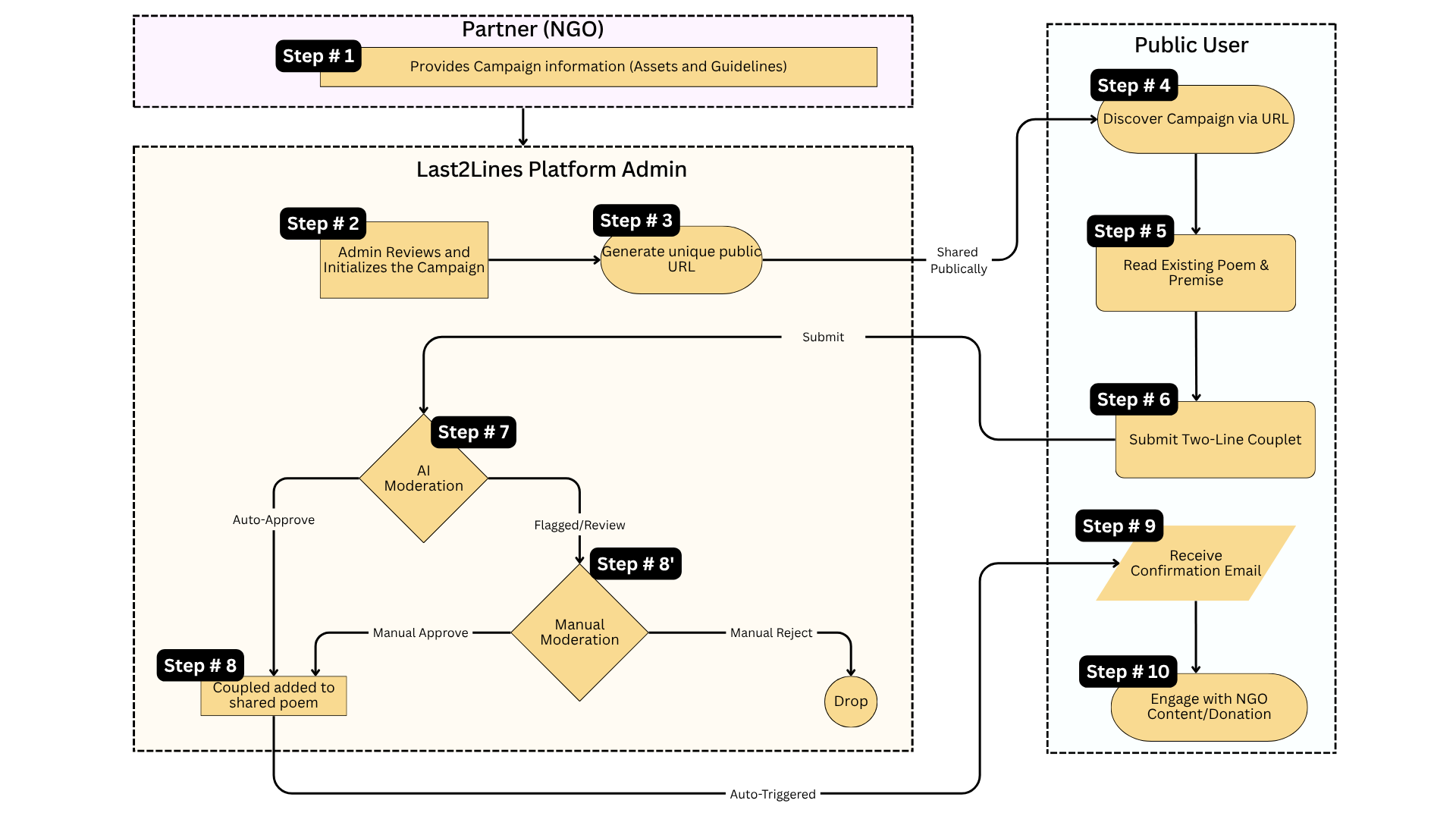 Figure 2: End-to-End Application Flow
Flow 1: User Contribution Journey
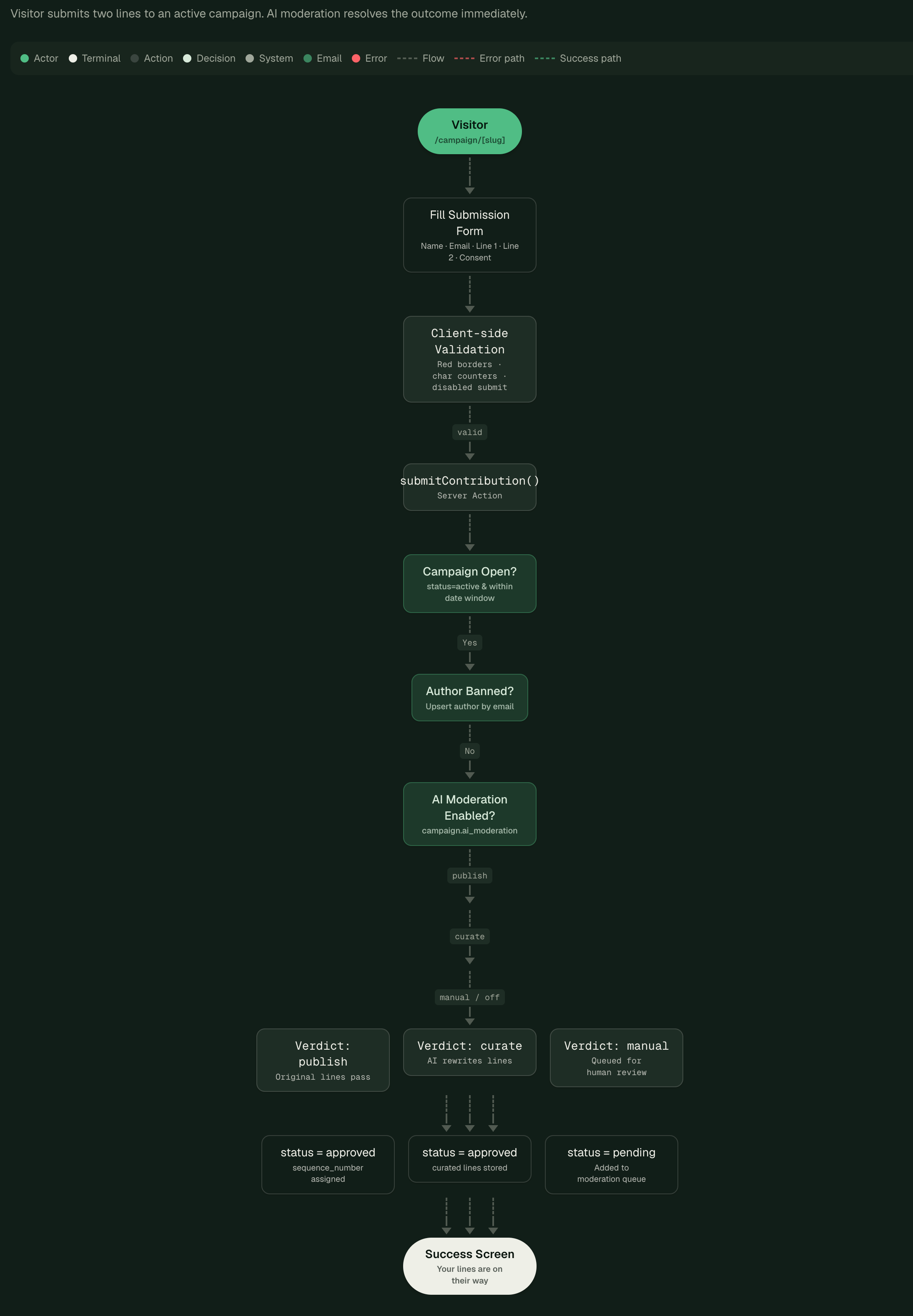 Figure 3: User Flow — Discovery to Published Couplet
Flow 2: Email OTP Verification
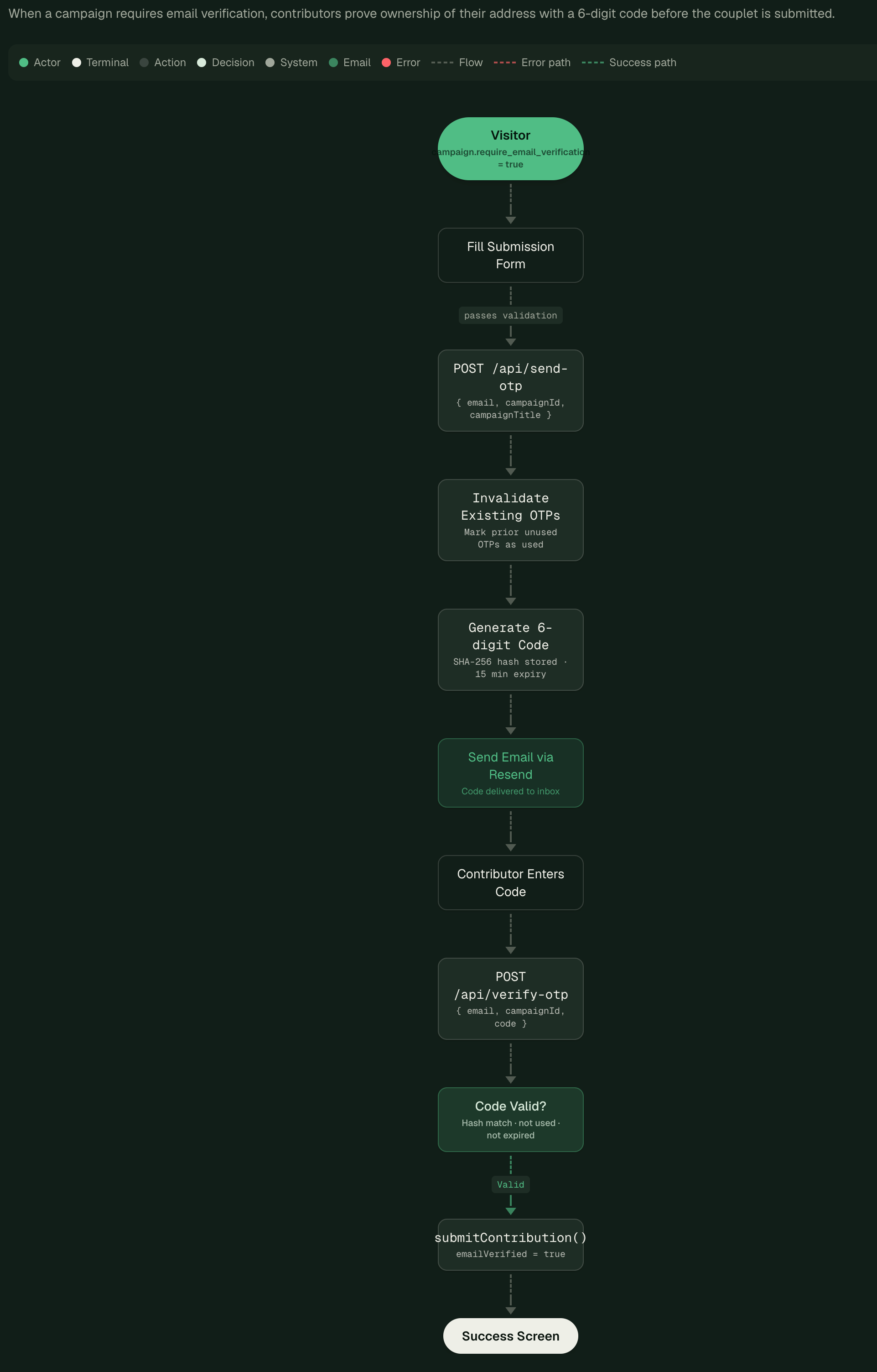 Figure 4: Optional Per-Campaign Email OTP Verification
Flow 3: AI Moderation Pipeline
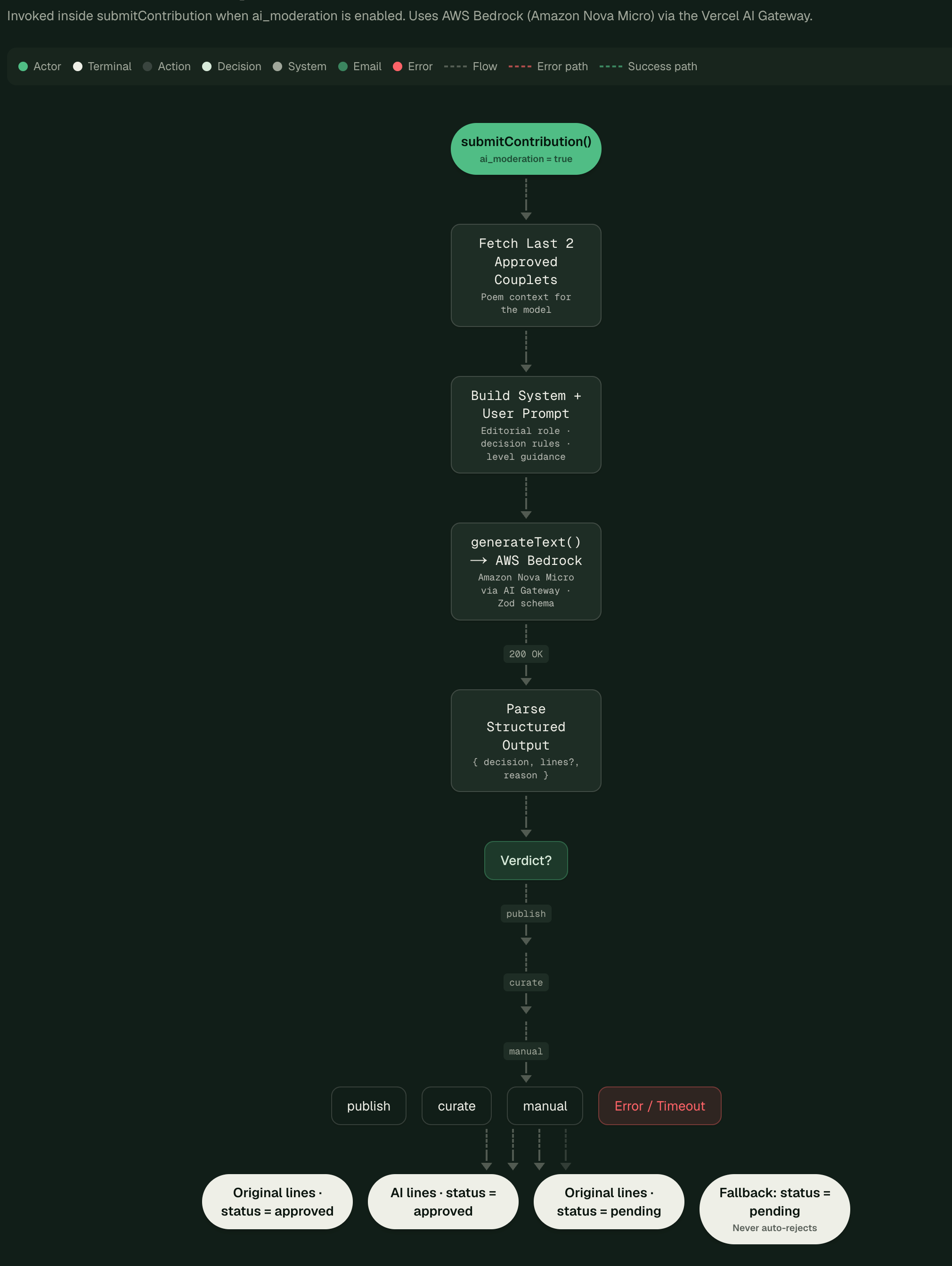 Figure 5: AWS Bedrock Three-Verdict AI Moderation Pipeline
Flow 4: Admin Manual Moderation
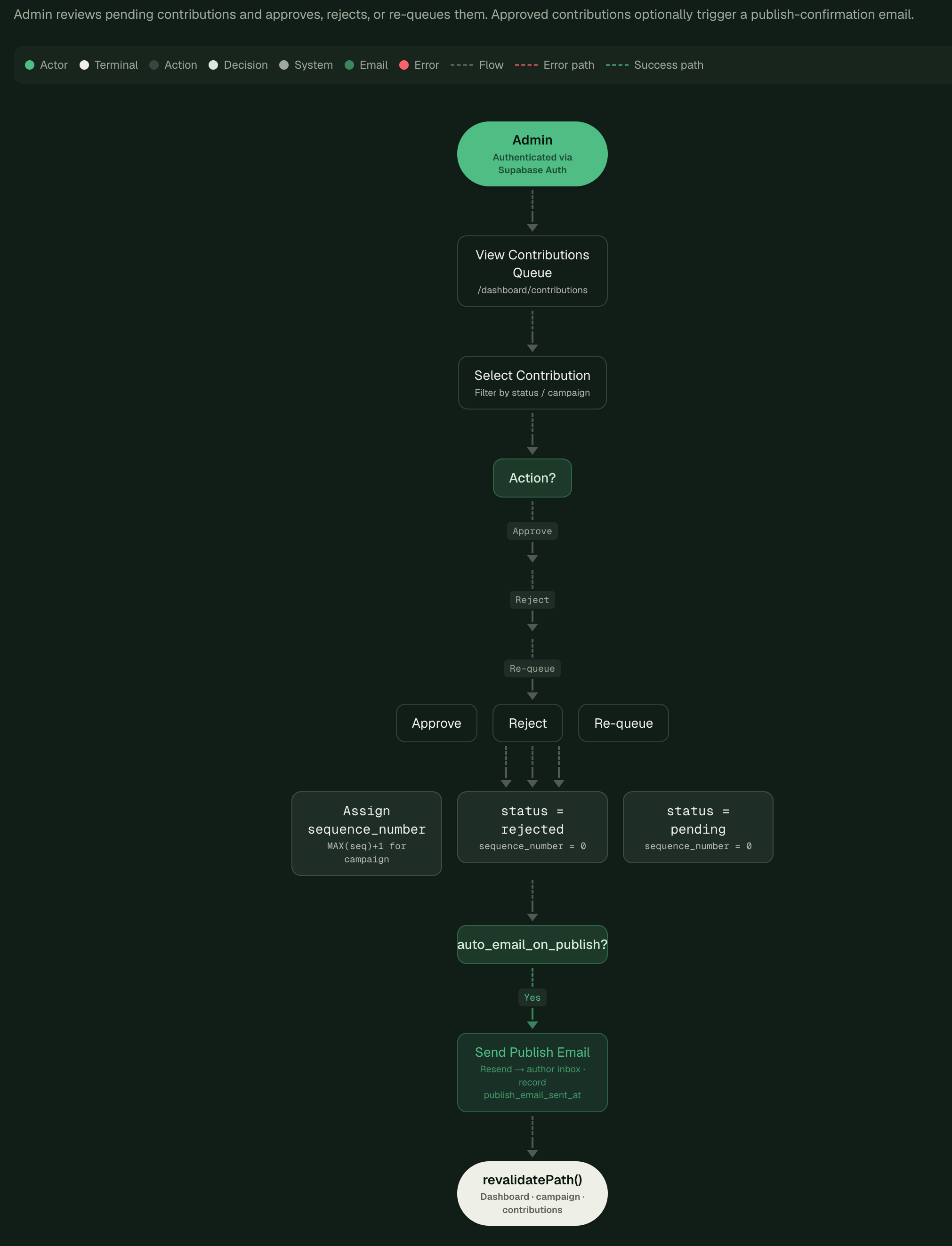 Figure 6: Admin Dashboard — Human Review Queue
Flow 5: Campaign Creation
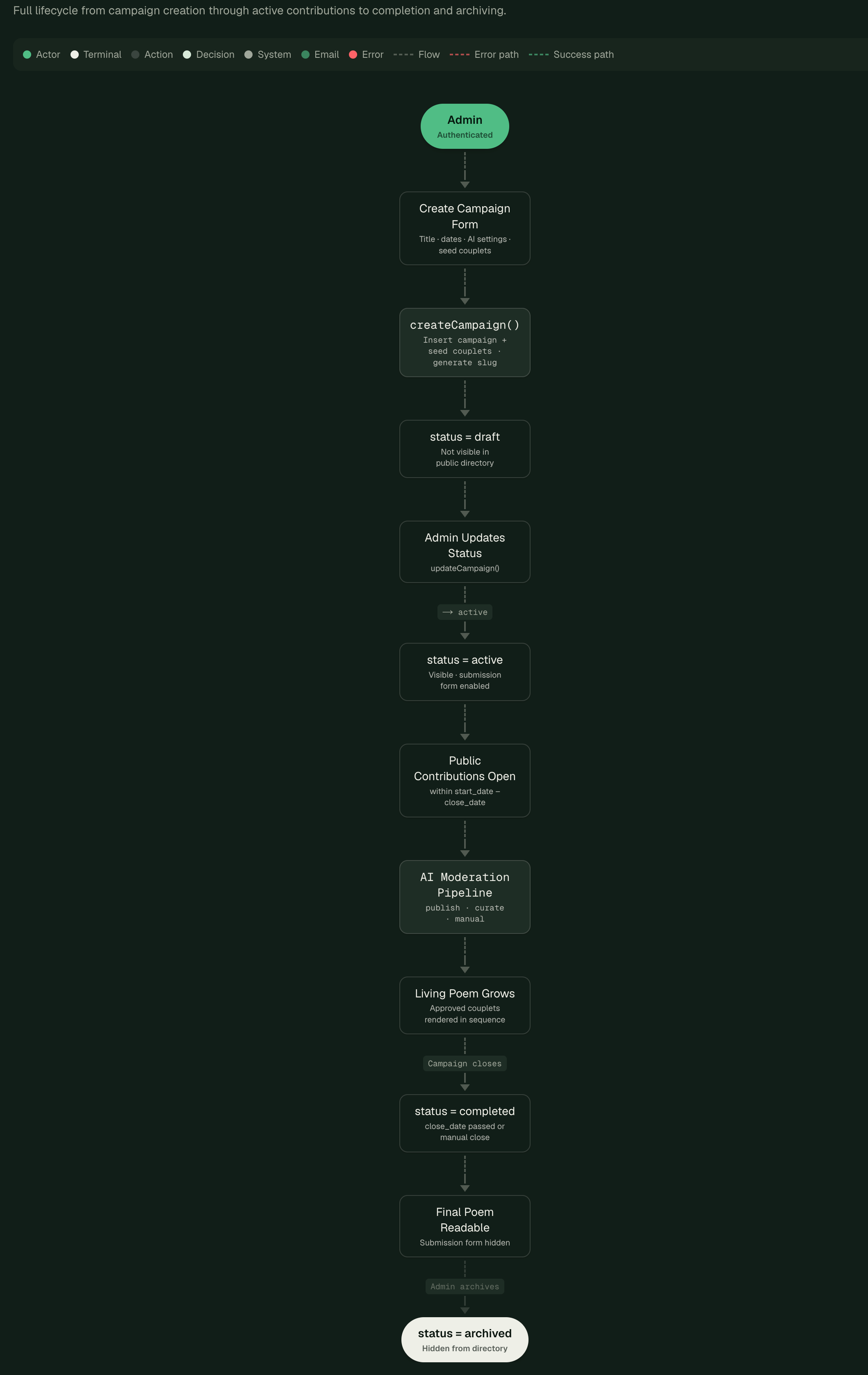 Figure 7: Admin Campaign Creation Lifecycle
Why Vercel
Vercel was the natural deployment target, providing three critical architectural advantages out of the box that directly shaped the application design:
1. Zero-Config AI Gateway (AWS Bedrock)
The AI Gateway gave direct access to AWS Bedrock via Vercel's OIDC identity. No Bedrock SDK to configure, no API keys to store — a single model string was sufficient. This eliminated an entire credential management category.
2. Optimized Serverless Database Connections
Fluid Compute and Database Connection Pooling (attachDatabasePool) efficiently manage connection lifecycles across serverless invocations, preventing connection exhaustion under traffic spikes without idle resource waste.
3. Edge-Optimized Authentication
Edge Middleware refreshes Supabase admin sessions on every protected request in a single shared location — zero per-page boilerplate. It also bypasses Supabase checks entirely on public pages, eliminating latency on high-traffic campaign URLs.
Beyond the Core: Vercel's Ecosystem Advantages
| Technical Pillar | Architecture & Strategy | Under-the-Hood Engineering Logic |
|---|---|---|
| Performance & Caching | Streaming SSR | Renders the initial page shell instantly to minimize Time to First Byte (TTFB) for dynamic campaign routes. |
| Incremental Static Regeneration (ISR) | Shields the Amazon Aurora backend from traffic spikes by serving heavily cached responses while refreshing the static data on a schedule. | |
| Native Image Optimization | Compresses and serves context-optimized imagery per device/browser using Vercel Blob to save user bandwidth on campaign assets. | |
| Explicit Cache-Control Headers | Strictly enforces headers that block CDN or browser-level caching on sensitive transactional states (such as auth tokens, OTP tokens, and email events). | |
| Reliability & Security | Fluid Compute (maxDuration) |
Dynamically adjusts function timeouts to completely prevent cold-start failures during intensive file uploads or heavy database schema migrations. |
| Vercel Skew Protection | Pins client-side static assets to the exact, corresponding server-side deployment ID, eliminating runtime JS chunk mismatches for active users. | |
| Encrypted AWS RDS Connections | Forces explicit SSL enforcement across all application data-in-transit pipelines routing into the AWS Aurora PostgreSQL instance. | |
| Marketing & Observability | Automated OG Image Generation | Programmatically generates customized, rich-text social media cards for instant previews when campaign URLs are shared across platforms. |
Cross-Service Telemetry (@vercel/otel) |
Aggregates and surfaces end-to-end distributed OpenTelemetry tracing directly inside the Vercel dashboard across Supabase and Resend. | |
| Real-Time Speed Insights | Continually tracks Core Web Vitals directly from actual user sessions to catch rendering or network performance regressions immediately. | |
| Client-Side Web Analytics | Captures real-time visitor attribution and conversion rates to identify exactly which campaign channels are driving user contributions. |
Why Amazon Aurora PostgreSQL
Last2Lines required strict relational consistency, foreign-key enforcement, and complex querying (aggregates, cursor pagination, partial indexing). Aurora PostgreSQL satisfied these requirements while unlocking two capabilities critical to the serverless architecture:
Zero-Trust IAM Authentication
Aurora's native IAM database authentication integrates directly with the Vercel OIDC flow. The @aws-sdk/rds-signer generates short-lived cryptographic tokens using the application's IAM role (AWS_ROLE_ARN). There is no static database password anywhere in the application. The same OIDC provider credential that authenticates Aurora also authenticates Bedrock — one IAM role, two AWS services, zero secrets.
Serverless-Native Scaling
The RDS Proxy infrastructure safely multiplexes connection spikes inherent to serverless architectures. Combined with connection caps, retry policies, and Fluid Compute lifecycle management, the database layer is purpose-built for a connection-per-invocation model at any scale.
Why v0
Speed is critical during a weekend hackathon. But as an advocate for disability and inclusive design, rigorous accessibility was equally non-negotiable. v0 bridged both goals simultaneously.
v0 was used to rapidly scaffold production-quality components across the entire platform:
- User-Facing UI — Campaign cards, frictionless submission forms with live character counters and real-time validation states
- Data Visualization — The interactive global contributions map layout structure
- Admin Dashboard — Comprehensive data tables, moderation queues, and inline editing controls
- Design System — A flawlessly implemented, system-aware dark/light mode toggle maintaining high-contrast readability in both states
Beyond speed, v0 natively enforced accessibility. It automatically generated WCAG-compliant semantic HTML, correctly mapped ARIA attributes, and implemented visible focus rings — ensuring Last2Lines could serve a diverse global audience from day one, without a separate accessibility audit.
I quickly exhausted the initial v0 credit allocation and purchased additional credits twice. My goal was to engineer an enterprise-grade application over the weekend — and v0 was the exact catalyst needed to achieve that quality.
Challenges
I. IAM Credential Bootstrap Latency
Operating without long-lived credentials is secure, but cold serverless invocations introduce a complex initialization sequence: OIDC token exchange → IAM role assumption → RDS auth token generation → TLS handshake → connection pool warmup → first SQL query. This added 3–8 seconds to cold starts.
Solution: A generous connectionTimeoutMillis (30 seconds) paired with a custom withRetry wrapper and an isRetryable classifier. The system safely identifies and retries transient connection errors during cold starts without masking genuine application bugs.
II. Structured AI Output Reliability
Extracting consistent, machine-parseable verdicts from Amazon Nova Micro for nuanced edge-case poetry — content that straddles moderation thresholds — required rigorous, iterative prompt engineering.
Solution: A system prompt that establishes a strict editorial identity, defines precise decision rules for all three verdict tiers, and dynamically accounts for per-campaign sensitivity levels (lenient, standard, strict). The entire pipeline defaults to the human review queue on any error — no exceptions propagate, no content is silently lost.
Accomplishments
Modernized Architecture & Scalability Successfully rebuilt a 10-year-old PHP application into a serverless, accessible, enterprise-grade platform in a single weekend — with production-ready observability, multi-campaign concurrency, and global scalability.
Context-Aware AI Moderation Engineered a three-verdict pipeline significantly more nuanced than binary approval systems. The "Curate" verdict — where the AI lightly edits good-faith submissions — maintains content quality while reducing administrative overhead. Strictly fail-safe by design.
Production-Grade Data Integrity
Partial indexes (idx_contributions_poem, idx_email_otps_active) maintain fast query speeds with minimal disk footprint. Referential integrity enforced via ON DELETE CASCADE. Zero-trust security maintained exclusively through parameterized queries and IAM token authentication.
Inclusive, First-Class Design System Accessibility as a core feature — not an afterthought. Fully keyboard-navigable, semantic HTML throughout, native dark/light mode, real-time character counters, live inline validation, and intuitive loading states. A frictionless experience for a diverse, global audience.
What I Learned
End-to-End Vercel + AWS Architecture Gained deep, practical understanding of the entire Vercel ecosystem — how v0 accelerates UI scaffolding, how the AI Gateway bridges Vercel and AWS, and how Fluid Compute, ISR, and Edge Middleware work together as a cohesive production system.
OIDC is the Superior Model for Serverless Trust Short-lived, federated tokens derived from the deployment platform's identity are not only more secure and auditable than stored credentials — they are fundamentally simpler to maintain. This is the zero-trust model for serverless cloud architecture.
Fail-Safe Architecture Over Happy-Path Optimization Ensuring the AI pipeline defaults to a safe fallback on any error improved system reliability more than any individual performance optimization. Build the failure path first.
Next.js Server Actions as an Architectural Boundary
Server Actions outperform traditional REST endpoints for internal mutations. Colocation with the triggering page, direct revalidatePath access, and elimination of API boilerplate made them the dominant mutation pattern throughout the application.
What's Next
| Feature / Roadmap Pillar | Technical & Functional Scope | Strategic Value & Advocacy Impact |
|---|---|---|
| Multi-Language Support | Per-campaign localization configurations matched with localized system prompts for AI moderation. | Eliminates language barriers, making digital advocacy globally inclusive for regional and indigenous campaigns. |
| Public Contributor Portfolios | Opt-in user profile pages aggregating and showcasing an individual's published work across multiple campaigns. | Fosters a persistent community of digital poets, encouraging repeat participation and organic social sharing. |
| Granular Campaign Analytics | Dedicated organization dashboards tracking submission velocity, verdict distributions, and geographic telemetry. | Equips NGO partners with clear data points to quantify campaign reach and demonstrate engagement to funders. |
| Automated Campaign Lifecycle | Integration of Vercel Cron jobs to autonomously handle transitions from Draft $\rightarrow$ Active $\rightarrow$ Completed. | Minimizes operational overhead, allowing time-bound campaigns (like Earth Day or 24-hour blitzes) to run hands-free. |
| Composable Webhooks | Event-driven architecture triggering external APIs to broadcast approved couplets instantly. | Creates powerful viral feedback loops by publishing live content straight to social feeds, Slack channels, or a CMS. |
| Print-Ready Artifacts | Programmatic compilation and typesetting of completed poems into high-quality, downloadable PDFs. | Transforms transient digital art into tangible physical assets for book publications, gallery prints, or donor impact packets. |
| Generative Banner Images | Built-in AI generation pipelines to automatically spin up relevant campaign cover artwork during creation. | Lowers the barrier to entry for resource-strapped non-profits lacking in-house graphic design support. |
| Agentic Admin Workflows | Autonomous AI agents parsing complex queues with strict human-in-the-loop validation mechanisms. | Maximizes administrative bandwidth by sorting edge cases and highlighting trends without sacrificing human final oversight. |
| SaaS Transition Model | Multi-tier organizational subscription architecture designed to cover underlying cloud compute costs. | Establishes long-term financial sustainability to keep the core tool free for grassroots activists and small-scale NGOs. |
Before & After
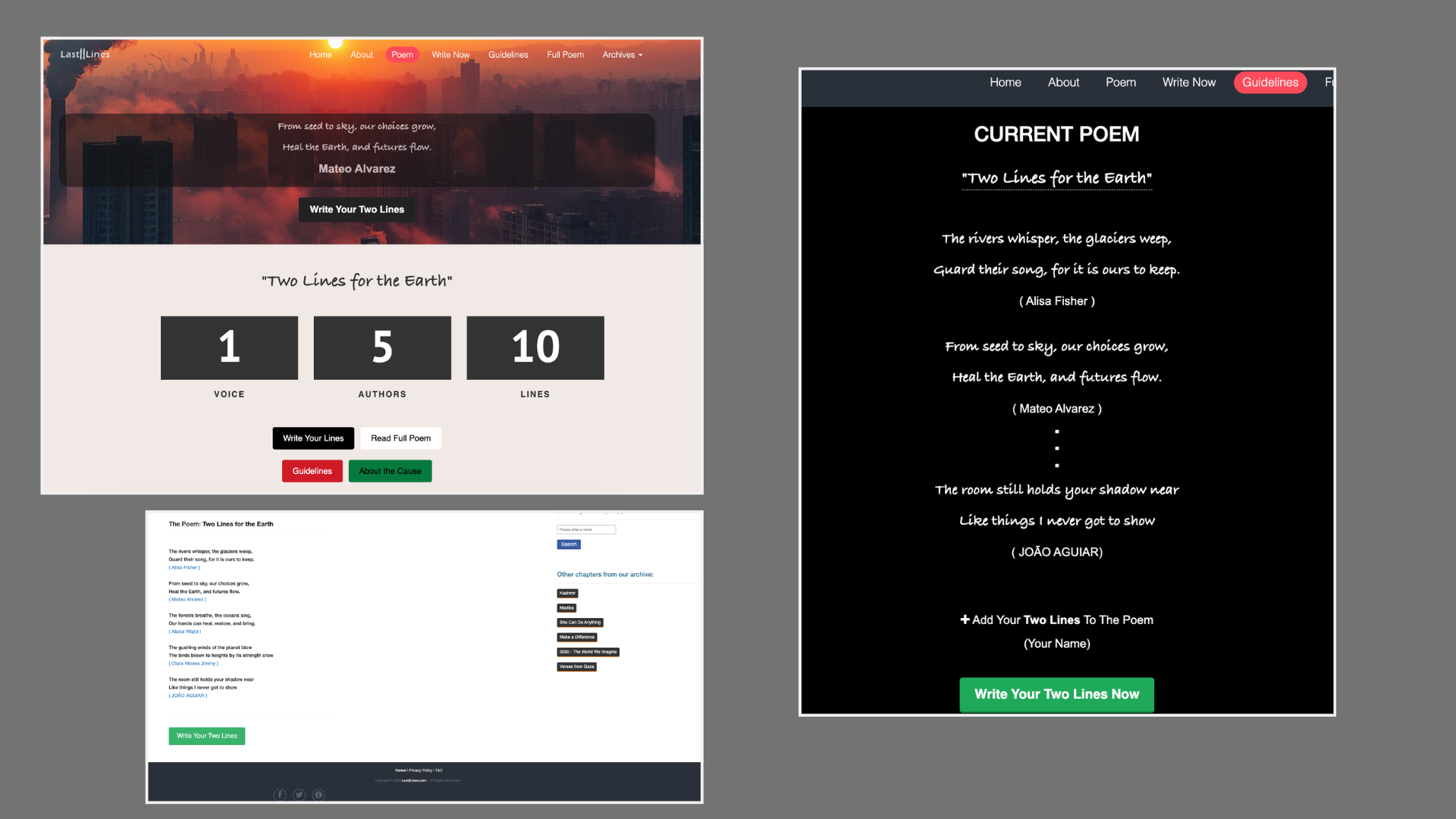
Before — Legacy Last2Lines
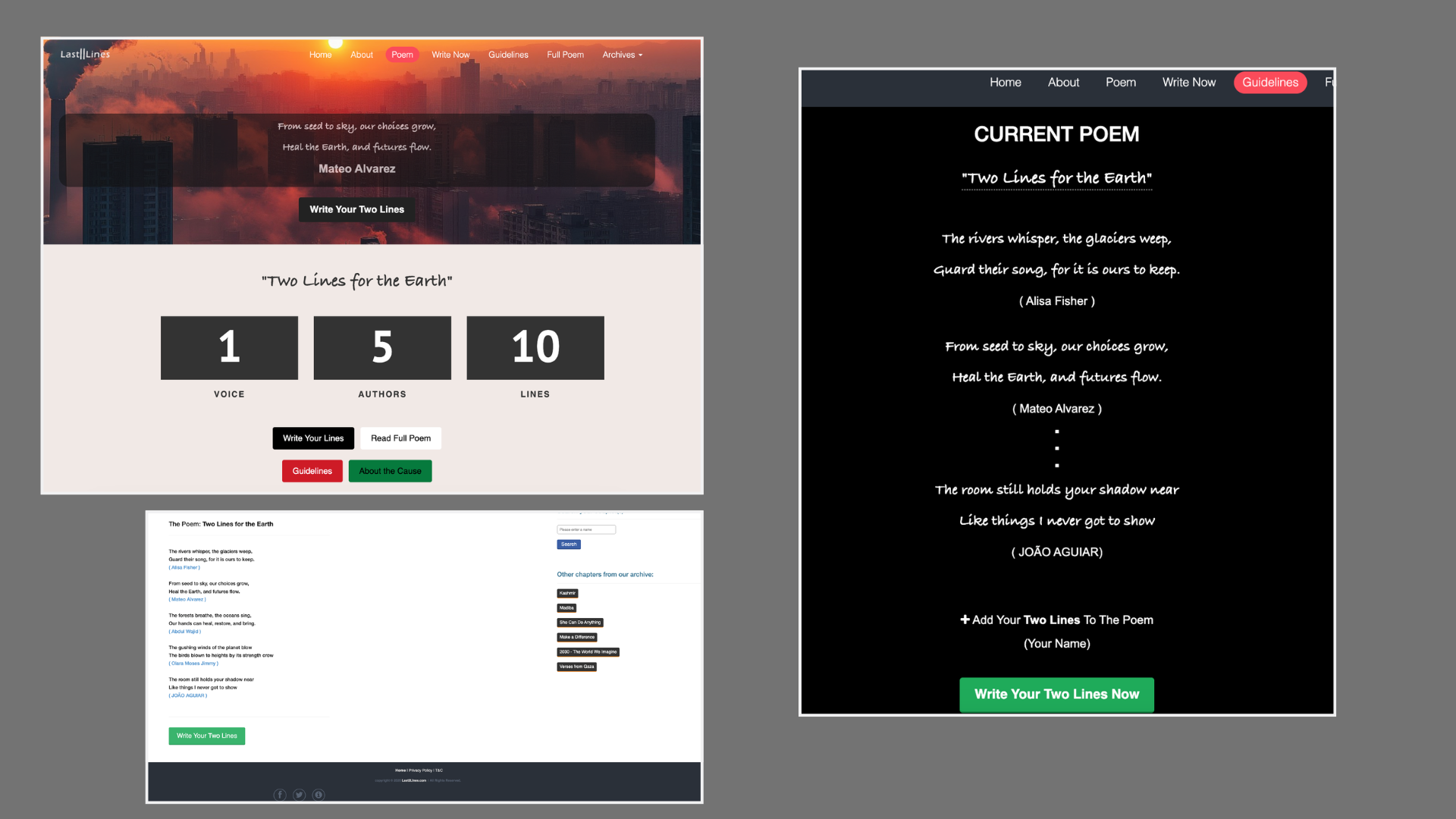 Figure 8: Last2Lines before the Vercel + AWS transformation
The legacy platform was a rigid, PHP-based application — a single campaign at a time, no accessibility standards, no observability, no third-party integrations, and no scalability for a global audience.
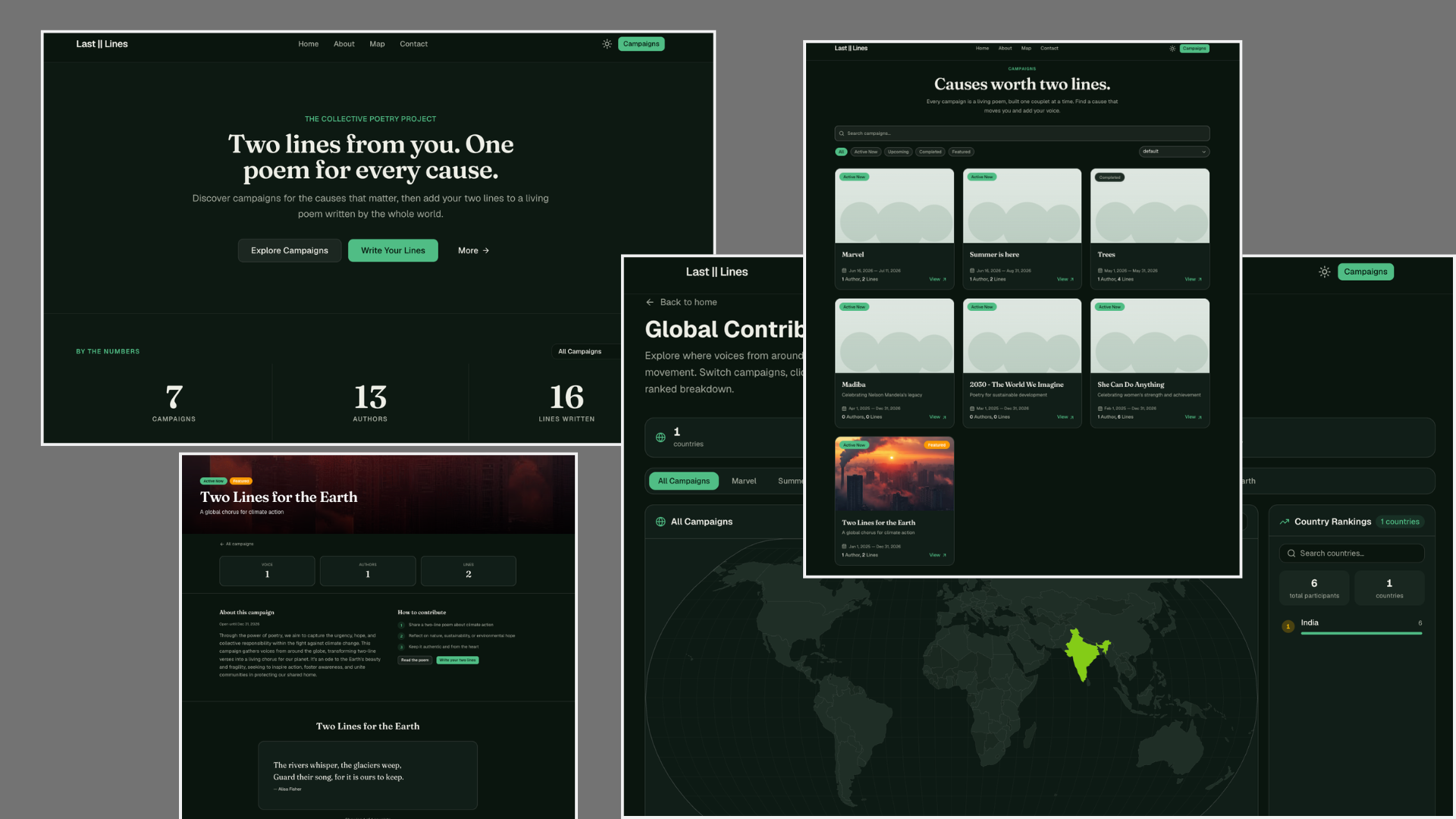
After — Last2Lines 2.0
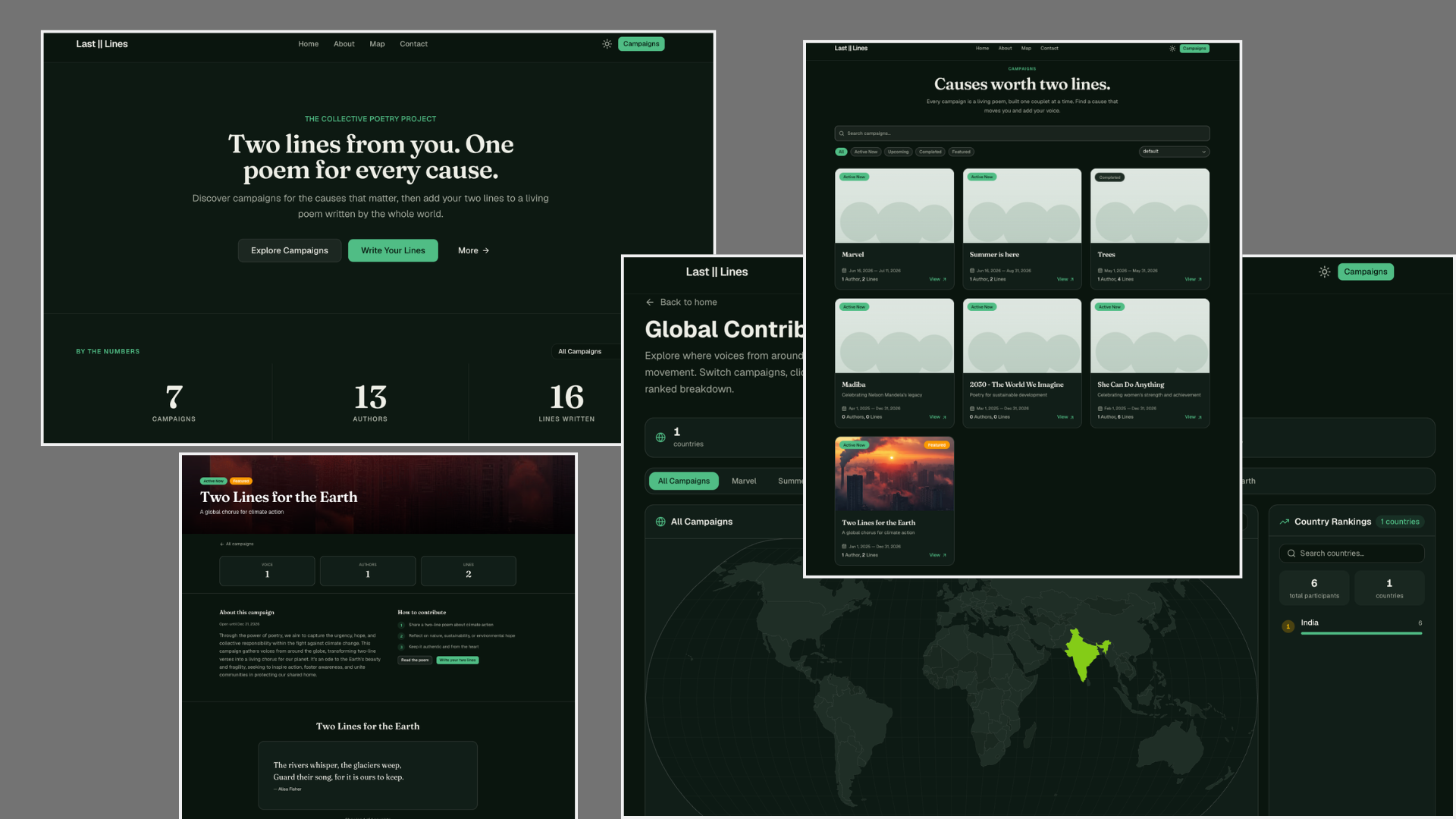 Figure 9: Last2Lines 2.0 — production-hardened on Vercel + AWS
Last2Lines 2.0 is a production-hardened, Vercel-optimized stack that:
- Shields the AWS backend from traffic spikes via ISR and edge caching
- Ensures rich social shareability via native OG image generation
- Provides comprehensive cross-service error tracing with OpenTelemetry
- Supports auto-scaling serverless functions with Fluid Compute
- Prevents deployment conflicts via Skew Protection
- Measures real user experience with Core Web Vitals in production
- Maintains security via efficient connection pooling and precise cache-control headers
This architecture is designed to scale from **100 to 100,000 concurrent users* without requiring further fundamental changes.*
Built With
- amazon-web-services
- nextjs
- typescript
- v0
- vercel

Log in or sign up for Devpost to join the conversation.