


CUID Challenge: VacPac, a solution to Last Mile Vaccine Delivery
Motivation
Vaccination is a cost-effective way to improve health. Treating one case of measles costs 23 times the cost of one vaccination, and $24 is saved for every $1 spent on the diphtheria-tetanus-pertussis (DTP) vaccine (Ehreth 2003). Along with the waste in resources and financial cost, spoiled vaccines also lead to an anti-vaccine mentality, as people become distrustful of vaccines after seeing them disregarded or being deemed unsafe for humans.
Vaccines get spoilt in two ways: either getting too warm or too cold. Most vaccines need to be kept between 2-8 degrees Celsius. The figure below highlights vaccines sensitivity to temperature.

Vaccines travel in a cold chain, a logistical transport network which ensures the vaccines always are kept at the correct temperature. Transport through the cold chain brings vaccines to many people, however in certain areas, notably developing countries in the southern hemisphere, cold chain infrastructure isn't as prevalent. This leads to the last mile problem:
How to ensure vaccines successfully get from cold storage to people without them being spoilt.
Existing solutions & issues with them
We are not the first group to look at last mile vaccine delivery, there are several solutions already on the market. The most notable of which are:
- The Indigo Cooler A passive device which uses evaporative cooling to extend vaccine life times.
- The Isobar A Dyson award winning device which uses gases to keep vaccines cool
- .... And many others
However, none of these solutions are in widespread use today. Currently most vaccine carriers look like this:
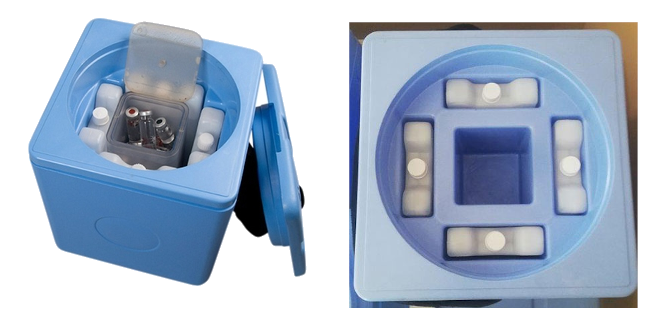
As mentioned before, there are two main issues: freezing and overheating. Solutions to prevent freezing are discussed in the appendix A. However overheating control is not widely implemented. An issue (human error) with these smaller scale vaccine carriers is that during vaccination, for ease of access they are left open for large stretches of time while a group of people are vaccinated. We investigated the effects of periodically opening and closing a cooler on the temperature inside (check appendix A for details) and found this gravely affected the temperature inside the cooler. This led us to our problem statement:
Can we build a low cost system that integrates with vaccine carriers in use today, that allow you to remove vaccines without exposing all the vaccines to heat?
The coronavirus pandemic has shown us the importance of vaccinating people. All people. We aim to leave no one behind no matter where they come from.
Our solution
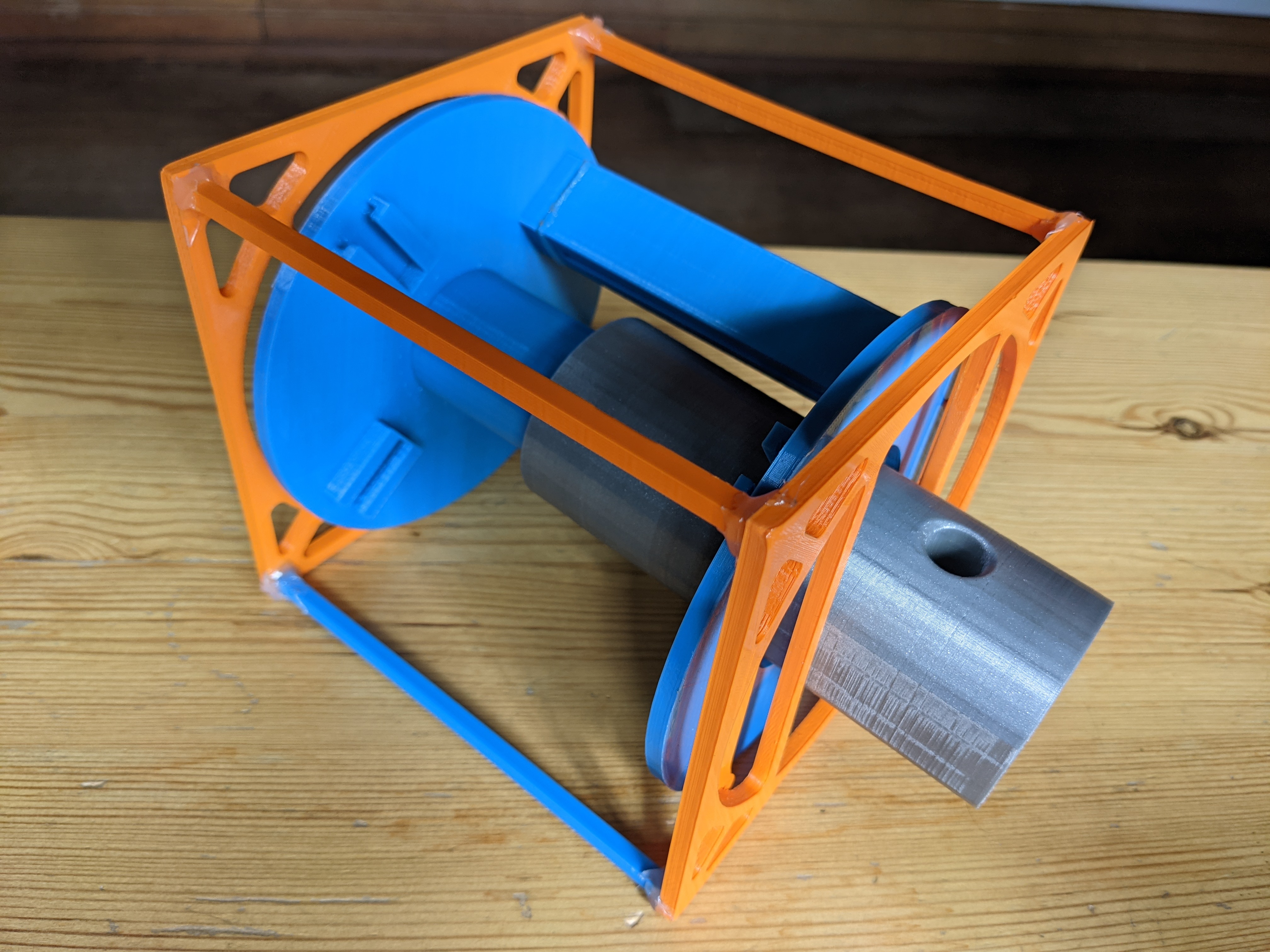
We have designed and prototyped what you see below:

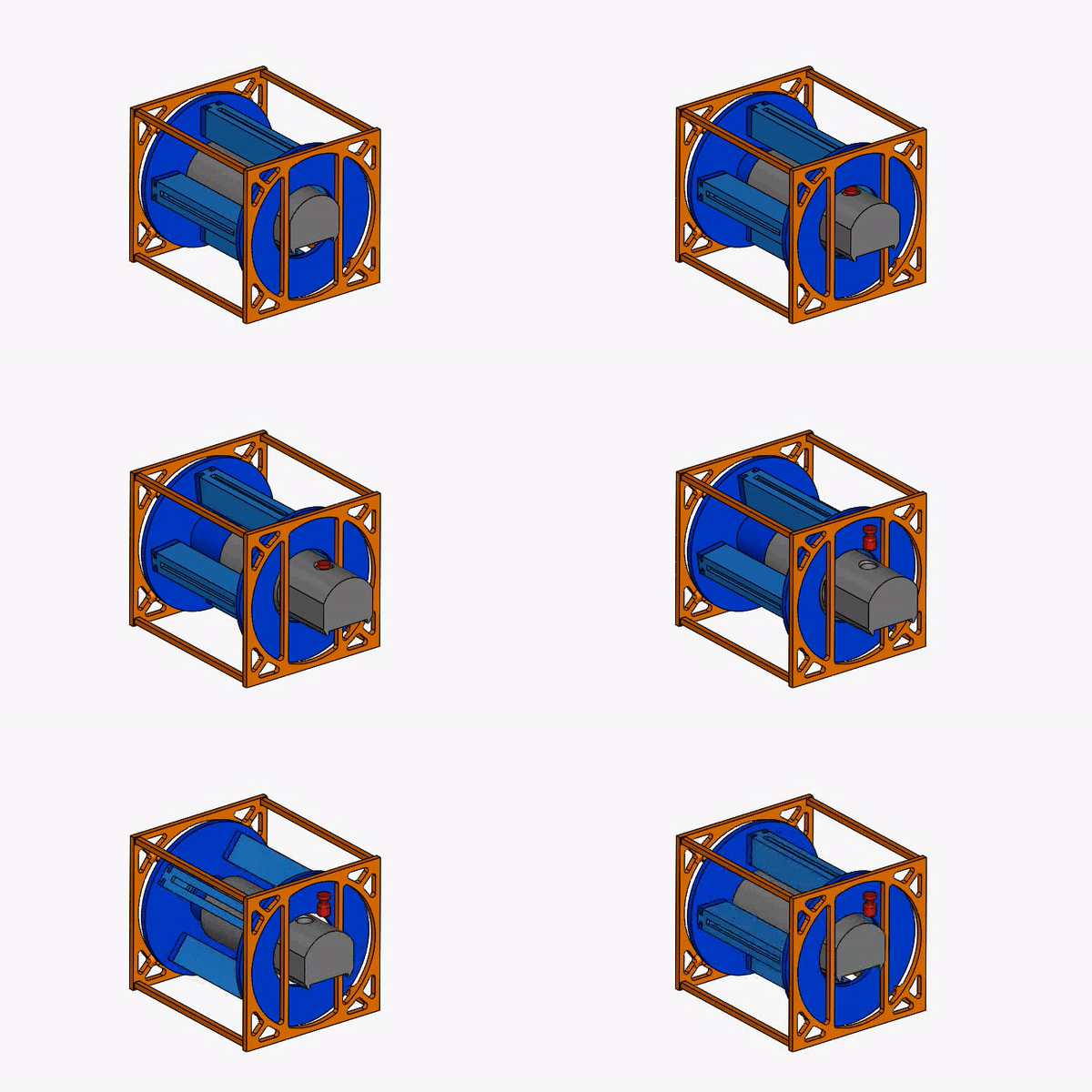
This simple mechanism allows you to remove vaccines without ever opening the vaccine cooler. To get a vaccine out of the box, all you need to do is pull a drawer out from the front of the box. This rotates an inner mechanism and allows a vaccine to fall down into it from a magazine in which they stored (see details below). Doing this over and over empties all the magazines evenly.
How does it work?
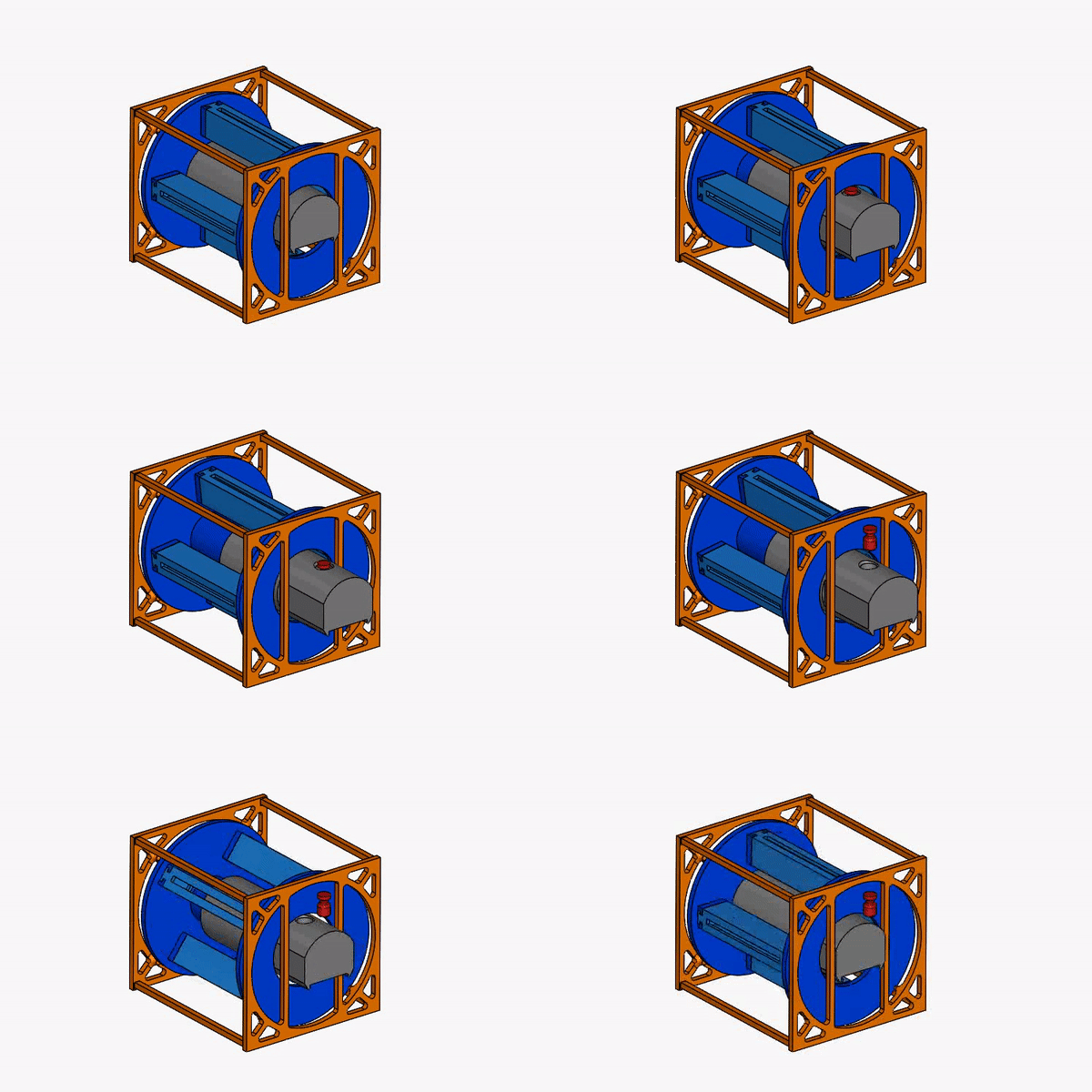
Our entirely mechanical design (no power required) works in the following way:
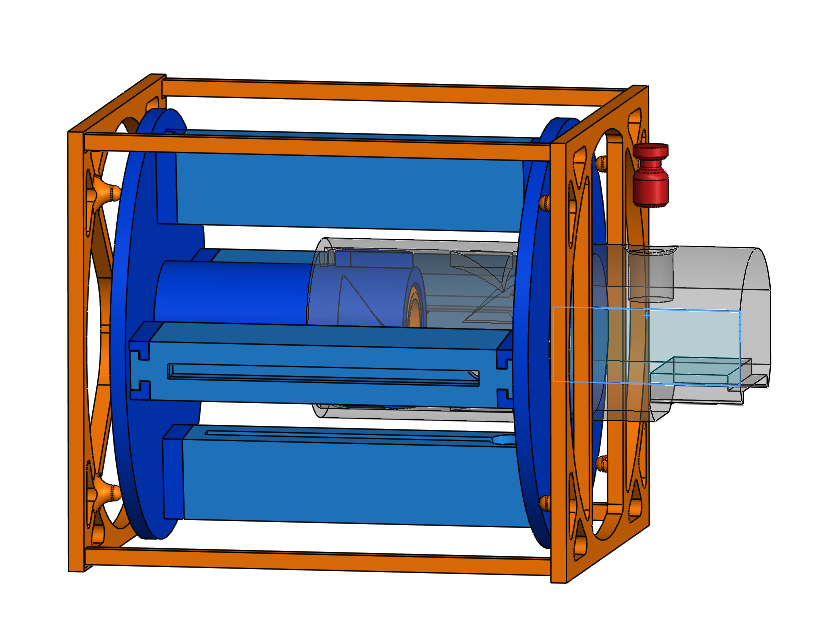
Vaccines are loaded into magazines, these are the long cuboids you see in the images. These magazines are spring loaded, so the vaccines are constantly being pushed out. Loading the vaccines is easy, you slide the magazine out of the assembly, pull the spring back and fill the magazine with vaccines.
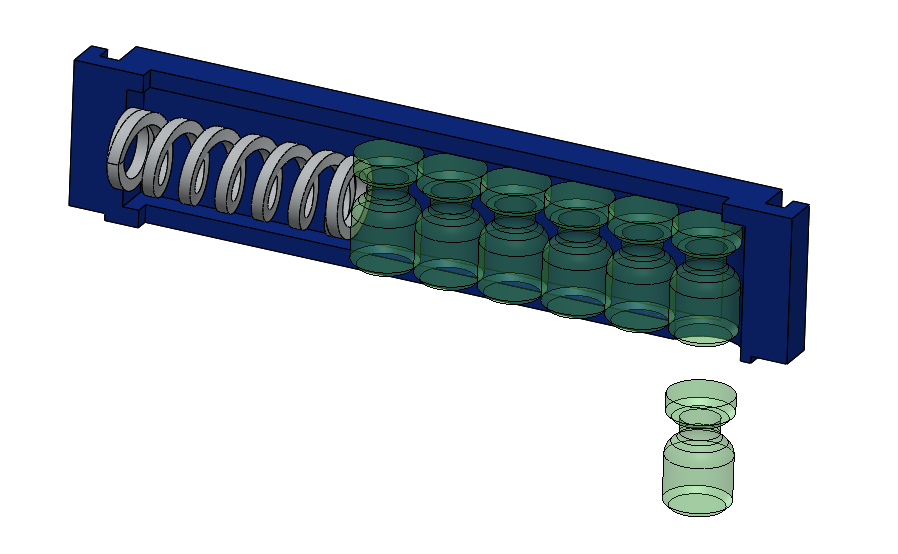
Notice that at the end of the magazine, there is a hole for a vaccine to fall through. This can only happen when the hole in the central drawer, the grey piece in our images, aligns with the magazine. This allows a vaccine to fall down into the drawer.
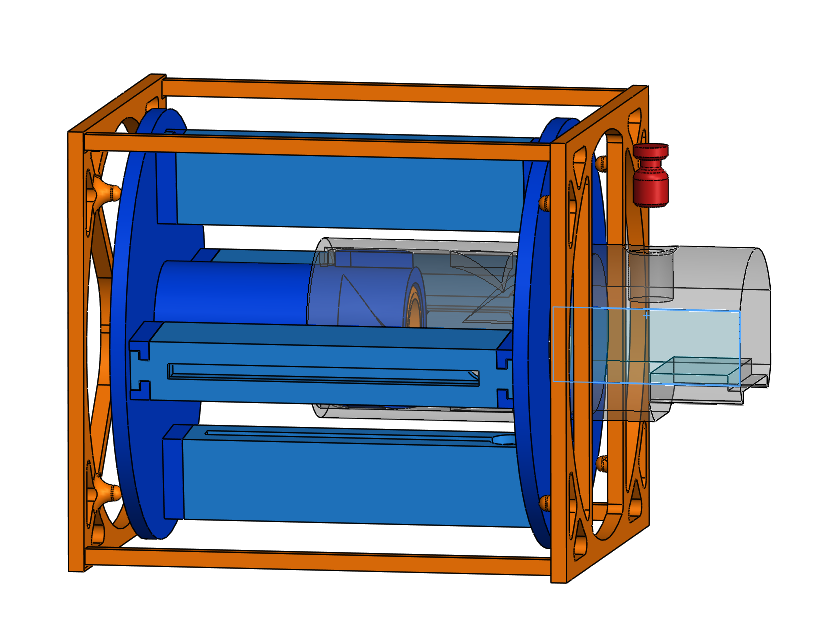
In the above picture, the central drawer is shown as translucent. This allows us to see the inside of the mechanism. We have carefully designed a series of curves inside the drawer. These curves rotate the entire blue magazine assembly by exactly 1/4 revolution, every time. This is a very reliable design, relying only on mechanical design, there are no electronics. For the finished product, we would like to have more magazine categories, and so we would change the mechanism to rotate less with each push making it more reliable.
This design of the VacPac means the internal temperature of the cool box is more resistant to the external heat, as there is never an open door.
Advantages
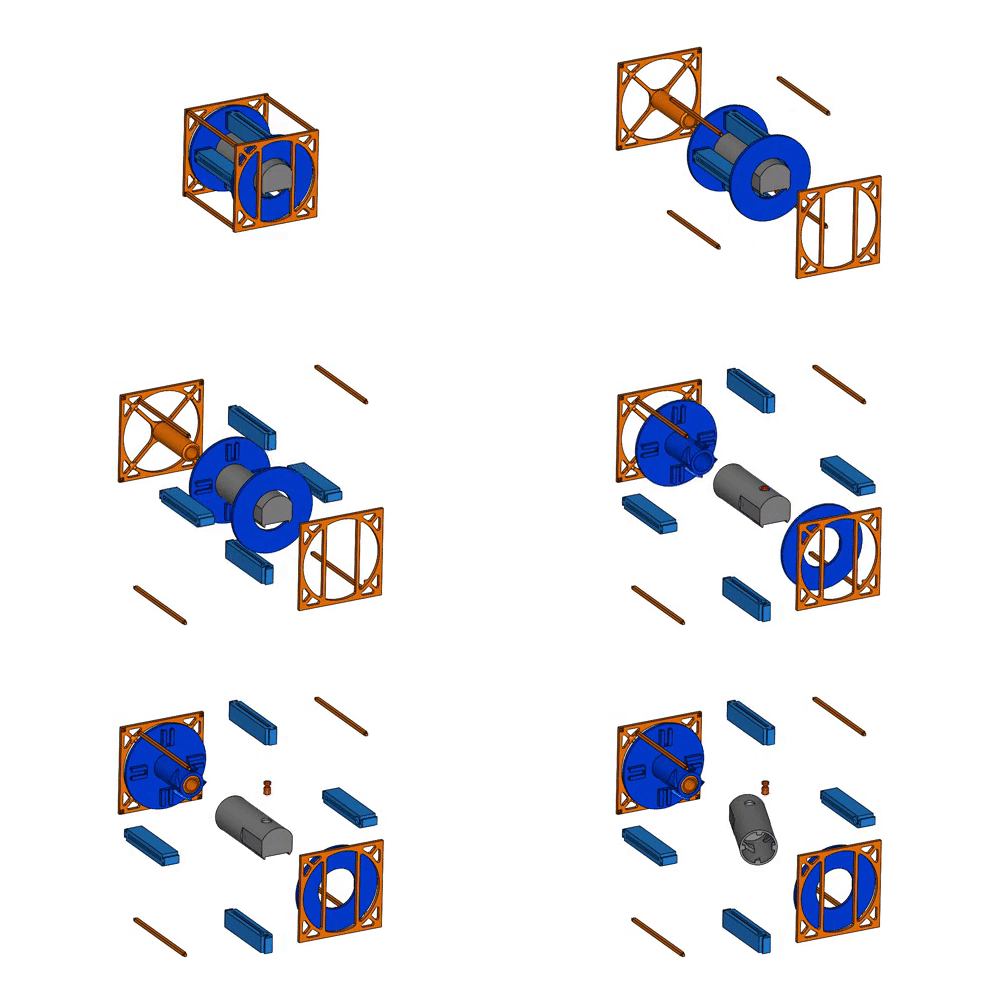
- VacPac fits into standard vaccine boxes in use today, as can be seen below. This means we are not trying to change what is in use now, we are trying to improve it. This reduces the cost of upgrade significantly. The below image shows the process of integrating VacPac with a vaccine container.
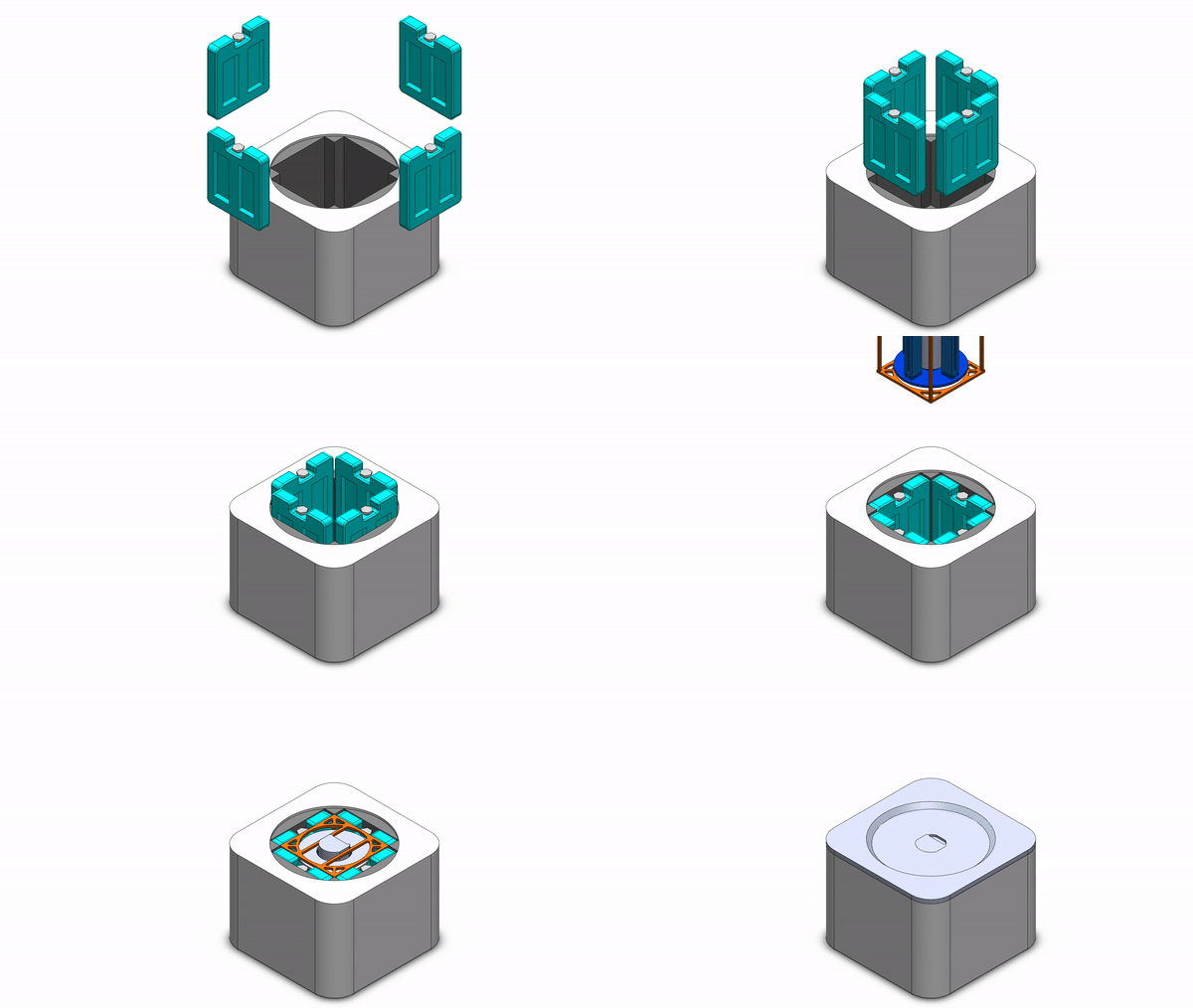
VacPac is entirely 3D printed this has numerous advantages:
- It can be manufactured anywhere where 3D printers are available. 3D printers can now be bought extremely cheaply and are becoming more prevalent all over the globe.
- The dimensions of our design can be quickly and easily changed to fit the exact dimensions of what is available.
- If parts break, rather then having to manufacture an entire new part, you can just 3D print the broken part.
- It is low cost, we estimate the entire assembly will only cost 4£ to 3D print.
- Our prototype is printed with PLA, a type of plastic that is by far the most popular for 3D-printing. The advantage of PLA is it's biodegradable. No long term negative effects from waste.
In short we believe
VacPac has economic and practical advantages, not present in other last mile solutions.
Limitations and issues we want to address
- VacPac's design is not currently perfect, there are still many improvements to be made.
- we would like to design our project to also be able to be laser-cut, as 3D printing can be a slow process, this could speed up manufacturer, although laser-cutters are less common then 3D printers.
- We would love to have the chance to talk with people who perform vaccinations in remote areas. This would allow us to address challenges that we haven't seen, and improve our design further.
About Us
 We are Egle Augustaityte, Louis Relandeau, David O'Brien-Møller & Juan Rodgers, we're all 3rd year engineers at Girton.
Appendix
Solutions to prevent freezing:
Many solutions are already introduced. A few common approaches include better monitoring of the cold chain for freezing temperatures, developing thermostable vaccine formulations, and providing health worker training, however most common approach is to use freeze-preventative vaccine carriers, which meet WHO requirements. [2]
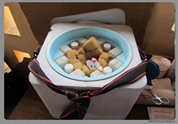
Figure 2 (taken from [1])
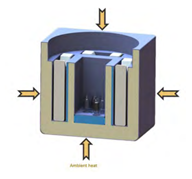
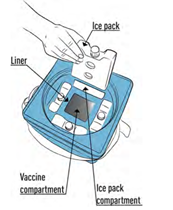
Figure 3 (taken from [2])
Solutions to prevent heating:
The current design (later called vaccination carrier) that is widely used in last mile vaccination transportation is shown in figure 4. It is noticeable that in order to take out a vaccine the lid needs to be fully removed.
Figure 4
Opening and closing lid does not poses great threat as there is not much heat exchange in such a quick process, however it has been reported that in some areas, due to humans’ factor error, lid gets open and will stay open for a longer period, disposing vaccines to the sun radiation, and heat exchange with the atmosphere, where temperature can reach up to +35 or more degrees Celsius. This makes vaccinations spoiled. To prove the importance of the lid being shut, we have performed an experiment. Experimental results: The experiment was performed on two insulated tupperwares with frozen water. The experimental setup is shown in figure 5. Two different size tupperwares were used in order to create an air gap between each other, creating insulation. One Tupperware was kept closed and another was half open, to understand better the difference in heat exchange, between open and closed vaccination carrier.
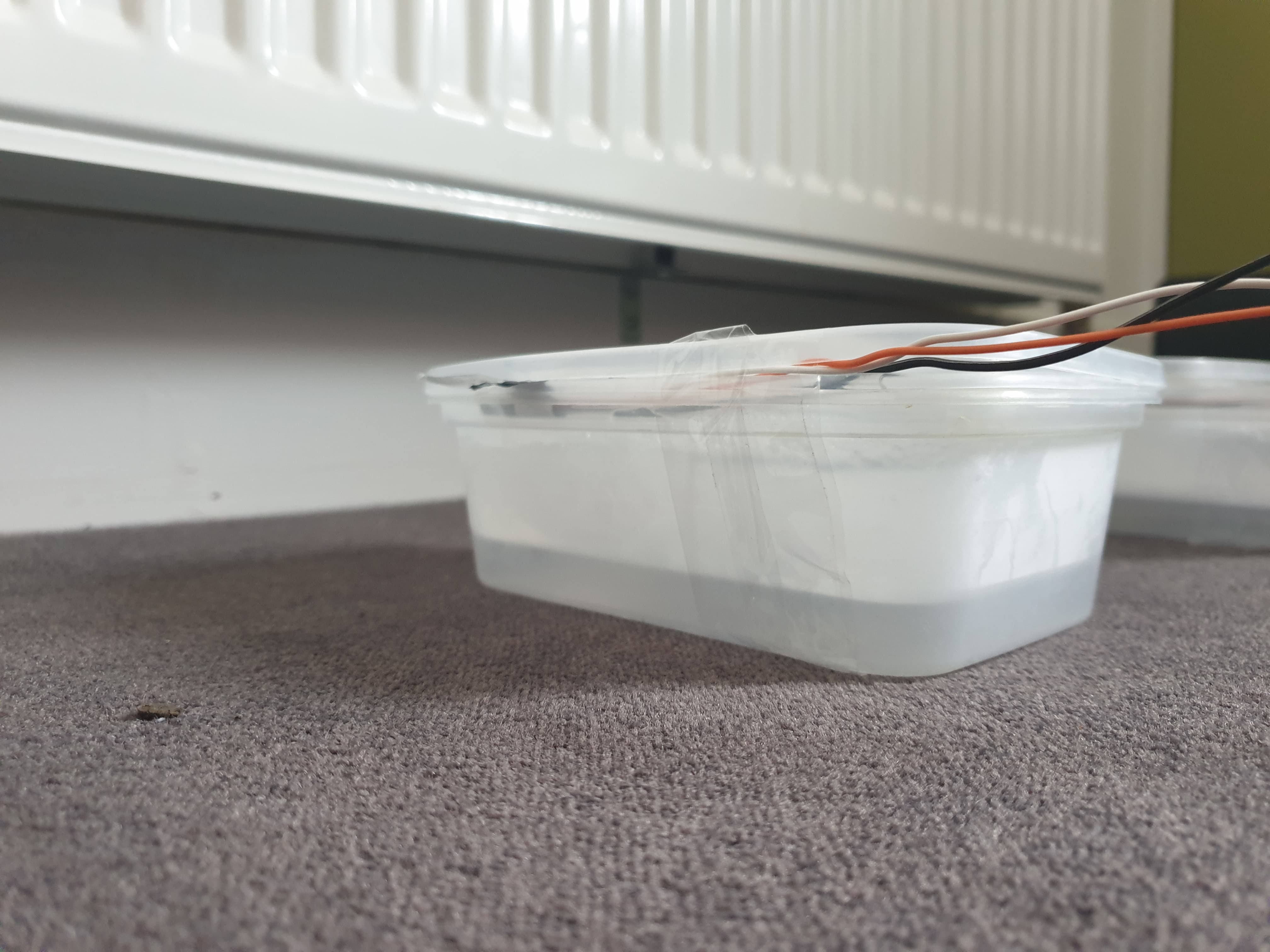
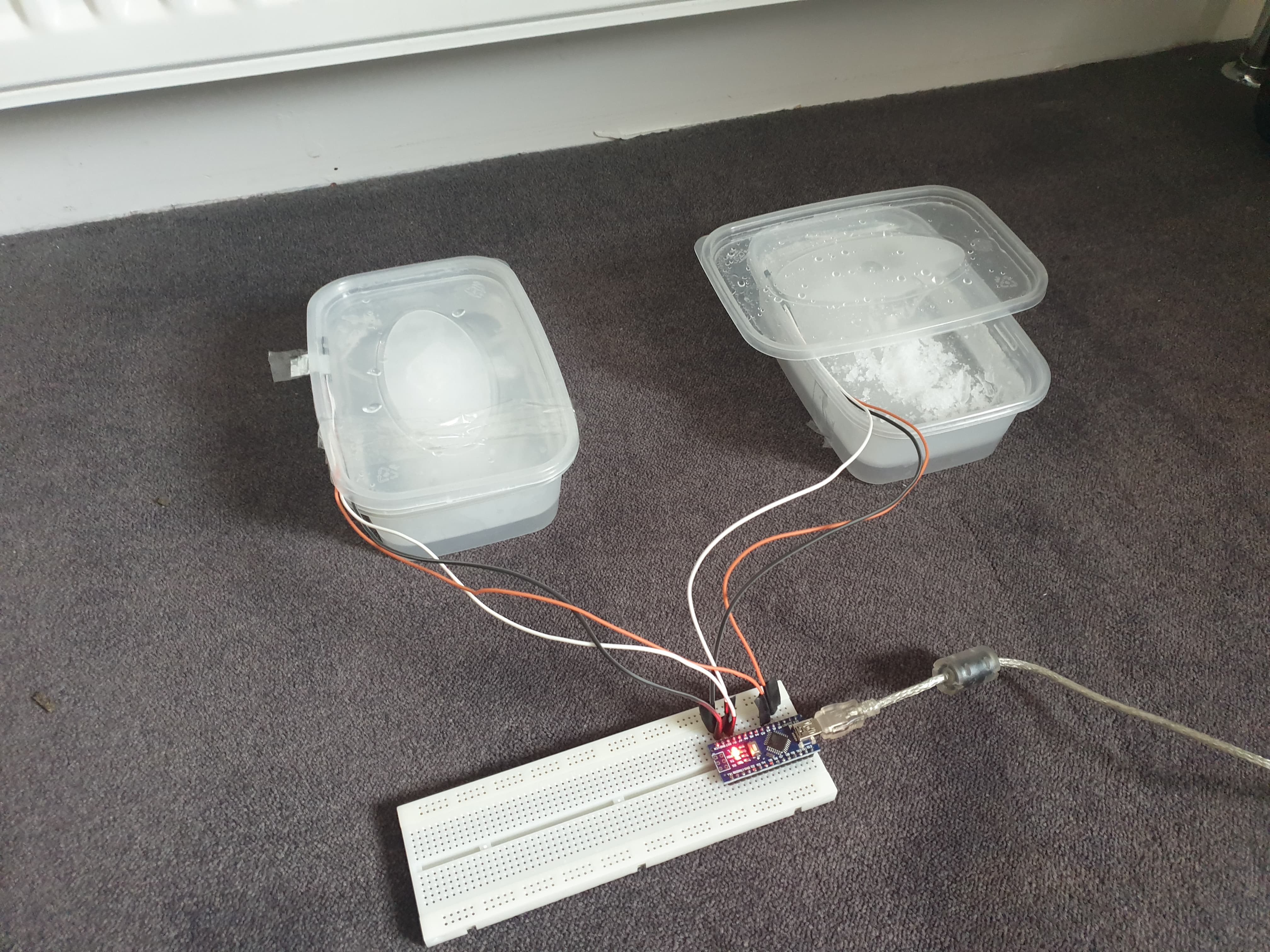
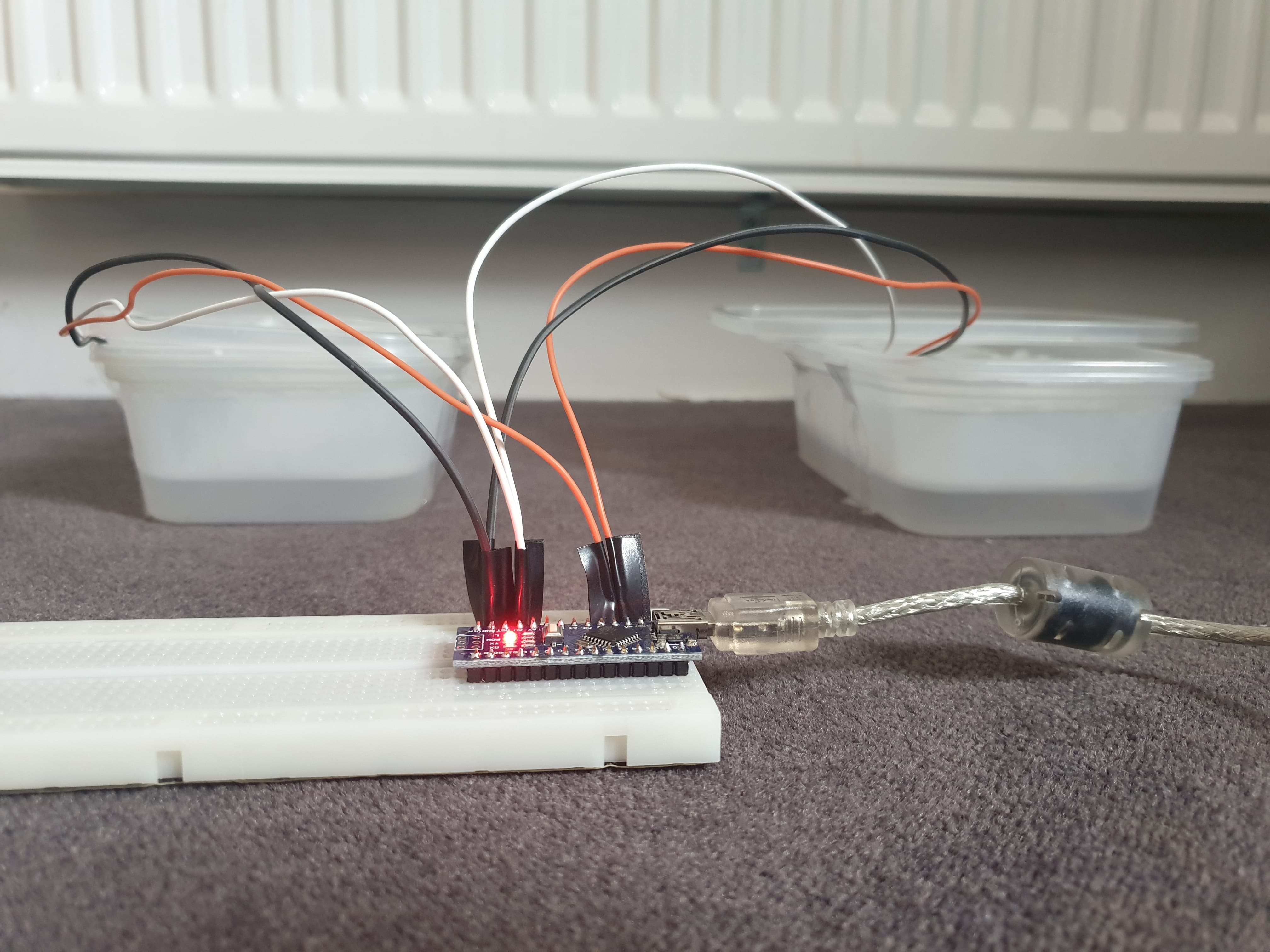
Figure 5 pictures taken by Egle Augustaityte
Collected data is presented in figure 6. It is visible that open lid container is first colder than the closed lid container, however in the long run the closed lid container shows better results at keeping cool temperatures. It is visible from the shape of the orange graph that it experiences the higher increase in temperature at the beginning, which is unexpected. The error might come because the sensor might be touching the lid, so it takes more time to cool down the temperature. Even though the difference is only in few degrees, it is worth mentioning, that the room temperature is a lot cooler than that on the field. Using the same sensor, the room temperature is taken to be 23 degrees Celsius, whereas field temperatures can reach up to +40 degrees Celsius.
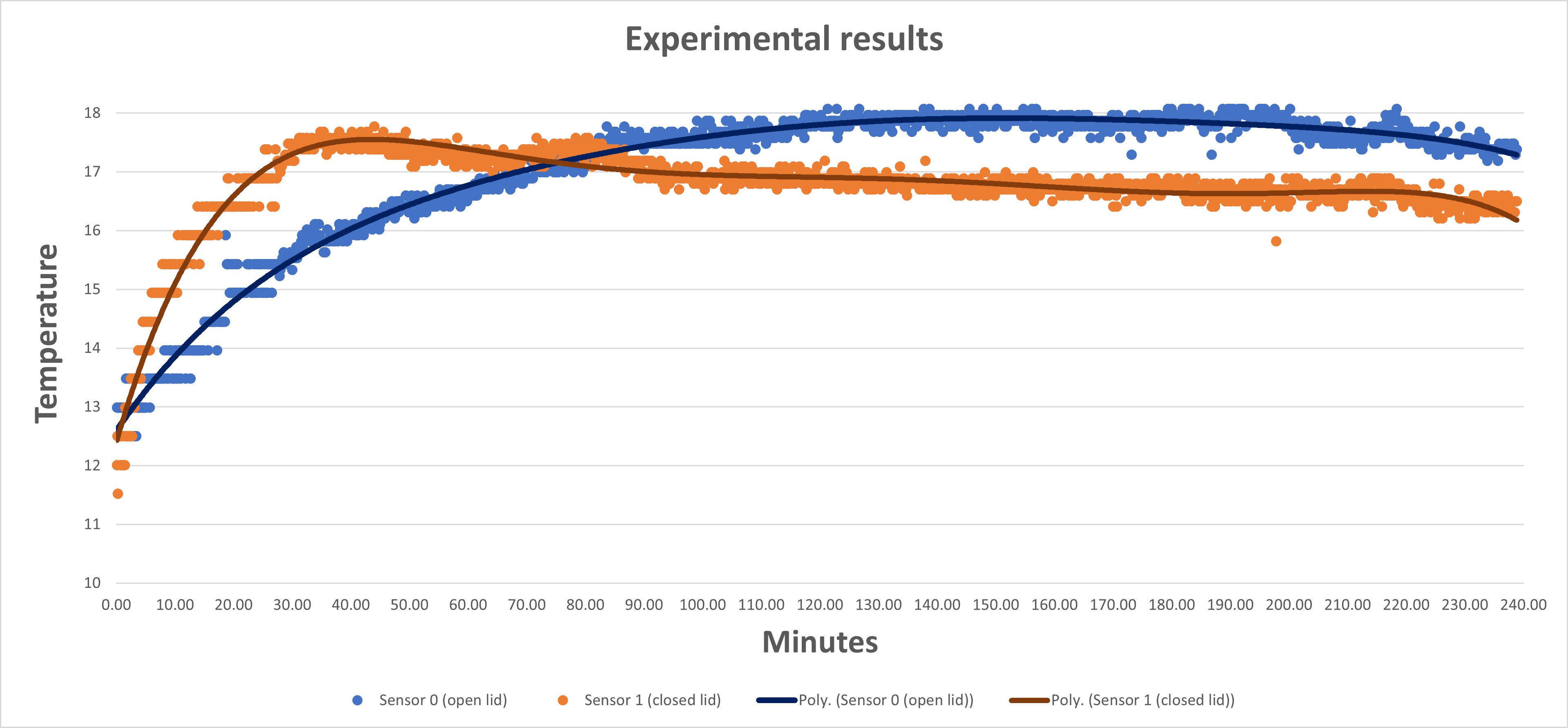
Figure 6
The experimental results justify that if possible, closed lid vaccination carrier should be used, to keep cool temperature longer. Conclusion: This experiment highlights the importance of the usage of closed lid vaccination carriers. They are better at keeping cooler temperatures which are very important to vaccines and their potency. Therefore, it is up to engineers to introduce more designs that would help keep temperatures consistent, so that less vaccinations would get spoiled.
Report References: [1] https://www.who.int/immunization/programmes_systems/supply_chain/resources/VaccineStability_EN.pdf [2] https://path.azureedge.net/media/documents/DT_freeze_prev_vacc_carrier_FAQs.pdf
References
Built With
- 3d-printing
- solidworkds


Log in or sign up for Devpost to join the conversation.