Last Mile Memory
AI-assisted household continuity when the primary organizer is unexpectedly unavailable.
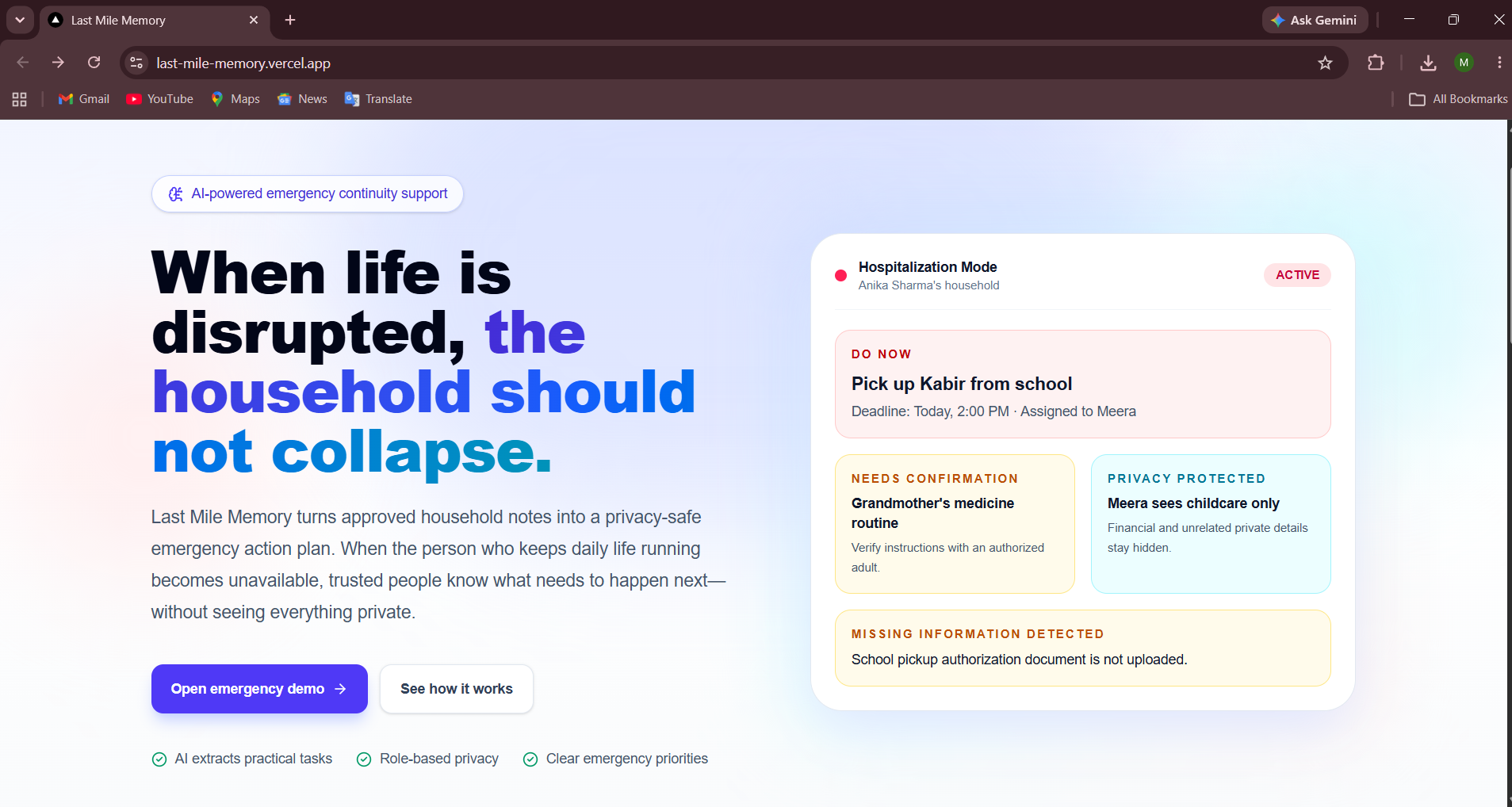
Last Mile Memory helps families turn scattered household notes into a structured, reviewable emergency action plan. It uses Gemini to extract actionable tasks from owner-provided household notes, stores approved tasks in Cloud Firestore, prioritizes them in Emergency Mode, and gives trusted delegates role-limited action boards.
Inspiration
In many households, one person often manages daily operations: school pickups, approved caregivers, pet-feeding routines, bill deadlines, landlord contacts, and emergency service providers.
If that person is suddenly hospitalized, traveling, or unavailable, family members may know that something needs to be done—but not know the exact school, pickup time, approved contact, food location, bill amount, or emergency number.
In real life, this information is often scattered across WhatsApp messages, sticky notes, calendars, memory, and phone calls. During an emergency, that creates stress, delays, and mistakes.
Last Mile Memory was inspired by the need to make household knowledge structured, accessible, and privacy-aware before an emergency happens.
What it does
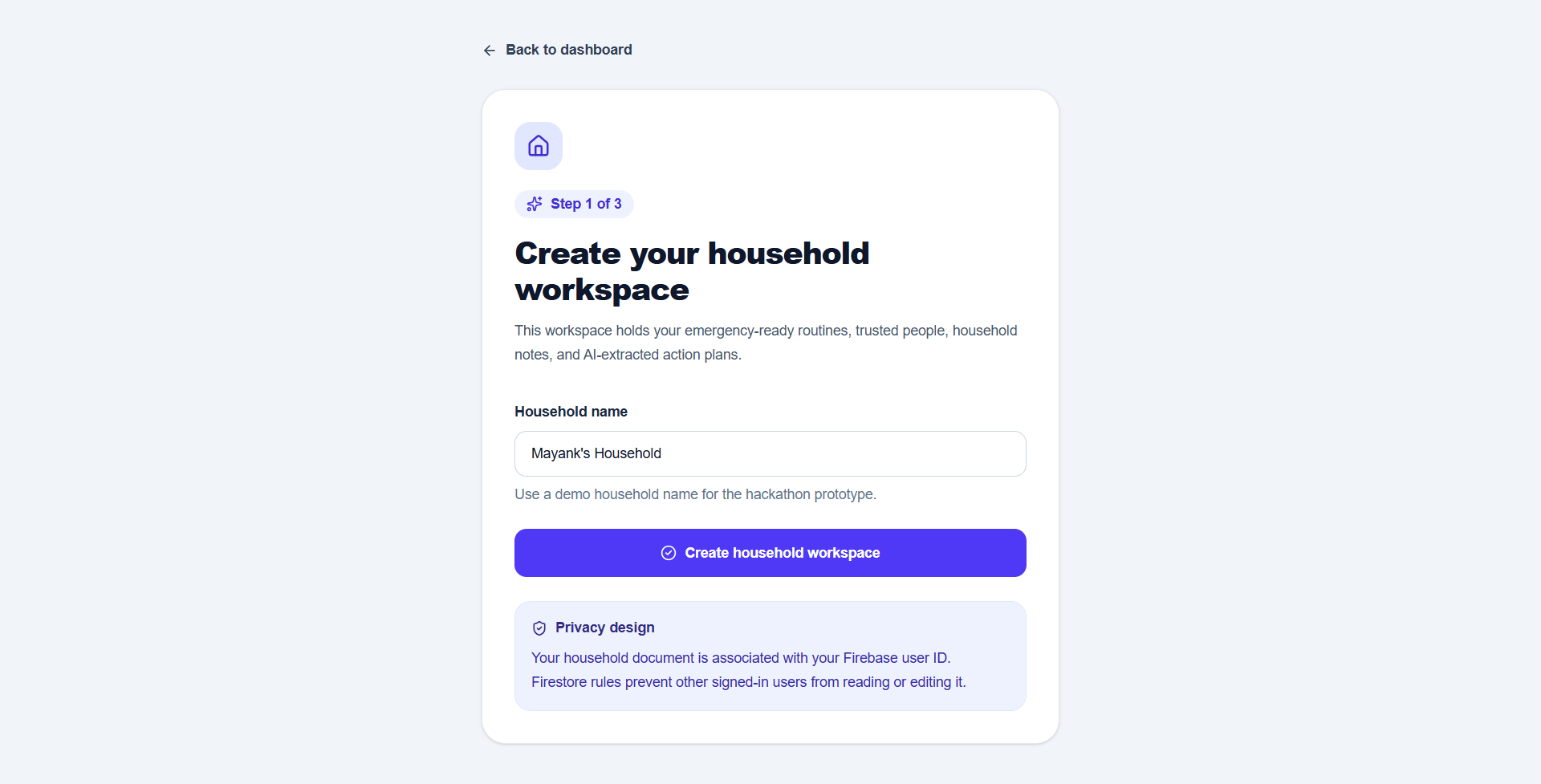
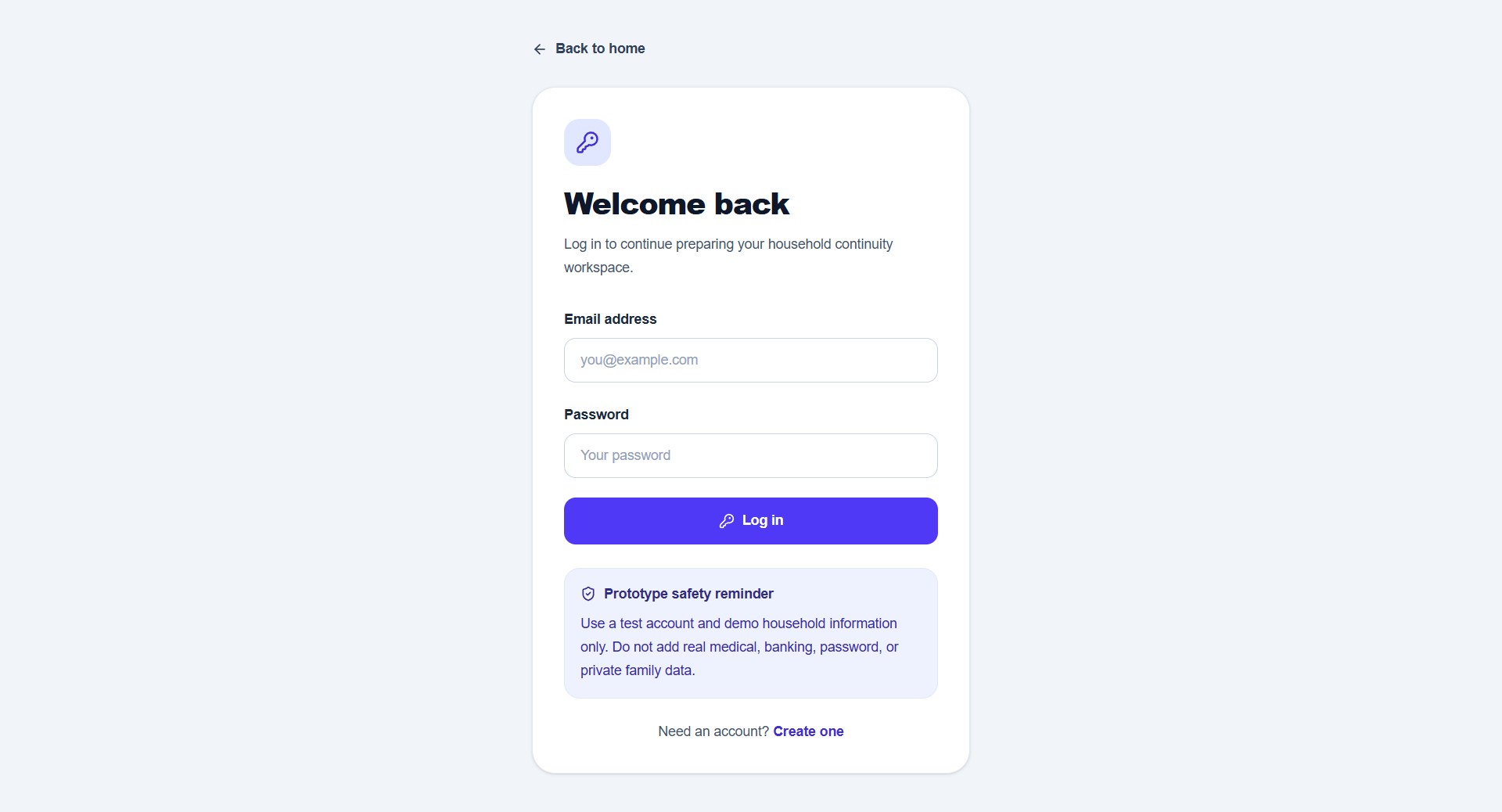
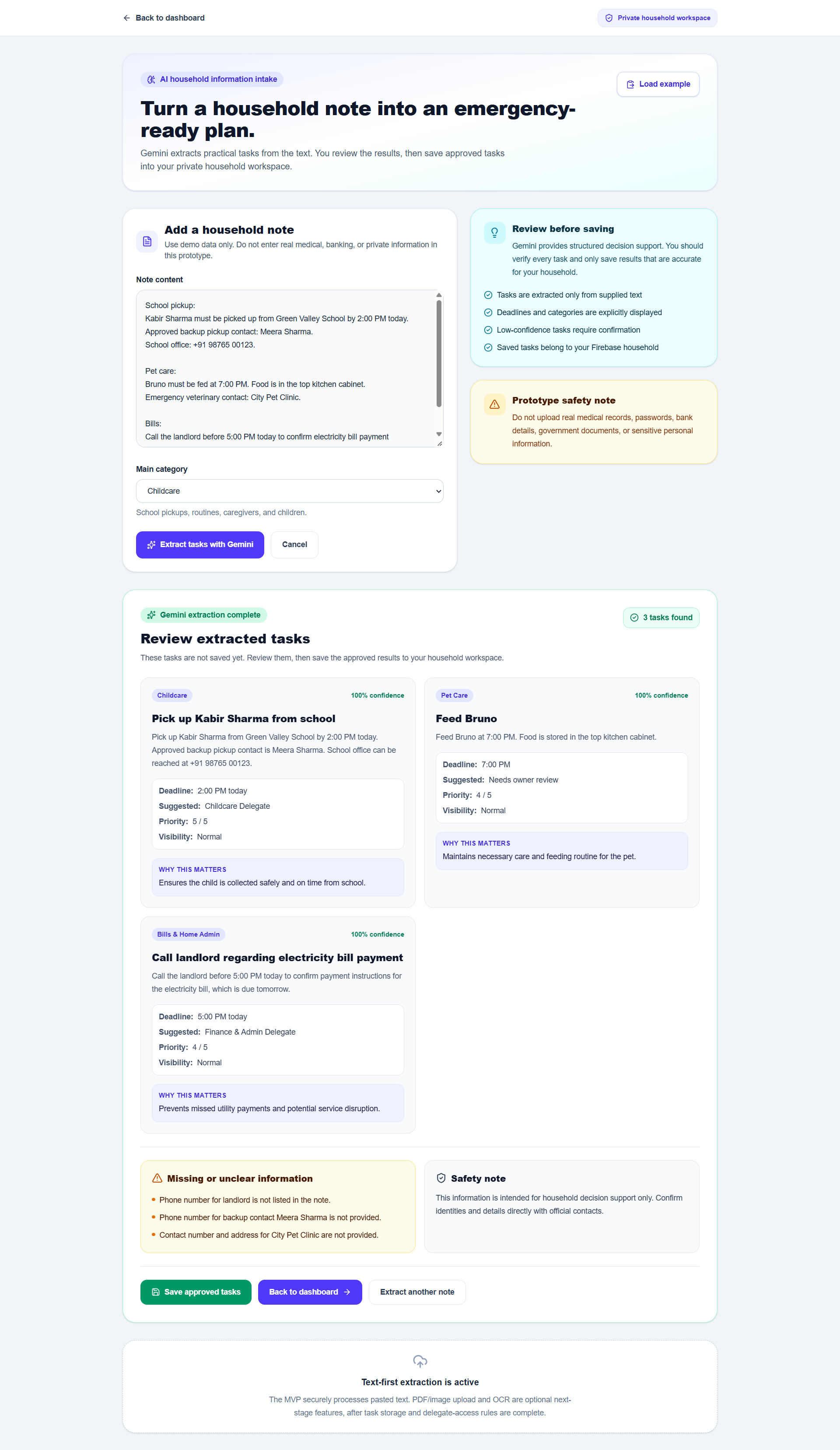
An owner signs in, creates a household workspace, and pastes a household note. Gemini extracts candidate tasks with categories, priorities, deadlines, confidence scores, suggested delegate roles, and explanations of why each task matters.
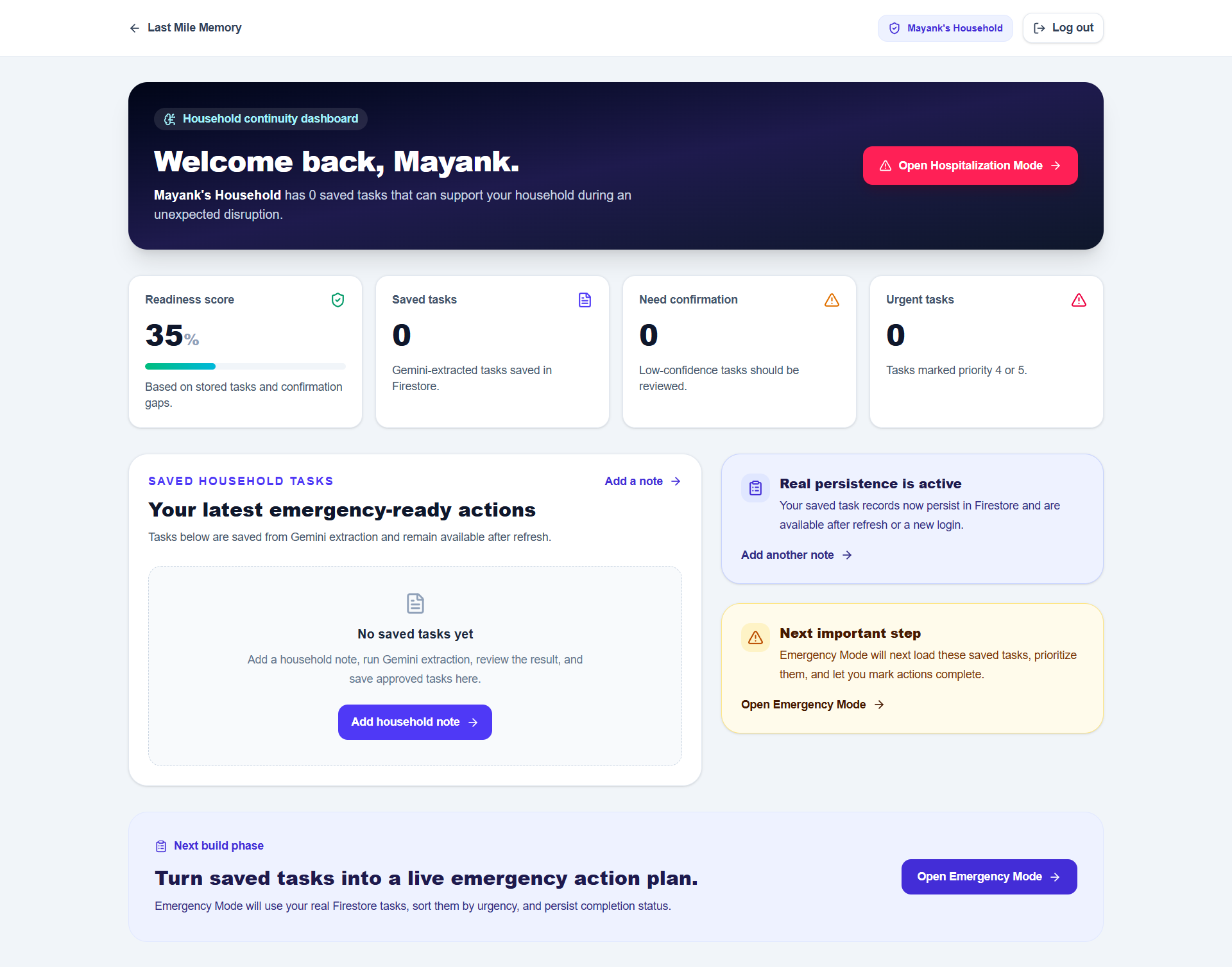
The owner reviews the AI output before saving. Approved tasks are stored in Cloud Firestore and appear in the household dashboard and Emergency Mode.
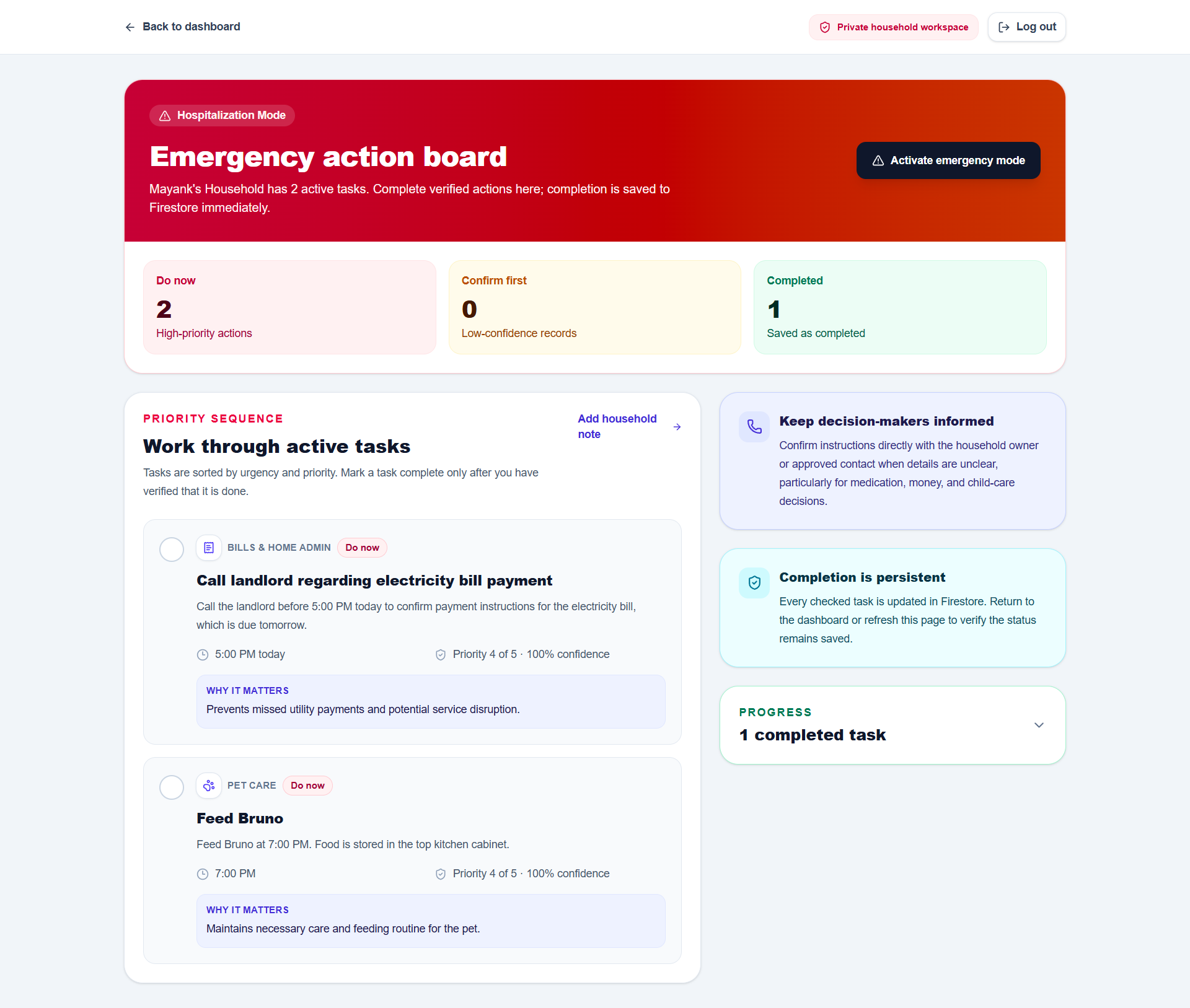
Emergency Mode prioritizes active tasks, allows verified actions to be marked complete, and persists both the emergency session and task-completion state.
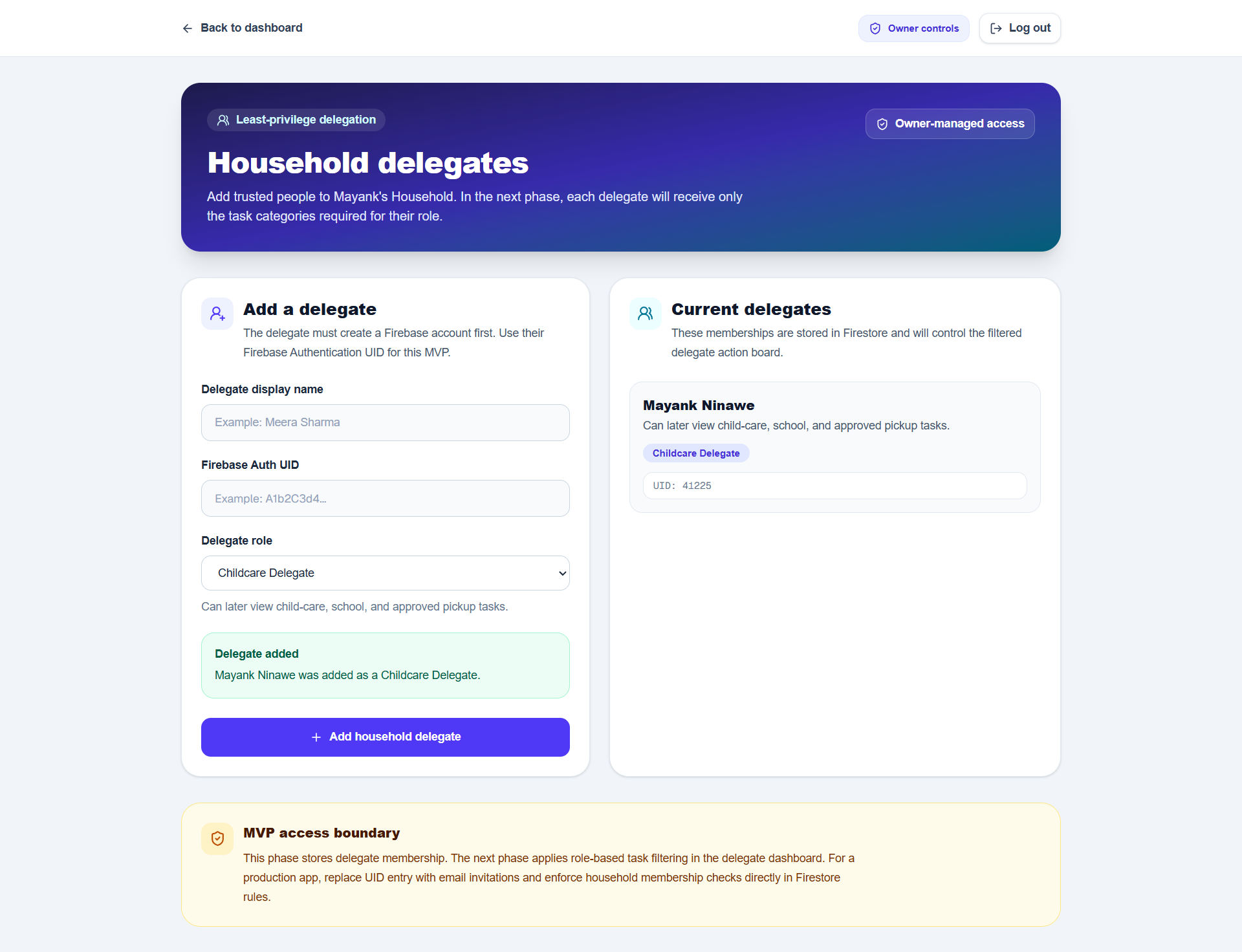
The owner can also add trusted delegates. A childcare delegate sees childcare, pet-care, and approved emergency-contact tasks. A finance delegate sees bills and emergency-contact tasks. This reduces unnecessary exposure of unrelated household information.
How we built it
Last Mile Memory is built with:
- Next.js for the full-stack web application
- TypeScript for type safety
- Tailwind CSS for the interface
- Firebase Authentication for secure email/password accounts
- Cloud Firestore for households, tasks, delegates, user profiles, and emergency sessions
- Google Gemini API for household-note extraction
- Zod for validating structured AI output
- Vercel for deployment
The AI workflow is intentionally review-first:
Owner pastes household note
      ↓
Gemini extracts candidate tasks
      ↓
Owner reviews tasks and confidence
      ↓
Owner saves approved tasks
      ↓
Tasks persist in Firestore
      ↓
Dashboard and Emergency Mode use real saved tasks
      ↓
Delegates receive only role-appropriate tasks
Challenges we ran into
The main challenge was making AI output reliable enough for a real household workflow. Gemini sometimes omitted optional fields such as deadlineText, assignedRole, confidence, and whyImportant. Instead of allowing the app to fail, we normalized missing fields with safe defaults and clearly marked lower-confidence tasks for confirmation.
Another challenge was connecting authentication, household ownership, Firestore security rules, and post-signup navigation correctly. We learned that creating a Firebase Authentication user is separate from creating the corresponding Firestore user profile and household document. Firestore Security Rules must explicitly allow the correct ownership-based operations.
We also focused on avoiding a common AI-demo mistake: treating AI output as automatically correct. Last Mile Memory keeps the household owner in control by requiring review before tasks are saved or acted upon.
Accomplishments that we're proud of
- Built a complete owner-to-delegate workflow rather than only an AI demo
- Connected Gemini extraction to persistent Firestore task storage
- Made Emergency Mode state and task completion persist after refresh
- Implemented role-limited delegate views
- Designed a clear privacy boundary around household information
- Kept the Gemini API key server-side rather than exposing it in the browser
What we learned
We learned how to design an AI feature that is useful without being autonomous. AI can help convert unstructured household information into structured tasks, but a human owner must review uncertain output before it becomes part of an emergency plan.
We also learned how Firebase Authentication, Firestore Security Rules, and client-side routing must work together. A successful signup does not automatically mean the app can create or read the user’s household document; ownership fields and security rules must match exactly.
Finally, we learned the importance of designing for real-world stress. During an emergency, people need a short prioritized action list—not another complicated app.
What's next for Last Mile Memory
- Email-based delegate invitations
- Stronger production-grade role enforcement directly in Firestore Security Rules
- Explicit task-level access control lists
- Audit logs for emergency-session activity and task completion
- PDF/image upload with OCR
- Notifications for trusted delegates
- Configurable household categories and custom delegate roles
Prototype boundaries
This prototype uses demo household information only. It does not process real medical records, passwords, banking details, government documents, or other sensitive personal information.
The delegate experience demonstrates role-scoped views. A production version would further harden least-privilege access through Firestore Security Rules, explicit per-task access lists, custom claims, or a trusted server-side authorization layer.
Built for ForgeHacks Online 2026
Last Mile Memory demonstrates how AI can transform fragmented household knowledge into a practical, reviewable, privacy-aware continuity plan during moments when families need clarity most.
Built With
- ai
- api
- css
- firebase
- gemini
- javascript
- llm
- next.js
- react
- tailwind
- typescript
- vercel
- zod

Log in or sign up for Devpost to join the conversation.