Inspiration
Saturday nights at 8 PM used to mean Twitch trivia with the regulars—usually around 30–40 viewers. I wanted streaming to feel like hosting that night again. My experience with bartending tutorials, themed trivia, tournaments, and spontaneous rabbit holes showed me that the memorable moments happen when chat helps shape the show.
Last Call turns that idea into a repeatable format: give viewers a small game to earn a say in the direction of the stream and interact with each other, while the streamer plays, then brings everyone together for a mystery finale.
What it does
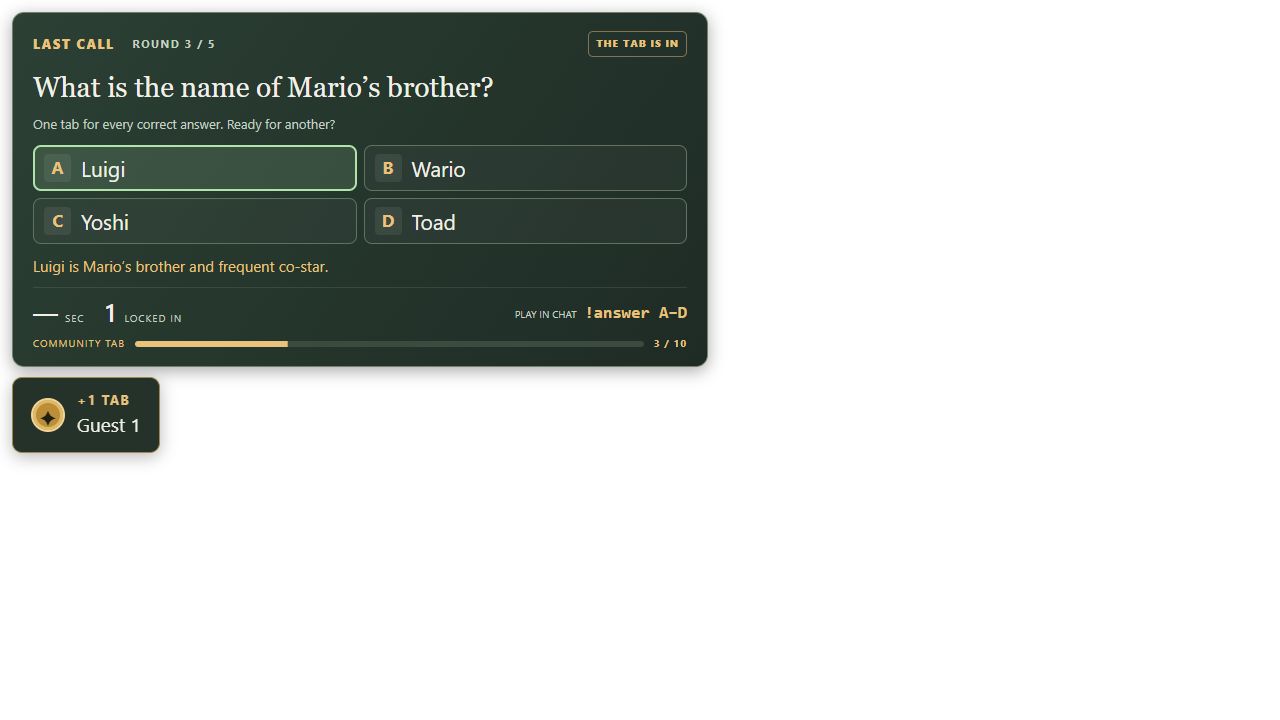
Viewers answer multiple-choice trivia directly in Twitch chat with !answer A, B, C, or D. Their first valid answer counts. Correct answers earn individual tabs and contribute to a shared community goal. A compact OBS overlay shows the question and a silent +1 TAB reward without adding distracting audio during gameplay.
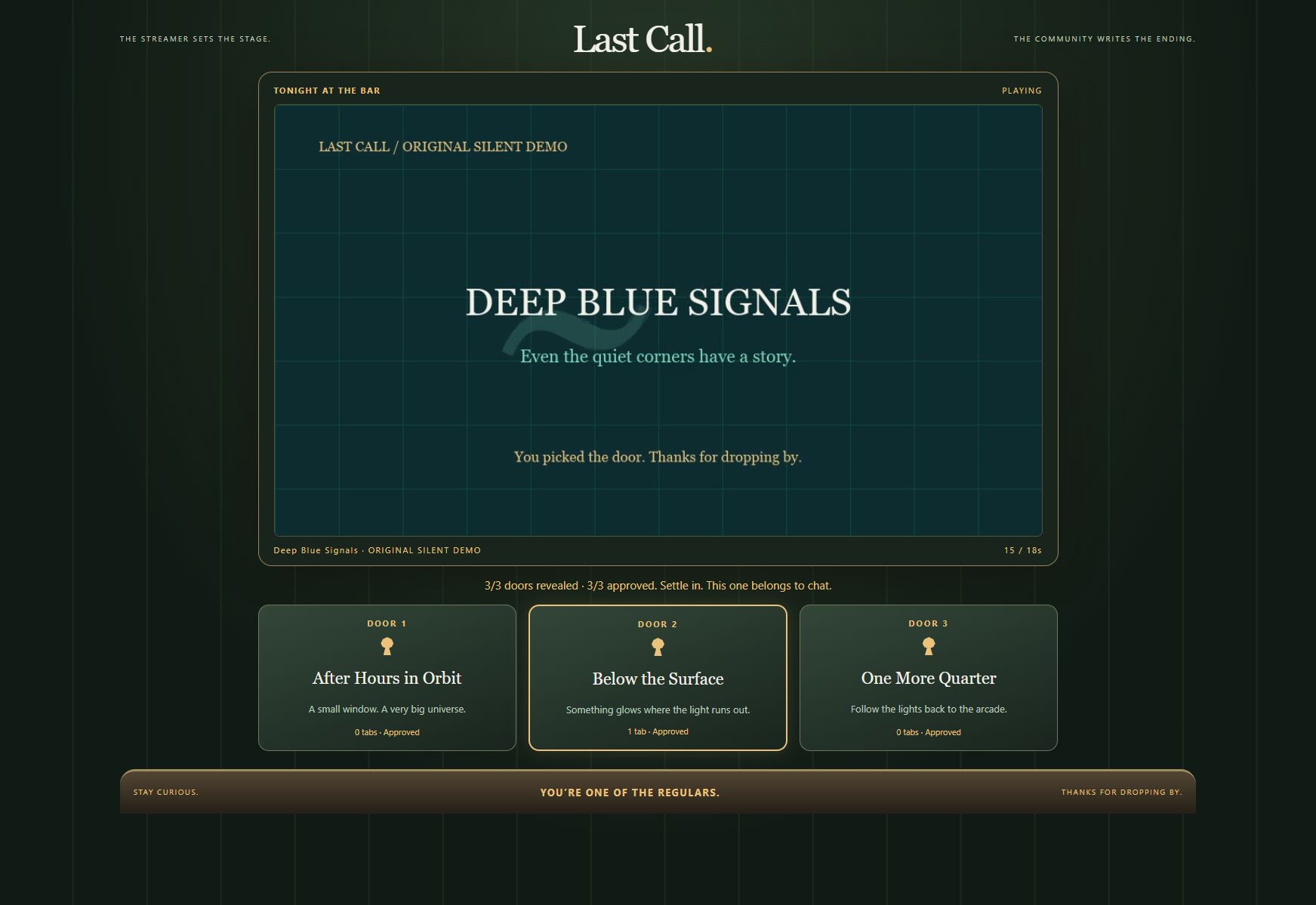
As the show progresses, the streamer reveals three mystery-door clues. At Last Call, viewers spend one earned tab on a ballot with !door 1, 2, or 3. The streamer closes voting and explicitly opens the winning door in a separate virtual-bar OBS scene. Content must be reviewed and approved before it can play; destinations stay hidden from streamer and audience views until playback. Pause, skip, stop, emergency removal, and end-show controls keep the host in charge.
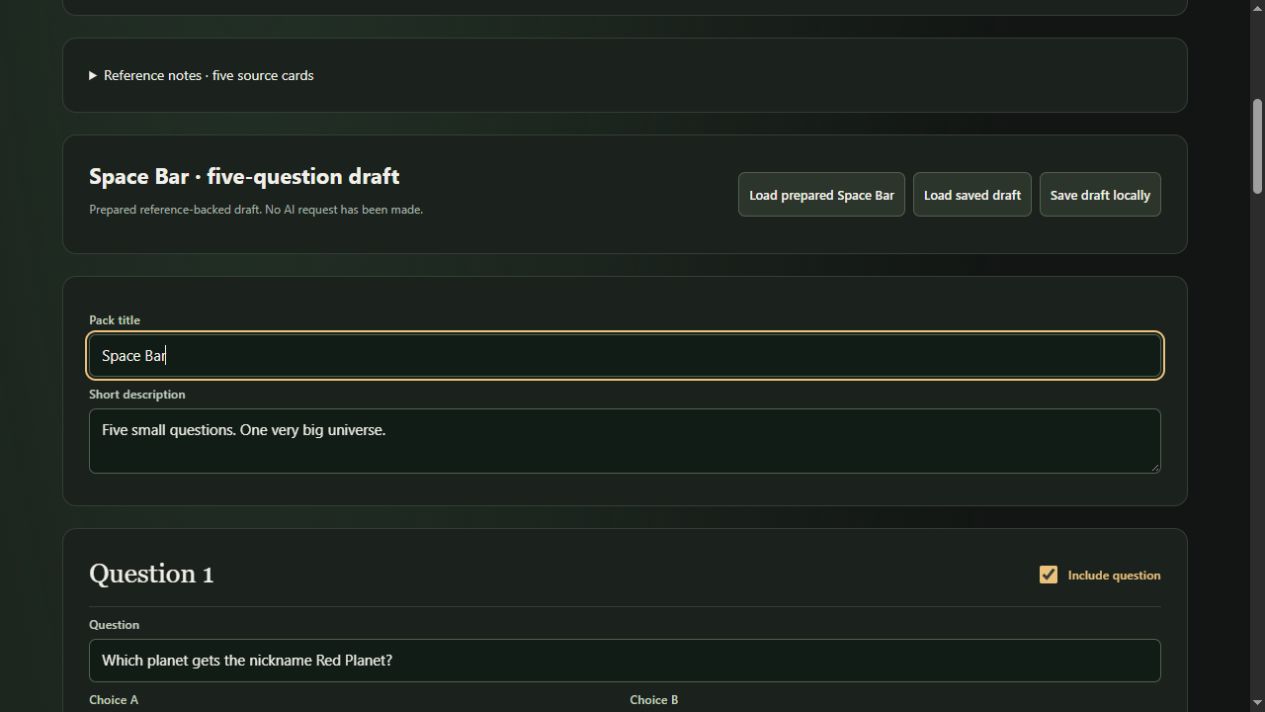
The Show Pack Studio lets the streamer edit questions, review source notes, exclude questions, save and reload local drafts, and apply a pack with fresh approval required. Answer windows can be set to 25, 45, or 60 seconds. A separate rehearsal room uses fake viewers and isolated scores.
How I built it with Codex
I built the project in this Codex conversation, starting from a small Node.js Twitch starter. Codex helped inspect the starter, implement and debug gameplay, build the dashboard and OBS views, add the Studio, write 31 automated tests, and prepare rehearsal runbooks. I directed the product, reviewed the experience, and tested it with my Twitch channel and a second viewer account.
The app uses native Node.js, JavaScript, HTML, and CSS with no third-party npm dependencies. Twitch OAuth connects the broadcaster; EventSub WebSocket delivers chat, and the Twitch API sends bot replies. Trivia and finale rules live in separate game engines so the show logic can evolve independently of Twitch messaging. OBS Browser Sources display the shared state.
Codex is the AI collaborator behind the build; the manual Show Pack Studio ships today. An optional drafting integration uses the OpenAI Responses API with structured output and supplied reference notes. It is gated behind local API-key configuration and still awaits a real generation check. It never auto-approves or launches content.
Challenges I ran into
Keeping the show fair and predictable mattered as much as making it look good. Duplicate chat events must not score or spend tabs twice. Stopping trivia must preserve earned tabs while cancelling an unrevealed round. Spending a viewer's tab must not reduce the community's earned total.
The finale also needed a real approval boundary: hiding a destination visually was not enough. Public state omits destinations before playback, and media access is limited to the active approved segment. Live and rehearsal data stay separate. Early live tests also showed how easy it was to miss a short answer window, which led to longer configurable windows and a clearer runbook.
Accomplishments I'm proud of
In our verified live Twitch rehearsal on woadi_, jaydubs1980 earned one tab and spent it on door two: one accepted ballot, zero remaining viewer tabs, and one community tab still earned. The approved 18-second segment played and ended naturally. I also checked both OBS scenes.
For reproducible evidence, a separate local HTTP rehearsal used one synthetic viewer: 10 answer submissions produced one accepted answer; 10 door-ballot submissions produced one accepted ballot. Cancelling the next unrevealed question preserved the earned tab. The segment ended after its real-time 18-second interval, and further media access returned HTTP 403. This is an isolated correctness check, not an audience-load or Twitch-latency benchmark. Run it and inspect the recorded results.
I'm especially proud that it feels like one show: the forest-green and gold bar, quiet rewards, mystery clues, and community choice all serve the same atmosphere.
What I learned
A live interaction needs to be easy for the host as well as the viewer. Clear modes, deliberate approval, forgiving timing, and immediate controls make a small feature set more useful. Working with Codex let me move from product ideas to a tested show, then refine the details using real Twitch behavior.
What's next for Last Call
Next steps are verifying real AI drafting, expanding streamer-approved content, and improving production shortcuts. Longer-term ideas include producer access, customizable celebrations, and a mobile companion using the same viewer identity and tabs.
The submitted prototype runs locally. Scores and Twitch connections are session-only. The three bundled finale clips are original silent demo animations, not AI-discovered videos. Remote moderation, subscription celebrations, and companion participation are future work.
The streamer sets the stage. The community writes the ending.
