Inspiration
I wanted to build a game where the AI wasn't just generating story — it was actively reading the player. Most AI games use the model as a narrator. I wanted it to be the opponent.
The concept came from a simple question: what if every word you typed under pressure determined whether 50 people lived or died? That tension — of choosing your words carefully when everything is falling apart — became LAST CALL.
The 1974 NASA setting came from wanting the technology to feel fragile. No warp drives. No shields. Just analog radio, a cracking hull, and 5 transmissions before the communications array dies permanently.
What It Does
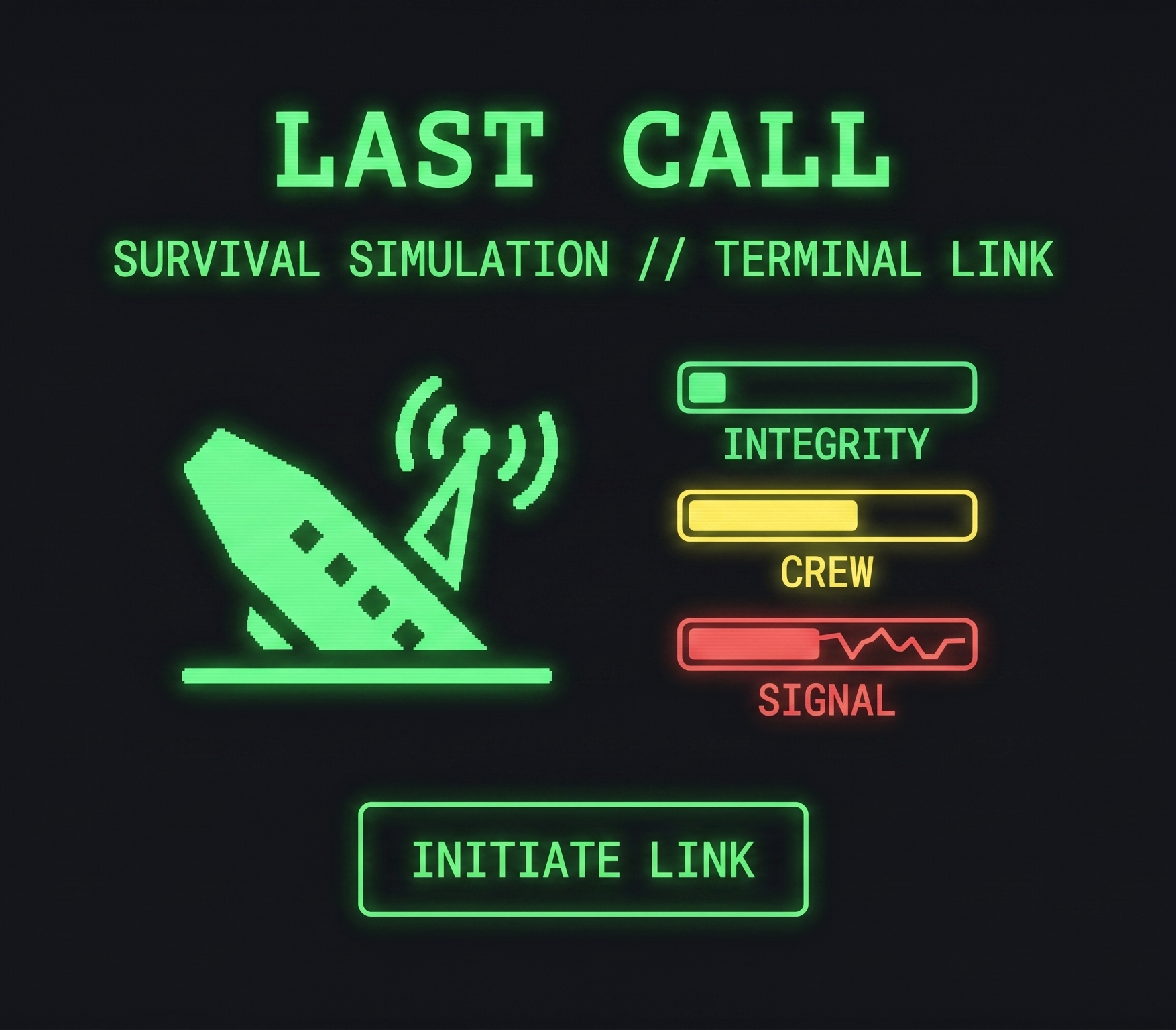
LAST CALL is a text-based survival simulation. You play as Lieutenant Kira Malone — acting commander of a classified NASA vessel stranded on Tartarus, an undocumented planet between Saturn and Uranus. Your mission was secret. Your commander is unconscious. Earth doesn't know you're there.
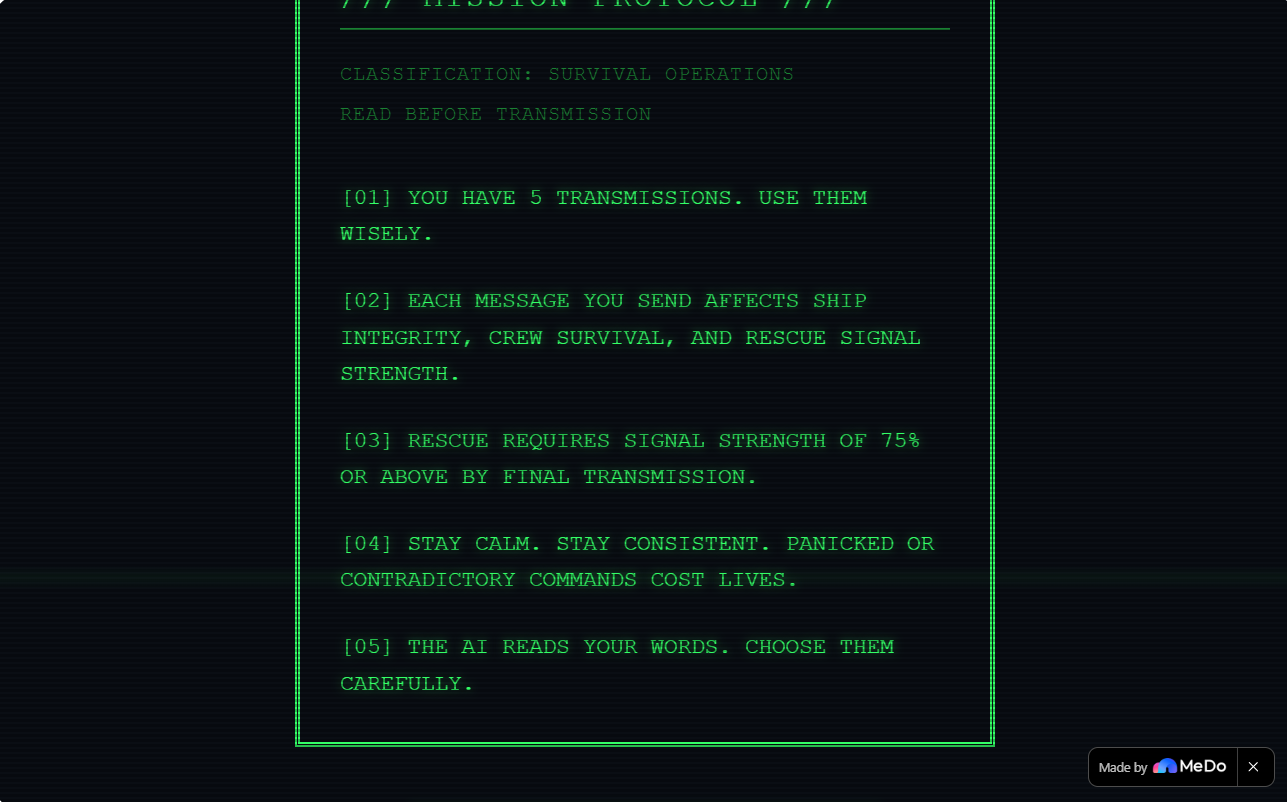
You have 5 transmissions to save 50 crew members.
Every message you send is evaluated by AI across four dimensions simultaneously:
- Priority — did you focus on the ship, the crew, or the signal?
- Method — rescue action, defensive move, or sacrifice?
- Tone — calm and decisive, or panicked and uncertain?
- Consistency — does this match what you said before?
Signal must reach 75% by your final transmission for Earth to lock your position. Signal below 30% — Tartarus keeps you.
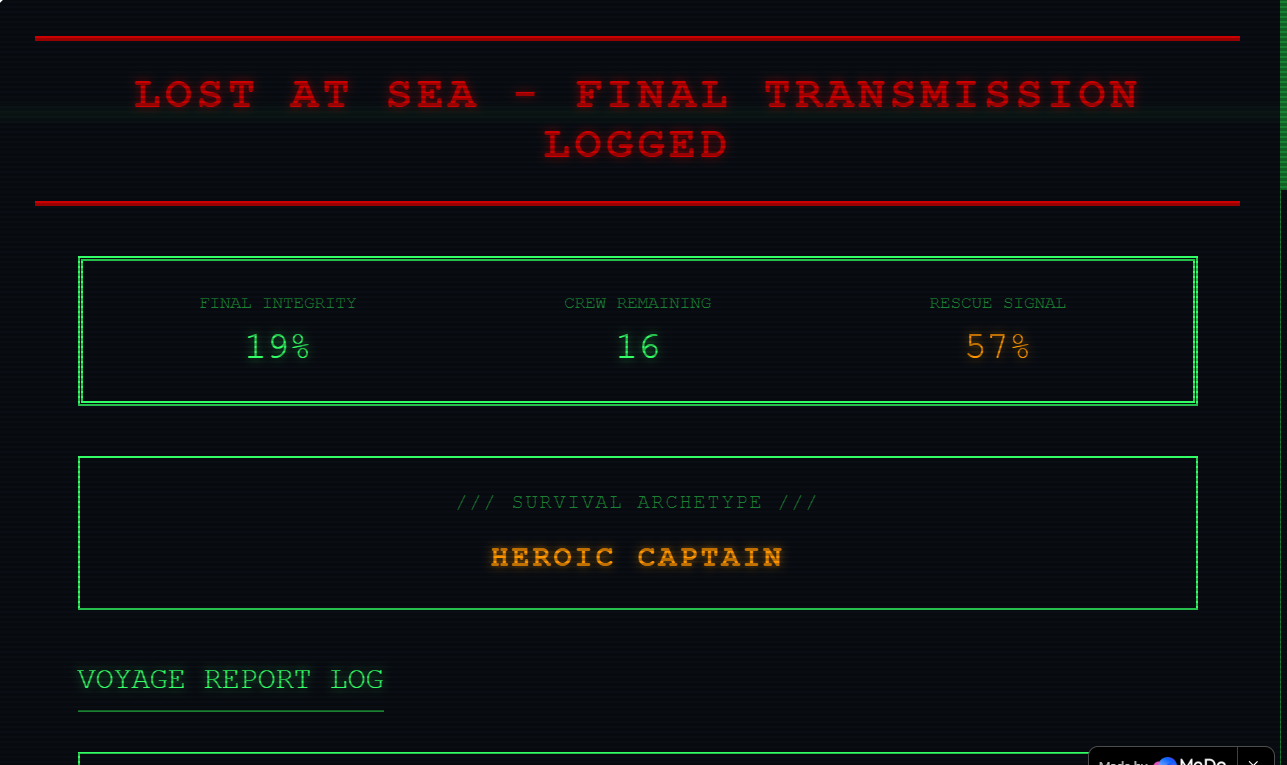
The game ends with a full Voyage Report revealing every hidden consequence of every decision, and assigns a Survival Archetype based on your behaviour across all 5 transmissions.
How I Built It
Built entirely on MeDo using its multi-turn AI conversation system as the core game engine.
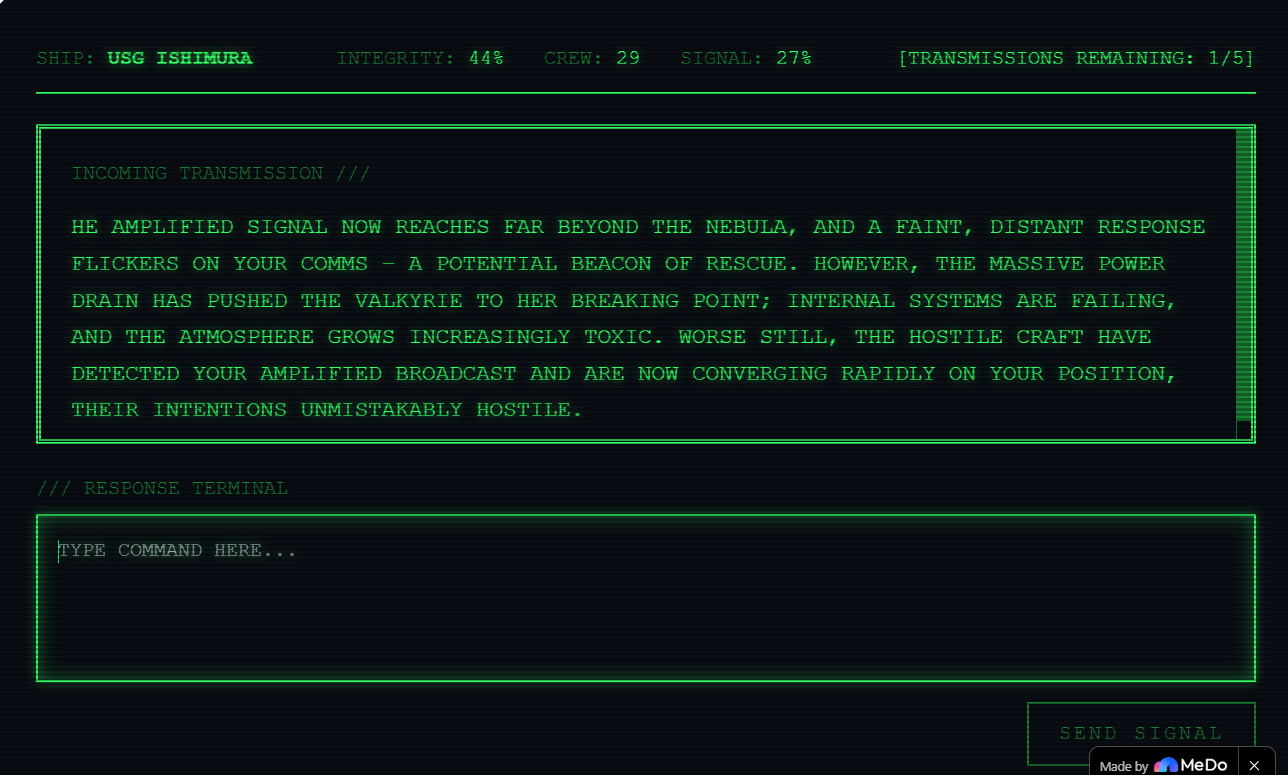
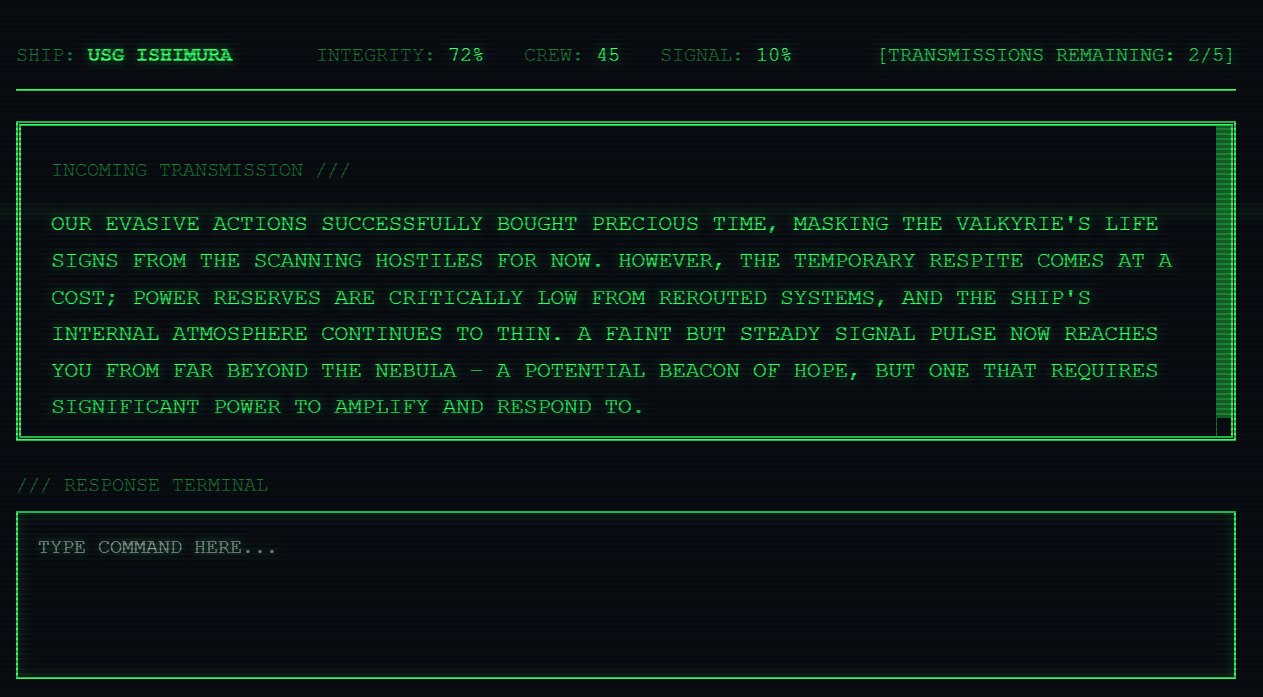
The entire game is a structured conversation — each transmission carries the full history of every previous player input, so the AI generates the next crisis based on exactly what the player said before. No two runs are identical because the player's own words shape every subsequent event.
Key systems built on MeDo:
- Intent Parser — evaluates each transmission across 4 dimensions to calculate variable changes
- Crisis Generator — builds each incoming transmission from current ship state + player word history
- Variable Engine — tracks ShipIntegrity, CrewAlive, and RescueSignal hidden from the player until the end
- Voyage Report — reconstructs the full decision log with consequence analysis and archetype classification
- Three ending conditions — Survived, Lost at Sea, and a third ending for signal below 30% that I won't spoil
The CRT terminal aesthetic, ship glossary, mission protocol screen, classified dossier, and 1974 story lore were all layered on top to make the AI mechanics feel like a real world.
Challenges
Getting the AI to stay consistent with the 1974 NASA lore was the hardest part. Early versions kept generating science fiction terminology — warp cores, FTL drives, alien weapons. Significant prompt engineering was needed to keep every crisis grounded in realistic 1970s technology.
The second challenge was the intent parser. Getting the AI to reliably detect tone, consistency, and priority from free-text player input — and translate that into specific numerical variable changes — required careful system prompt design to make it behave predictably across very different player writing styles.
What I Learned
MeDo's multi-turn conversation handling is genuinely powerful for this kind of stateful game. Carrying full context across transmissions without any external database means the game feels alive — the AI remembers what you did in round 2 when it generates round 4's crisis.
The bigger lesson: the best AI game design hides the AI entirely. Players shouldn't feel like they're prompting a model. They should feel like they're commanding a ship.
What's Next
- Multiple scenario settings — underwater research station, frozen planet outpost, deep space derelict
- Shareable Voyage Report cards for social posting
- Leaderboard tracking highest crew survival counts
- Audio atmosphere — deep space ambience, mechanical keypress sounds, three distinct ending audio experiences
Built With
- css
- ernie
- html
- javascript
- medo
- svg
- web-audi-api


Log in or sign up for Devpost to join the conversation.