Inspiration
We wanted to explore what it feels like to be the recommendation algorithm instead of the person consuming content. Behind the scenes, algorithms are constantly making decisions about what to show next to hook users, and we saw this as an entertaining way to educate players on the topic.
The idea came from how platforms try to maximize engagement, often prioritizing content that keeps users watching longer rather than what is necessarily best for them. We wanted to flip that perspective and put the player in control of those decisions, while also showing how difficult it can be to consistently “satisfy” a user.
At the same time, we wanted to design something that builds awareness on an individual level. Recommendation systems shape everyday experiences in subtle ways, influencing what people see, think about, and engage with. By turning this process into an interactive game, we aimed to make those invisible systems more visible, helping players better understand how their own digital experiences are curated.
What it does
Larporithm is a game where the player types in YouTube-style video titles. An AI system analyzes each title and determines what kind of content it represents across 8 genres.
The game compares the AI’s interpretation to a hidden user preference profile. If the title aligns well with what the user “likes,” the player is rewarded with more time. If it doesn’t, the user becomes less engaged and the timer decreases.
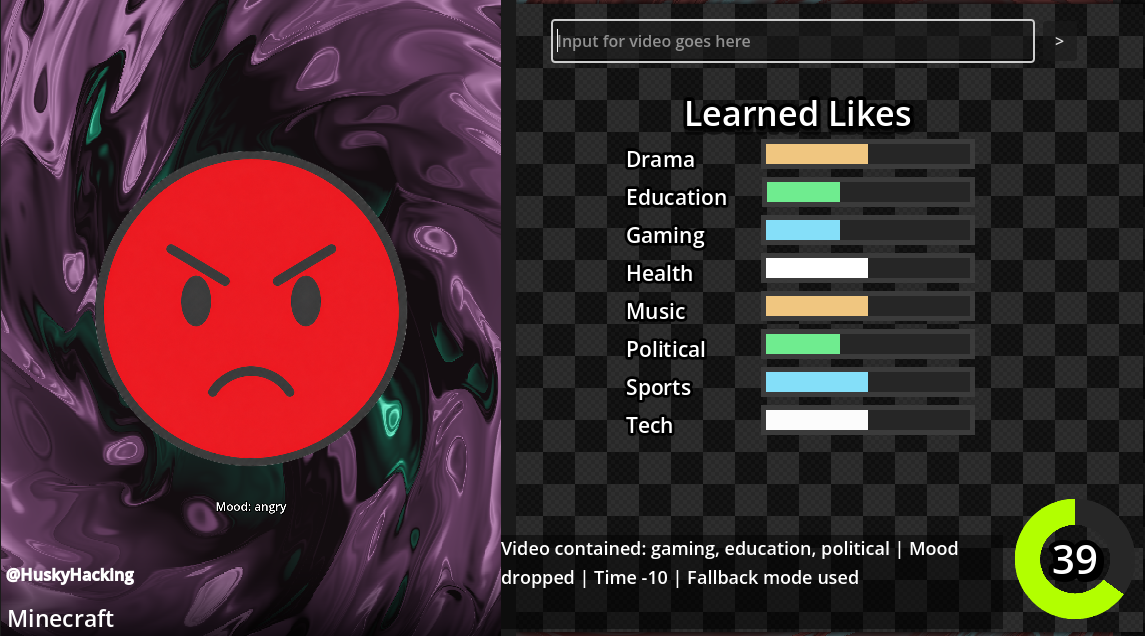
Over time, the player builds a “content mix” based on their inputs. This is visualized through an analytics panel that shows the average distribution of genres in their recommendations, encouraging players to adapt their strategy.
Beyond gameplay, the experience is meant to be reflective. Players begin to notice patterns in what “works,” and how quickly they might shift toward optimizing engagement over variety or balance. This mirrors real-world systems and encourages players to think more critically about how content is recommended to them in everyday life.
How we built it
We built the game in Godot using GDScript, structuring the project into multiple scenes and systems to keep things modular and manageable.
Key components include:
- A search bar that captures player input
- An AI handler that sends the title to a language model and receives genre scores
- A scoring system that compares AI output to a randomized preference profile
- A timer system that reflects user engagement
- An emotion system that visually represents how satisfied the user is
- An analytics panel that tracks and displays the player’s evolving content mix
The AI evaluates each title across eight genres: gaming, politics, music, sports, technology, health, drama, and education, distributing a total of 100 points to represent the content mix.
We designed these systems to work together in a loop that mirrors real recommendation systems, while still being simple enough for players to understand and interact with.
Challenges
This was our first time working with Godot, so understanding scenes, nodes, and signals took time. Learning how to properly structure the project and connect different parts of the game was a major hurdle early on.
Another challenge was integrating AI into gameplay. We had to translate a text-based input (a video title) into structured numerical data that the game could use. Making sure the AI consistently returned usable results and handling edge cases (like formatting issues) required careful design.
We also had to figure out how to make the scoring feel meaningful - turning genre similarity into clear gameplay feedback like time gain or loss, while still keeping the system intuitive for players.
What we learned
We learned how to structure a game project in Godot, including how to separate logic across scripts and connect them to scenes.
We also gained experience working with AI as part of an interactive loop rather than just a standalone tool. Designing prompts, parsing responses, and integrating the output into gameplay helped us understand both the strengths and limitations of AI in real-time systems.
More importantly, we learned that systems like recommendation algorithms become much easier to understand when users can interact with them directly. By making the system visible and interactive, players can reflect on how their own preferences - and the platforms they use - shape their daily experiences.
What’s next
We want to finish fully connecting all parts of the game and refine the overall experience. This includes polishing the UI, improving feedback systems, and making the game feel more responsive.
Additional features we’re considering include:
- More detailed analytics and end-of-game summaries
- Improved visualizations of content trends
- Expanding the range of content types and user behaviors
- Adding reflection prompts or insights to help players connect gameplay to real-world experiences
Ultimately, we want Larporithm to not only be engaging, but also meaningful - helping individuals better understand the systems that shape their online environments and encouraging more mindful interaction with digital platforms.


Log in or sign up for Devpost to join the conversation.