-
-
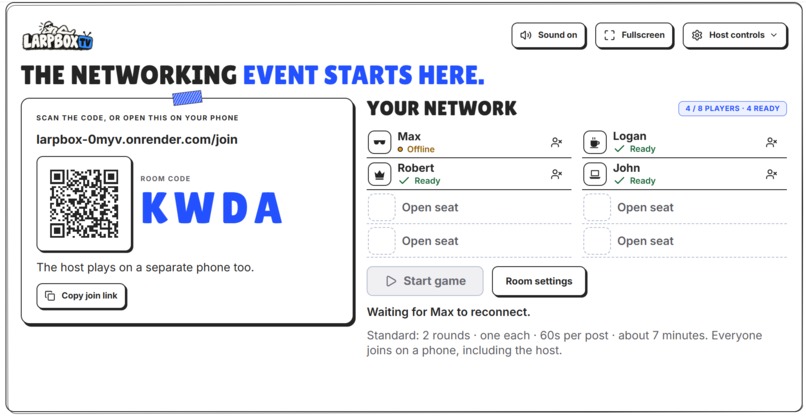
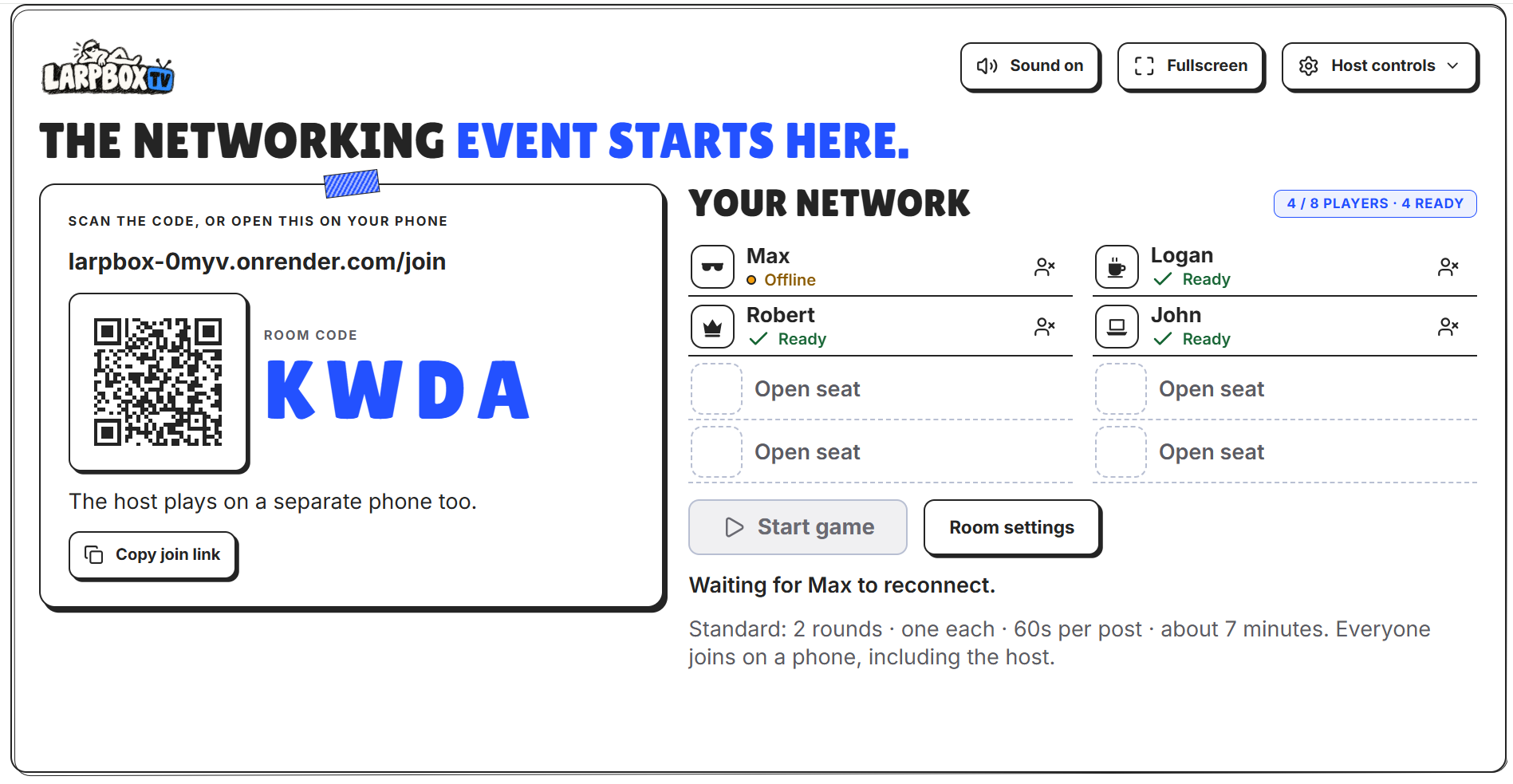
Multiplayer, TV-style set up: compete against your friends!
-
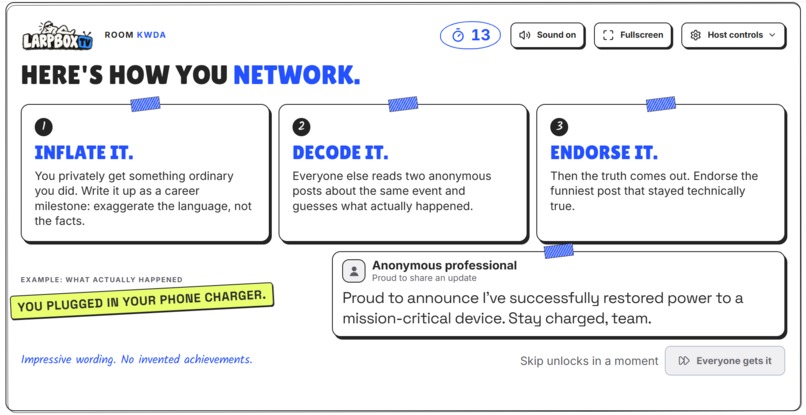
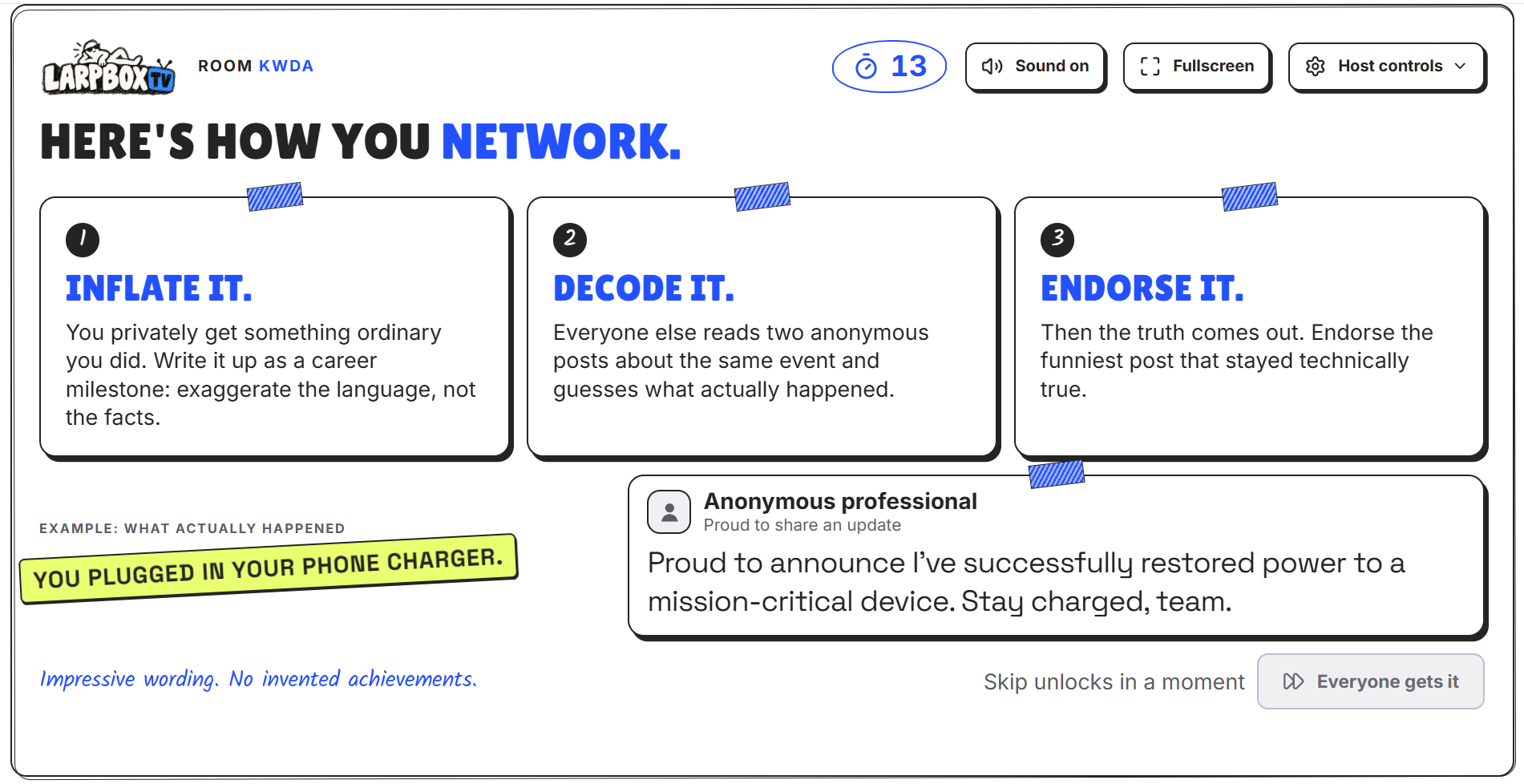
Game instruction screen
-
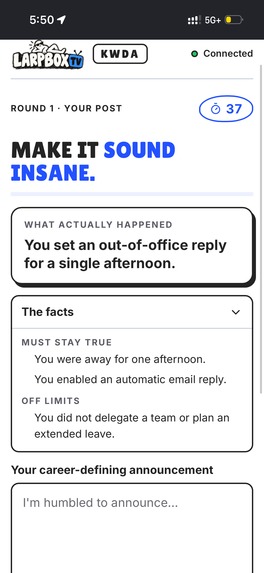
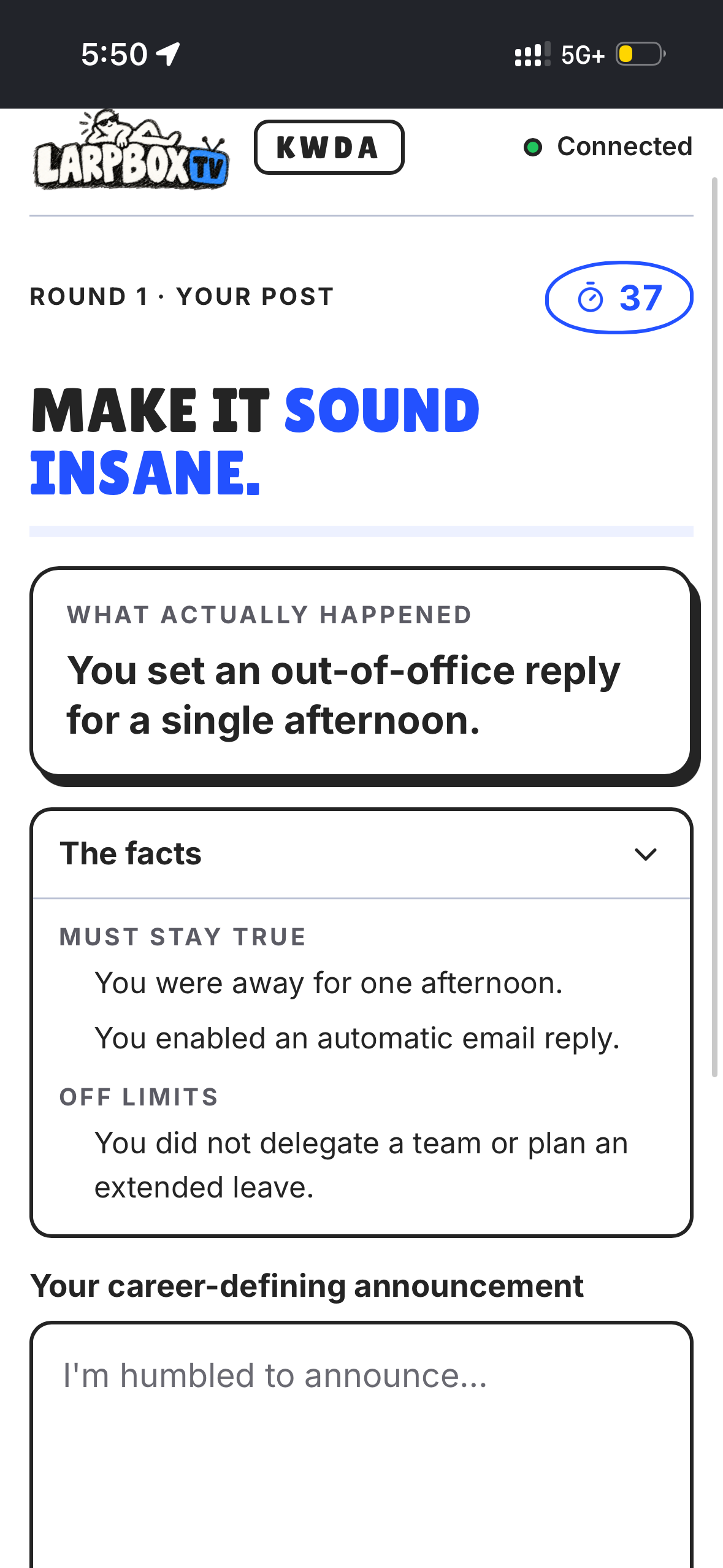
Mobile game-play view: type in your larp!
LARPbox TV
A party game where taking out the trash becomes a career achievement.
LARPbox TV is a browser game for 3 to 8 friends playing together. One person opens the game on a laptop or TV so everyone can see it. Each player joins on their phone, which they use to write answers and vote.
The game gives you an ordinary task, such as taking out the trash. Your job is to describe it as the most impressive professional accomplishment possible while keeping it technically true. Your friends then try to figure out what you actually did and vote for the funniest description.
Imagine a room full of people competing to write the most unnecessarily dramatic LinkedIn announcement. That is LARPbox TV.
What a round looks like
Two players privately receive the same event:
You put the fries in the bag.
Each writes an announcement about it. One player submits:
Proud to lead the final stage of a high-volume food delivery operation. Every order represents a commitment to excellence.
The other writes:
Today I helped a group of potatoes take the next step in their journey. Honored to have played a small part.
Both posts appear on the shared screen, with their authors hidden. The other players choose from possible explanations of what actually happened.
Then the game reveals the original event: they put fries in a bag.
Now the audience votes for the funniest announcement that stayed true to the event. They can also choose “Neither.” After voting, the game reveals who wrote each post and awards points, called Clout, for correct guesses and endorsements.
Everyone gets turns writing and guessing. Players write two posts per round, and the second round doubles the points. The player with the most Clout at the end wins.
Inspiration
We kept noticing how people on LinkedIn, the professional networking platform, could make a small accomplishment sound enormous. Attending a meeting became collaborating with industry leaders. Fixing a typo became improving critical documentation. We thought it would be funny to give everyone the same tiny accomplishment and see who could make it sound the most important.
That joke also raised a question about the information we encounter online: how much of our impression comes from the facts, and how much comes from the way they are presented? A post can be technically true and still leave readers with a misleading understanding. Confident language, missing context, and selective details can make an ordinary event seem extraordinary.
Our mission is to help people recognize misleading information online and build the media literacy to question it. LARPbox lets players experience framing from both sides. They write an exaggerated announcement, then try to decode someone else's. When the original event is revealed, the room can see exactly how the wording shaped their expectations.
We want that habit of asking “What actually happened?” to carry beyond the game, into the headlines, viral posts, and impressive claims people read and share. The game explores one part of the broader misinformation problem: how a story's presentation can distort its meaning. Our hope is that a memorable joke makes players more curious about context and evidence the next time a claim catches their attention.
Showerhacks encouraged us to build something silly and creative, so we gave that mission the form of a party game. The name LARPbox comes from role-playing: everyone gets to pretend they are an executive making a major announcement about doing their laundry. Inspired by Jackbox, we use private phone controls and a shared screen so the whole room can laugh, guess, and discover the truth together.
What makes it funny
The rule that everything must stay technically true gives players something to work with. Plugging in a phone really does restore power to a communications device. Taking out the trash really does involve moving unwanted materials out of a building. The challenge is finding the most ridiculous way to describe those facts.
Two people can turn the same event into completely different stories. One might write a serious corporate announcement. Another might write a heartfelt reflection on how the experience changed their life.
The author reveal adds another moment for the room to react. Everyone gets to find out which friend decided that putting fries in a bag deserved a paragraph about leadership.
Why people would share it
Each round creates a joke that works outside the game: an impressive-sounding announcement followed by the ordinary thing that actually happened.
A screenshot can carry both parts. A short video can show someone reading the announcement, give viewers a moment to guess, and then reveal the answer. People watching can participate immediately.
We want LARPbox to become something friends pull up at a hangout and say, “You have to try this.” Joining takes a browser and a room code. Different groups bring different humor, so familiar prompts can keep producing new jokes.
Shareable post cards and spectator voting are the next features we want to build around that experience.
How we approached the build
The application has two interfaces. The host interface runs on the shared screen and shows instructions, anonymous posts, reveals, and scores. The player interface runs on each phone and handles private prompts, writing, guessing, and voting.
Our technical design uses React and TypeScript for the frontend, with a Node/Express backend and Socket.IO to send updates between the server and connected browsers. The server coordinates the game so everyone moves through the same stages together.
We organized those stages around the experience players see: write the announcements, read them, guess the original event, reveal the truth, vote, and reveal the authors.
The visual design borrows from a social-media post. Each announcement sits in a large rounded card, and the actual event appears on a crooked yellow label. Our illustrated logo and bold blue headings give the whole thing the feel of a homemade game show.
What we learned
Building a multiplayer game taught us how much coordination goes into a single vote. The server has to check who sent it, whether they are allowed to vote, whether voting is still open, and whether their vote has already been accepted.
We also learned to plan carefully around private information. A player's phone needs their own prompt, while the shared screen needs only the information that the room is supposed to see. Keeping those views separate protects the guessing stage and makes the reveals happen at the right time.
Refreshes and dropped connections brought up another challenge. A returning player needs to recover their place in the game and any unfinished writing. That made player identity, reconnection, and draft storage important parts of our design.
The biggest game-design lesson was pacing. Players need time to think of something funny. The audience needs time to read it. The truth and author reveals each need their own moment. Those decisions shape how the joke lands.
Challenges we ran into
Explaining “technically true” was one of our main creative challenges. Players need an ordinary, specific event they can describe in their own way. We focused on familiar tasks so everyone starts with a clear understanding of what happened.
We also had to design for people looking across a room and people typing on a phone. The shared screen needs large, readable posts. The phone needs a comfortable writing area and clear voting choices.
Finding the visual style took several iterations. We tried handwritten post text, then moved toward a cleaner font that was easier to read. Rounded cards, strong shadows, and yellow labels hanging slightly outside their borders gave us the playful look we wanted.
What we are proud of
We turned a recognizable social habit into something friends can play with together. The rules give people a starting point, and their personalities supply the jokes.
Our favorite part of the concept is the combination of guessing and revealing. First you wonder what someone could possibly be describing. Then you find out it was carrying groceries upstairs. Finally, you learn which friend called it a major logistics achievement.
What's next
We want to add downloadable announcement cards, audience voting for larger groups and streams, and custom prompts for campus life, roommates, and internships. A recap of the best posts would give everyone something to keep after the game.
For now, we are proud to announce the successful gamification of online LARP.
Built With
- docker
- express.js
- node.js
- playwright
- react
- socket.io
- tailwind
- typescript
- vite
- vitest
- zod
- zustand

Log in or sign up for Devpost to join the conversation.