Here is a polished version you can use for your project write-up.
Inspiration
The inspiration behind Larp came from the rise of online personas and “fake-it-till-you-make-it” internet culture. Everywhere online, people are building personal brands around hustle, startups, fitness, beauty, trading, productivity, and lifestyle. Some are genuine builders, while others are farming engagement, selling dreams, or carefully curating an image of success.
We wanted to turn that idea into a satirical but strategic game: Can you become internet-famous without getting exposed?
Larp was inspired by tycoon games, social media dashboards, internet culture, and the absurdity of chasing followers, engagement, credibility, and money all at once.
What it does
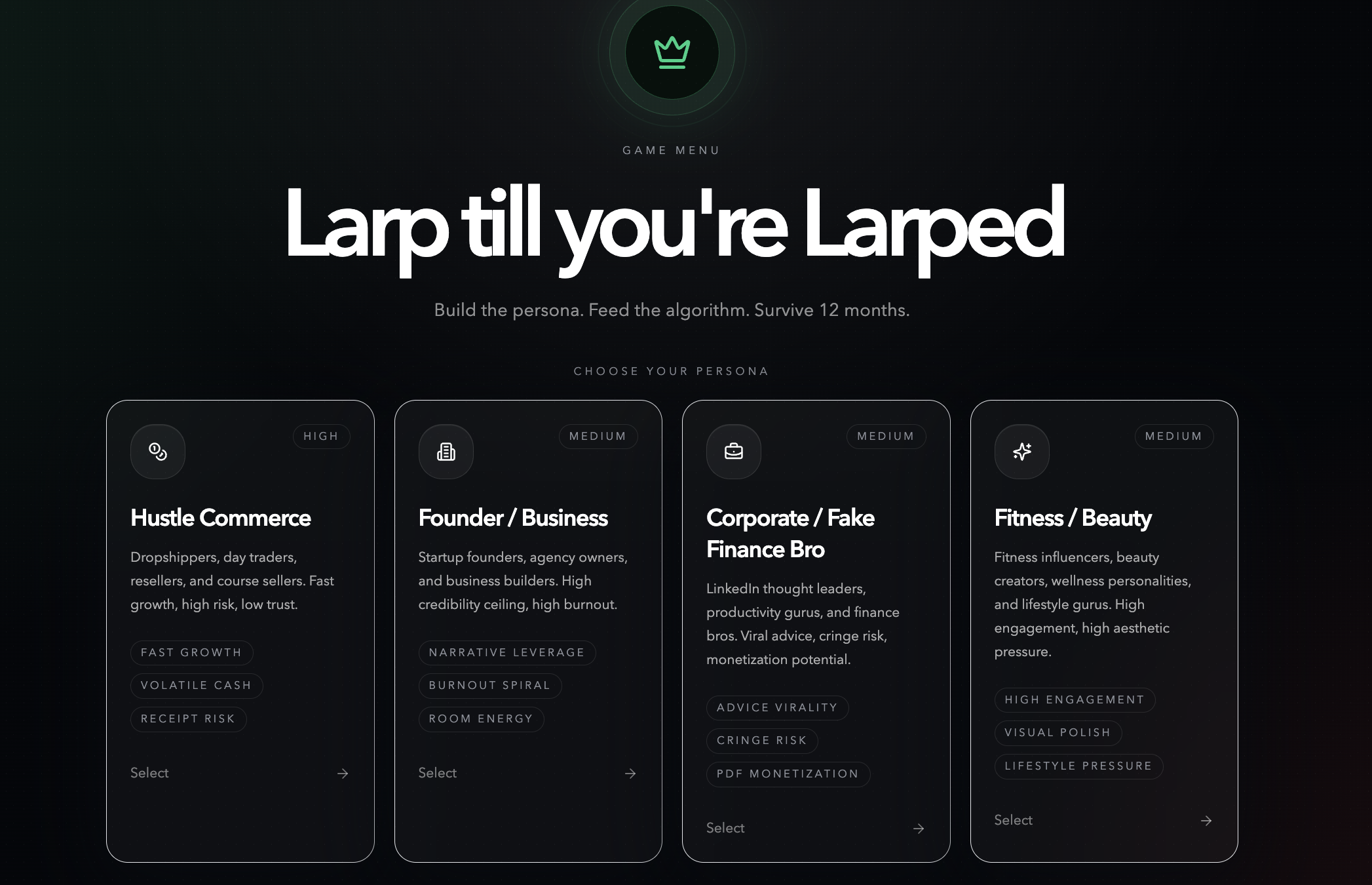
Larp is an AI-powered internet persona simulator where players choose a persona and try to grow their online empire over 12 months.
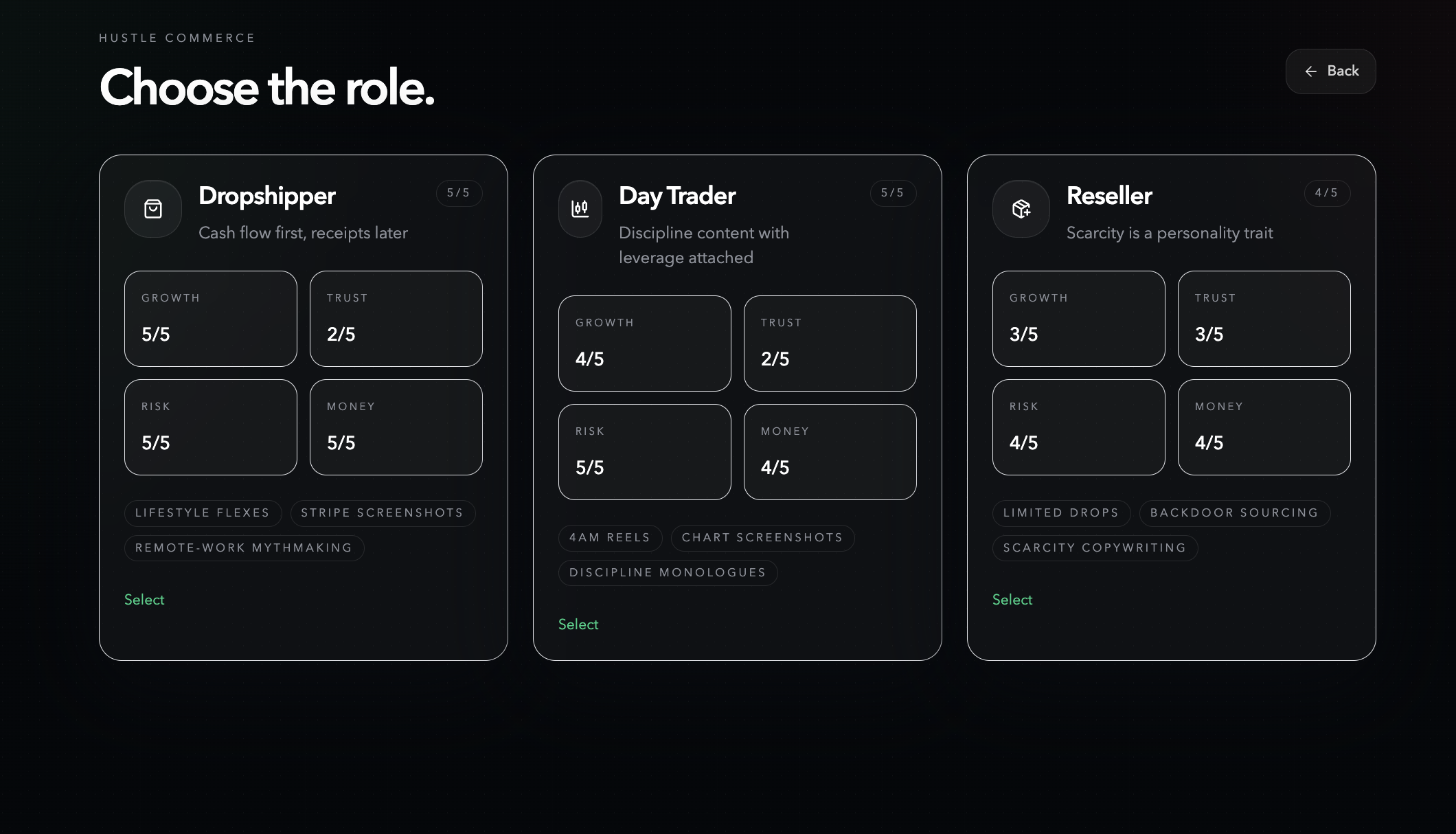
Players can become personas such as:
- Dropshipper
- Day Trader
- Reseller
- Startup Founder
- Agency Owner
- Corporate Bro
- Fake Finance Bro
- Fitness Influencer
- Beauty Influencer
- Wellness Creator
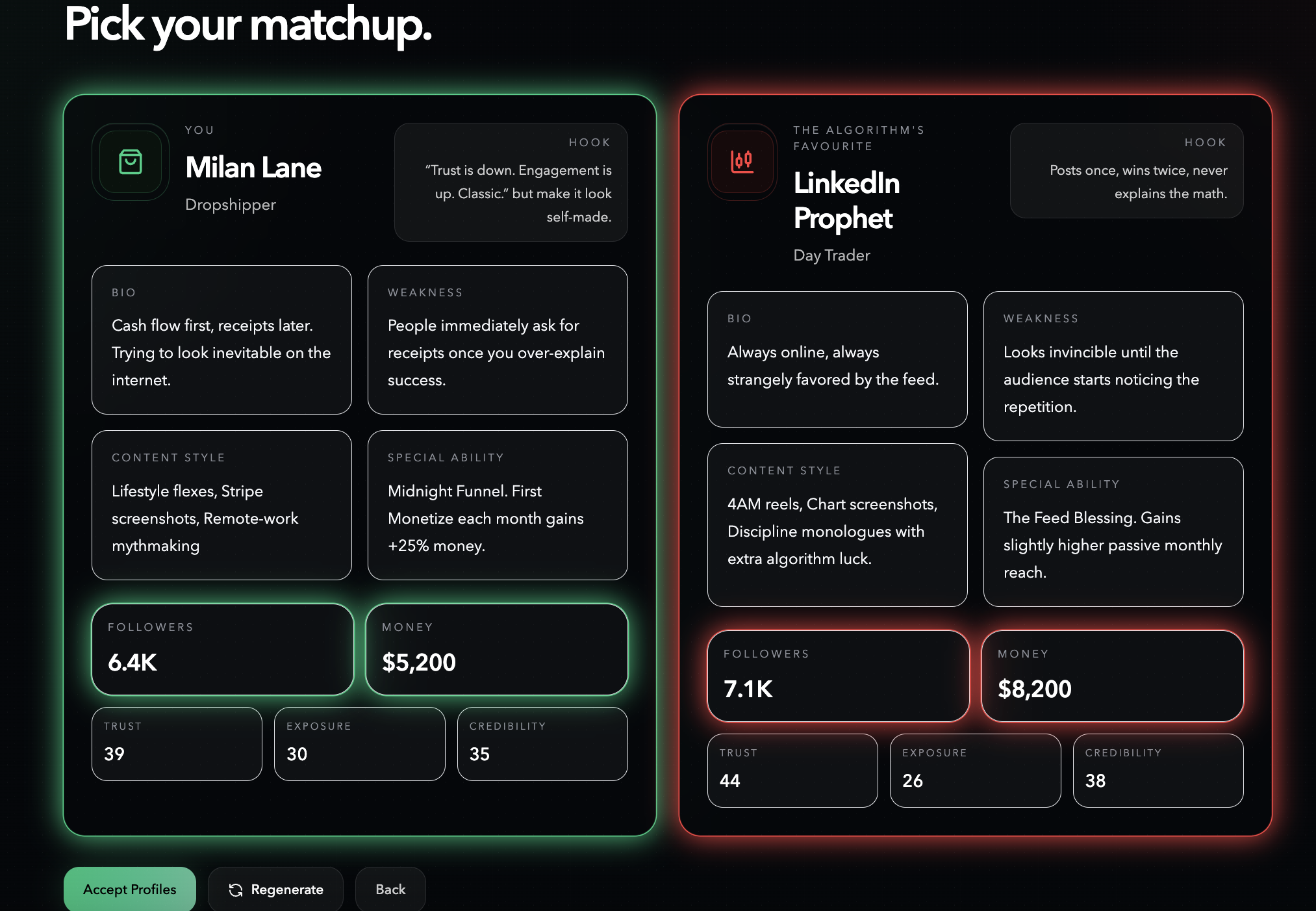
Each player competes against an AI rival known as The Algorithm’s Favourite.
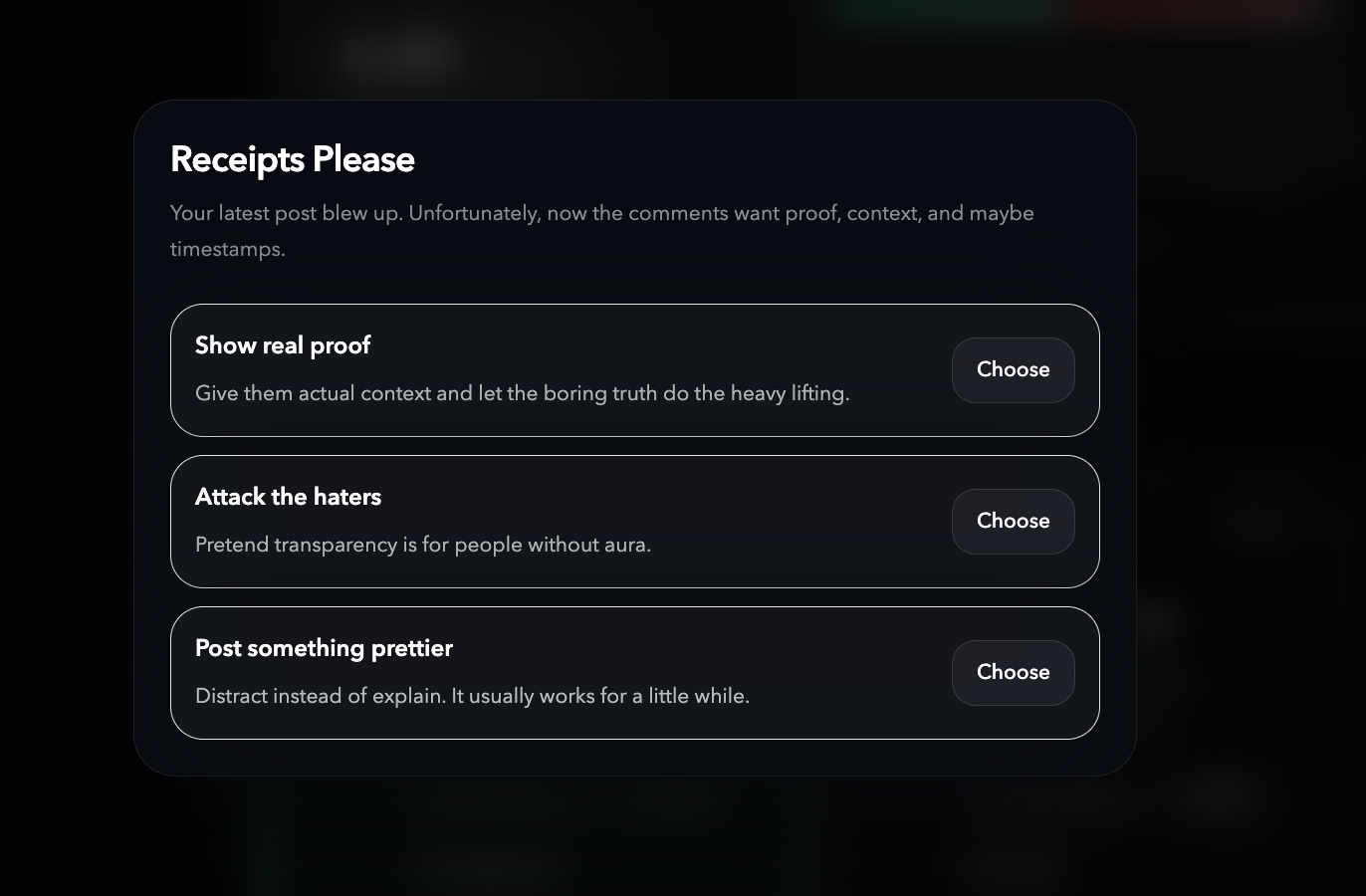
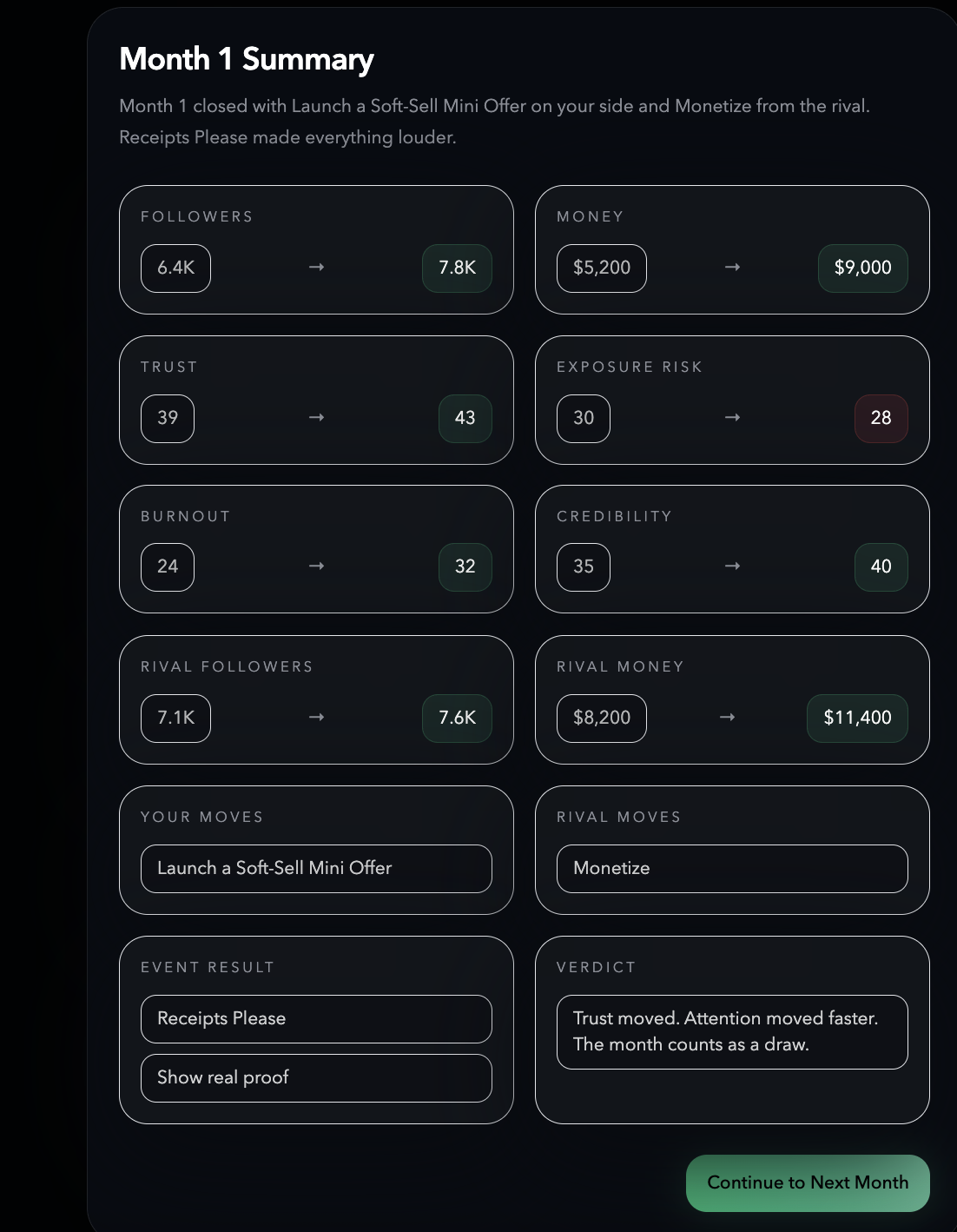
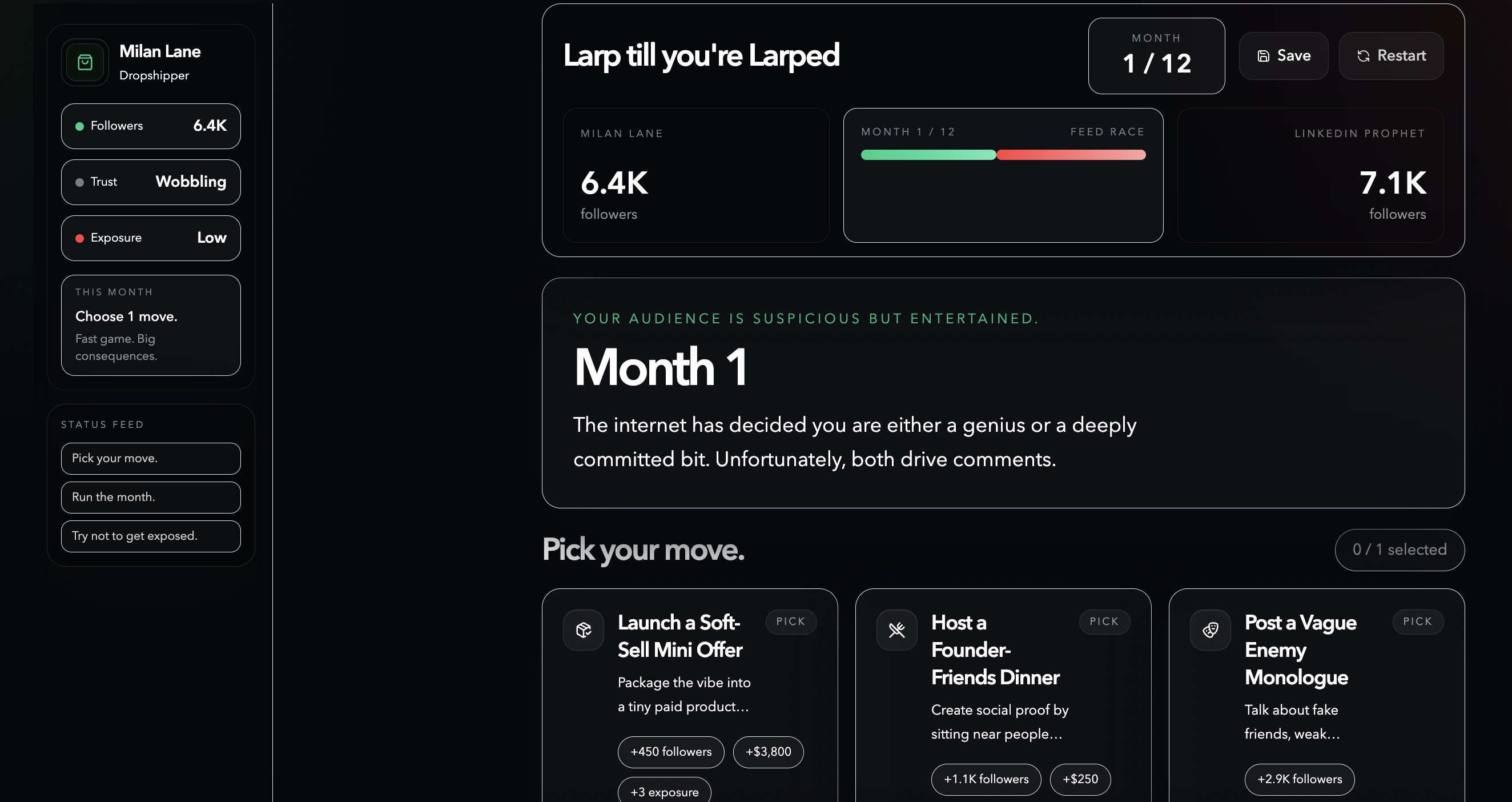
Every month, the player chooses actions such as posting content, improving their product, networking, monetizing their audience, recovering from burnout, or stirring drama. These decisions affect key stats such as:
- Followers
- Engagement
- Money
- Trust
- Exposure Risk
- Burnout
- Credibility
AI is used to generate custom profiles, monthly narratives, random internet events, rival actions, and final recaps. This makes every run feel different, funny, and replayable.
The goal is to achieve the highest clout score while surviving the chaos of the internet.
How we built it
We built Larp as a polished browser-based strategy game with a strong focus on UI and game feel.
The frontend was built using:
- Next.js
- React
- TypeScript
- Tailwind CSS
- shadcn/ui
- Framer Motion
- lucide-react
The game uses a dark tycoon-style dashboard inspired by strategy and simulation games. The layout includes a top HUD, a left action sidebar, and two competing panels: one for the player and one for the AI rival.
We also created an isometric-style “social media empire board” using CSS transforms, gradients, and shadows to make the game feel more visual and immersive.
AI generation is handled through a backend API route so that API keys are not exposed on the frontend. The AI generates structured JSON for player profiles, rival profiles, events, action cards, and recaps, while the app itself controls the actual game logic and stat calculations.
Game progress is saved using localStorage, allowing players to continue or restart their run.
Challenges we ran into
One of the biggest challenges was balancing AI-generated content with consistent game logic. If AI controlled too much, the game could become unpredictable or unfair. To solve this, we let AI generate the flavour, story, and descriptions, while the app controls the stats, rules, scoring, and progression.
Another challenge was making the UI feel like a real game instead of a basic web form. We spent a lot of time refining the dashboard layout, action interactions, stat cards, animations, and isometric board visuals so the experience felt polished and engaging.
We also had to think carefully about safety. Since some personas involve trading, fitness, beauty, and business, we made sure the game stays fictional and satirical, avoiding real financial advice, medical advice, or harmful recommendations.
Accomplishments that we're proud of
We are proud that Larp feels more like a proper browser game than a simple AI wrapper. The game has a clear loop, a polished interface, meaningful stats, AI-generated replayability, and a strong satirical identity.
Some accomplishments we are especially proud of:
- Creating a professional dark game dashboard UI
- Building a 12-month simulation loop
- Adding an AI rival to make the game feel competitive
- Using AI to generate funny and contextual events
- Designing stats that create real trade-offs between growth, trust, burnout, and exposure
- Creating a final recap that makes each playthrough feel shareable
- Turning internet culture into an actual game mechanic
The game is funny, but it also reflects something real about how people perform success online.
What we learned
We learned that AI works best in games when it supports the experience rather than replacing the entire game system. By separating AI-generated flavour from deterministic game logic, we were able to keep the game both creative and playable.
We also learned how important UI polish is for making a project feel complete. Small details like animated stats, glowing borders, hover states, progress bars, and clean layout choices made a huge difference in how the game felt.
Most importantly, we learned that a strong concept matters. Once we had the core idea of “internet persona simulator,” every feature, stat, and event became easier to design around.
What's next for Larp
Next, we want to expand Larp into a deeper and more replayable simulation.
Future features could include:
- More personas and rival archetypes
- More random events and crisis scenarios
- Unlockable abilities based on playstyle
- Different endings and achievement badges
- Shareable final recap cards
- Leaderboards for clout score
- Multiplayer mode where friends compete as different personas
- AI-generated avatars and profile pages
- More detailed social media empire upgrades
- A larger event system with scandals, sponsorships, collaborations, and viral moments
Eventually, we want Larp to feel like a full satirical internet career simulator where every run tells a different story of ambition, clout, chaos, and questionable branding.
Built With
- built-with-typescript
- framer-motion
- lucide-react
- next.js
- react
- tailwind-css
- the-openai-api

Log in or sign up for Devpost to join the conversation.