-
-
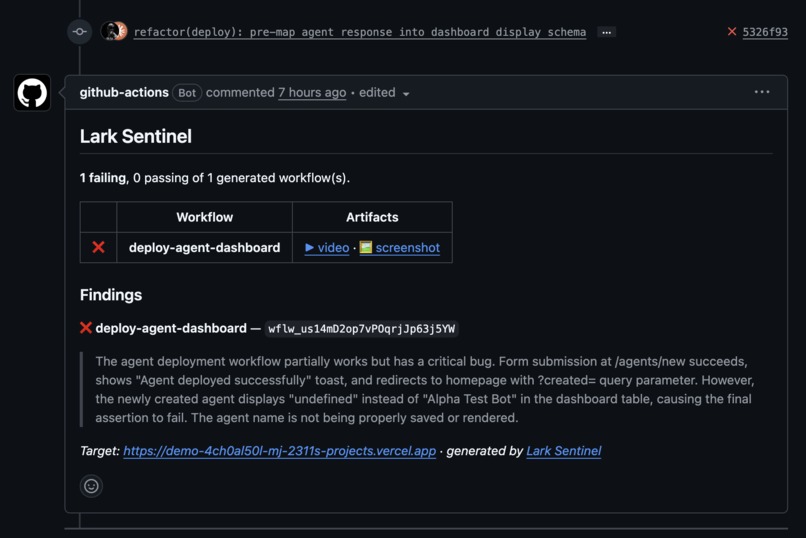
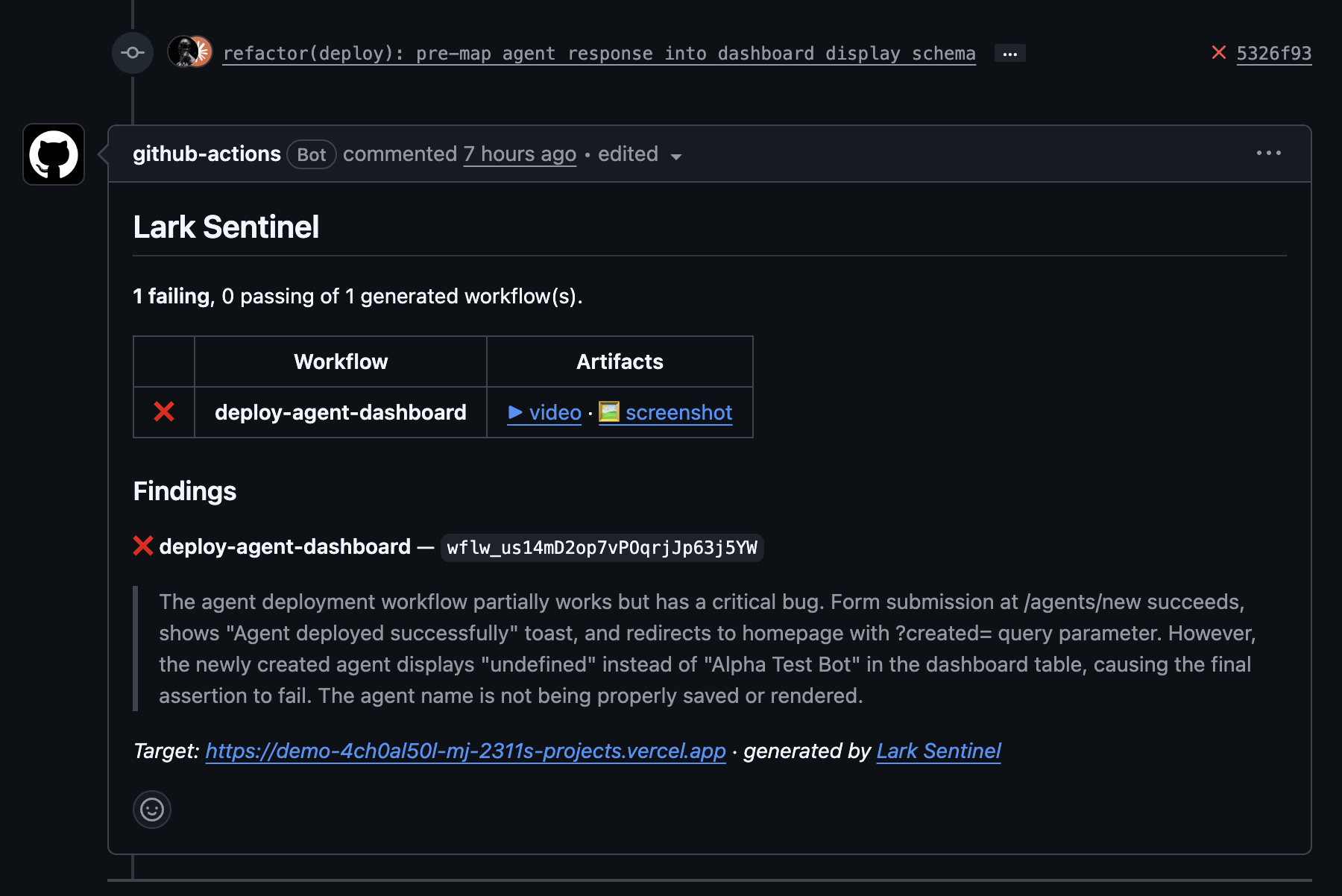
Sentinel comment
-
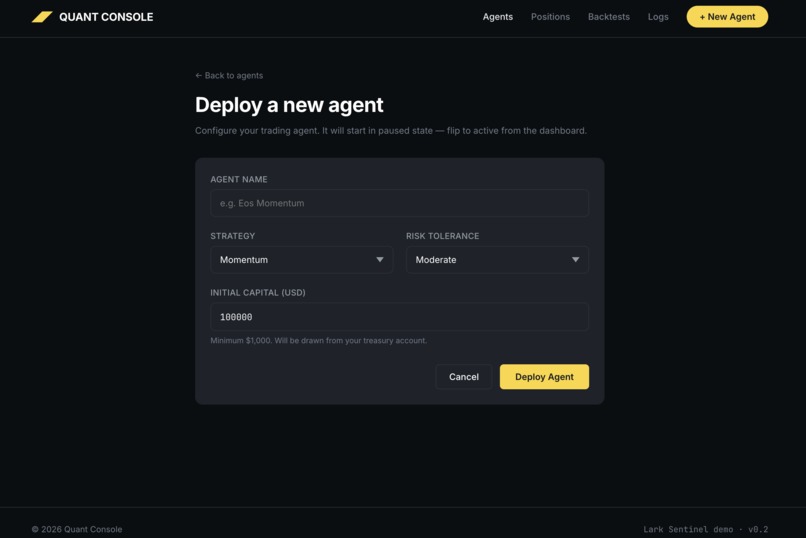
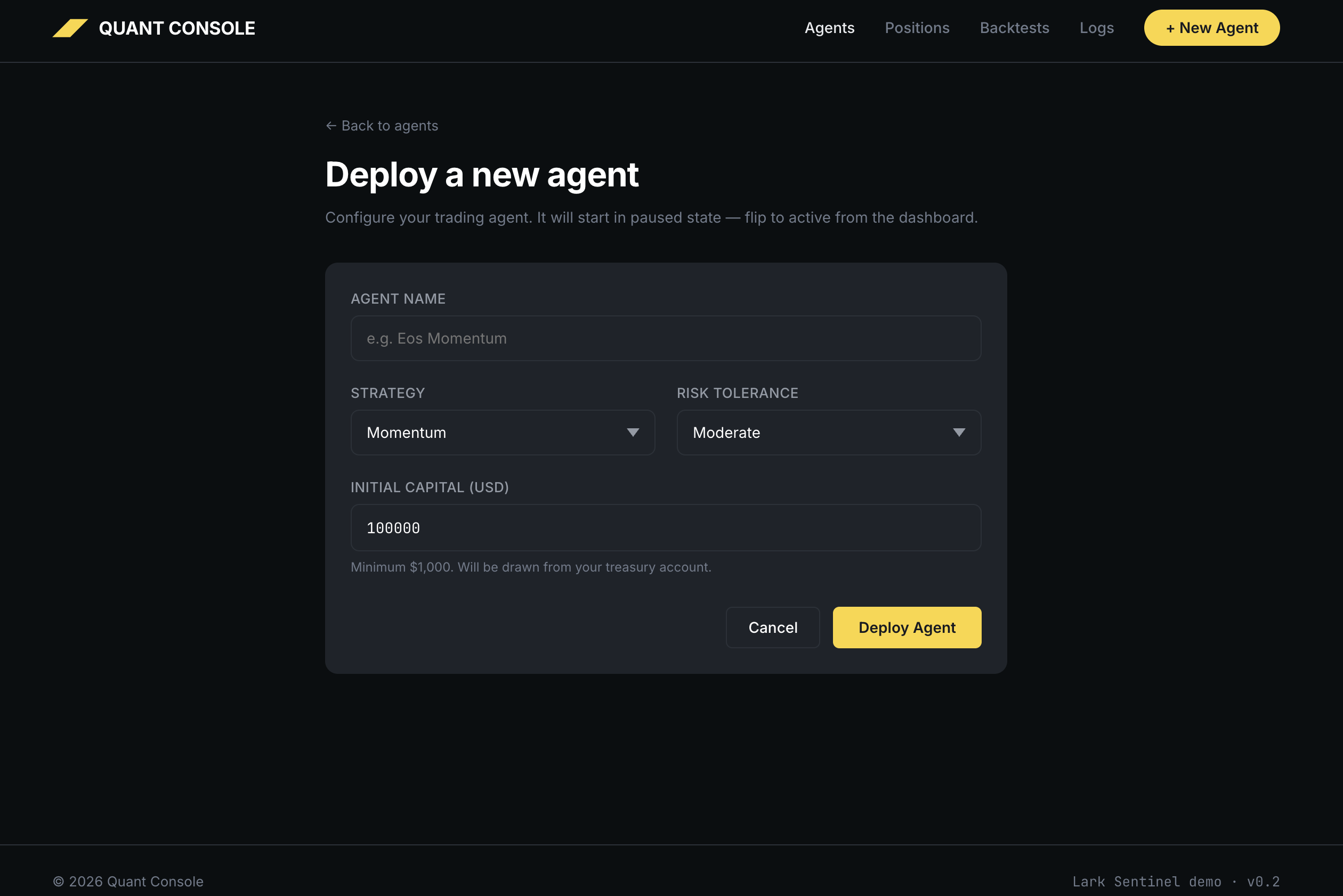
Demo web page (Quant console agent deploy form)
-
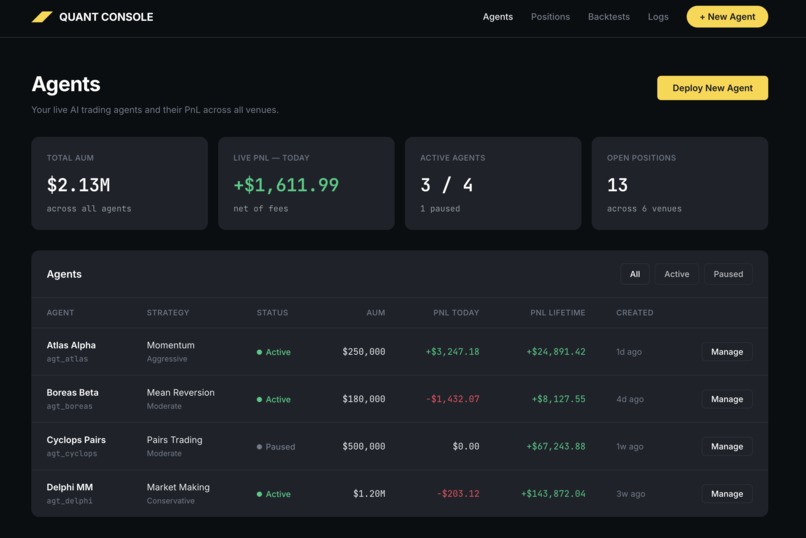
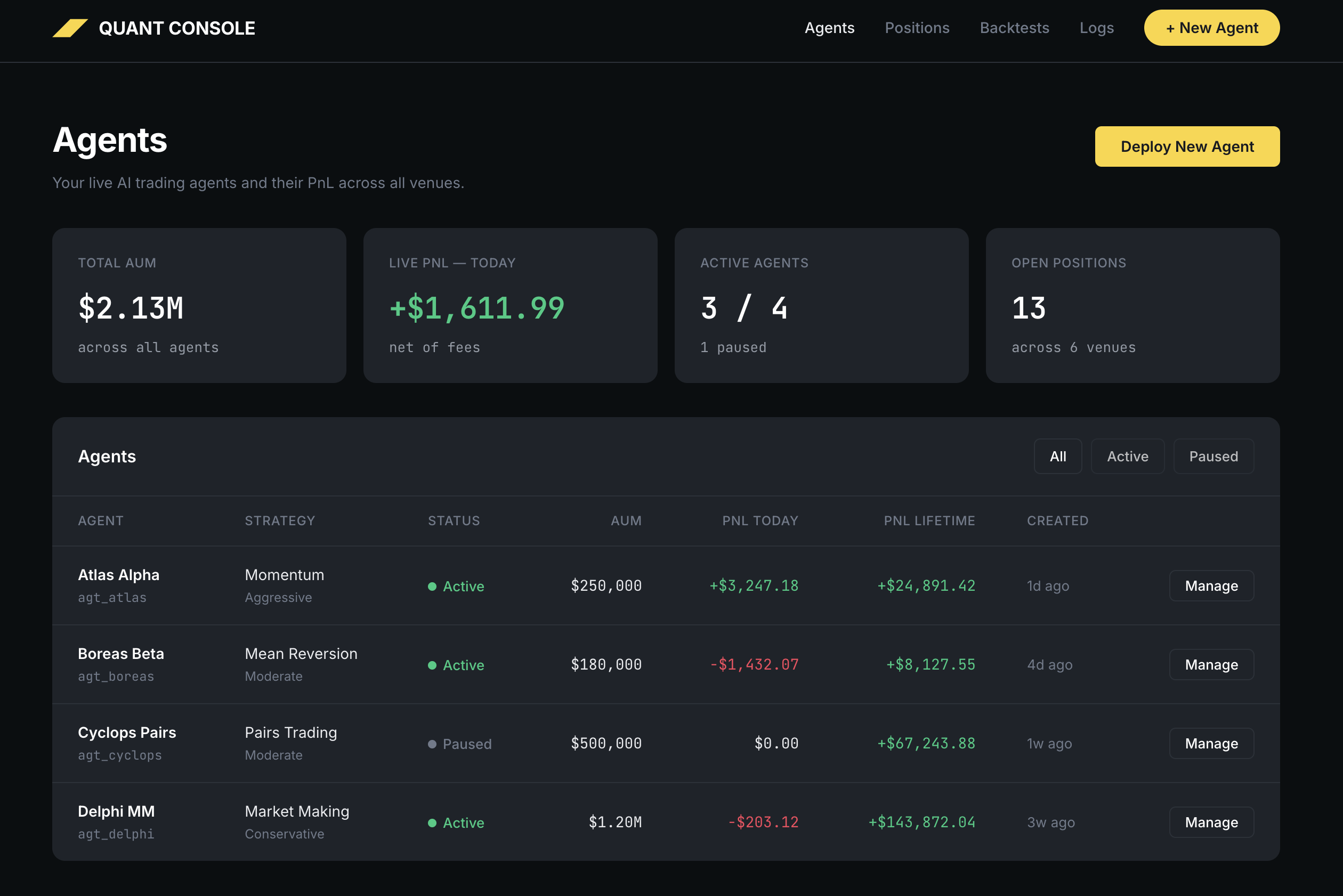
Demo web page (Quant console dashboard)
Inspiration
Coverage % doesn't tell a PR reviewer which user journeys this diff breaks, and the E2E suite only catches what someone wrote a test for months ago. PRs that touch the checkout flow or a layout component ship with no fresh, targeted verification that the user-facing surface still works.
Lark's own validate-branch skill runs the existing workflow catalog.
We wanted the inverse: a GitHub Action that generates a brand-new,
diff-targeted regression suite on every PR, runs it against the PR's
preview deploy, and posts a video-rich pass/fail back to the PR.
What it does
For every PR Lark Sentinel:
- Reads the PR diff via the GitHub API.
- Maps the changed files to user-facing surface (Next.js app router pages, layouts, route handlers, route-child components, pages router, shared components).
- Deploys the PR's code to a fresh Vercel preview with
vercel buildvercel deploy --prebuilt.
- Prompts OpenAI gpt-5 with the surface area + the actual diff patches, asking for natural-language regression workflow descriptions (not diff-verification tests).
- Creates the workflows in Lark via
getlark workflows create, invokes them with--wait, and parses both the JSON-shaped and human-readable CLI outputs. - Polls each execution via
getlark workflows executions get, pulling presigned URLs for the video recording, screenshot, and repro script. - On a first-run failure, triggers Lark's
repairsflow (when the workflow is deterministic) and re-invokes. - Posts (and upserts) a single PR comment with pass/fail badges, the summary Lark generated, and the artifact links.
- On any real failure, files a Linear issue via the Linear GraphQL
issueCreatemutation with the video + repro attached. - Archives the ephemeral workflows so the Lark dashboard stays clean.
How we built it
- Composite GitHub Action (Node 20, ESM, no build step) so the same
action can be dropped into any repo via
uses: minjaeso/lark-sentinel@v1. - Lark CLI (
@getlark/cli) for every write operation. We probed every command's stdout/stderr against a live Lark account to lock in parsers tolerant of both JSON and human-readable formats. - Vercel CLI in-CI so each PR gets a truly per-commit preview URL.
- OpenAI gpt-5 with
response_format: json_objectso we get parseable output without retries. - Linear GraphQL for the failure-to-ticket pipeline.
Challenges we ran into
- Prompt grounding. First iteration generated tests that asserted the diff did what its author claimed — so a broken PR passed because the test verified the bug. Rewrote the prompt to frame the LLM as a regression detector that asserts user-visible outcomes, ignoring whether the diff matches a sane interpretation.
- getlark CLI output is dual-format. Most commands return JSON, but
workflows invoke --waitemits human progress on stderr and exits non-zero on test failures (which is correct CLI behavior but breaks naive parsers). Built a tolerant parser that accepts both shapes and exit codes [0, 1]. - Vercel deployment protection. Every Vercel preview is gated by default; Lark's browser agent has no way to authenticate. Resolved by disabling Vercel Authentication on the demo project.
- Surface mapper coverage. First implementation only matched
app/<route>/page.tsx— editing a helper component under the same route fell through and Sentinel reported the PR as having no surface. Added anAPP_ROUTER_CHILDfallback. - Repair flow only works on deterministic workflows. AI-driven workflows can't be "repaired" because they regenerate each run. Added a graceful skip so the orchestrator doesn't warn loudly on every fail.
Accomplishments we're proud of
- Goes from
git pushto a video-bearing PR comment in ~2 minutes. - Both demo paths (green + red) are reproducible by opening one PR each, no manual setup required after secrets are wired.
- The regression-not-diff prompt change is a real product insight — we watched the same PR flip from "passes the bug" to "catches the bug" after the rewrite.
- Composes 4 separate platforms (GitHub, Vercel, Lark, OpenAI, Linear) without managing any infrastructure of our own.
What we learned
- Lark's CLI surface is enough to build production-grade automation on top of without ever touching the dashboard.
- LLM-driven E2E test generation lives or dies by what context you ground it in. Surface area + literal diff patches is the right level.
- The "diff is the bug" framing is the key to building useful regression detectors with LLMs — telling the model to verify the diff is exactly the failure mode you want to avoid.
What's next
- True per-PR preview URLs via Vercel-GitHub integration (currently uses CLI deploy from the action — works but couples cost to CI minutes).
- Use Lark's
secret-contextsto pass test fixture credentials (login credentials, API keys) for workflows that need an authenticated state. - Switch generated workflows to deterministic mode after first run so the repair-on-flake path actually fires.
- A GitHub App distribution so the action installs in one click.

Log in or sign up for Devpost to join the conversation.