Inspiration
Every SME owner, freelancer, and tenant in Nigeria signs contracts they don't fully understand—a shop owner taking on a supplier deal, a tenant signing a lease, or a service provider accepting client terms. Traditional legal help is expensive, slow, and inaccessible to most, so people sign anyway and only discover the traps—auto-renewal loops, one-sided termination clauses, or hidden fees buried in paragraph four—when it’s too late.
We realized the core gap wasn't legal knowledge itself, but accessibility and translation. Most risky clauses aren't hidden—they're just obscured by dense legal jargon meant to be skimmed past. What people need isn't a 20-page legal brief; they need someone to point at the trap in plain language and explain why it matters. That’s why we integrated Nigerian Pidgin—not as a gimmick, but as a core accessibility feature for how our target users natively think, speak, and do business.
What it does
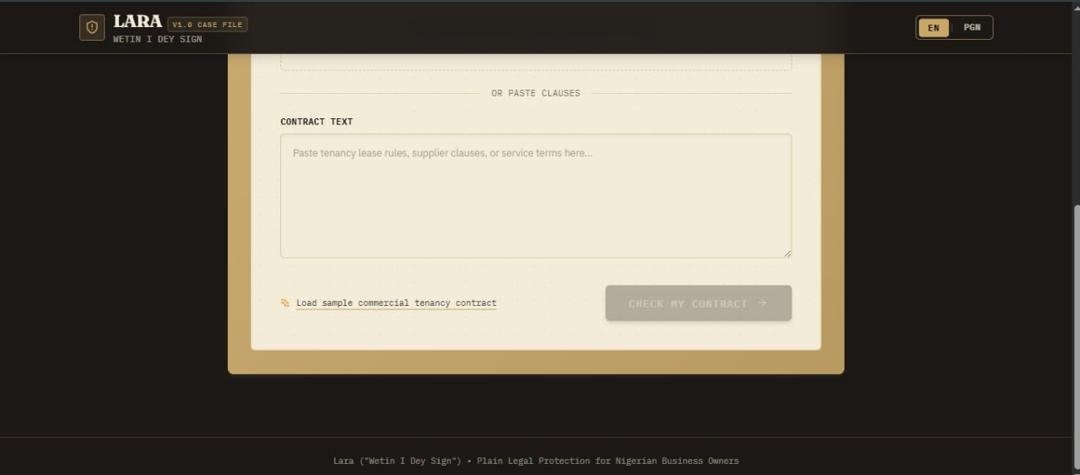
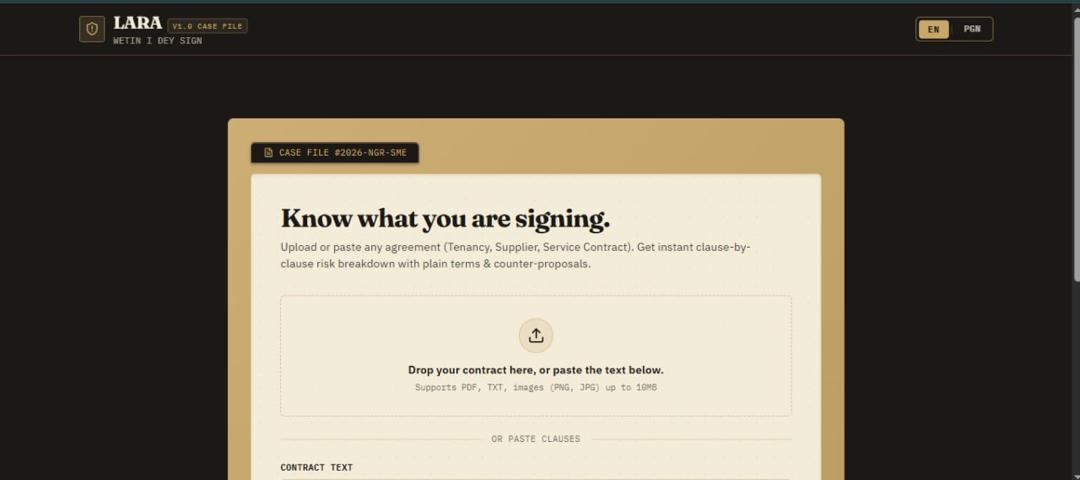
Lara acts as an instant, accessible legal assistant. Users can upload a PDF contract or paste text directly into the web app to get a full clause-by-clause risk breakdown in seconds.
Key capabilities include:
- Severity Scoring: Automatically flags and color-codes clauses by risk level (High, Medium, Low).
- Bilingual Explanations: Breaks down complex legal language into plain English and a seamless Nigerian Pidgin toggle.
- Actionable Counter-Language: Generates realistic, suggested counter-proposals that users can copy and offer back to the other party.
- Exportable Risk Summaries: Generates a clean, printable summary beat for quick review on the go.
How we built it
We executed a high-speed, parallel 4-hour hackathon sprint by locking down a rigid JSON schema within the first 20 minutes across all team tracks:
- AI & Prompt Engineering: Designed and tuned the system prompt to force structured JSON outputs, accurately scoring risk severity and providing parallel plain English and Pidgin translations without falling back on generic boilerplate responses.
- Backend Engine (Python / FastAPI): Built lightweight endpoints to ingest uploaded PDFs, extract document text cleanly, and wrap the AI extraction pipeline into an integrated API route.
- Frontend UI: Constructed an intuitive interface built around hardcoded mock schema data first, ensuring screen polish and loading states were completely finished before integrating with the live backend endpoint.
We validated the pipeline using synthetic contracts seeded with deliberate, real-world traps (e.g., non-refundable deposit penalties, asymmetric termination rights, auto-renewal clauses).
Challenges we ran into
- Strict JSON Formatting: Preventing the LLM from outputting markdown code blocks or extra conversational wrapper text required strict prompt constraints and structured output schema enforcement.
- Distinguishing Real Risk from Legal Boilerplate: Standard contracts contain plenty of intimidating language that isn’t inherently predatory. Tuning the AI to ignore harmless standard clauses while reliably catching buried, asymmetrical risks required rapid prompt iteration against our test contracts.
- Time-Constrained Integration: Wiring the live frontend to the Python API and real-time model output within our strict hackathon timeframe meant keeping error handling bulletproof and fallbacks (like direct text pasting) ready if PDF parsing lagged.
Accomplishments that we're proud of
- End-to-End Delivery: Built a fully functional, zero-fluff prototype—from PDF ingestion to structured risk breakdown—within a single 4-hour sprint.
- Authentic Local Relevance: Implemented a Pidgin toggle that delivers genuine context and nuance rather than literal word-for-word translation.
- Seamless Team Parallelism: Locked down our API contract early so backend, frontend, and prompt engineering teams built simultaneously without blocking each other.
What we learned
- Schema Discipline is Everything: Agreeing on an explicit JSON interface early eliminates 90% of integration friction during fast-paced hackathons.
- AI Legal Tooling Demands Precision: Building reliable AI-driven legal tools is less about model size and much more about prompt engineering rigor and schema validation.
- Localization Equals Empowerment: Complex tools become infinitely more useful when designed around the native phrasing and language of the people who need them most.
What's next for Lara
- WhatsApp Integration: Allow users to snap a photo of a physical contract and send it directly via WhatsApp for immediate analysis.
- Interactive Document Chat: Enable follow-up Q&A so users can ask specific questions like "Can I break this lease early without losing my deposit?"
- Attorney Handoff Pathway: Provide a direct connection to real legal professionals for high-stakes or highly complex agreements.
- Saved History & Document Vault: Allow recurring users, such as small business owners renewing seasonal vendor contracts, to store and track contract versions over time.


Log in or sign up for Devpost to join the conversation.