-
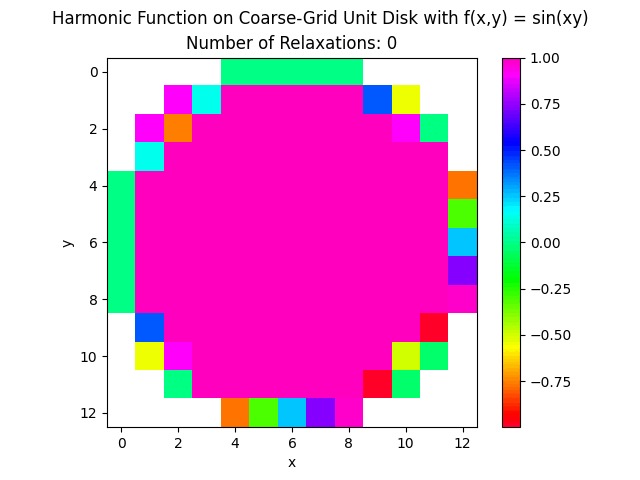 GIF
GIF
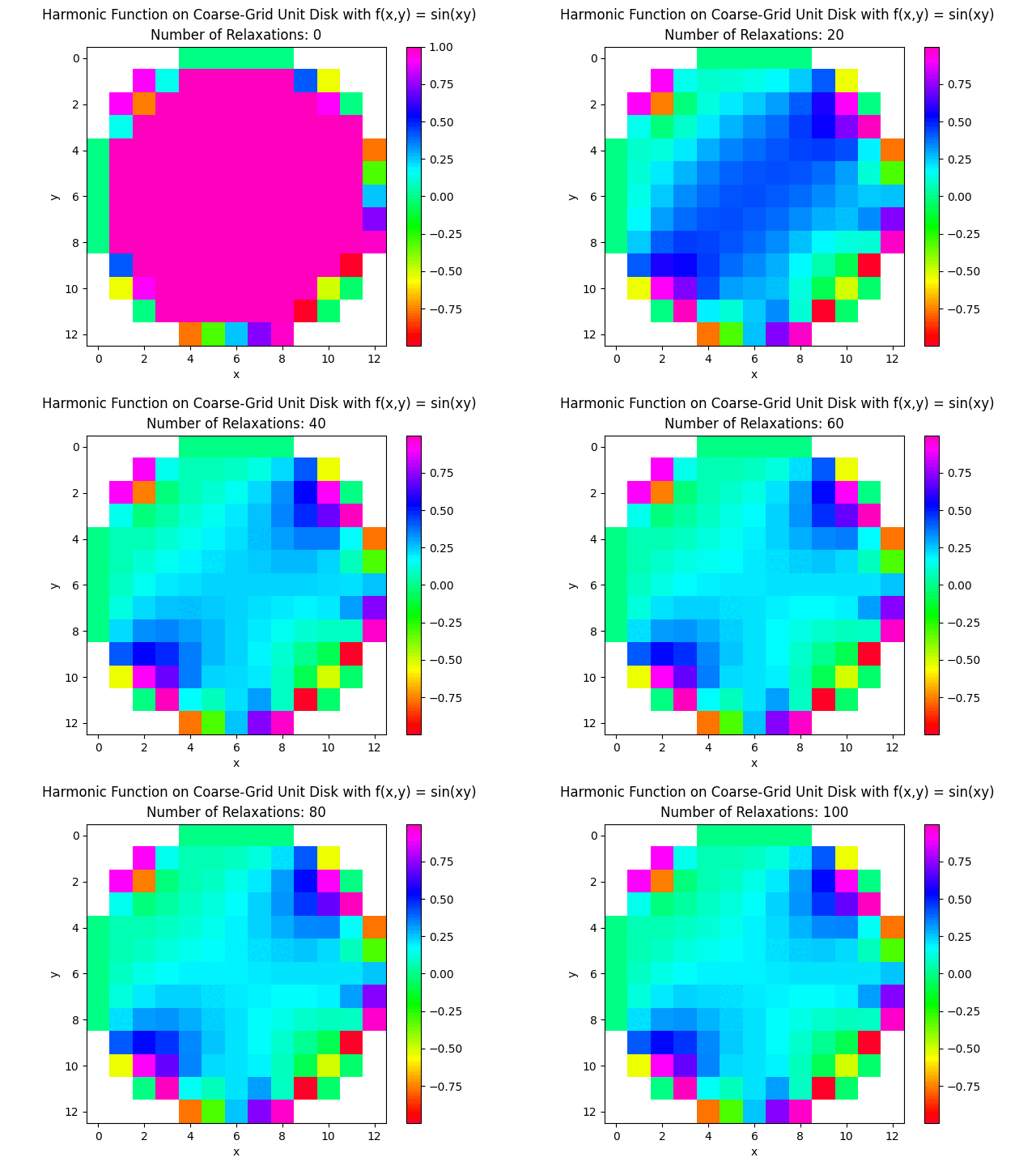
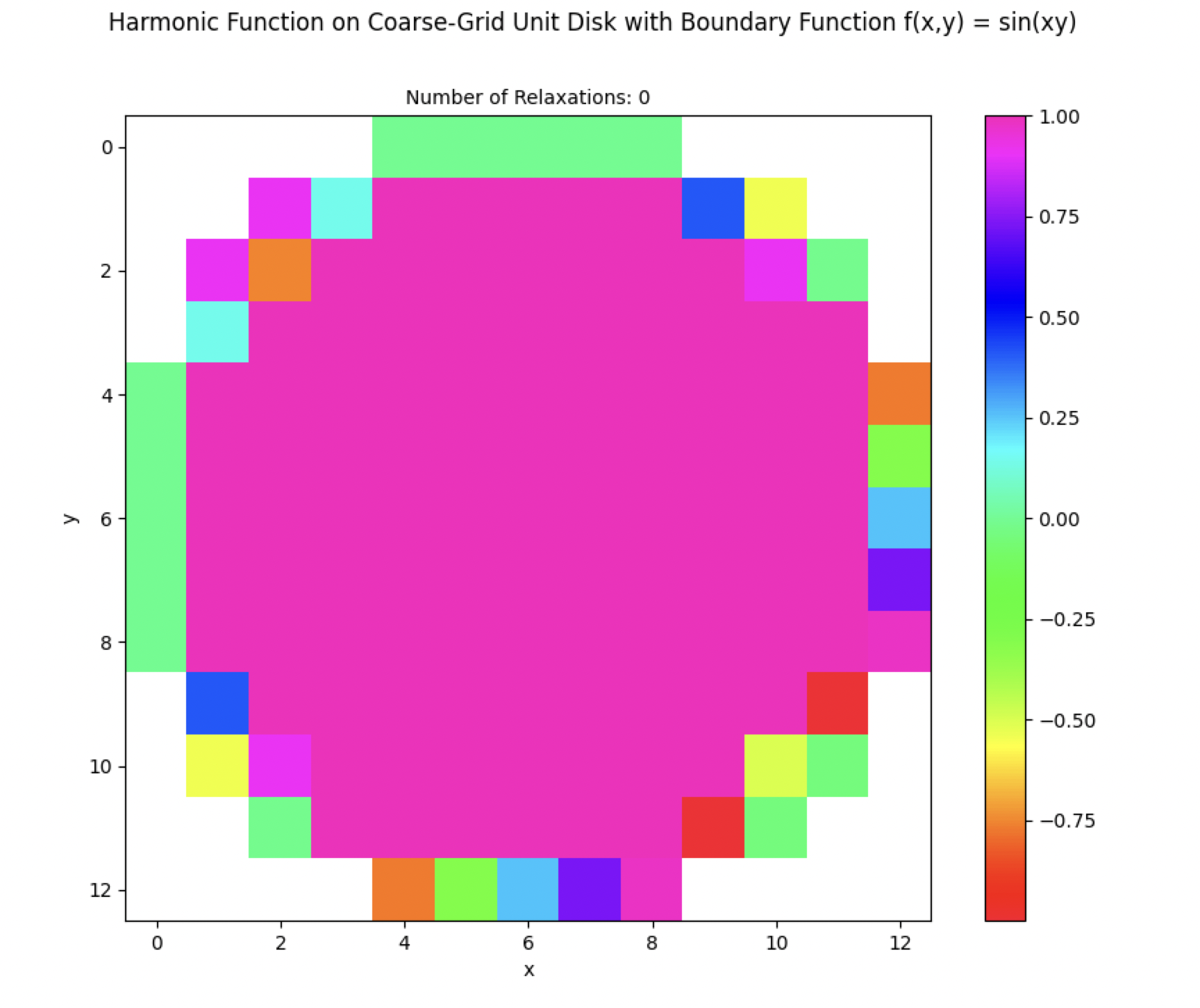
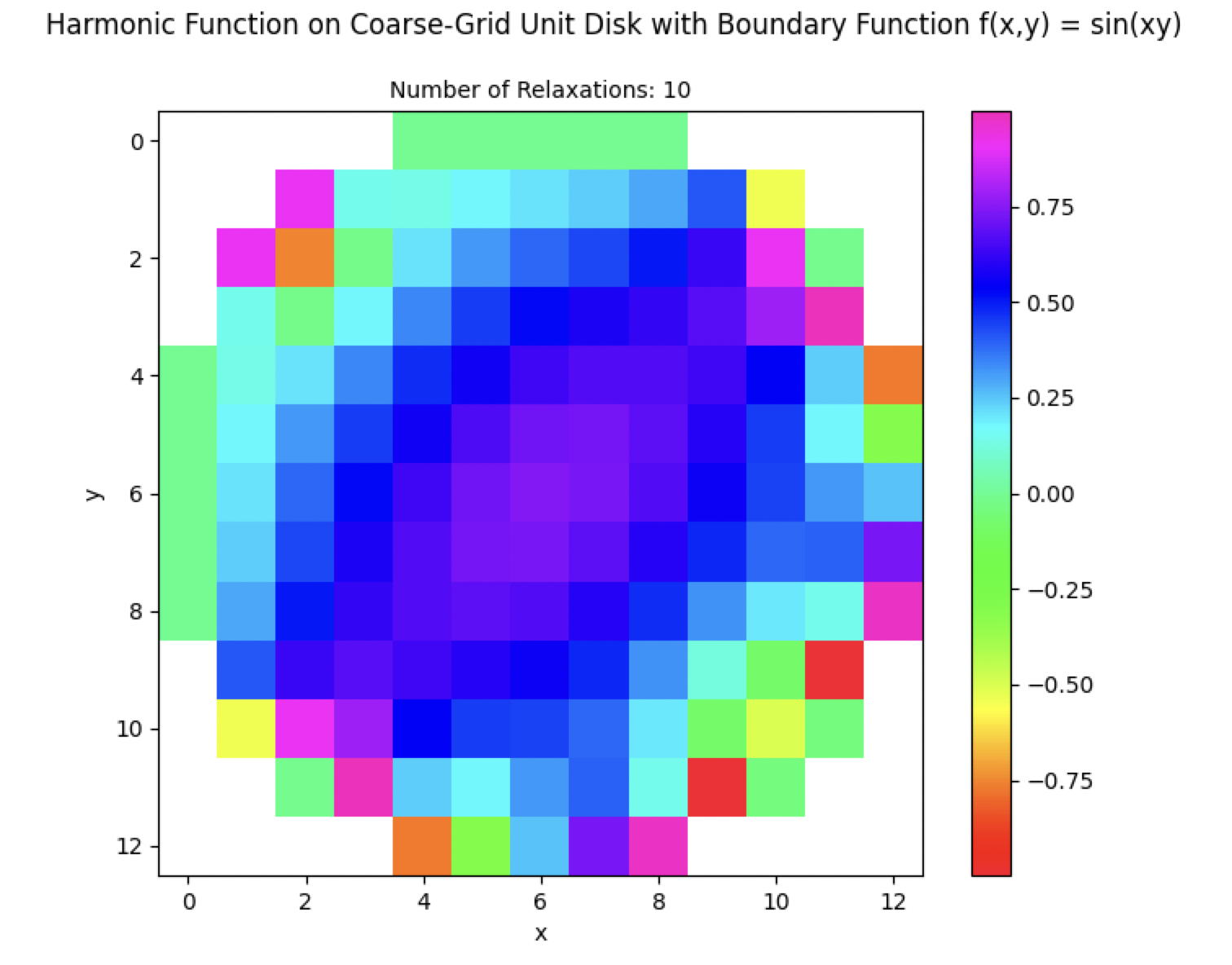
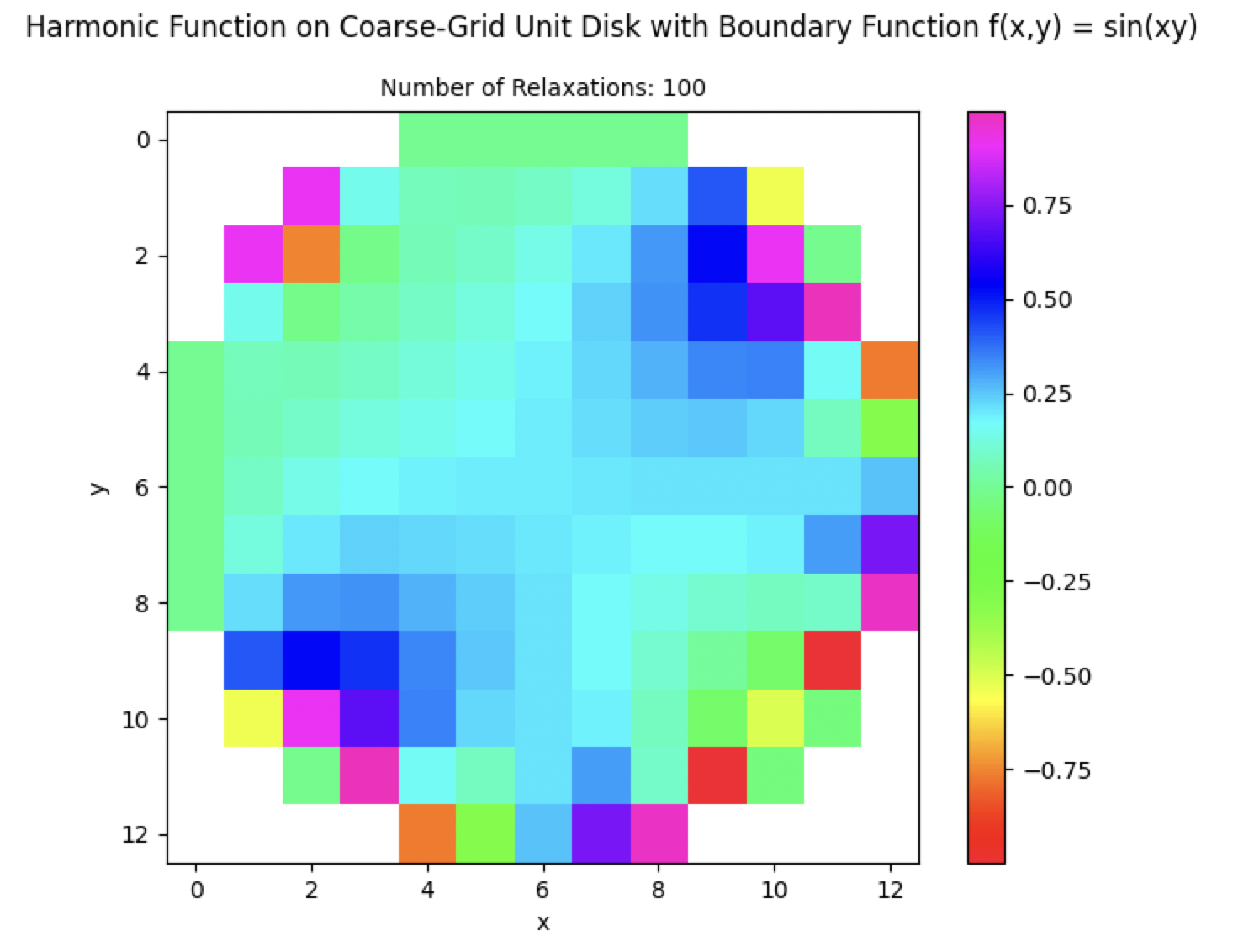
Animation of the discrete coarse plot with respect to increasing relaxation on the sin(xy) function.
-
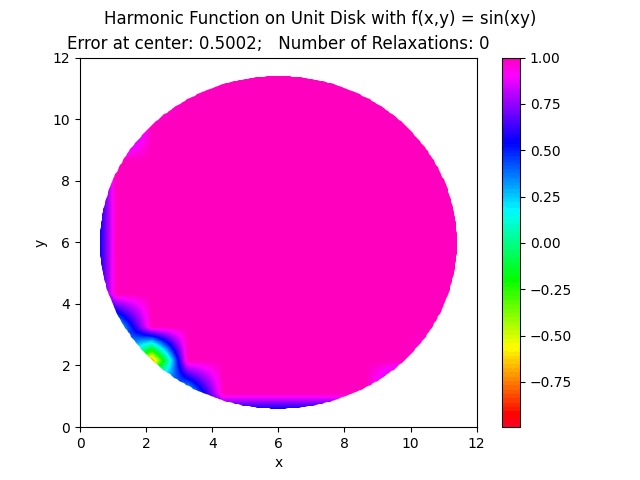 GIF
GIF
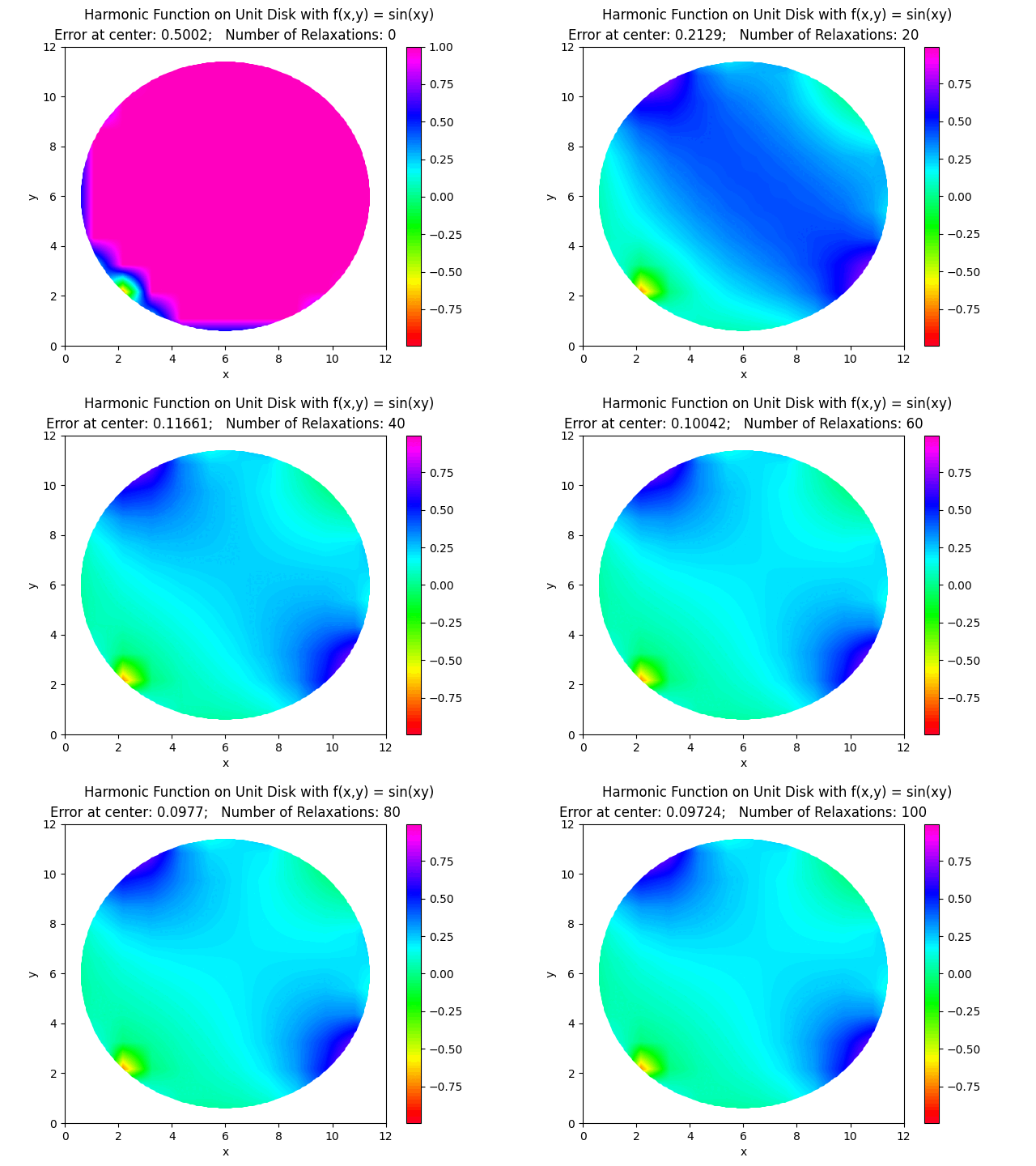
Animation of the interpolation plot and respective error with respect to increasing relaxation on the sin(xy) function.
-
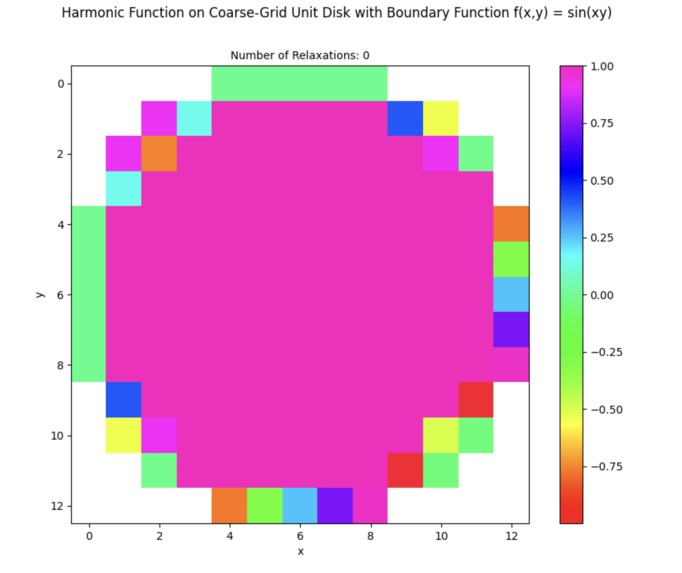
Discrete coarse plot of f(x,y) = sin(xy) with 0 relaxations.
-
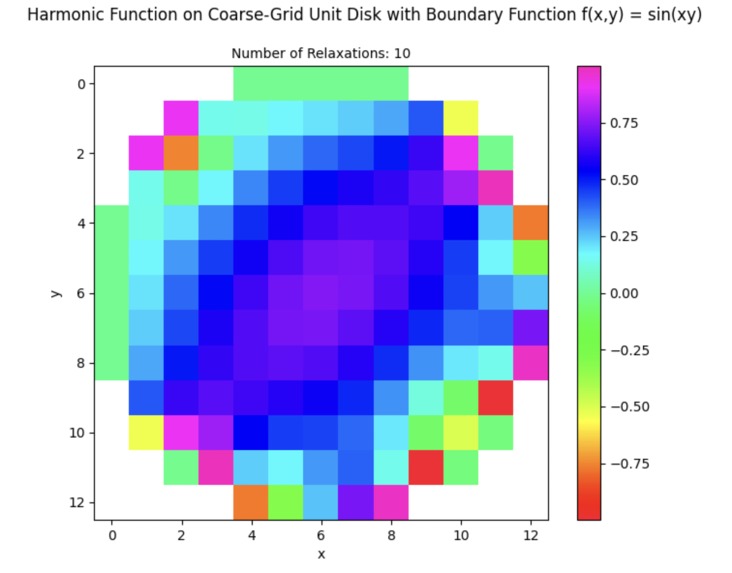
Discrete coarse plot of f(x,y) = sin(xy) with 10 relaxations.
-
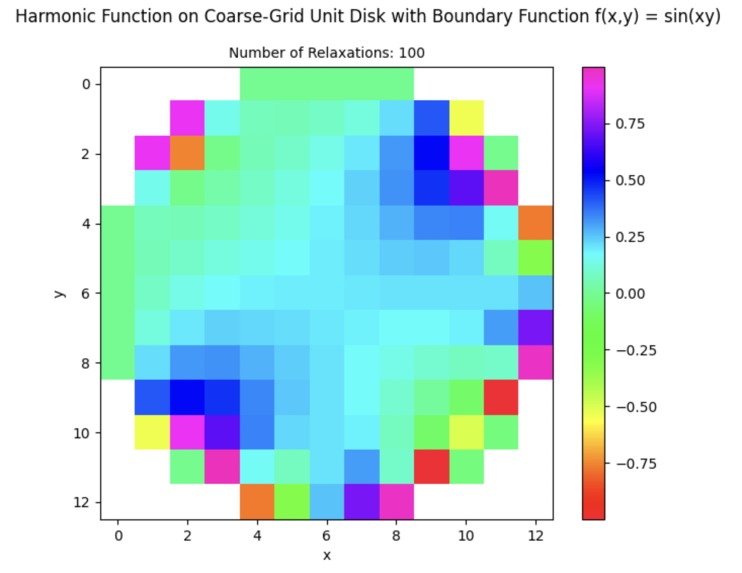
Discrete coarse plot of f(x,y) = sin(xy) with 100 relaxations.
-
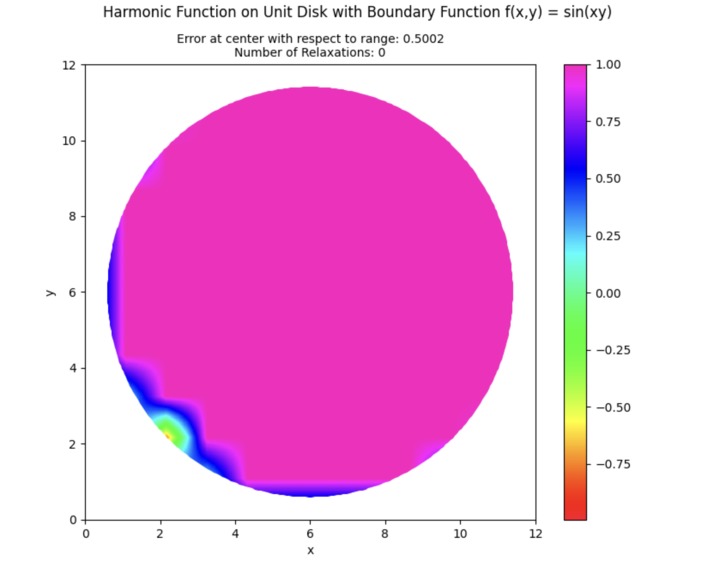
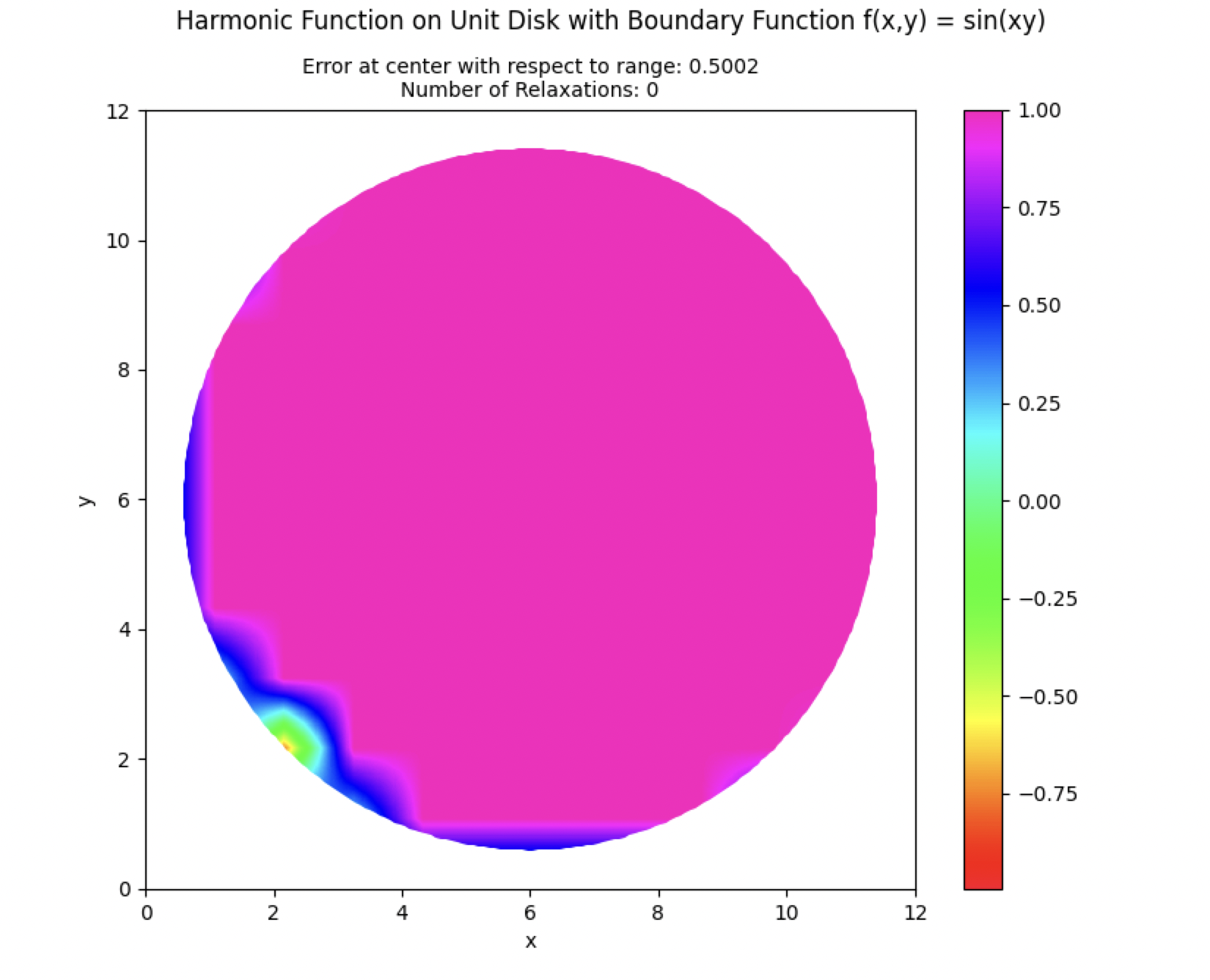
Interpolation plot of f(x,y) = sin(xy) with 0 relaxations.
-
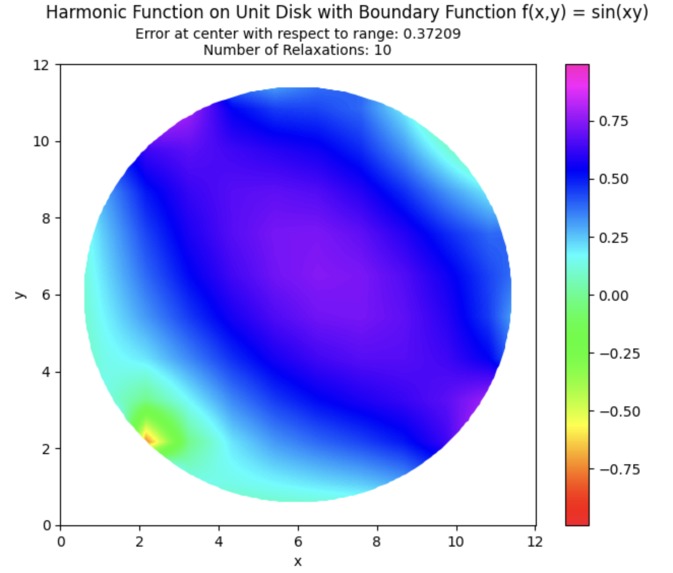
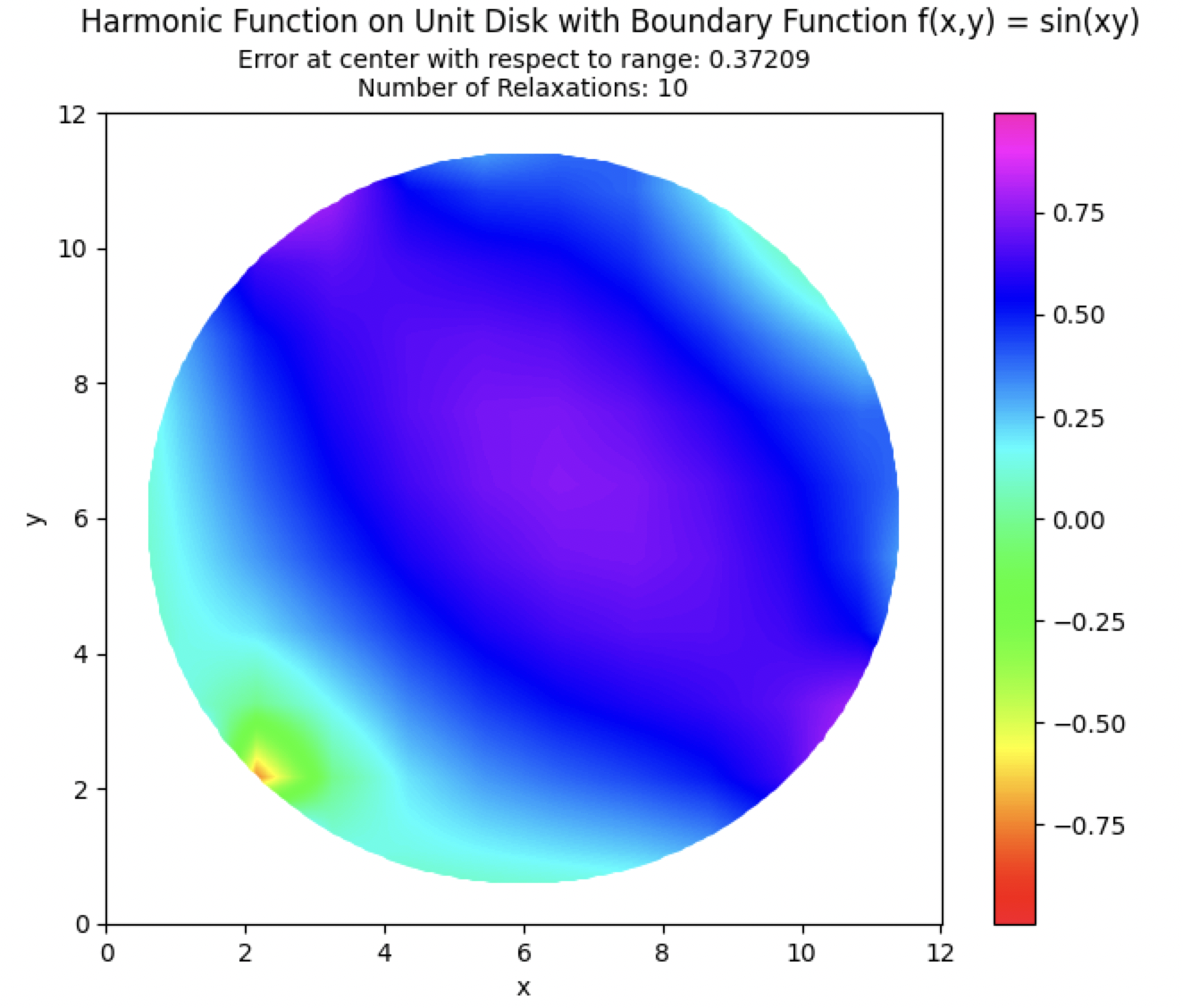
Interpolation plot of f(x,y) = sin(xy) with 10 relaxations.
-
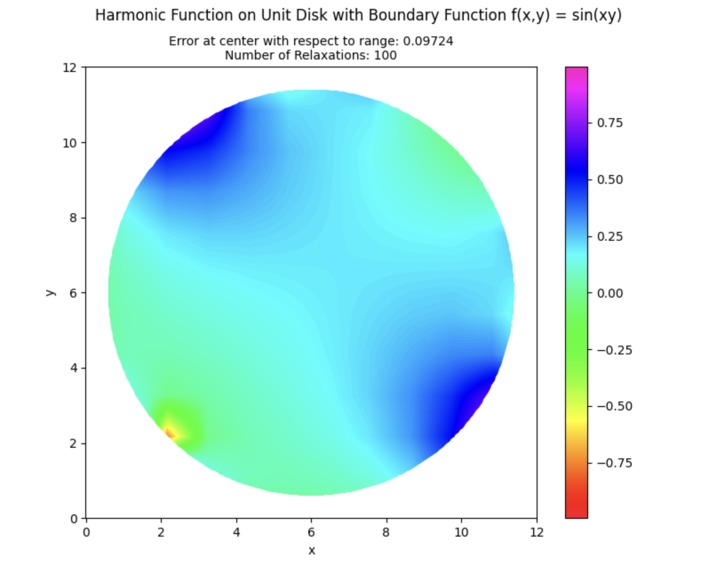
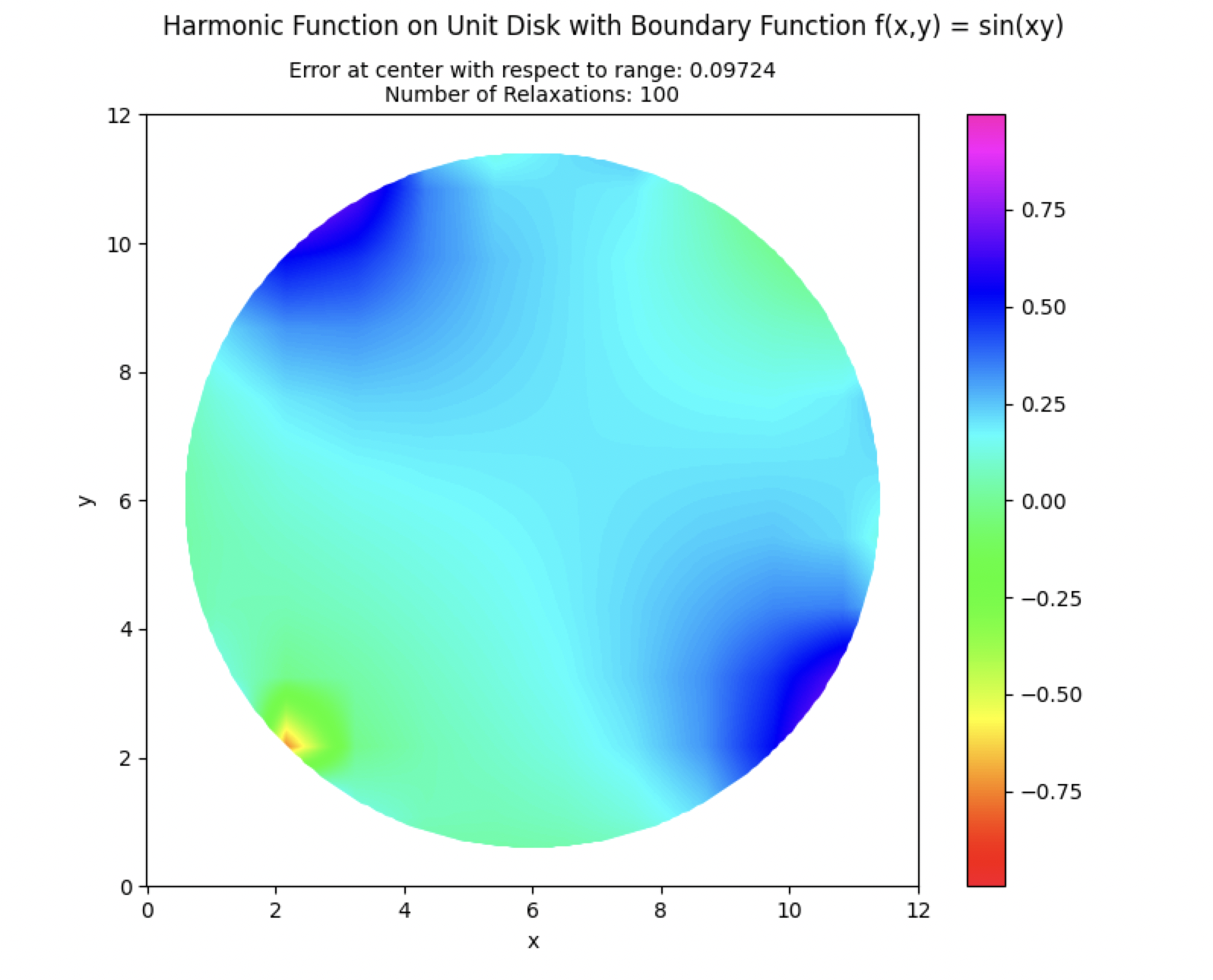
Interpolation plot of f(x,y) = sin(xy) with 100 relaxations.
-
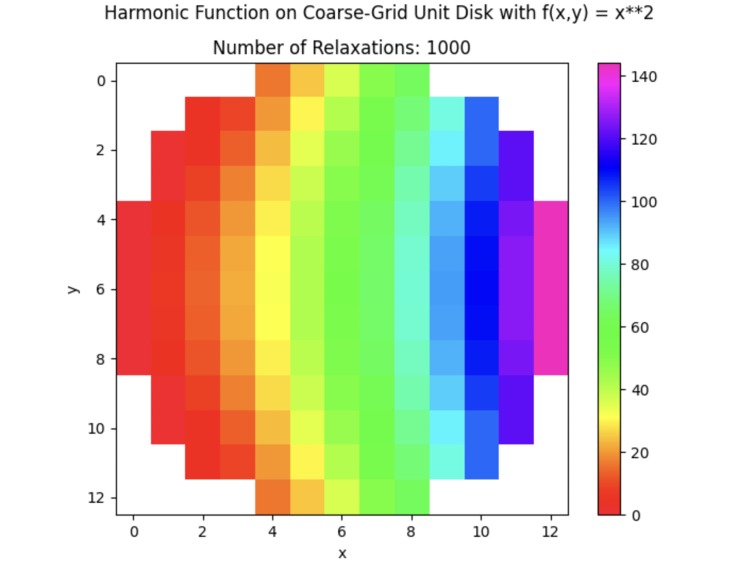
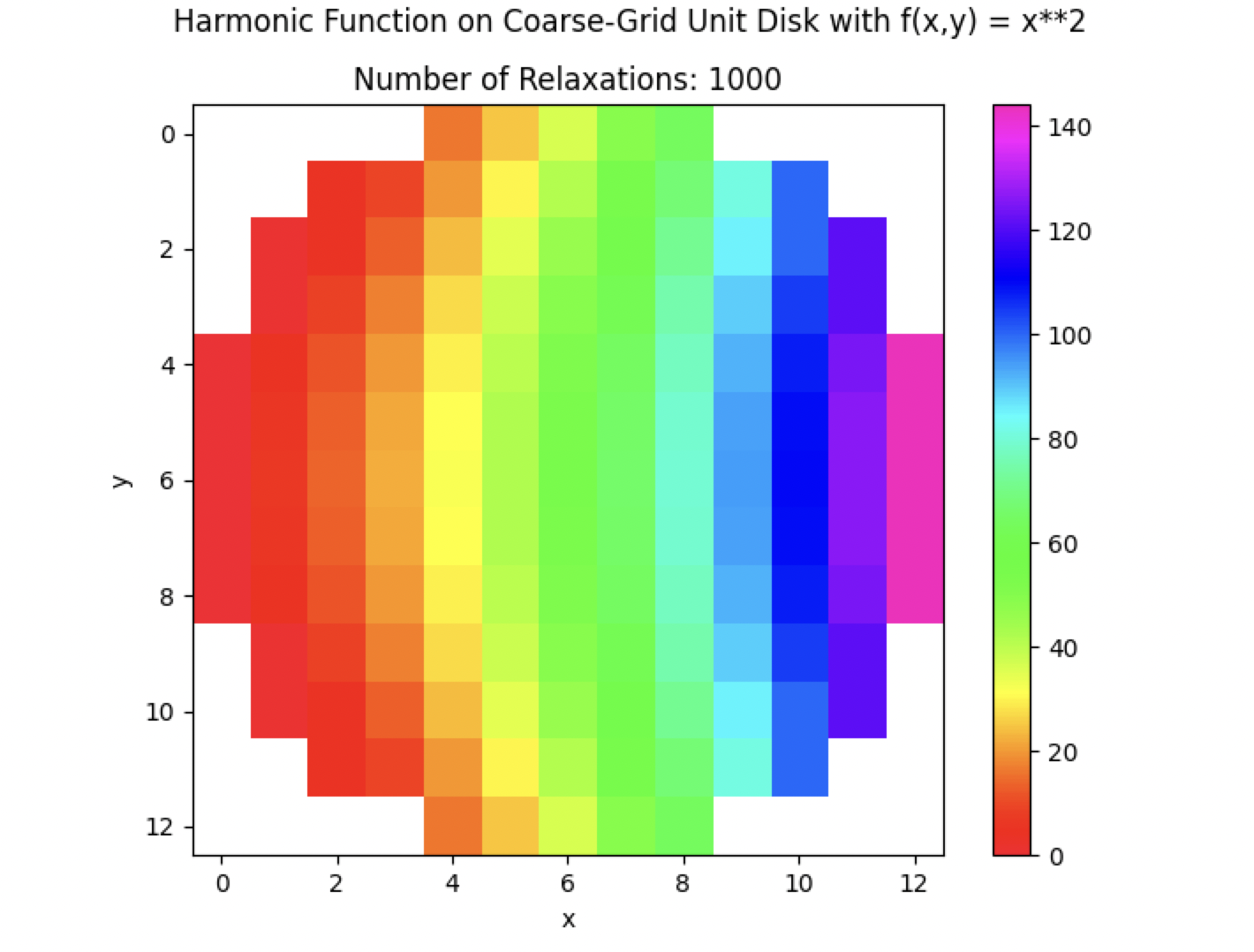
Discrete coarse plot of f(x,y) = x^2 with 1000 relaxations.
-
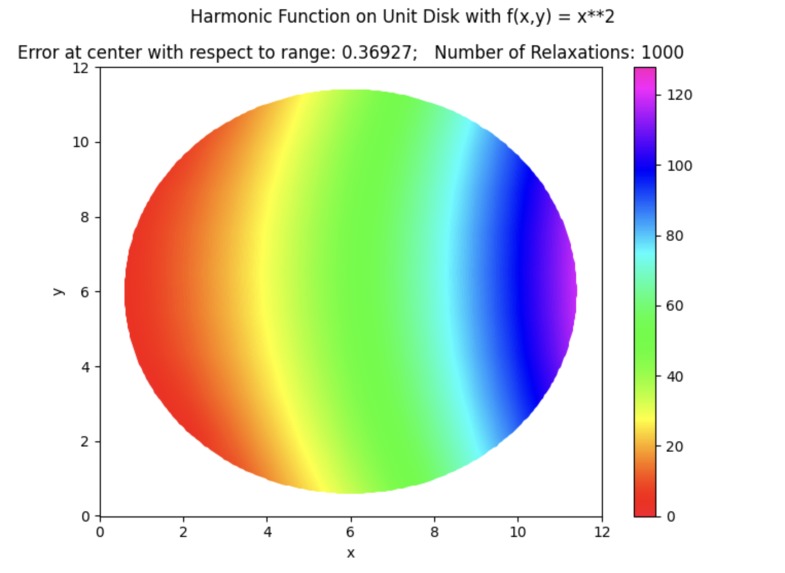
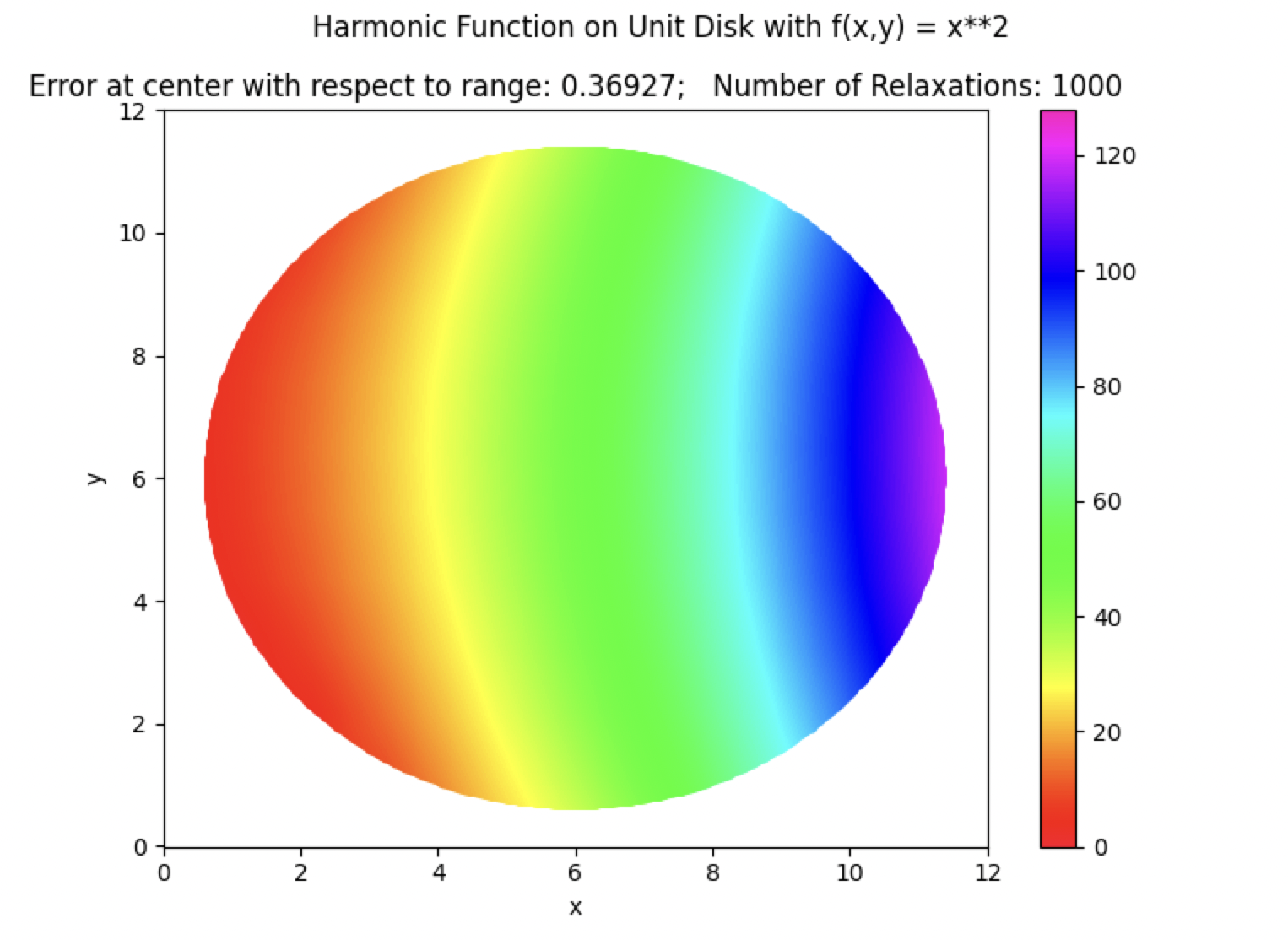
Interpolation plot of f(x,y) = x^2 with 1000 relaxations.
-
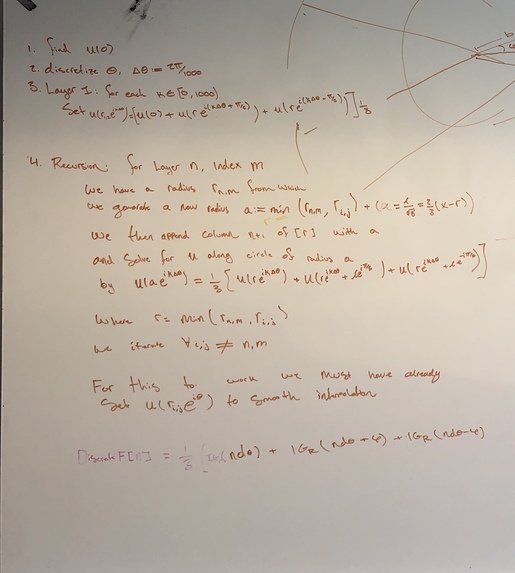
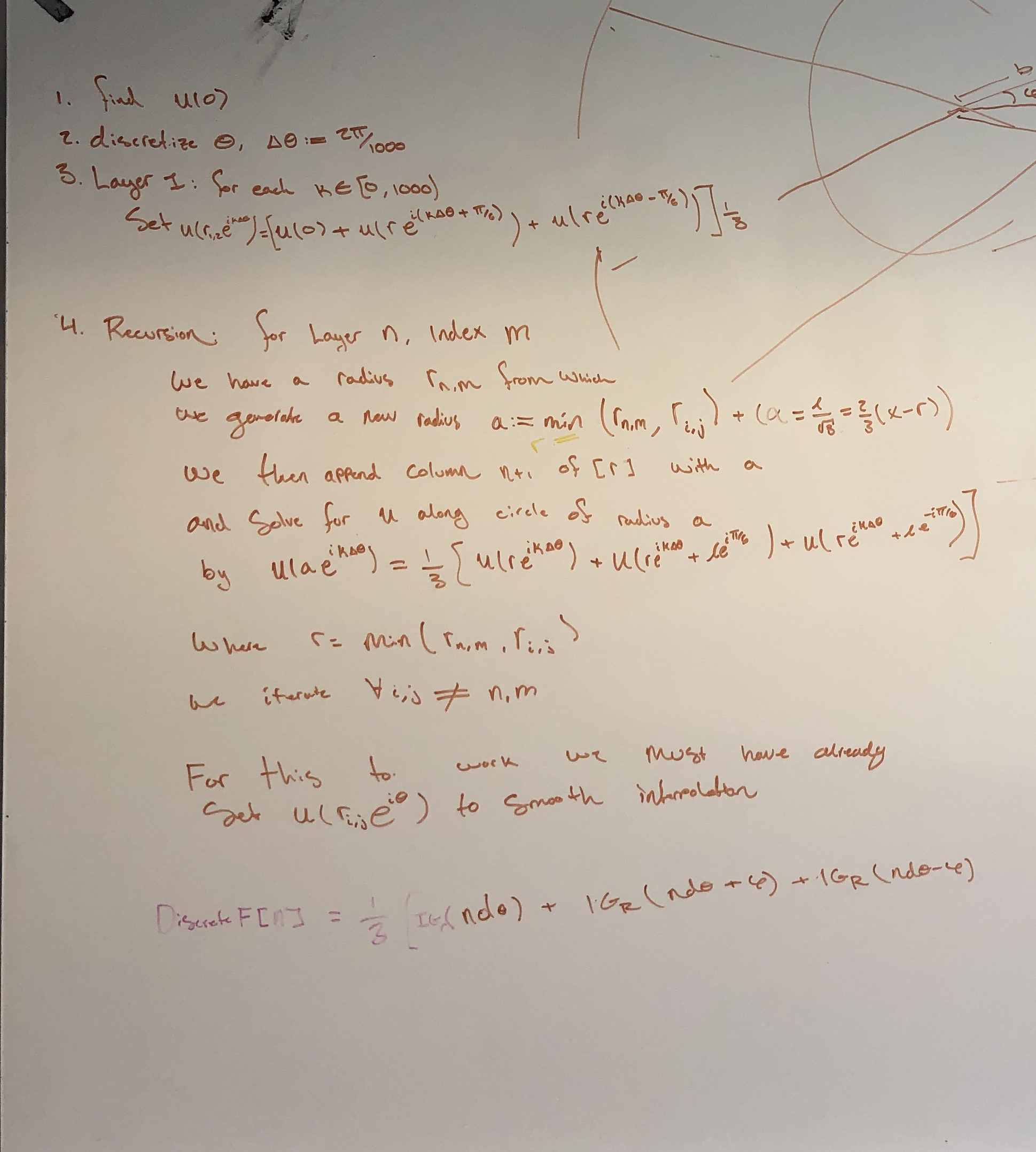
Attempted Algorithm for Polar Graph Solution Taking Advantage of Exact Value at Origin.
Inspiration for this project came from the one and only McGill Professor of Mathematics, Rustum Choksi. One group member is currently taking his course on PDEs and felt his passion when covering the Laplace equation. Harmonic functions encode symmetry like no other and the beauty of functions over discrete graphs whose values at any arbitrary node (not on the boundary) depends precisely on the value of every other node was irresistible.
What it does
Our program uses a relaxation method to numerically solve for the specific harmonic function over the unit disk in R2 with boundary value f(x,y) on S1. Here, f is an arbitrary continuous function that we can manipulate as an input. Additionally, our program determines the relative error at the origin because this is a value that can be solved for explicitly.
How we built it
We used a pascal algorithm with relaxation.
Challenges we ran into
We faced many challenges considering neither of us had ever done any numerical analysis. Additionally, one partner is still learning multivariable calculus.
Accomplishments that we're proud of
We are proud of all of it! It was quite rewarding.
What we learned
We learned pretty much everything we implemented on the spot.
What's next for Laplace's Demons
More hackathons!


Log in or sign up for Devpost to join the conversation.