-
-
-

Old logo
-

Inspiration
The inspiration for AI Summarizer came from the sheer amount of time and effort it takes to go through complex, lengthy documents. Professionals or legal teams are often forced to read entire contracts to understand the key points, often wasting valuable time. I wanted to create a tool that could automate this process, offering a concise and accurate summary in seconds and allowing users to focus on what matters most.
What it does
The AI Summarizer was created with the goal of simplifying the process of reading and understanding lengthy agreements and documents, like contracts, legal texts, and reports. As professionals, students, or businesses, we often find ourselves bogged down by dense content. The idea for this project stemmed from the need to save time and improve productivity when dealing with large volumes of text, especially regarding legal agreements.
How we built it
API Integration: The project's core relies on the ChatGPT API, which summarizes input text. By integrating this powerful language model, the tool can analyze and condense content intelligently.
DocuSign Integration: To make the product more suited for business and legal applications, I integrated DocuSign to handle and summarize legal agreements and contracts. This ensures that users can upload documents in various formats, including those that contain signatures and other specific elements found in agreements.
User Interface: I designed an intuitive web interface that allows users to upload documents easily, choose summary styles (e.g., concise, detailed, bullet points), and view the output. This was built using modern front-end technologies to ensure a seamless user experience.
Testing and Optimization: After developing the core functionality, I tested the tool with different types of documents. The goal was to ensure it could handle complex structures and provide accurate and meaningful summaries.
Challenges we ran into
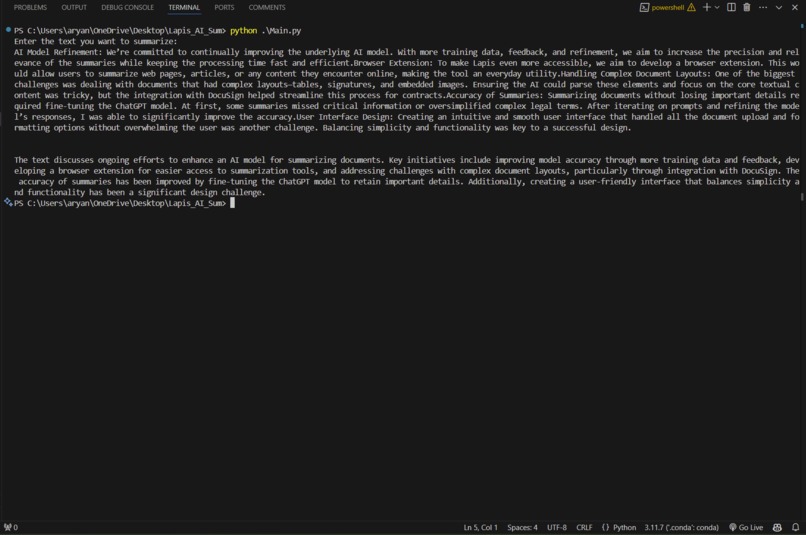
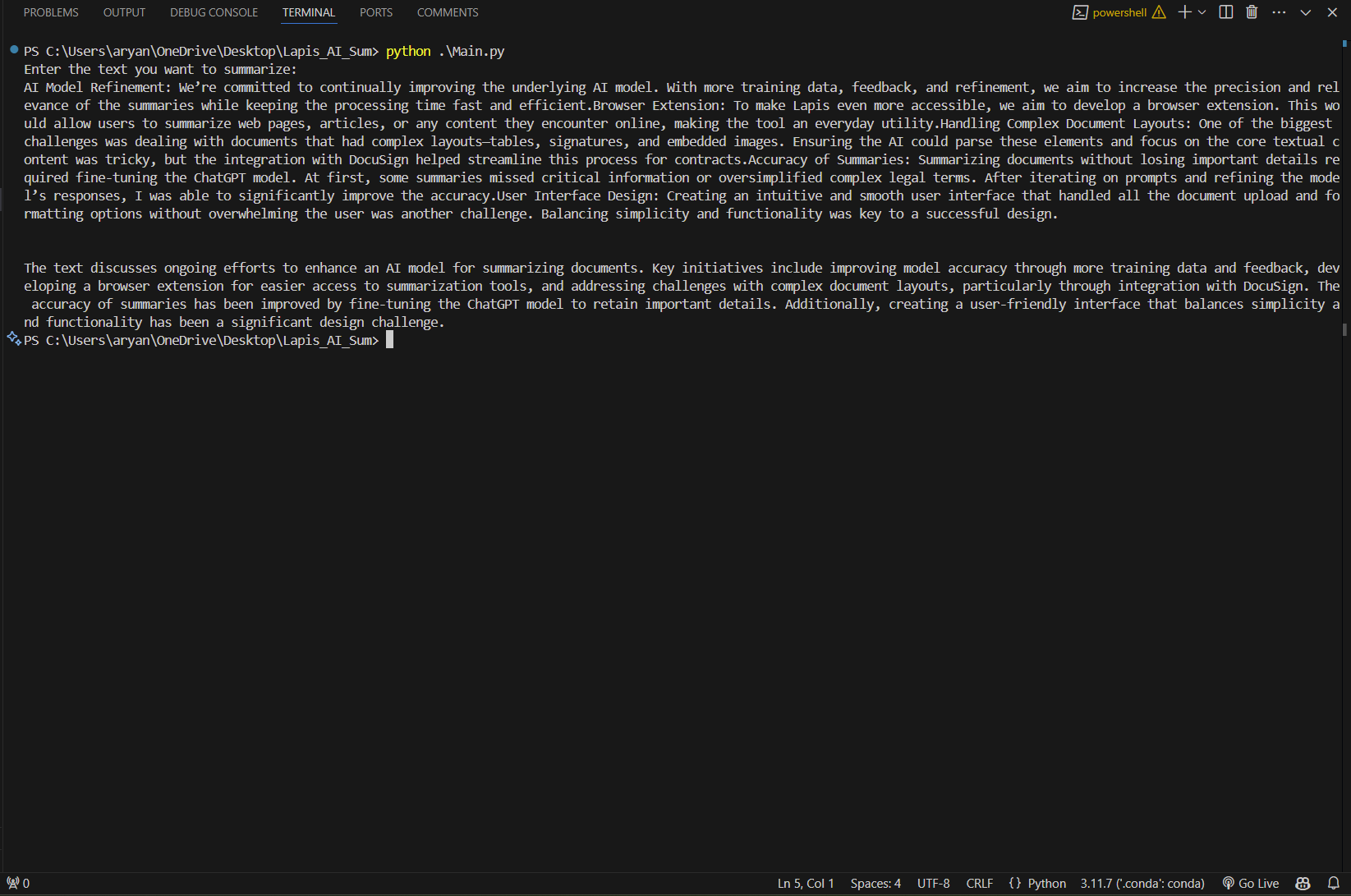
Handling Complex Document Layouts: One of the biggest challenges was dealing with documents that had complex layouts—tables, signatures, and embedded images. Ensuring the AI could parse these elements and focus on the core textual content was tricky, but the integration with DocuSign helped streamline this process for contracts.
Accuracy of Summaries: Summarizing documents without losing important details requires fine-tuning the ChatGPT model. At first, some summaries missed critical information or oversimplified complex legal terms. After iterating on prompts and refining the model’s responses, I improved the accuracy significantly.
User Interface Design: Another challenge was to create an intuitive and smooth user interface that handled all the document upload and formatting options without overwhelming the user. Balancing simplicity and functionality was key to a successful design.
Accomplishments that we're proud of
Seamless AI Integration: Successfully integrated ChatGPT API to summarize complex texts quickly and accurately, delivering high-quality summaries that capture the core points without losing essential details.
DocuSign Integration: Enhanced the functionality of the project by incorporating DocuSign, making it especially useful for handling legal documents, contracts, and agreements. This allowed us to process documents in a way that was accurate and relevant to business and legal professionals.
Multi-Format Support: Developed the tool to support various document formats, including PDFs, plain text, and URL-based content, ensuring the summarizer could handle diverse input types efficiently.
Customizable Summaries: Enabled users to customize the output according to their preferences—whether that’s a detailed summary, a concise version, or bullet points—tailoring the results for different use cases.
Time and Productivity Gains: Through extensive testing and feedback, we’ve seen significant time savings for users in legal, business, and academic sectors. Automating the summarization process has helped individuals and teams focus on higher-level tasks.
Hackathon Achievement: Completing this project in the short timeframe of a hackathon, from concept to deployment, was a massive accomplishment. It demonstrated the team's ability to work efficiently, collaborate, and deliver a functional, innovative product.
What we learned
Throughout this project, I gained a deeper understanding of how natural language processing (NLP) works in real-world applications. Specifically, I learned how to leverage the ChatGPT API to effectively break down and summarize text. Integrating DocuSign to process legal agreements added another layer of complexity and enhanced the project by making it even more practical for business and legal uses. I also learned how to handle different document formats, like PDFs, which can be tricky due to embedded images, tables, and non-standard layouts.
What's next for Lapis
Multi-Language Support: We plan to extend Lapis’s capabilities by adding multi-language support. This will allow users worldwide to benefit from the summarization tool, whether they work with documents in English, Spanish, French, or other languages.
Browser Extension: To make Lapis even more accessible, we aim to develop a browser extension. This would allow users to summarize web pages, articles, or any online content, making the tool an everyday utility.
AI Model Refinement: We’re committed to continually improving the underlying AI model. With more training data, feedback, and refinement, we aim to increase the precision and relevance of the summaries while keeping the processing time fast and efficient.
Mobile App: We plan to develop a mobile version of Lapis for on-the-go summarization. This would allow professionals, students, and anyone managing multiple documents to access the tool anytime.
Security and Compliance: As Lapis becomes more widely used for legal and business documents, we'll focus on improving the security and privacy aspects of the platform. Compliance with industry standards like GDPR and HIPAA will be a priority as we scale.


Log in or sign up for Devpost to join the conversation.