Inspiration
Every AI agent today is a thin wrapper around a cloud API. When the network drops — on a factory floor, in a rural clinic, on a plane, in a subway — the agent dies. Users get nothing. We asked: what if the agent never stopped working?
What it does
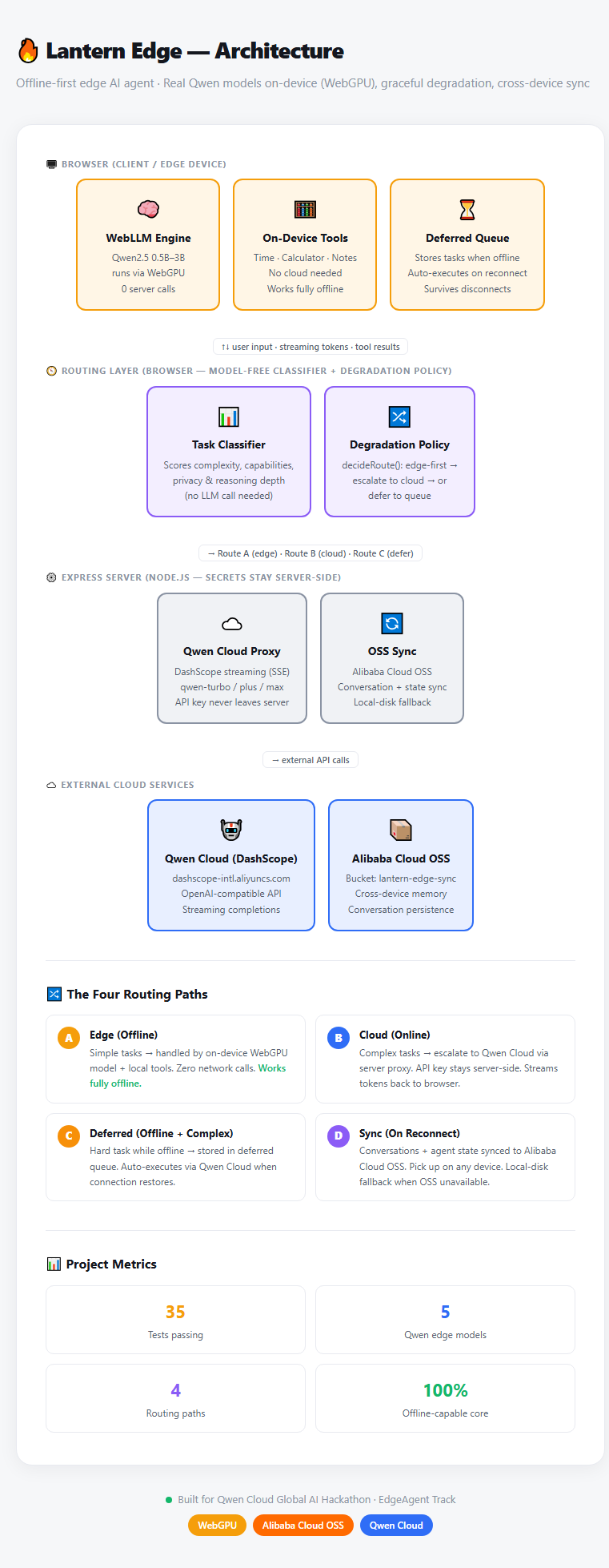
Lantern Edge is an offline-first edge AI agent that runs real Qwen models directly on-device and degrades gracefully when connectivity drops. It uses a model-free classifier — pure functions, no LLM call needed — to route every task to the cheapest brain that can handle it:
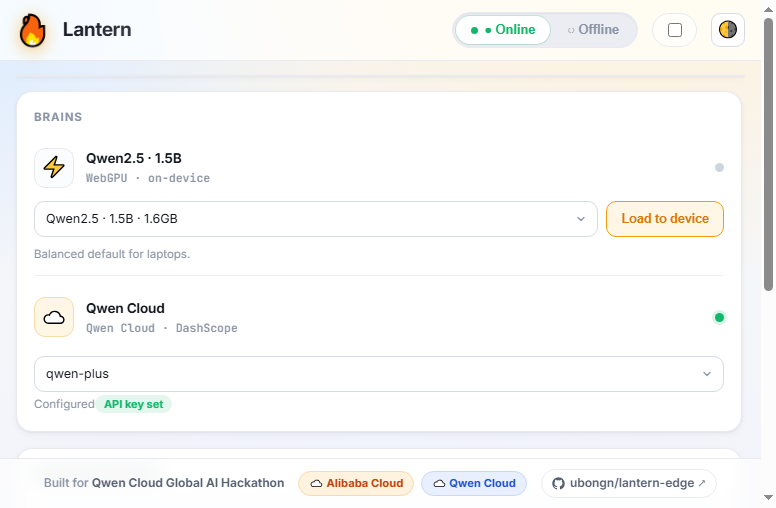
- ⚡ Local Tools (time, calculator, notes) — zero network, zero model, instant
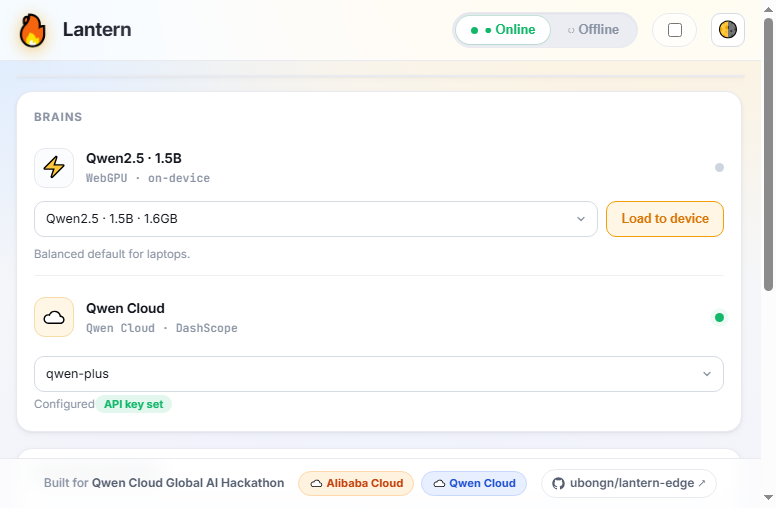
- 🧠 Edge Models (Qwen2.5 0.5B–3B via WebGPU) — on-device inference for privacy-sensitive or offline tasks
- ☁️ Qwen Cloud (DashScope) — streaming completions for complex reasoning when online
- ⏳ Deferred Queue — complex tasks queued offline, refined automatically on reconnect
The core innovation: offline never means failure. Simple tasks use local tools instantly. Complex tasks run on the edge model best-effort. Tasks too hard for the edge get queued and refined by Qwen Cloud the moment connectivity returns. The agent never breaks.
How we built it
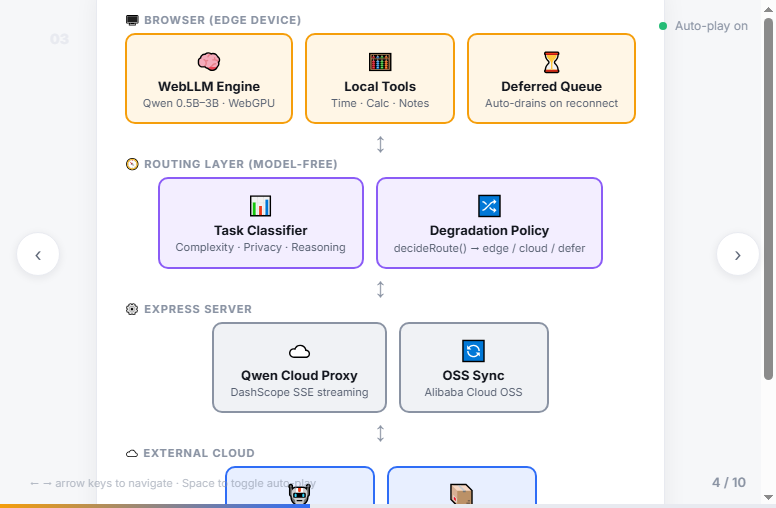
Three-layer architecture:
- Edge Layer (Browser): React + Vite frontend with WebLLM/WebGPU for on-device Qwen model inference. Includes a tool execution engine (time, calculator, notes) and a deferred-queue manager that drains on reconnect.
- Routing Layer (Model-Free): The heart of the system. A pure-function classifier analyzes task complexity, capability requirements, privacy sensitivity, and reasoning depth — then a degradation policy (
decideRoute()) picks edge / cloud / defer. No model needed for the decision. Fully unit-tested. - Server Layer (Express): Qwen Cloud streaming proxy via DashScope API (international endpoint) with SSE token streaming. Alibaba Cloud OSS for persistent cross-device state sync with local-disk fallback.
Qwen Cloud integration: Server-side proxy to DashScope (dashscope-intl.aliyuncs.com) supporting qwen-turbo, qwen-plus, and qwen-max. API key stays server-side — never reaches the browser. The agent loop is tool-augmented (maxSteps: 4), so Qwen can call local tools between reasoning steps.
Alibaba Cloud integration: OSS (Object Storage Service) in oss-cn-hangzhou for cross-device conversation sync. Full conversation history persists across devices. Graceful fallback to local disk when OSS is unavailable.
Challenges we ran into
- WebGPU hardware compatibility: On-device inference only works on machines with WebGPU support. We designed the entire degradation flow so that even without WebGPU, the agent still works — it defers to Qwen Cloud or uses local tools.
- Model-free routing accuracy: Getting the classifier to make good routing decisions without any LLM call required careful tuning of complexity scoring, capability coverage analysis, and reasoning depth estimation. Every path is unit-tested (35 tests passing).
- Seamless degradation: The hardest part was making the offline → online transition smooth. The deferred queue needed to drain automatically on reconnect, update responses in place, and never lose data.
Accomplishments that we're proud of
- 35 unit tests covering classifier, degradation policy, agent loop, and calculator — all passing
- Real on-device inference via WebGPU with Qwen2.5 models, not a mock or simulation
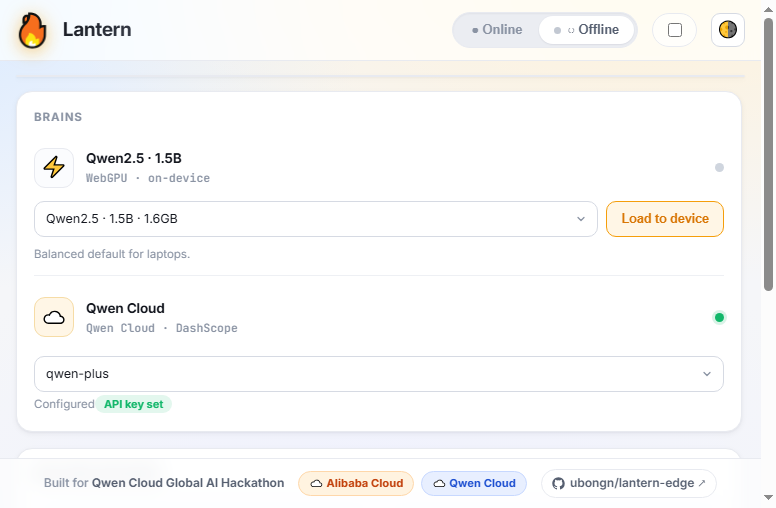
- The degradation flow works end-to-end: online → load edge model → go offline → edge answers + complex task deferred → reconnect → Qwen Cloud refines automatically
- Zero models needed for routing — pure functions make every decision
What we learned
- Designing for graceful degradation fundamentally changes how you architect an AI agent. Every component needs an offline story.
- Model-free routing is surprisingly effective — you don't need an LLM to decide which LLM to use.
- WebGPU + WebLLM makes real on-device inference practical for small models, but hardware support is still uneven.
Track: EdgeAgent (Track 5)
Lantern Edge demonstrates:
- Edge-cloud orchestration under bandwidth/latency constraints
- Privacy-aware data handling — privacy mode forces all processing on-device
- Graceful degradation — the agent never breaks, it adapts
Built With
- alibaba-cloud-oss
- dashscope-api
- docker
- express.js
- node.js
- qwen-cloud
- react
- render
- typescript
- vite
- vitest
- webgpu
- webllm


Log in or sign up for Devpost to join the conversation.