-
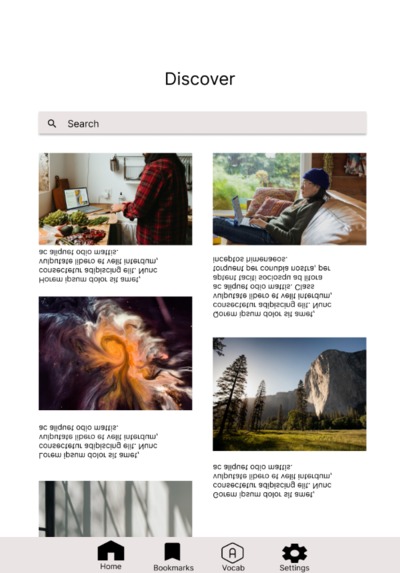
Home screen - high fidelity

Inspiration
Just to tell you a bit about myself, I have been taking courses on and self studying French and, later on, Mandarin Chinese for the last 5 years or so, and I am currently a French tutor at UT Austin. I've seen how I, and many of my tutees, often struggled with memorizing their courses' vocabulary when learning a foreign language. I often times wished I had an intuitive and high quality flashcard maker that would be personalized to the material I am studying, and so the idea of Language Reader was born.
What it does
Learning a language is, essentially, heavily reading based. Even when watching a show, we are often still reading the subtitles, so why not have an application that could keep track of the words we are coming across? Language reader 'prepares the content' on a page and allows users to tap words and get instant definitions. In the background, the app keeps a running tally of unique words we come across, the frequency of times we press certain words, and stores them as flashcards based on user preferences. This is where the magic comes in. Language reader will create high quality flashcards that contain audio and images and will store each unique instance of a sentence that a word appears in as example sentences on the flashcard, all of this personalized for each user's with features in place like SRS systems of reviewing and quick tests.
How I built it
First, as I came up with the idea for my app and began designing it, I conducted market research in order to see which language apps would be in completion with Language Reader and how I could provide a specific niche as a language learning app. I found that my app could differ from popular language apps like Duolingo, Rosetta Stone and LingQ, which also bases its app on reading, because their approach to learning was either based on translation or self-study and acquisition, which differs from the model my app was provides, considering that Language Reader is aimed at educational institutions and students specifically (although it will be a major help to anyone learning a foreign language).
After having conducted market research, I dove into the design process using figma where I developed wireframes for the app and began design a high fidelity version. I also did work in Android Studio with Kotlin and Jetpack Compose, and ran tests using an emulator.
Challenges we ran into
Going into the hackathon, as a beginner, I had no experience building an app, and did not know how long it would take or the technologies I would need. I tackled the problem I wanted to solve with a mindset quite like that of our keystone speaker in that I would 'build it anyway' no matter the challenges.
Off the get go, I saw it would take a while to complete the project even from the time it took me to gather market data and begin designing the app. While designing, I decided to stop after creating the wire frames and a higher fidelity model of the home page because I wanted to get some work done on the app.
I began looking up tutorials on how to build an app from A-Z and reading documentation on Android Studio, Kotlin, and jetpack Compose, all technologies I had never used to build a project; therefore, by the end of the hackathon, I did not have much of a working version to show off.
Accomplishments that we're proud of
I am proud of the market research I did for the app because I feel that when developed and running, Language Reader has a place among the other popular language learning apps today. Moreover, I am excited to have researched how to design an app and been able to gain some experience using figma to make wireframes and high fidelity versions, design words I had not come across in context until this hackathon. I think I learned a lot and I will be able to continue forward using this knowledge to expand upon Language Reader and build a live running app.
What we learned
I learned and gained experience using figma, Android Studio, Kotlin and some Java, as well as Jetpack Compose. I also got better at learning new technologies by reading the documentation and testing the things I learned.
On the less technical side, I learned how to problem solve in more efficient ways and to 'build it anyway' even when my technical skills are not at the level they need to be for a certain project.
What's next for Language Reader
I have big plans for Language Reader. During the hackathon I really tried to mock up the most basic version of the project, but continuing forward their are a lot of features I would like to add and sections I would like to finish. I hope to finish the design of the project, and gain more experience in building apps so I can finish the base version of the project and then go on to make the experience more user friendly as well as make the app specialized and detailed for each language that is added. I plan to touch up the home screen, add recommendations to it for reading on level native material, as well as finish the bookmarks, vocabulary and settings tabs, and then get it out on to the google play store/app store.
Built With
- android-studio
- figma
- jetpack-compose
- kotlin
